Skip to content
DevMeme
2151 of 7435
The Paradox of Progress: Faster Hardware, Slower Software
Performance Post #2401, on Dec 1, 2020 in TG

The Paradox of Progress: Faster Hardware, Slower Software

Why is this Performance meme funny?

Level 1: Faster Car, Heavier Trailer

Imagine you have a super-powerful sports car that can go twice as fast as your old car. 🚗💨 You’d expect to get to school or work in half the time, right? But now suppose you also start towing a huge trailer full of heavy stuff behind that car. The car’s engine is stronger than ever (just like new hardware that’s faster), but the poor thing now has to pull so much weight (like bloated software) that it can’t go any faster than your old car did! In fact, sometimes it might even be slower uphill because of all that extra load.

This is exactly what the meme is joking about: every time our “engine” gets an upgrade, we end up attaching a bigger “trailer” that drags it down. It’s funny in a silly way because it’s like we solve a problem (make the car or computer faster) only to immediately create a new problem (make the load or software heavier) that cancels it out. It’s as if you got an awesome new toy but then put so many add-ons on it that it moves just like the old toy. The humor comes from that ironic twist – we expect things to be speedier with a better engine, and then we shake our heads and laugh when we realize we made them just as slow by piling on stuff. It’s like running in place: lots of new effort, but you end up in the same spot, which is both a bit absurd and comically relatable.

Level 2: Faster Chips, Slower Code

Let’s break down the joke in simpler terms. Over the years, computer hardware (the physical stuff like CPUs, memory, GPUs) has been getting a lot faster and more powerful. This trend is often described by Moore’s Law, which basically observed that we could pack twice as many transistors into chips every couple of years. In practical terms, more transistors and improved designs mean your computer or phone can do a lot more calculations per second than older ones. For example, a phone today can process way faster and handle more things at once than a big clunky desktop from 20 years ago.

Now, you’d think all our programs and apps (that’s the software side) would be running blazingly fast thanks to this hardware evolution. And indeed, some low-level tasks do: if you took a simple old program from the ’90s and ran it on a modern PC, it would scream along thousands of times faster. But here’s the catch the meme jokes about: our modern software tends to be much larger and more demanding – what developers call software bloat. “Bloat” means the program has a lot of extra stuff – code, features, or inefficient logic – that uses up a lot of those CPU cycles and memory, often unnecessarily. It’s like the software has gotten fat and slow even though the hardware is fit and athletic.

So the meme text, “When hardware gets faster through the years but software gets more bloated,” describes this frustrating reality. The bottom caption twists the well-known phrase to “Modern solutions require modern problems.” In this context, the “modern solution” is super-fast modern hardware, and the “modern problem” is super-heavy, slow software that nullifies the benefit of that hardware. Basically, every time we get a faster computer (solution), we find a way to make our programs more sluggish and resource-hungry (problem), keeping the end-user experience about the same. It’s a cheeky way to say we’re running in place.

Let’s go through some terms and ideas here:

  • Hardware gets faster: This refers to improvements like higher processor speeds, more CPU cores, more RAM, and faster disks or solid-state drives over the years. For example, a CPU in 2020 can have 8 cores running at 3 GHz, whereas one in 2000 might have had 1 core at 800 MHz. That’s a huge jump in raw capability. Similarly, we have devices now with 8 or 16 GB of RAM commonly, where two decades ago 128 MB was a lot. These improvements should mean our computers can do things much quicker.

  • Software gets more bloated: Software bloat means modern programs often consume a lot more resources (CPU, memory, etc.) than older programs did, sometimes without a proportional benefit to the user. This can happen for a few reasons:

    • Feature Creep: Over time, software tends to add more and more features. Think of a simple text editor that over years turned into a full-word processor with spell-check, image import, web connectivity, etc. Those features are nice, but each one needs code and resources. The term feature creep describes this slow accumulation of features that can make the software heavier and more complicated than originally intended. As a junior dev, you might have already seen this: maybe a project starts lean, but each new requirement or idea bolted on makes it a bit slower or more memory-hungry.
    • Higher-level frameworks: Modern developers often use frameworks or libraries to build apps faster. For instance, instead of writing an app in low-level C code which is very efficient, they might use Python with a bunch of libraries, or build a desktop app using a web technology framework like Electron (essentially building a web app that runs on the desktop). These frameworks do a ton of things for you, but they aren’t free performance-wise. A web-based framework might bring along an entire browser engine, which uses a lot of memory and CPU. It’s resource-hungry. So a task that could be done with 50 lines of efficient code might be done with 5 lines of high-level code that behind the scenes executes thousands of operations. From a dev’s perspective, it’s easier and faster to write – but the end user’s computer has to work harder to run it.
    • Overengineering: This term means designing a system more complex than it needs to be. For example, imagine a simple app that shows today’s date. If someone architects it with multiple microservices, a database, a bunch of design patterns, and networking (an extreme example), it’s way overbuilt for what it does – that’s overengineering. Overengineered software can be slower because it does a lot more work than necessary. Sometimes newcomers (and even experienced devs) fall into this by following patterns blindly or trying to make the software very “flexible” and extensible, at the cost of speed. It’s like building a Rube Goldberg machine for a simple task.
    • Inefficient code: This is more straightforward – sometimes software is slow because the code isn’t optimized. Maybe the algorithm is not ideal (e.g., using a slow sorting method on huge data) or there are a lot of unnecessary calculations or data conversions. In many cases, developers might write code that’s easier to understand or quicker to implement, even if it’s not the most efficient, expecting that today’s powerful hardware will handle it.
  • Performance trade-offs: In software development, there’s often a trade-off between how fast/efficient something is and other factors like how easy it is to write, how quickly it can be developed, or how flexible it is for future changes. For example, writing something in pure assembly language might yield the fastest, leanest program, but it’s very time-consuming and error-prone to do that. Using a high-level language like Python lets you write the program in a fraction of the time, but it runs slower. The decision is a trade-off: you trade some performance for developer productivity. With hardware getting faster, it often seemed worth making that trade – after all, if the program is a bit slow today, just wait for next year’s faster CPU and it’ll run fine, right? This mindset has contributed to software bloat because we’ve been okay with less efficient software as long as it delivered features quickly.

Now, why is the meme relatable, especially to developers? Because it points out a sort of absurd reality: no matter how much better hardware gets, typical users might not feel things are that much faster overall, since modern software often expands in complexity to use up those gains. If you’ve ever wondered, “Hey, why does this brand new laptop not feel much faster than my old one for browsing the web or using a text editor?”, the meme is exactly about that. Developers often joke about how a simple program from the 1970s (say, a text adventure game or an old operating system) would run instantaneously on today’s hardware, yet some modern apps still lag. The bloat has essentially canceled out the hardware gains (performance_gain_cancelled, as the tags say).

To give a concrete scenario: imagine an early-career developer, Alice, who writes a small application to display “Hello, World!” on the screen with some styling. She could just print text (which is very fast), but she decides to use a modern JavaScript framework and some libraries because that’s what she’s familiar with. She ends up with a package that includes a whole framework, lots of styling code, etc. When she runs it on her high-end development PC, it seems fine. But then she tries it on an older machine or a low-powered laptop and notices it takes a couple of seconds to start up and display the message. What happened? Resource-hungry frameworks and extra layers of code made a simple task much heavier than expected. The high-end PC’s hardware hid that slowness (the free hardware power soaked it up), but on a weaker machine it becomes obvious. This is a learning moment: hardware can compensate for inefficient software to a point, but inefficiencies are still there under the hood.

Another example: think of your web browser. If you open one or two tabs of simple sites, even an older computer handles it well. But open 20 tabs – especially of modern sites loaded with scripts – and you’ll see even a good machine start to slow down or the fan spin up. Each site is doing a lot in the background (ads, trackers, fancy interactive elements). The browser itself is hardware-accelerated and super optimized, but the content (the websites) have become more bloated over the years. Compare browsing today to browsing in 2005: today’s web is more beautiful and capable, sure, but it can also be slow on anything but the latest hardware. That’s why an old PC might struggle with today’s web, even though that same old PC could easily handle the simpler web of the past.

The meme is really a commentary on this phenomenon. It resonates with developers because they’re aware of how software is built and have often seen the trade-offs and overengineering up close. It’s almost a running gag in tech communities: whenever someone mentions a powerful new CPU or doubling RAM, someone might quip “Great, that means Slack/Chrome will just use twice as much 😜.” We know new features and more abstraction will come along to soak up that capacity. This shared understanding is what makes the meme funny – it’s pointing out the ironic truth that modern hardware advancements often invite equally modern bloated software, leaving end-user performance roughly a zero-sum game.

So in simpler summary: Hardware vs. Software is like a cat-and-mouse chase. Hardware (the cat) gets faster and pounces forward, but software bloat (the mouse) manages to stay just out of reach by also getting “bigger” and slower. The end result is the distance between them (which symbolizes how fast things feel to a user) doesn’t change as much as you’d expect. And that’s both funny and a bit frustrating – which is exactly the feeling this meme conveys.

Level 3: Modern Hardware Requires Modern Bloat

Why do experienced developers smirk at this meme? Because it nails a universal pattern in our industry: no matter how much faster hardware gets, somehow software finds a way to use it all up and then some. The top text sets the stage: “When hardware gets faster through the years but software gets more bloated.” We’ve all been there. You get a new machine with double the CPU cores and heaps of RAM, yet your everyday apps feel no faster – sometimes even slower – than on your old machine. This meme flips an old Dave Chappelle joke on its head: “Modern solutions require modern problems.” In tech terms, it’s saying modern hardware improvements seem to require (or attract) equally modern software bloat to cancel them out. It’s an absurd reversal that rings true, eliciting a knowing, slightly painful laugh from seasoned devs.

Shared experience examples:

  • The sluggish IDE upgrade: Your company issues you a top-of-the-line laptop. It has an advanced GPU and a CPU with more threads than a 90s supercomputer. But then you open the latest version of your IDE or code editor (loaded with countless plugins, a built-in web browser, and who knows what else) and it still lags or takes forever to index files. That extra hardware horsepower? Consumed by indexing daemons, electron-based UI chrome, and background telemetry processes. The editor on a 2020 machine starts up in about the same time as a much simpler editor did on a 2010 machine. So you chuckle at the meme because you’ve lived it.
  • Web pages as heavy as entire applications: Remember when webpages were just HTML and a few images? Now a modern website might pull in megabytes of JavaScript frameworks, trackings scripts, high-res images, and autoplay videos. Even though your phone’s processor is insanely faster than the one in your old desktop PC, that phone can stutter scrolling a bloated webpage. Modern web developers often rely on huge libraries (React, Angular, etc.) and dozens of npm packages for convenience, resulting in pages that demand a lot of CPU and memory. The irony: a news article site in 2020 might max out a core for seconds during load, while a simpler 2005 version of the same site would load instantly on much weaker hardware. The meme’s humor stems from exactly this irony: we keep reinventing slower software to run on faster hardware.
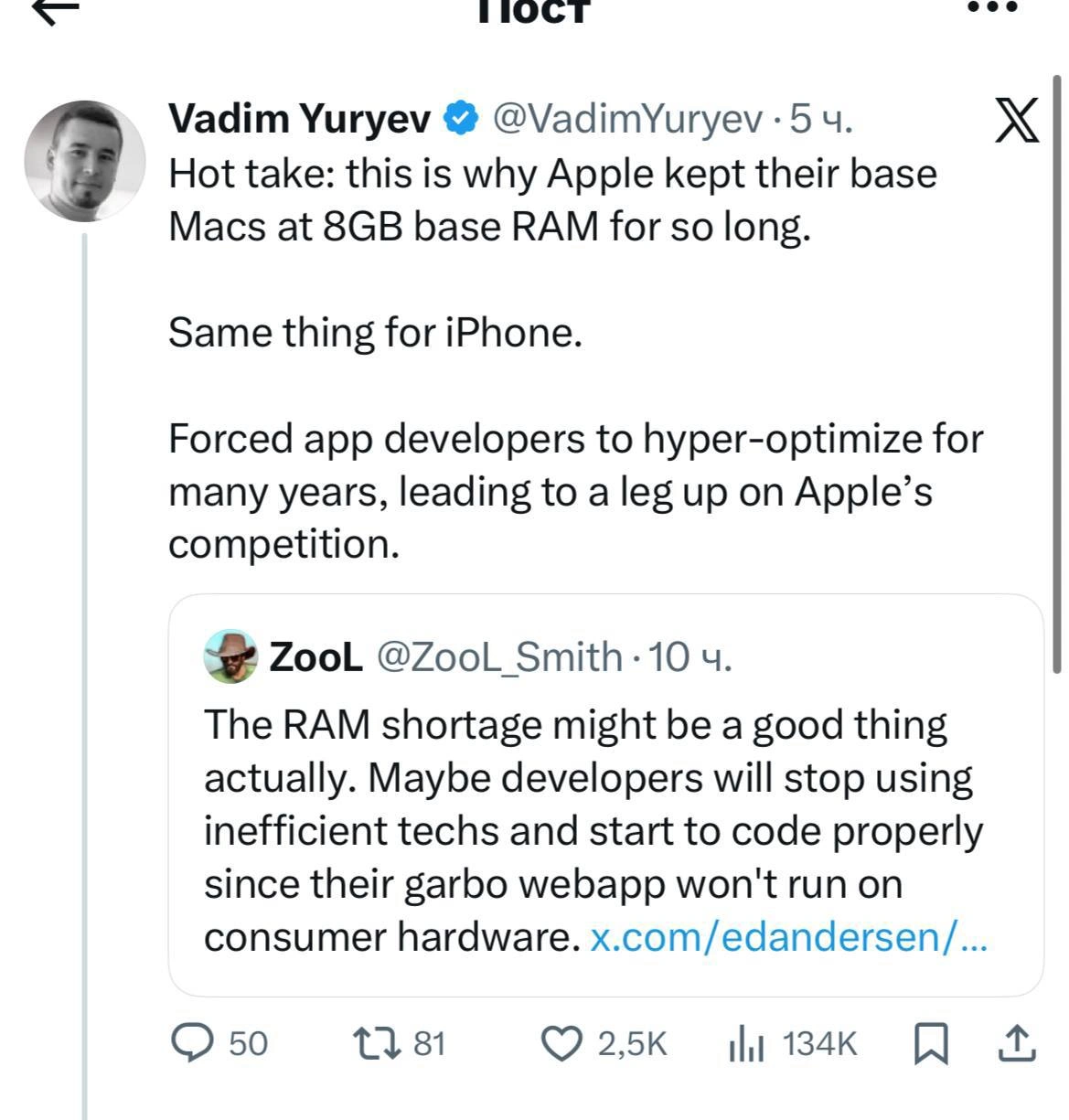
  • Electron apps and multi-GB “Hello World”: Many desktop apps these days (Slack, VS Code, Discord) are built with Electron – essentially bundling a whole Chromium browser with each app. This is great for developer productivity (write once in JavaScript, run cross-platform), but it’s not light. Each Electron app can eat hundreds of MBs of RAM and considerable CPU just to show a chat window or text editor. Developers joke that “what Moore’s Law giveth, Electron taketh away.” You double your RAM from 8GB to 16GB? Great, now you can run two Electron apps without swapping! It’s funny because it’s true: hardware evolution enabled these convenient but heavy frameworks, and now they soak up every bit of those resources.

Industry pattern & history: This dynamic has been going on for ages in tech history. In the 90s, there was a saying: “What Intel giveth, Microsoft taketh away,” referencing how each new, faster Intel CPU would be matched by a more demanding version of Windows or Office from Microsoft. Your shiny new Pentium processor ran Windows 95 about as fast as your old 386 ran Windows 3.1. Why? Because the newer software had prettier graphics, more features, and yes, more bloat. It’s a classic performance tradeoff: software vendors add features (and often overengineering and generality in the code) that use up the new hardware capacity. Another semi-serious “law” called Parkinson’s Law of Software states: Software expands to fill the available memory. Give developers 100x more RAM and clock speed, and somehow applications end up requiring 100x more resources over time.

The meme taps into that collective memory. Seasoned devs recall when operating systems fit on floppy disks and ran in a few megabytes of RAM. Today, a typical desktop OS or even smartphone OS takes gigabytes of space and hungrily uses many gigabytes of RAM when running. Sure, today’s software does more – but often the perceived speed or responsiveness isn’t much better, and sometimes worse! We laugh (perhaps a bit ruefully) because the pattern is so consistent: as soon as hardware solves one performance problem, feature creep and rising user expectations introduce new ones. It’s as if the tech industry can’t help but use up every bit of slack that Moore’s Law provides. If CPUs get faster, developers find ways to incorporate more complex graphics, heavier frameworks, maybe some machine learning in the background – something that eats those cycles right up. If memory increases, software starts caching more data or using higher-resolution assets, until memory is tight again.

Why does this happen? Not (usually) because developers are perversely trying to make things slow, but because of trade-offs and incentives:

  • Developer Productivity vs. Performance: High-level languages and frameworks (like Python, Java, Electron, etc.) make it faster and easier to build applications. The catch is they add runtime overhead. In a world where hardware kept getting faster, it became rational to favor developer time over machine efficiency. Why spend weeks squeezing micro-optimizations in C when you can write the feature in a day with Python and it runs “fast enough” on today’s CPU? Over time, though, this layers lots of abstraction upon abstraction. Each layer (virtual machines, garbage collectors, thick frameworks) is somewhat slower than optimized low-level code – but it was acceptable because hardware improvements masked the cost. We essentially spent our hardware gains to buy more developer convenience and richer features.
  • Feature Creep and User Expectations: In competitive markets, software with more features or fancier UIs can attract users. Each version of an app tends to accumulate new capabilities (some truly useful, some arguably not). All those features have a cost – extra checks, background services, bigger libraries, more complex settings dialogs – and they collectively weigh the software down. Yet, if one product didn’t add features, it might be seen as stagnant. So teams keep adding. Over years, that turns a lean app into a sprawling suite. A simple text editor morphs into an entire IDE with plugins and cloud sync and whatnot. By the time it’s done, you need a cutting-edge machine to get the same snappy feeling the old simple version had. The performance gain was canceled by layers of new stuff.
  • Backward Compatibility and Legacy Code: Sometimes software carries the weight of old decisions. New hardware often has new capabilities (like 64-bit architecture, new instruction sets, etc.), but applications might still be burdened by having to support older systems or data formats. Developers might choose a least-common-denominator approach (which can’t fully exploit new hardware speed) or include multiple code paths to handle old and new, which adds complexity and overhead. In essence, software can accrue technical debt that even powerful hardware can’t completely overcome. It’s like dragging along baggage; faster hardware helps, but you’re still dragging something.
  • “Good enough” mentality: Once an application meets an acceptable performance on current hardware, optimization often stops. Teams focus on new features rather than making the code leaner. Over time, “acceptable” became a moving target – if users all have faster PCs now, an operation taking 2 seconds is okay where 1 second used to be the goal. This complacency can lead to sloppy coding practices. Many devs have an unspoken attitude of “if it’s too slow, the next hardware upgrade will fix it.” In many companies, there’s also a lack of reward for engineers who optimize code that already “works”. Shiny new features get applause; making code use 50% less memory usually goes unnoticed by management (until things crash). So the path of least resistance is to consume the available resources.
  • Systemic Issues – Web and Enterprise ecosystems: Particularly on the web, there’s a culture of pulling in massive libraries for convenience. Need a few icons and some interactivity? It’s not uncommon to import a whole UI framework and dozens of npm packages. Each piece might solve a modern problem (responsive design, state management, etc.), but collectively it’s heavy. Everyone uses them, so the entire ecosystem normalizes this over-engineering. The result: even trivial web apps can be resource-hungry frameworks in disguise, doing a lot behind the scenes. On the enterprise side, there’s often layers of microservices, serialization and deserialization of data repeatedly, huge object-relational mappers – all adding latency. By the time a user’s simple request is fulfilled, it’s gone through so many layers that even a fast server feels slow to respond. As the meme suggests, we’ve created modern problems (all this complexity) to justify using our modern solutions (powerful hardware and elaborate software stacks).

All these factors mean that performance improvements are often negated. It’s almost a running joke among veteran engineers that no matter how powerful hardware gets, software will find a way to slow back down to a familiar crawl. The humor has a dark edge of truth: it’s relatable. We see absurd examples daily: a to-do list app that uses more RAM than an entire operating system did twenty years ago, or a simple chat program (looking at you, Slack) that can spin fans on a high-end laptop. We laugh because it’s better than crying – the meme is a comical acknowledgment of our industry’s habit of shooting itself in the foot performance-wise.

In summary, the meme resonates with the senior perspective because it speaks to an historical cycle we’ve witnessed: each generation of hardware evolution promises faster, smoother computing, and each time software bloat rises up to consume those gains. It’s the classic tale of performance trade-offs – gain and loss, action and reaction. Modern tech gives us solutions (faster chips, more memory), and we respond by inventing modern problems (heavier apps, endless features) to use it all up. The result: the relatable developer experience of feeling like nothing truly got faster. It’s both funny and a bit exasperating – a wink and sigh that says, “Yep, that’s the way it goes in tech.”

Level 4: Moore's Law vs Wirth's Law

At the lofty theoretical level, this meme highlights a tug-of-war between two computing “laws” – one exponential, one lamentably linear. Moore’s Law famously observed that the number of transistors on a chip (and by proxy, computing power) tends to double every ~2 years. This hardware evolution gave us a steady stream of faster CPU clock speeds, bigger caches, and more cores. In an ideal world, software would run proportionally faster on each new generation of hardware – but reality has a sense of irony. Enter Wirth’s Law (attributed to Niklaus Wirth), which tongue-in-cheek claims that software gets slower faster than hardware gets faster. In other words, while engineers pack ever more performance into silicon, developers concurrently pack ever more bloat into code, nullifying those gains. It’s a Moore vs. Wirth showdown: an exponential growth in capability met by an almost cynical expansion in resource demands.

From a computer architecture and algorithms perspective, the meme hints at fundamental limits and behaviors:

  • Amdahl’s Law: Even if part of your system runs much faster on new hardware, the overall speedup is limited by the portions that didn’t improve. If software introduces new inefficiencies or heavier workloads (the “bloated” parts), they become the bottleneck that caps overall performance gains. A $2\times$ faster CPU doesn’t help if the program ends up doing $2\times$ more work or waiting on slower parts of the system.
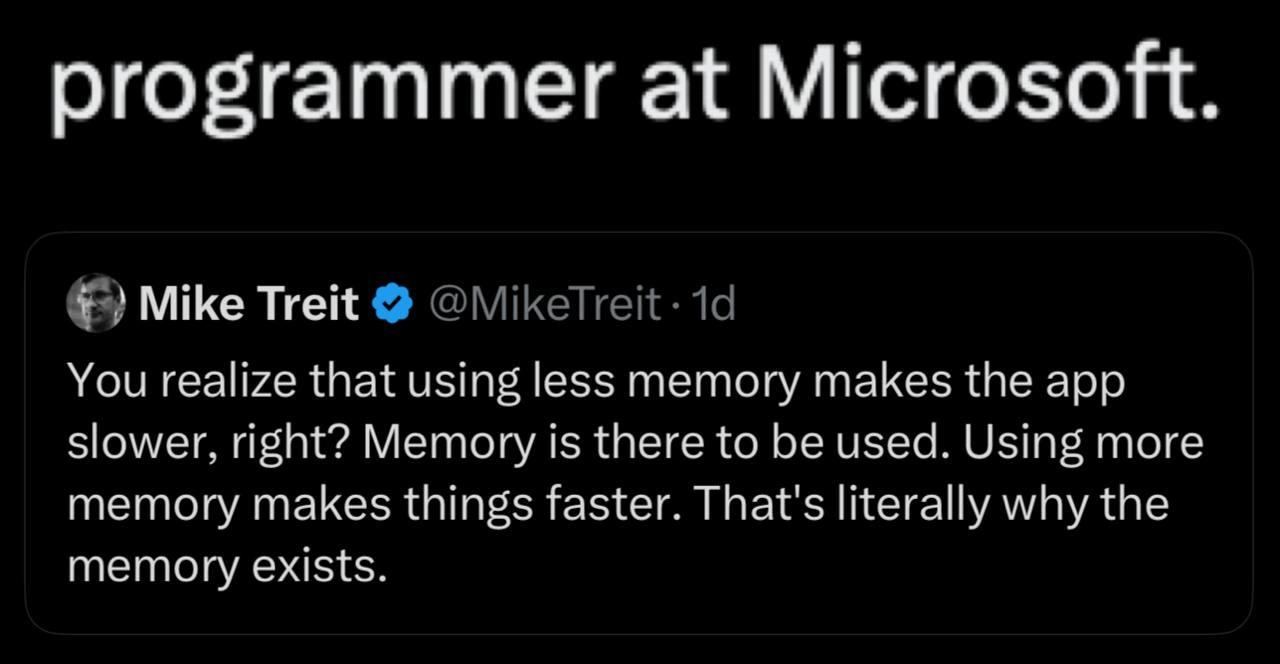
  • The Memory Wall: Over decades, CPU speeds grew at a far higher rate than memory access speeds. Modern bloated software often sprawls across large data sets and layers of abstraction, causing frequent cache misses and memory fetches. Those blazing fast CPU cores end up stalled, waiting for data from main memory. So even though transistor switching got faster, the effective speed for a memory-hungry program might hardly improve – the CPU is twiddling its thumbs.
  • Abstraction Penalties: Each high-level language, framework, or virtualization adds interpretive overhead. Calling a simple function might involve virtual machine bytecode, dynamic type checks, or lots of tiny objects triggering pointer chasing in memory. All these add constant factors (or worse) to algorithmic complexity. So an $O(n)$ task in theory might take 100× longer in practice because of those overheads. Constant factors matter when they accumulate, and Moore’s Law only fights the multipliers for so long. A classic tongue-in-cheek example:
    # In theory, trivial addition. In practice, pulls in big library overhead.
    import numpy as np  
    result = np.add(2, 2)  # Using a heavy library to add two numbers
    
    Here the algorithm is constant time (just one addition), but the software bloat (importing a large library, allocating objects) makes it orders of magnitude slower than a single CPU instruction. On a 1980s machine you’d write an assembly instruction; on a 2020 machine, you might inadvertently run thousands of instructions to accomplish the same thing, simply because it’s easier for the programmer. And despite billions of CPU cycles per second, those extra layers can soak them all up.
  • The End of Dennard Scaling / “Free Lunch”: Up until the mid-2000s, not only did chips get denser (Moore’s Law), but they also got faster clock speeds and similar power usage (Dennard scaling). This meant a single thread of code kept running faster automatically every couple of years – a “free lunch” for software. But physics caught up: power and heat constraints stopped clocks from ramping much beyond ~3GHz, and improvements shifted to multi-core parallelism and specialized units. The “free lunch is over,” as Herb Sutter put it. Modern software, however, often isn’t automatically parallel – a bloated single-threaded app doesn’t magically run faster on more cores if it can’t use them. If anything, many bloated apps spend a lot of time in sequential tasks (parsing huge config files, loading enormous frameworks on a single main thread), which Amdahl’s Law tells us will dominate and slow the overall experience.

In essence, at this deep level we’re dealing with a paradox of technological progress: every advance in hardware capability (more transistors, higher FLOPs, bigger memory bandwidth) tempts us to raise our software’s resource appetite in tandem. The meme’s sarcastic “modern solutions require modern problems” perfectly encapsulates this. It’s a nod to how fundamental constraints (like memory latency, algorithmic complexity, and parallel speed-up limits) conspire with human nature (laziness, high-level abstractions) to erase the theoretical gains hardware should deliver. The result is a kind of equilibrium: your brand-new superpowered laptop runs the latest bloated application no faster than yesterday’s machine ran last decade’s lean software. From a physics and CS theory standpoint, it’s almost poetic – like a digital form of Newton’s third law: every increase in computing power meets an equal and opposite increase in computing requirements.

Description

A meme featuring comedian Dave Chappelle in a suit, pointing forward with a serious expression. The top caption reads, 'When hardware gets faster through the years but software gets more bloated.' The bottom caption is a clever edit of the original 'Modern problems require modern solutions' meme format. It has been altered to say, 'Modern solutions require modern problems'. This meme humorously illustrates Wirth's law, an observation in computing that software's complexity and bloat tends to expand to fill any gains made in hardware performance. The 'modern solution' of ever-faster hardware has paradoxically created the 'modern problem' of developers writing increasingly inefficient, resource-heavy applications, resulting in a user experience that often feels just as slow as it did years ago. This is a deeply relatable frustration for senior engineers who have witnessed this cycle for decades
Comments

9
Anonymous ★ Top Pick We used to spend weeks optimizing for kilobytes of RAM. Now we spend weeks configuring YAML files to deploy a container that uses 2GB of RAM to say 'Hello World'
  1. Anonymous ★ Top Pick

    We used to spend weeks optimizing for kilobytes of RAM. Now we spend weeks configuring YAML files to deploy a container that uses 2GB of RAM to say 'Hello World'

  2. Anonymous

    Moore’s Law hands us twice the cores; Wirth’s Law has the Electron app claim four times the RAM before the splash screen even draws - cosmic balance restored

  3. Anonymous

    Remember when we complained about Java using 128MB of RAM? Now our text editors are Chromium instances consuming 2GB just to display a blinking cursor. At this rate, by 2030 we'll need a distributed Kubernetes cluster just to run 'Hello World'

  4. Anonymous

    We've gone from '640K ought to be enough for anybody' to 'Why does my Hello World app need 500MB of node_modules?' It's Wirth's Law in action: software gets slower faster than hardware gets faster. We've essentially achieved the remarkable feat of making a 2024 MacBook Pro feel as sluggish as a 2004 Pentium 4, just by adding enough Electron apps and a few dozen Chrome tabs. The real innovation isn't Moore's Law - it's our ability to consistently consume every performance gain with another abstraction layer, another framework, and another 'modern solution' that requires downloading half the internet just to render a button

  5. Anonymous

    Moore's Law doubles transistors every 18 months; software bloat doubles bundle sizes every sprint - net zero, plus one more refactor ticket

  6. Anonymous

    Moore’s Law funds our performance budget; Wirth’s Law allocates it to shipping Chromium with every to‑do app

  7. Anonymous

    Moore’s Law buys us cores; Wirth’s Law spends them rendering a todo list in Electron

  8. @misesOnWheels 5y

    too bad garbage collectors can't catch garbage developers

    1. @ImJmik 5y

      Wow

Use J and K for navigation