An Arachnid's Career Pivot
Why is this WebDev meme funny?
Level 1: Spider Learns to Code
Imagine you found a little spider in your house. Instead of squishing it or putting it outside, you decide to become friends. You take the spider out with you, maybe to a café or for ice cream. You find out the spider is actually really friendly! While you’re chatting, the spider learns that you build things on the “Web.” Now, the spider only knows about one kind of web – the sticky one it makes every day to catch bugs. But it hears you say “web” and gets super excited. It’s as if the spider is thinking, “Wow, I make webs too! Maybe I can help make your webs?”
The funny part is a mix-up: when you say “web,” the spider thinks of its own web, not the internet. So the spider now wants to be a “web developer,” which to you means a person who makes websites on the computer, but to the spider it just sounds like someone who makes webs – and he’s already an expert at that! It’s like if a bird heard you talking about “Twitter” (where people post messages called tweets) and the bird said, “I tweet all the time, I’d be great at that job!” You’d giggle because the bird is mixing up its natural behavior (tweeting as in chirping) with the human technology term.
In this little story, instead of a scary or gross moment (many people yell, “Ah! A spider!”), it turns into a cute friendship and a spider with a dream. The silly misunderstanding — taking the spider “out” like a friend, and the spider wanting to do your web job — is what makes it funny. It’s kind of heartwarming too. The person didn’t harm the spider; they treated it kindly, and now the spider wants to learn and be like their new friend.
So why do we laugh? Because it’s totally unexpected and absurd. We know spiders can’t really code or use a computer. Seeing an everyday creature suddenly act like a human buddy and talk about a career is a goofy idea. It takes a scary situation (nobody really likes finding a spider on the wall) and turns it into a happy ending (a new pal who might even help with work!). The play on the word “web” is the big joke: one web is made of silk, one Web is made of websites, and the poor spider doesn’t know the difference. It’s a bit like a cartoon in our head — picture a little spider wearing glasses, typing on a tiny keyboard, trying to make a website. That image alone can make you giggle. In the end, the meme is just a fun, simple story: be kind, make friends, and who knows, even a spider might share your interests!
Level 2: Cobwebs to Code
At a simpler level, this meme is all about a pun and a funny misunderstanding. Let’s break down the scene: A person’s wife says, “take the spider out instead of killing it.” In everyday English, “take it out” usually means take it outside to release it (so the spider won’t be harmed inside the house). But the developer in the joke pretends to misunderstand this as “take the spider out (on the town)” — like you’d take a friend out for drinks. This twist sets up the punchline: “We had some drinks, cool guy, wants to be a web developer.” It’s an unexpectedly friendly outcome! Instead of a scary spider scenario, it turns into a buddy story where the spider is surprisingly chill and even interested in the person’s line of work.
The big joke here is the double meaning of the word “web.” In WebDevelopment, a web developer is someone who builds websites or web applications (using tools like HTML, CSS, and JavaScript to create pages on the World Wide Web). But a spider’s web is that sticky net a spider weaves out of silk to catch bugs. When the spider in the meme says it “wants to be a web developer,” it’s funny because spiders literally develop (build) webs in nature. It’s a classic web_pun_meme mixing a real spider’s skills with an Internet job title.
Think of it this way: the spider hears about the person’s job and goes, “Hey, I can do webs too! I’d be great at that!” Of course, being a web developer in tech is very different from being a spider making a cobweb in the corner. But the humor is in treating them as the same kind of activity just because of the word “web.” It’s playing with language. This is common in DeveloperJokes – we often take a technical term that means something else in regular life and mash them together for a laugh.
Let’s clarify some of the key terms and context for anyone new to this joke:
- Spider: A real-life arachnid, an eight-legged creature that spins webs. Many people are afraid of spiders, so they might normally want to get rid of one found in the house. Here, instead of squishing it, the person chooses a kind approach (under wife’s instructions) to escort it out. But our jokester takes it a step further and socializes with the spider.
- “Take it out”: This phrase is intentionally misinterpreted. The wife likely meant “take it out of the house.” The developer acts like it meant “take it out to do something fun” – like you’d take someone out on a date or to hang out. This literal twist is a big part of the joke’s setup.
- Web Developer: This is the tech term being puned. A web developer is a programmer who creates websites on the internet (the Web). They write code, for example making the layout of a site (the front-end) and maybe the server logic (the back-end). In everyday terms, if you enjoy websites like a game site or a social media page, those are made by web developers. In the meme, when the spider says it wants to be a web developer, it’s comical because a spider dealing with internet websites is unexpected. How would it even type? (Maybe with all those legs, it can hit a lot of keys at once!)
- Mentorship vibe: The title of the meme given (“Mentoring an eight-legged newbie eager to spin up its web dev career”) highlights the silly scenario: the experienced developer is now a mentor to this newbie spider. In real life, mentoring means guiding a new programmer through learning the ropes of coding. It’s funny here because the newbie is not a typical human student, but a little spider with a big dream. The phrase “spin up its web dev career” is a pun too: in tech, to “spin up” something means to quickly set it going (like spinning up a new server), and spiders spin webs. So it’s a cute way to say the spider is starting his journey in coding.
This meme falls under TechHumor/DeveloperHumor because it takes a scenario only a techie would concoct – turning a household spider into a budding software engineer. It’s a light-hearted joke, not referencing any complicated programming concept, so you don’t need deep coding knowledge to get it. But it does help to know that “web developer” means coding and not literally making spiderwebs. Once you know that, the punchline clicks: the spider’s natural talent (making webs) is being humorously mistaken as a qualification for a web development job in tech. It’s the kind of simple joke you might groan at and laugh, and maybe even show your non-tech friends to share a chuckle. After all, it’s basically a dad-joke in programmer form.
There’s also an underlying sweetness to it. Instead of a scary outcome for the spider, it becomes a story of giving the spider a new opportunity — almost like a spider_to_webdev training program! The term arachnid_career_change jokingly labels what’s happening: our spider friend is switching careers from catching flies to catching code bugs. It exaggerates the idea that in today’s world, anyone (or anything) can learn to code. We sometimes say “learn to code” is open to all, and this meme takes that to a funny extreme: even a spider can do it! 🕷️💻
For a junior developer or someone just learning about tech culture, the meme is a chuckle-worthy reminder that programmers love wordplay. It’s not referencing any specific software or tool, so you won’t see mention of JavaScript frameworks or anything here beyond the idea of building for the Web. The humor is universal enough: it simply combines a common household situation with the world of programming. If you’re new to coding, know that web developers spend a lot of time making things on the internet work — but no actual spiders are involved in that job! The spider in the meme just thinks his web-weaving skill will be useful, which is adorable and funny. It’s a playful take on how we sometimes use the same word for very different things (a physical web vs. the Web online), and how misunderstandings can lead to comedic outcomes. In short, spiders & the Web collided in a silly way, and that’s why this meme makes people smile.
Level 3: Full-Stack Arachnid
On the surface, this meme is a classic bit of DeveloperHumor combining everyday life with a coding twist. The joke takes the ordinary instruction “take the spider out” and interprets it in a literal, geeky way. Instead of simply removing the spider from the house, the developer imagines taking it out for a night on the town. Why? Because we developers can’t resist a good pun, especially when it involves the Web. Here, “web” has a double meaning: the spider’s silk web and the World Wide Web of the Internet. A web developer normally means a programmer who builds websites, but a spider hears “web” and thinks, “Hey, I make webs too!” 🕸️.
For seasoned folks in WebDevelopment, this kind of wordplay is oddly satisfying. It’s a nod to how our technical world overlaps with everyday words. The humor comes from the spider essentially making an arachnid career change — an "eight-legged newbie" joining the dev team. Senior engineers chuckle because it playfully exaggerates the idea of mentoring an unlikely junior. Many of us have onboarded junior developers from non-traditional backgrounds, but an actual arachnid_career_change? That’s taking diversity in tech to a hilarious extreme. The spider turns out to be a “cool guy” who wants to be a web developer, and the senior dev (instead of squashing a bug 🐛) ends up with an eager new mentee. This good-natured twist resonates with mentors who’ve seen enthusiasm come from surprising places.
The meme’s text itself is structured like a setup and punchline: the first line sets a scene with the wife’s instruction, and the second line delivers the unexpected outcome. The punchline hits a mix of tech pun and wholesome humor: a spider at happy hour expressing interest in coding. It’s absurd, but within the realm of TechHumor that developers adore. We often anthropomorphize our tools and bugs; here we’ve anthropomorphized a literal spider and welcomed it into the coding community. There’s also an inside joke for web developers: in search engine terminology, a web crawler is often called a “spider” because it crawls the Web, hopping from link to link like a spider sensing vibrations on its web. So the concept of a spider being involved in web tech isn’t entirely foreign – Google’s indexing bot is nicknamed Googlebot, essentially a spider that “develops” the search index of the web. This adds an extra layer for the initiated: the meme isn’t just a silly thought; it winks at the fact that spiders (of the software kind) already have a job in the web world.
Let’s break down why an experienced dev might find this meme extra amusing:
- Double Meaning of “Web”: We spend our careers building the Web, but here comes a creature that builds webs naturally. That clever semantic overlap is the core of this web_pun_meme. It’s the kind of pun you groan at and laugh because it’s so on the nose.
- Mentorship Absurdity: Senior devs often mentor juniors — explaining Git, doing code reviews, helping them “spin up” their first server. The phrase “spin up” in tech means to initialize or start something (like spinning up a new environment), and a spider literally spins a web. The meme’s title even jokes about “spinning up its web dev career,” blending jargon with spider behavior. An experienced dev imagines the literal scenario: setting up a code editor for a spider, teaching it to type with eight legs, doing pair programming (or should we say eight-legged programming). It’s an absurd mentorship scenario that tickles the imagination.
- Catching Actual Bugs: We joke that developers spend their time catching bugs (fixing errors). A spider actually catches bugs for a living. In a fantasy where a spider is on the dev team, it could catch both software bugs and flies buzzing around the office. That’s a win-win situation! In stand-ups, the spider might literally report, “I fixed three bugs last night”, and everyone would applaud, not realizing it means actual insects. 🦟🐞🐜
- Full-Stack Nature: An experienced dev might quip that a spider would make a great full-stack developer. “Full-stack” means handling both front-end (what the user sees) and back-end (server, database) development. With eight legs in action, our arachnid apprentice could conceivably juggle multiple tasks — one leg writing HTML, another debugging JavaScript, and others deploying code to servers. It’s a tongue-in-cheek way to imagine an eight-legged multitasking coder. And let’s not forget those multiple eyes: perfect for code review and spotting issues that humans might miss with just two eyes! 👀👀👀👀
Beyond the puns, the meme has a gentle, positive vibe. Instead of fearing the spider or smashing it (solving the “problem” in the brute-force way), the developer chose a compassionate (and quirky) route: inclusion. In tech, there’s a growing sentiment that anyone can learn to code, and we should welcome newbies — even if they’re very different from us. This spider represents the ultimate “non-traditional background” for a programmer. Yet, after a few drinks and some camaraderie, he’s part of the gang, excited to start writing code. For a senior engineer, it humorously echoes experiences of turning someone’s curiosity into a career. We’ve all seen that junior who knew nothing at first but was so eager to learn — mentoring them can be rewarding (and occasionally requires the patience of dealing with something completely alien, though maybe not literally an alien spider 😄).
Finally, there’s an extra wink for the true web veterans: one of the earliest and most important web JavaScript engines is actually called SpiderMonkey (used in Firefox). And Python has a web-scraping framework called Scrapy where you write “spiders” to crawl websites. The tech world is surprisingly full of arachnid references. So a spider aspiring to join web development isn’t just a random joke — it’s almost poetic. The spider in the meme might not know it, but his species has been indirectly contributing to the internet for years! This melding of arachnids and the Web in language and tools makes the meme even more delightful to a seasoned developer who catches these nuances. It’s a lighthearted reminder that our field has a sense of humor and a place for even the strangest of “contributors.” In summary, the humor works on multiple levels for the experienced: a play on words, a commentary on mentoring, and a clever nod to spiders lurking in web technology terminology. It’s the kind of joke you share with your team on Slack for a quick chuckle during a late-night coding session. Cheers to our new eight-legged colleague! 🥂👾
Description
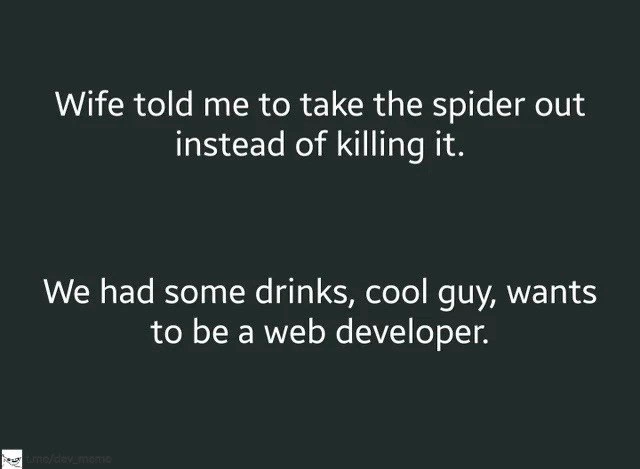
A simple, text-based meme presented on a dark gray background. The joke is delivered in two parts with white, sans-serif text. The first line sets the scene: 'Wife told me to take the spider out instead of killing it.' After a break, the punchline follows: 'We had some drinks, cool guy, wants to be a web developer.' The humor operates on a classic bait-and-switch, reinterpreting the phrase 'take the spider out' from a literal instruction to a social outing. The tech-specific layer is a pun, connecting the spider's natural ability to create webs with the profession of a 'web developer', a common entry point into the software industry
Comments
7Comment deleted
The spider wants to be a web dev because it's already an expert at creating sticky, poorly-documented networks that are a nightmare to debug
If he can already spin production-ready webs, imagine his CSS grid skills
After 20 years of debugging production issues, I finally understand why spiders make better web developers than us - they never ship broken builds, their architecture is always responsive, and they've mastered async/await without a single callback hell
The spider's already mastered asynchronous web spinning and event-driven architecture - just needs to learn that 'debugging' in web development unfortunately doesn't involve eating the bugs
He asked what 'web dev' entails; I said 80% CSS and 20% negotiating npm's dependency graph - he figured eight legs were enough to untangle both
Natural career path: start as a crawler, obey robots.txt, evolve into a headless‑Chrome renderer - just don’t let those eight async callbacks deadlock
Finally, a junior dev who spins responsive threads without whining about Tailwind conflicts