The Code Reviewer's Reaction to a Massive Pull Request
Why is this CodeReviews meme funny?
Level 1: 800-Page Book Report
Imagine you wrote a huge book, say an 800-page story, and you finish it just before it’s due. You hand it to your friend (or teacher) and say, “Can you check if this is all good?” Your friend’s eyes widen at this giant stack of pages. They have maybe an hour to go through it. So what do they do? They flip through a few pages, skim a bit here and there, and then give you a big thumbs-up with an awkward smile, saying, “Uh… it’s great, looks OK!”
Now, do you think they actually read all 800 pages carefully? No way! There’s just too much to read in so little time. They’re pretending everything is fine because they can’t possibly catch every mistake or understand the whole story on such short notice. They figure, “Well, I didn’t see anything obviously wrong in the tiny bit I read, so… OK!”
This is exactly what the meme is joking about, but with computer code. One person wrote a ton of code and dropped it on their teammate at the last minute. The teammate (the code reviewer) responds with an “OK” hand gesture and a smile, acting super calm. On the inside, though, that reviewer is probably overwhelmed, just like your friend with the 800-page book. The meme is funny because we can all picture that situation: being asked to do way too much and just going along with it with a shrug and a smile. It’s the coder’s version of saying, “Yeahhh, sure, I totally reviewed it… looks perfect!”
Level 2: Too Large; Didn’t Review
Let’s break down what’s happening here in simpler terms. In a software team, when you finish a piece of work, you create a pull request (PR) asking your teammates to pull your changes into the main codebase. As part of that, someone acts as a code reviewer – they check your new code for bugs, readability, and whether it meets the team’s standards. Now, 800 lines of code is a lot to drop into a PR at once. We often measure change size by LOC (lines of code), and usually a change in the low hundreds of lines is already considered on the large side. Many teams prefer smaller PRs (say, 50-300 lines) because they’re easier to understand.
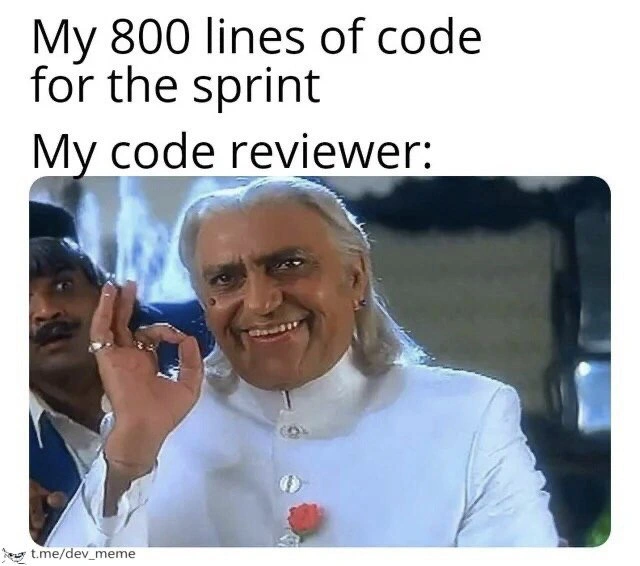
In the meme text, the developer proudly says, “My 800 lines of code for the sprint.” A sprint is a 1-2 week period in Agile where a team works on a set of tasks or features. Ideally, you’d be merging code continuously throughout the sprint so that by the end, everything’s integrated smoothly. But sometimes a developer takes on too much (this is often called overcommitting) and ends up rushing to finish at the last moment. The result? They dump a huge chunk of code — in this case 800 new lines — right as the sprint wraps up. It’s like cramming for an exam and writing the entire project overnight.
Now the second part: “My code reviewer:” with that image of a person giving an OK hand gesture with a sly smile. Normally, a code reviewer would have a lot to say about an 800-line change! They might request you split it into smaller parts, or they’d leave many comments on various lines. But the image shows the reviewer just giving an “OK” sign. That comes across as sarcastic or at least overly nonchalant. It’s as if the reviewer is saying, “Oh wow, 800 lines… sure, looks totally fine 🙄.” In reality, reviewing 800 lines is a big job. It’s easy to miss things when there’s so much code — imagine trying to spot a tiny typo in a 50-page essay versus a 1-page essay. The more pages (or lines of code), the harder it is to catch every mistake. This is what we mean by a heavy cognitive load on reviewers: it’s just a lot of mental work to keep track of everything in a giant change set.
So why would the reviewer just say “OK” then? Two likely reasons: (1) They’re being implicitly humorous, acknowledging it’s too much to properly review. Or (2) they feel pressured to approve it quickly (maybe because the team needs the code merged for a release or to meet the sprint goal). In many real teams, if someone opens an enormous PR, the reviewer might actually respond with a comment like “TL;DR” (short for “Too Long; Didn’t Read”) or politely ask for it to be broken up. But if that ship has sailed — say it’s due right now — the reviewer might do a quick skim and give a thumbs-up just to keep things moving. They effectively become a rubber stamp, approving without deep inspection.
For a newer developer, the lesson here is: smaller is better when it comes to code reviews. An 800-line PR is likely to get a superficial review at best, which isn’t good for code quality or your poor reviewer’s sanity. This meme is funny to developers because it exaggerates a real tug-of-war between getting things done fast and doing them right. The author of those 800 lines is excited to deliver a big chunk of code, and the reviewer responds with an exaggerated “Okay!” – playing along with a hint of irony. It’s a lighthearted reminder that dumping too much work on someone at once might get you an “approval,” but not necessarily a careful one.
Level 3: Rubber Stamp Review
Ah, the mega PR at the end of the sprint – every seasoned dev’s favorite surprise 😒. The meme shows a caption, “My 800 lines of code for the sprint,” followed by “My code reviewer:” and an image of a person in an immaculate white suit flashing an exaggerated “OK” sign. For experienced engineers, this instantly brings back memories of opening a gargantuan pull request and thinking, “You have got to be kidding me.” Yet outwardly, especially if you’re trying to be polite or avoid conflict, you might respond just like the image: with a forced smile and a quick LGTM (Looks Good To Me) approval. This is the essence of a rubber-stamp review – when the reviewer just signs off without deep scrutiny, often out of fatigue or futility. The calm “OK” gesture drips with sarcasm. It’s the reviewer saying, “Sure, everything’s absolutely fine,” while both people know no one could possibly comb through all those changes with full care.
Why is this scenario so relatable (and cringey) in DeveloperCulture? In Agile teams, we plan work in sprints, trying to break tasks into bite-sized chunks. A best practice in code reviews is to keep pull requests small and focused. It’s not just a nitpick: smaller PRs get reviewed faster and more thoroughly. An 800-line pull request blows past the unwritten reviewability limit. It’s the code equivalent of dumping a novel on your editor on Friday at 4 PM. The code reviewer opening such a PR feels a mix of dread and resignation. They know that diving into that many lines – untangling new functions, changes across multiple files, maybe even some sneaky bug fixes snuck in – will be a serious time sink. Often, there’s also pressure: it’s the end of the sprint, and merging this monster is required to declare the user story “done.” So the reviewer faces a dilemma: either push back and delay the merge (risking the feature not making the sprint demo), or skim and approve, effectively sprinting through the review.
The meme humorously captures the latter outcome. The reviewer opts for the path of least resistance, giving an “OK, fine” gesture. The faint smoke in the background of the image hints that something might be on fire – a nice touch echoing the classic “This is fine” meme. In real life, that “smoke” could symbolize potential problems smoldering unnoticed in the code. The reviewer’s serene smile and OK sign mask an internal thought: “If this blows up later, don’t say I didn’t warn you.” Seasoned devs have all been there: either on the receiving end of a terse “please break this into smaller PRs” comment, or on the giving end of an exasperated approval when a teammate drops a monolithic diff on them. It’s a shared pain point (CodeReviewPainPoints): big PRs create big headaches.
This meme nails the absurdity: the developer probably overcommitted on scope (hello, sprint planning failure!), crunched to push 800 LOC at once, and now expects a quick review. The reviewer responds with facetious enthusiasm – “Marvelous, absolutely okay!” – because what else can they do in the moment? It’s a perfect snapshot of the subtle, sometimes sarcastic, communication that happens in dev teams. We use humor to cope: the code gets merged “👍 OK”, and we all tacitly agree to deal with any fallout later. The punchline lands because it’s true — in the world of agile deadlines and DeveloperExperience_DX, sometimes code review becomes less about rigor and more about just surviving to the release.
Level 4: Cognitive Stack Overflow
When confronted with an 800-line code dump, a reviewer’s mind faces a cognitive load challenge akin to a computer hitting a stack overflow. The human brain’s working memory is limited – often cited as ~7 ± 2 chunks of information – yet an overly large pull request forces one to juggle dozens of new code paths and concepts simultaneously. In theory, understanding a change set this big edges toward solving a mini verification problem. Each extra line increases the mental search space (think of variables, functions, and interactions) almost combinatorially. Ensuring an 800-line diff is flawless by inspection alone starts to feel like doing a partial formal verification in your head – a task that’s exponentially harder than reviewing a small patch.
Software engineering research backs this up: studies on code review effectiveness have found that beyond a few hundred lines, the ability to catch bugs drops off steeply. It’s as if the reviewer’s internal parser runs out of memory. Reading massive diffs incurs more context-switching and recall effort, similar to how a CPU thrashes with too much to handle at once. You can imagine the reviewer’s brain throwing a StackOverflowError or going into an infinite loop trying to trace logic across 800 new lines. At this extreme, the act of reviewing turns from a quick quality check into an arduous cognitive exercise. The humor here is that the reviewer’s chill “OK” gesture is essentially a tongue-in-cheek acknowledgment of these limits. It’s saying, “You’ve exceeded human parsing capacity, so I’m just gonna assume it’s fine.” In other words, a monolithic 800-line diff practically guarantees a rubber-stamp outcome not because reviewers are lazy, but because even the best of us are bound by the constraints of human cognition.
Description
A two-part meme with text at the top and an image below. The text on the white background says, 'My 800 lines of code for the sprint' followed by 'My code reviewer:'. The image features the character Mogambo, played by Amrish Puri, from the Bollywood movie 'Mr. India'. He has slicked-back grey hair, is wearing a white Nehru jacket with a small red rose, and has a sinister, knowing smile. He is making a perfect 'OK' gesture with his right hand. Another man in the background looks on with a worried expression. The watermark 't.me/dev_meme' is in the bottom-left corner. This meme captures the common developer experience of receiving an excessively large pull request (PR). An 800-line change is difficult to review thoroughly. The reviewer's expression is sarcastic, implying that while they are gesturing 'OK', they are either about to unleash a barrage of critical comments or give up and approve it superficially, knowing that hidden issues are likely present. It's a commentary on poor development practices and the social dynamics of code review
Comments
7Comment deleted
The reviewer's smile says 'LGTM,' but their eyes are already composing a polite email to the SRE team to expect 'unforeseen turbulence' in production
Nothing screams ‘missing the micro-PR memo’ like an 800-line diff - the reviewer’s OK sign really means ‘split it up before GitHub starts doing garbage collection on your change set.’
After 15 years of reviewing code, you realize that '800 lines added' usually means 750 lines of copied Stack Overflow, 40 lines of actual logic, and 10 lines that will survive the review - and the reviewer knows this before even opening the diff
Ah yes, the classic 800-line PR dropped at sprint's end - a code reviewer's favorite opportunity to demonstrate why 'small, incremental changes' wasn't just a suggestion in that architecture doc everyone skimmed. They're already mentally drafting the 47-comment thread about that one variable name on line 342, followed by the inevitable 'let's discuss the broader architectural implications' that spawns three follow-up meetings and a Confluence page no one will read
800 LOC PR approved in 8 seconds: either architectural perfection or the reviewer just skimmed for semicolons
Our review algorithm is O(1) regardless of diff size - 800 LOC gets instant LGTM, with the amortized cost paid on next sprint’s on-call
Reviewer’s OKR: keep PRs under 200 LOC; result - zero approvals for your 800-line sprint dump