A Malicious Opportunity
Why is this Management PMs meme funny?
Level 1: No Problems, Only Chances
Imagine you spill a big cup of juice all over the kitchen floor. It’s a huge sticky mess, and you’re upset because this is clearly a problem — now you have to clean it up. But then a parent walks in and says with a smile, “Remember, there are no problems, only opportunities.” Confused, you look at the mess and reply, “Well then, I guess I have a floor-cleaning opportunity!” It’s funny because even though everyone knows the spill is a real mess (a bad thing), you’re jokingly calling it an “opportunity” to follow the parent’s positive spin. In the same way, the meme’s developer calls a serious outage a “DDoS opportunity” to poke fun at the manager’s overly cheerful outlook. It shows how silly it sounds to label something obviously bad as a good opportunity, just by changing the words.
Level 2: Spin vs Reality
For a less experienced developer (or someone new to tech), let’s break down what’s happening. DDoS stands for Distributed Denial of Service. That’s a type of cyberattack where a bad actor uses many computers (sometimes a whole botnet of hijacked machines) to flood a target server or network with so much traffic that it can’t handle it. It’s like prank-calling someone’s phone a million times a minute so that real callers can’t get through. In simpler terms, a DDoS is a big problem because it can knock your website or service offline by sheer overload. One common method is a "SYN flood" – sending a ton of fake “let’s start a connection” requests (SYN packets) to tie up the server’s capacity, but never following through to actually connect. The server gets swamped keeping track of these phantom handshakes, and real users are left hanging. So when the developer says, “We have a problem,” they mean something serious is happening: users can’t reach the service because it’s under attack.
Now, the manager’s response is a classic bit of corporate-speak: “There are no problems, only opportunities.” This is the kind of optimistic catchphrase you might hear in motivational talks or see on a poster with a sunset background. The idea is to encourage seeing the bright side or a chance to improve whenever something goes wrong. However, in a literal sense it sounds pretty silly here. The developer is reporting a major security incident, and the manager basically replies with a Pollyanna attitude: “Hey, look on the bright side!” It’s as if the manager is instructing the team not to even use the word “problem.”
To a junior developer on their first on-call rotation (meaning you’re responsible for handling issues in live systems, sometimes at odd hours), this can be really confusing. You might be seeing error alerts, systems failing, maybe a graph showing way too much incoming traffic. You’re thinking, “This is bad. We need to fix it ASAP.” If your manager then chirps, “Remember, it’s not a problem, it’s an opportunity,” you’d probably do a double-take. The developer in the meme does exactly that, but with sarcasm: they rephrase the catastrophic situation as a “DDoS opportunity.” It’s a snarky way to follow the manager’s no-problem rule while still making it obvious that this opportunity is actually a nightmare scenario.
In plain terms, the joke highlights the gap between reality (the servers are being overwhelmed and it’s definitely a bad situation) and spin (the manager’s forced positive twist). As a newcomer, you quickly learn that in some company cultures, how you talk about an issue can be almost as sensitive as the issue itself. Managers sometimes prefer gentle terms like “challenge” or “opportunity” instead of “problem” to keep morale up or avoid blame. But as this meme humorously shows, renaming a Denial-of-Service attack doesn’t make it any less of a denial of service. If a site is down, users aren’t experiencing an “opportunity” — they’re just unable to use your app. The developer’s witty reply is basically poking fun at that practice, in a way that anyone stressed out by an outage can appreciate.
Level 3: Denial-of-Service Denial
From a seasoned engineer’s perspective, this meme perfectly captures the clash between technical reality and corporate spin during a crisis. The manager’s mantra “there are no such things as problems, only opportunities” is a well-worn cliché in corporate culture — a sugar-coated way to maintain positivity. It’s the kind of line you hear in all-hands meetings and see on motivational posters in the office. But in the heat of a real security incident like a DDoS attack, that rosy reframe feels comically out-of-touch. This is literally a case of denial about a Denial-of-Service. While the server is on fire (figuratively speaking) under a flood of malicious traffic, the manager insists on a positive outlook.
Experienced developers chuckle (or maybe groan) at this because they’ve been on those 3 AM incident bridge calls where leadership tries to put a positive spin on a meltdown. Perhaps you’ve heard a director say, “This is a great learning opportunity for us to improve our infrastructure,” while the website is completely down and alarms are blaring. The developer in the meme responds with deadpan sarcasm: “Well then, we have a DDoS opportunity.” By phrasing it that way, the developer is essentially saying, “If you insist on calling problems ‘opportunities,’ fine — here’s one of your precious opportunities, an opportunity for everything to crash.” It’s a cheeky way to highlight how absurd the situation is.
The humor hits home for senior folks because it’s too real. In many organizations, there’s an unwritten rule to stay optimistic and never call an outage a “disaster” in front of higher-ups or customers. A manager often acts as a spin doctor, downplaying severity: “It’s not a failure, it’s an unscheduled load test,” or “We’re seeing an opportunity to stress-test our system’s resilience.” Meanwhile, the engineers on on-call duty are frantically watching graphs spike, CPU cores melt, and network logs fill up with thousands of suspicious IP addresses. Renaming the crisis doesn’t resolve it, but it does create a dark kind of comedy. It’s the same vibe as joking, “No one’s getting fired; we’re just offering a surprise career transition opportunity.”
This meme nails that tension: the manager’s optimism-at-all-costs versus the engineer’s ground-truth pragmatism. It satirizes how corporate culture sometimes values positive framing even to the point of absurdity. And it validates that eye-rolling feeling many tech workers get when a higher-up breezes in during an outage with a catchphrase instead of a solution. The phrase “DDoS opportunity” has become a tongue-in-cheek shorthand for “a massive problem that someone is trying to pretend is a good thing.” Anyone who’s survived a production outage or a security breach has probably encountered this exact flavor of forced optimism. It’s both cathartic and cringeworthy — which is exactly why it’s funny.
Level 4: Opportunity Overload
At the packet-level, this meme reveals a fundamental truth: no amount of rebranding can alter the laws of computing physics. A DDoS (Distributed Denial-of-Service) attack overwhelms system resources by sheer volume, and it operates at layers of the stack where motivational language is irrelevant. In a classic DDoS scenario like a SYN flood, an attacker sends an explosive barrage of TCP SYN packets (the "hello" of a TCP handshake) without ever finishing the handshake. Each incomplete connection forces the server to reserve space in a limited SYN backlog queue waiting for the final ACK. Soon that queue overflows. The server’s kernel has a fixed size for half-open connections; once it’s saturated, new legitimate SYN requests get dropped on the floor. Essentially, the server is drowning in half-handshakes.
No corporate spin can persuade the TCP/IP stack to ignore this flood. The NIC (network interface card) will still see tens of thousands of packets per second, and the operating system will still struggle under the load, potentially resorting to sending RST resets or enabling mitigations like SYN cookies in a desperate attempt to cope. SYN cookies are a clever algorithmic trick that allow a server under siege to avoid storing state for half-open connections (it encodes connection info into the sequence numbers), but even such measures have limits. Critically, calling the onslaught an "opportunity" doesn't magically increase buffer sizes or network throughput. The bandwidth of your incoming pipe remains finite (e.g., a 1 Gbps link can only handle so many packets per second); positive thinking won’t raise that to 2 Gbps. Similarly, CPU and memory constraints won't bend just because management calls the incident a "learning opportunity".
This highlights the absurdity through a deep technical lens: a denial-of-service event is rooted in hard constraints of computing (buffer capacities, algorithmic limits, hardware throughput). It’s the kind of scenario where systems theory meets slapstick reality. The humor emerges from this incongruity — the physical reality of an ongoing DDoS (with SYN queues overflowing and malicious packets piling up) versus a manager’s attempt to apply a Pollyanna filter. In practice, when a production server’s connection table is maxed out and legitimate users can’t get through, engineers reach for rate-limiters, firewalls, and traffic scrubbing services. They don’t reach for a thesaurus to rename the problem. The message is clear: you can’t optimize network performance with semantics.
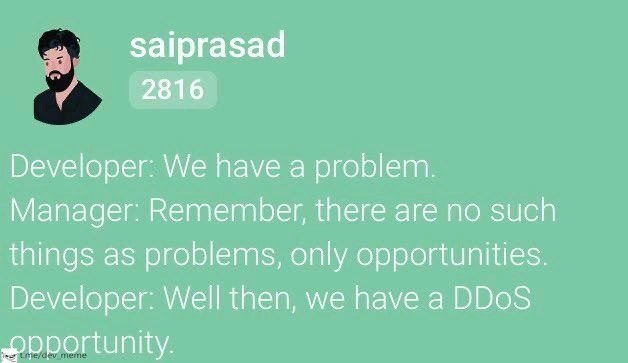
Description
A text-based meme presented on a light teal background, simulating a social media post by a user named 'saiprasad'. The image displays a three-line dialogue between a developer and a manager. The developer starts with, 'We have a problem.' The manager responds with a classic corporate platitude: 'Remember, there are no such things as problems, only opportunities.' In a brilliant display of malicious compliance, the developer retorts, 'Well then, we have a DDoS opportunity.' The humor arises from the developer sarcastically applying the manager's meaningless positive spin to a severe technical crisis - a Distributed Denial-of-Service attack. This perfectly captures the disconnect between managerial jargon and the stark reality of technical emergencies, a scenario deeply familiar to experienced engineers
Comments
7Comment deleted
The manager probably logged it as an 'unforeseen user engagement spike' in the weekly report
Great news, everyone - our traffic just hit 1M RPS! Ignore that it’s all SYN packets; marketing calls it ‘hyper-engaged leads.’
I've been in enough incident reviews to know that "opportunity" is just management-speak for "something that will definitely be mentioned in your performance review, but not in the way you'd hope."
When your manager's 'growth mindset' training collides with a Layer 7 attack, suddenly your incident response runbook includes a section on 'reframing availability zones as learning zones.' Nothing says 'we value psychological safety' quite like calling a 500Gbps traffic flood an 'unexpected load testing opportunity' while your SLAs burn and your on-call rotation questions their career choices
Calling a DDoS an “opportunity” is just unscheduled, adversarial load testing that converts your error budget into marketing spin
DDoS hits: not a crisis, just a 'scalability opportunity' to max out your autoscaling budget
It’s not a problem, it’s an ‘unauthenticated internet-wide load test’ - Finance calls it the Q3 cloud bill