Skip to content
DevMeme
3821 of 7435
The 'Spaghetti at Home' is a Legacy Monolith
CodeQuality Post #4163, on Feb 4, 2022 in TG

The 'Spaghetti at Home' is a Legacy Monolith

Why is this CodeQuality meme funny?

Level 1: Not the Dinner I Wanted

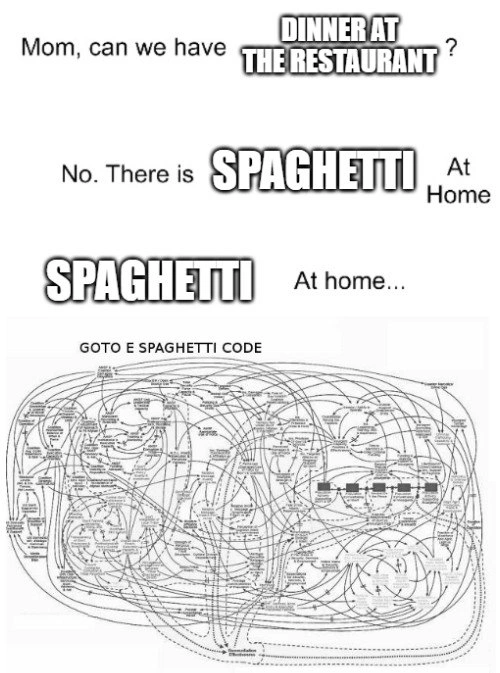
Think of it this way: a kid asks to go out to a fancy restaurant for dinner, but mom says, “No, we have food at home.” The kid expects something special, but the “food at home” turns out to be a cold, tangled bowl of spaghetti. Not exactly what they were hoping for! This meme is playing on that same idea. The developer wanted something well-made and nicely organized (like a fancy meal), but instead they got handed a big messy plate of spaghetti (a jumbled old solution). It’s funny because of the disappointment and the contrast – we all know the feeling of expecting something great and ending up with the exact opposite, served in the messiest way possible.

Level 2: Tangled Code Noodles

In simpler terms, this meme is joking about spaghetti code versus a clean program structure. Spaghetti code is a nickname developers use for code that’s all tangled up and hard to follow – just like a bowl of spaghetti. Imagine a program where you can’t easily tell what runs in what order, because the code keeps jumping around. One big culprit for spaghetti code in older programs is the goto statement. A goto is an instruction that tells the program, “jump to this other labeled spot in the code,” no matter where that spot is. It’s like if you’re reading a story and suddenly one line says, “Flip to page 50 now,” and then on page 50 it says, “Actually, go back to page 10.” The plot would get pretty confusing! Back in the day, languages like early BASIC and C allowed (and sometimes even encouraged) liberal use of goto for things like error handling or loops. But too many gotos will twist your program’s flow into a maze.

To see how goto can tangle things up, here’s a tiny pseudo-code example:

start:
    initialize(); 
    if (errorFound) goto handle_error;
    processData();
    if (needRetry) goto start;       // jump back to start (loop)
    goto done;                       // jump forward to done

handle_error:
    fixIssues();
    goto start;                      // after fixing, jump back to retry

done:
    finalize();

In this snippet, the program jumps forward and backward using goto. If you try to trace the execution, it’s leaping up to start and down to handle_error and done in a non-linear way. This is a simple example, but you can imagine a large program with many such labels – it would be really hard to figure out the actual order of events. That’s exactly what the meme’s flowchart is showing: all those crossing arrows are like a bunch of goto jumps criss-crossing, creating a big knot. This kind of messy control flow is what we call spaghetti code.

Now, when the child in the meme asks for “dinner at the restaurant” (in coding terms, that means a well-designed, clean architecture), they want a program that is organized and easy to maintain. Clean architecture usually means the code is divided into logical sections or layers – for example, the user interface parts are separate from the business logic, which is separate from the database handling. Each part of the program has a clear responsibility and interacts with other parts in a controlled way. It’s like a well-planned meal with separate courses – everything is organized and in the right place. In contrast, spaghetti code is more like dumping all the ingredients in one pot. It might still fill you up, but good luck figuring out what’s going on inside!

The mom’s reply, “No. We have spaghetti at home,” implies that the company or team already has an existing solution (the legacy code) and they don’t want to spend time or money creating a brand-new “restaurant-quality” solution. Legacy code means old code that the team inherited from previous developers or earlier projects. It often wasn’t built with modern best practices, so it can contain things like goto statements or just generally have a clumsy structure from years of quick-and-dirty changes. Maintaining such a legacy system can be frustrating for newer developers because it’s full of what we call technical debt. Technical debt is like the consequence of cutting corners in your code – for instance, choosing a quick hack that makes the code messier in order to meet a deadline. It’s called “debt” because although you save time now, you pay for it in future troubles (like bugs or difficult updates). In our meme, the spaghetti code is the technical debt everyone has to live with, because at some point people chose fast fixes over a clean rewrite.

This meme uses the familiar “X at home” template to make the situation relatable. It highlights the gap between what developers hope for (clean, quality code) and what they often get in reality (spaghetti code that “works… somehow”). For a junior developer, it’s a lighthearted reminder of why CodeQuality matters. A clean structure (like a nicely prepared meal) takes more effort upfront, but it saves a lot of headaches later. Spaghetti code might satisfy the immediate need (like a quick meal from the fridge), but it can turn into a horror when you have to debug it or add features. The meme gets a laugh because any programmer who has dug into an old codebase recognizes the “spaghetti at home” situation – it’s that mix of amusement and pain when you see a mess and think, “Yup, been there, done that.”

Level 3: Patterns vs Pasta

The meme repurposes the classic “We have X at home” joke to highlight an all-too-familiar software scenario. Here, dinner at the restaurant represents a well-designed, Clean Architecture – think of a neatly layered, high-quality codebase as satisfying as a fine dining experience. The "kid" (a frustrated developer) is basically asking management, “Can we please implement this properly?” However, the "mom" (the powers-that-be) shuts it down with: “No. We have spaghetti at home.” That “spaghetti at home” is a cheeky reference to SpaghettiCode – the kind of nightmare legacy code that no one really wants but everyone ends up dealing with. It’s the software equivalent of last night’s leftovers instead of a gourmet meal.

In the bottom panel, we see what "spaghetti at home" actually means: a tangled monochrome flowchart labeled “GOTO e spaghetti code.” This diagram is a visual punchline – essentially a map of messy control flow where arrows crisscross in a chaotic tangle, just like a bowl of noodles. Every seasoned developer instantly recognizes this as a depiction of unstructured logic (the infamous flowchart hell of old programs). It’s painfully humorous: the diagram might as well be a real-life legacy system's internals, complete with goto statements leaping all over. You can practically hear a senior dev muttering, “Here’s your clean architecture, fresh out of 1970 – bon appétit.” The mention of goto is key: indiscriminate use of the goto statement is a hallmark of spaghetti code. In fact, back in 1968, computer scientist Edsger Dijkstra wrote Go To Statement Considered Harmful, warning that code using too many gotos becomes impossible to follow. The meme’s convoluted flowchart hilariously embodies that warning – it’s a LegacySystem so convoluted that reading it feels like untangling holiday lights, only to find every light blinks randomly and some wires are on fire.

The humor here cuts deep because it’s rooted in TechnicalDebt and broken expectations. The developer asked for a CodeQuality upgrade – a clean, maintainable design – but got handed a plate of old spaghetti code instead. This is a shared joke among developers: we often start projects dreaming of elegant patterns and end up maintaining something held together by duct tape and goto statements. The “spaghetti at home” is code that’s evolved over years of quick fixes and legacy hacks. Why does such code exist? Because rebuilding a system from scratch is expensive and risky, so teams keep patching the old code (heaping on more noodles) to meet new needs. Over time, the program turns into a big ball of pasta – a.k.a. the Big Ball of Mud architecture anti-pattern. Seasoned engineers have seen it all: modules with zero separation of concerns, functions thousands of lines long, logic jumping in circles – the kind of stuff that gives on-call developers nightmares at 3 AM. The meme perfectly captures that exasperation with a dash of dark humor. It’s funny in the “it’s true because it’s tragic” way: asking for a pristine design and being told to be content with scary spaghetti code at home is an experience many of us know too well. After all, nothing says “enterprise legacy app” like a codebase that looks like an ill-fated spaghetti dinner instead of the Michelin-star meal we hoped for.

Description

A multi-panel meme that leverages the 'Mom, can we have X? We have X at home' format to joke about code quality. The first three lines set up the joke: a child asks, 'Mom, can we have DINNER AT THE RESTAURANT?', the mom replies, 'No. There is SPAGHETTI At Home,' followed by the punchline setup, 'SPAGHETTI At home...'. The final, large panel reveals the 'spaghetti at home': an extremely dense and convoluted flowchart labeled 'GOTO E SPAGHETTI CODE'. This diagram, with its tangled web of arrows and nodes, is a visual representation of 'spaghetti code' - a pejorative term for software that has a complex and tangled control structure. The humor lies in the perfect analogy: the desire for a clean, well-architected system ('dinner at the restaurant') is denied in favor of the messy, unmaintainable, and often legacy codebase ('spaghetti at home') that the development team is stuck with
Comments

10
Anonymous ★ Top Pick I showed this to my manager as a proposal for our new microservices architecture. He asked where the entry point was. I told him, 'Yes.'
  1. Anonymous ★ Top Pick

    I showed this to my manager as a proposal for our new microservices architecture. He asked where the entry point was. I told him, 'Yes.'

  2. Anonymous

    Inherited a GOTO spaghetti module so tangled the cyclomatic complexity outnumbers our file descriptors - suddenly hexagonal architecture feels like fine dining

  3. Anonymous

    The new junior dev proudly announced they'd optimized the codebase by replacing all those "inefficient" function calls with GOTOs, and now the debugger needs therapy

  4. Anonymous

    Dijkstra warned us GOTO was considered harmful; he never mentioned it also ships with unlimited refills

  5. Anonymous

    When the PM asks why the legacy system refactor is taking six months, just show them this flowchart and explain that every GOTO is a production incident waiting to happen. The original developer retired in 1987, the documentation is a single comment that says 'good luck,' and the last person who tried to understand this code flow is now a sheep farmer in New Zealand. At least restaurant spaghetti eventually ends when you reach the bottom of the plate

  6. Anonymous

    Asked for clean architecture; got “spaghetti at home” - a control-flow graph so tangled that Dijkstra’s “goto considered harmful” is basically the README

  7. Anonymous

    GOTO spaghetti: the family recipe where every refactor loops back to square one

  8. Anonymous

    When the call graph looks like linguine, the incident runbook just says: goto REWRITE;

  9. dev_meme 4y

    💌

  10. @zherud 4y

    Hey, how did my app code get on the internet? It was supposed to be secret.

Use J and K for navigation