Skip to content
DevMeme
3820 of 7435
The Unanswerable 'Defect Free' Question
Stakeholders Clients Post #4162, on Feb 4, 2022 in TG

The Unanswerable 'Defect Free' Question

Why is this Stakeholders Clients meme funny?

Level 1: The Trick Question

Imagine you’ve just finished cleaning your room really well. Your mom or dad comes in to inspect and asks, “So, is your room now completely spotless, with absolutely no mess anywhere?” That’s a pretty tough question, right? You think about it and blink – you did clean a lot, but you’re not totally sure if maybe a little dust or a stray toy is still hidden somewhere. Before you answer, your older brother or sister taps you on the shoulder and quietly whispers, “Careful. It’s a trick question – don’t say yes.”

Why would they say that? Well, if you confidently say, “Yes, it’s perfectly clean, no mess at all,” your parent might immediately start looking for the tiniest thing out of place. Maybe there’s a sock under the bed you forgot, or a little corner you didn’t dust. If they find even one small thing after you promised it was spotless, you’re in trouble for “lying” or not doing a good enough job. On the other hand, you don’t really want to say, “Um, there might be some mess,” because that sounds like you didn’t clean well. You’re kind of stuck!

Your older sibling knows from experience that this question is a trap. It’s almost impossible to guarantee everything is 100% perfect. So the safest move is to be very careful with your answer – or maybe let your parent see for themselves instead of you boldly claiming it. The whisper “It’s a trick, don’t answer” is like saying: sometimes not falling for the question is the smartest thing to do.

So in everyday terms, the meme is like that. The client asking “Is version 2.0 defect-free?” is like the parent asking if the room is spotless. The developer blinking is the kid unsure how to answer, and the manager saying “It’s a trick. Send no reply.” is the older sibling warning them not to promise something that might not be true. It’s funny because we all know cleaning 100% perfectly or making something with zero mistakes is really hard – and having someone put you on the spot about it can be nerve-wracking. The best chuckle comes from recognizing the situation: uh oh, they just asked a trick question!

Level 2: Meeting Expectations vs Reality

Let’s break down what’s happening in this meme in simpler terms. We have a production release meeting – that’s a meeting where the team talks about pushing the latest software version out to real users (the production environment). In this meeting, a client (the person or company who wanted the software, basically the boss or stakeholder) asks the team, “So now this release 2.0 is defect free?”

First, some definitions: a defect is just a fancy word for a bug. A bug/defect is when something in the software is not working correctly – maybe a feature is broken, or you get an error, etc. So the client is really asking, “Is this new version 2.0 completely free of any errors now?” They’re hoping to hear that everything is perfect. Version 2.0 implies a big update or a next major version of the software. Often a move from version 1.x to 2.0 means a lot of changes and improvements have been made. Clients often expect that a major release like 2.0 will have addressed all the shortcomings or bugs of the previous version. Basically, they’re thinking, “This is the big polished release, so it should be flawless, right?”

Now, the meme shows the developer’s response as just “Thinking and Blinking.” That means the developer (the “Me:” in the dialogue) is caught off-guard, maybe a bit shocked or unsure how to answer. It’s like when someone asks you a question and you freeze for a second, blinking, because you’re not sure what to say. Why would a developer be unsure or hesitant here? Because saying “Yes, it’s defect free” would be a very big promise – and in truth, it’s almost impossible to be 100% sure there are no bugs at all. On the other hand, saying “No, there might be defects” isn’t a great look either, especially in front of a client who wants to hear good news. So the poor developer is stuck in a dilemma, thinking, “How do I answer this?”

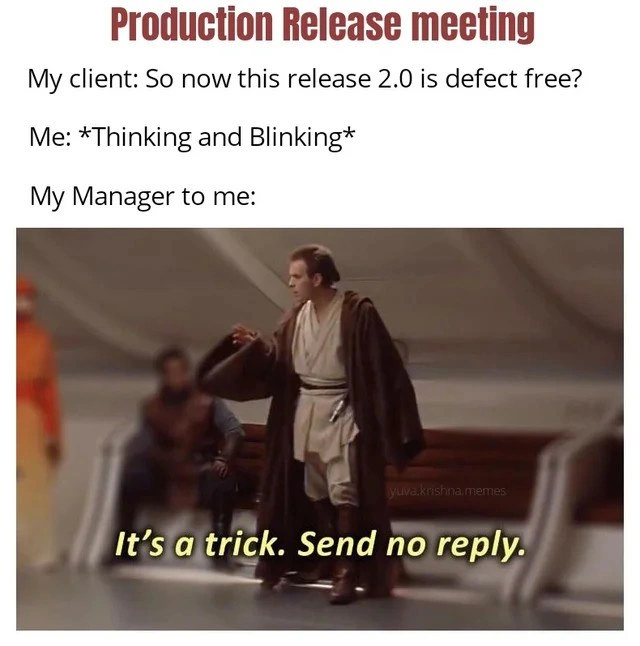
Enter the manager (the developer’s manager or project manager). In the meme, the next line is “My Manager to me:” and then instead of words, it shows a picture from Star Wars with a subtitle that says “It’s a trick. Send no reply.” This is meant to be the manager giving advice or an order to the developer. Basically, the manager is cautioning them: “Careful, don’t answer that question.” It’s like the manager is whispering, “This question is a trap.”

Why would the manager say that? Because the manager likely understands that the question “Is it defect-free?” is what we call a trick question or a trap question. If you answer “Yes, it’s absolutely defect-free,” and later even a tiny bug shows up, the client will be very upset and say you lied or didn’t do a good job. If you answer “No, there might be some defects,” you’re basically admitting imperfection at the worst possible time, which could make the client lose confidence or get angry. There’s no good way to directly answer it. So sometimes, the best approach is to not answer immediately or to let someone more experienced handle it with a very careful answer. Here, the manager is essentially telling the developer, “Let me handle this, don’t commit to anything.”

The humor in the meme comes from using that Star Wars scene. Tech memes often borrow famous movie scenes to make a point. Star Wars is a favorite source, and the line “It’s a trap!” (said by Admiral Ackbar in Return of the Jedi) is an iconic warning in pop culture. The meme tweaks it to “It’s a trick. Send no reply.” to fit the scenario. It’s funny because you have this dramatic Jedi Master image representing a very relatable office moment. The manager isn’t literally a Jedi of course, but the meme frames him as the wise mentor figure protecting the junior (the developer) from making a mistake. The phrase “Send no reply” is like something out of a spy movie or a battle scene, which makes the everyday situation of a meeting feel more epic and humorous.

Let’s connect this to reality a bit more: In software development, claiming that a product has zero bugs is almost always a bad idea. Quality Assurance (QA) teams will test the software before release. They do their best to find all the major bugs and fix them. By the time you’re releasing, ideally all known bugs, especially serious ones, have been resolved. But does that mean there are absolutely no bugs left? Not necessarily. It just means we haven’t seen any more in our testing. There’s a big difference between “no known defects” and “no defects at all.” Experienced people know that there could always be an unknown issue that pops up when real users start using the software in ways we didn’t fully anticipate. For instance, maybe a user enters data that’s very unusual and it causes an error, or maybe the system behaves differently under heavy real-world load than it did in testing. This is why saying “defect-free” is kind of taboo – it tempts fate.

What would a manager or team lead usually do in real life when a client asks this? They’d probably use some diplomatic language. Instead of a flat “Yes,” they might say, “We have tested the release thoroughly and addressed all the issues we found. We’re confident in the quality of this build.” Notice, that doesn’t literally say “there are zero bugs,” but it’s a reassuring statement. It’s honest about fixing what was found, but it doesn’t guarantee the absolute impossible. If a bug shows up later, the team can say, “Well, it was an unknown issue and we tackled it as soon as it was discovered,” which is normal.

The meeting aspect is also important. In meetings with clients or high-level stakeholders, there’s often pressure to be positive and confident. It can be a bit of a performance. The developers and QA might be sweating inside, knowing there’s always some risk, but they want to project calm. The client is looking for that green light and thumbs-up. So the manager giving a secret signal to the dev to stay quiet is a comedic exaggeration of how a project manager might politely intercept a question to prevent an overly blunt or risky answer.

In short, for a junior developer or someone new: this meme is illustrating the tension between expectations and reality. The client’s expectation is a flawless Release 2.0. The development team’s reality is that “flawless” is an almost impossible standard in software. The humor comes through a pop culture reference: the manager is compared to a Jedi Knight saving the day by stopping the developer from making an unwinnable promise. It’s a lighthearted take on the very real communication challenges in tech projects. Also, if you’re a Star Wars fan, the added layer of the Jedi quote makes it even funnier. Essentially, everyone in on the joke knows two things: Star Wars quotes and the fact that no software is ever truly bug-free. Mix those together in a meeting scenario, and you’ve got a recipe for a classic developer meme that’s funny because it’s true.

Level 3: The Defect-Free Illusion

In a real-world production release meeting, this scenario is painfully familiar to experienced developers and managers. A stakeholder or client asks with a hopeful smile, “So this version 2.0 is defect free now, right?” – essentially looking for a guarantee that the new release has no bugs. Every seasoned engineer in the room immediately feels a jab of release anxiety. We’ve all learned the hard way that the idea of a completely bug-free release is a myth – a comforting illusion that stakeholders sometimes cling to, but an illusion nonetheless.

The meme’s dialogue captures this perfectly. The client asks for assurance of perfection. The developer (the “Me” in the meme) is described as “Thinking and Blinking”, visually tongue-tied. Why the awkward silence? Because no one with actual development experience wants to answer that question directly. It’s what we call a loaded question – there’s no safe way out:

  • If the developer pipes up, “Yes, absolutely, defect-free!”, they’ve just walked into a minefield. The first time a user discovers a bug (and they will – users always find that one weird scenario), the client will remember that false promise. Cue the angry calls: “You told us it was bug-free!” Trust is shattered faster than a production server under heavy load.
  • If instead the developer admits, “Well, there might be a few minor bugs…”, the client could panic. Admitting that right at the release meeting is like throwing a wet blanket on the celebration. Stakeholders might question the team’s competence or delay the launch. Saying “No, it’s not defect-free” is truthful, but it’s politically hazardous in that moment.

In other words, the direct answers are no-win scenarios. This is why the manager intervenes. In the meme image, a Jedi Master extends his hand and the subtitle reads, “It’s a trick. Send no reply.” This is the manager’s subtle way of telling the developer: “Don’t answer that! Stay quiet, I’ll handle it.” The Star Wars reference is spot-on – the manager is effectively Obi-Wan, sensing a trap in the Force. The client’s question is the dark side tempting the young developer to say something foolish. The manager, likely battle-scarred from prior incidents, knows that sometimes the only winning move is not to play (not to answer unwise questions directly). In meme-speak, “It’s a trap!” – a classic line from Star Wars – is the unspoken subtext here.

This humorous scene reflects real office dynamics. Seasoned managers often coach their teams on how to handle unrealistic stakeholder expectations. They might step in to give a more nuanced answer, something corporate-yet-cautious like, “We’ve addressed all known issues in testing and the team will be on standby to quickly tackle any unforeseen problems.” Notice how that phrasing carefully avoids the absolute guarantee. It says “all known issues” (because known bugs have been fixed) but leaves room for unknown issues (without bluntly saying so). This kind of response manages the client’s expectations without making a false claim. It’s a polished way of saying, “We think it’s good, but we’re not so arrogant to promise it’s perfect.” The meme shortens this whole diplomatic dance into one hilariously blunt Jedi quote: “Send no reply.”

The Star Wars imagery amplifies the humor. The particular scene (a robed Jedi with hand raised) evokes the classic “Jedi mind trick.” In Star Wars, a Jedi wave of the hand can make someone believe something or drop a subject. Here the manager is essentially attempting a Jedi mind trick on the whole meeting: “This isn’t the question you’re looking for… move along.” It’s a geeky way to dramatize what a savvy manager would do – redirect the conversation away from an unsolvable question. The meme’s creator even used the line “It’s a trick” as a playful twist on Admiral Ackbar’s famous “It’s a trap!” line. The change to “Send no reply” fits our context: instead of springing the trap, just don’t respond at all. It’s like the manager is cautioning silence as the ultimate silent response strategy to survive the moment.

From an engineering perspective, this meme also resonates because it underlines a universal truth in software development: there’s no such thing as a completely defect-free release. Every developer and tester might dream of delivering a perfect version 2.0, but in practice, something always lurks. Maybe it’s an obscure workflow nobody tried, or a certain browser/OS combination, or an integration with a third-party service that behaves differently in production. We have QA teams and extensive testing exactly because bugs are sneaky. Yet even with rigorous testing, you can’t guarantee catching everything. The meme is basically winking at us: “We all know 2.0 still has some bug hiding somewhere.” That’s why it’s funny – it’s humor rooted in a shared professional experience.

The categories listed (Production, Bugs, Meetings, Stakeholders_Clients, QA) all converge in this little scene:

  • Production: This is happening right as code is about to hit the live environment (production). Everyone’s nerves are jangled because a bug in production has real consequences (downtime, unhappy users, midnight hotfixes). The stakes are high.
  • Bugs: The entire joke centers on bugs (AKA defects) – specifically the impossibility of claiming there are none. Even if you squashed 99% of them, the last 1% are hiding like stealthy gremlins.
  • Meetings: It’s literally set in a meeting, one that many of us recognize – a release go/no-go meeting or a client update meeting where final assurances are requested. The meeting humor here comes from the absurdity of what’s asked versus what can honestly be answered. If you’ve sat in enough project meetings, you’ve seen similar cringe moments.
  • Stakeholders/Clients: The meme highlights the tension between clients (who want everything perfect) and developers (who know perfection is practically unattainable). It’s poking fun at how clients or upper management sometimes ask naive questions, not realizing what they’re really asking.
  • QA: Quality Assurance gets a nod because they’re the ones who usually declare if a build is good to release. Even after QA signs off, no good QA lead will ever say “100% bug-free” – they’ll say “no known critical defects.” The meme’s client either doesn’t understand that nuance or just wants extra reassurance, which puts QA and devs in a tight spot.

The common tags like ReleasePressure and ReleaseAnxiety are embodied in the developer’s blinking reaction. Every developer knows that butterflies-in-the-stomach feeling at release time. The funniest part of this meme is that it wraps up all that stress and unspoken truth in a single, absurd exchange. The manager’s dramatic “It’s a trick!” is exactly what a lot of us are thinking internally when someone asks, “It’s perfect now, right?” We’ve learned from countless production issues that you never tempt fate by declaring a release flawless. In fact, it’s almost a superstition: the moment you claim “No bugs!”, the universe (or Murphy’s Law) takes it as a challenge.

In summary, this meme makes seasoned developers and IT folks laugh (or groan) because it’s too real. It satirizes the impossible position engineers are put in when non-tech stakeholders expect certainty. The image of a Jedi Master (manager) urgently warning his pupil not to respond captures both the seriousness and the absurdity of the moment. It’s a bit of dark humor: we’re laughing, but only because we’ve all lived through that tension. As a collective industry joke, it reminds us that defect-free releases are like unicorns – we talk about them, but nobody’s actually seen one in the wild. And if someone asks you to swear you’ve found every bug, well… don’t fall for that trick.

Level 4: Only Sith Deal in Absolutes

At the most theoretical level, asking if a software release is defect-free is like asking for a mathematical proof that no bugs exist. In computer science, proving the total absence of bugs in any non-trivial program is almost as hard as solving the Halting Problem (in other words, undecidable in general). We can test software extensively and use logic, but there's a famous saying by Edsger Dijkstra: "Program testing can be used to show the presence of bugs, but never to show their absence." This meme slyly nods to that paradox. The client’s question demands an absolute guarantee, something seasoned engineers know is theoretically unfeasible except under very strict conditions.

To truly guarantee a program has zero defects, you'd have to account for every possible input, state, and interaction – an astronomically large set, often combinatorial explosion in complexity. Even advanced practices like formal verification and model checking (used for mission-critical systems like avionics or medical devices) can only prove correctness relative to a precise specification, and only for parts of the system small enough to reason about. The average web app or enterprise software is far too complex and rapidly changing to ever be fully proven “bug-free.” In practice, absolute certainty in software is a pipe dream – a lesson grounded in theoretical computer science and real-life experience.

So when the manager in the meme warns “It’s a trick. Send no reply,” it echoes a deep truth: any claim of “defect-free” is a trap based on an impossible absolute. In a tongue-in-cheek way, the subtitle “Only Sith deal in absolutes” (a twist on a Star Wars quote) jabs at the folly of making absolute promises in software. Only someone on the Dark Side (or extremely naïve) would assert with 100% certainty that a complex production system has zero bugs. The veteran developer inside us knows that the probability of no bugs is theoretically indistinguishable from zero. In short, the client’s question isn’t just tough – it defies the fundamental limits of computing logic. The manager’s Jedi-like caution is scientifically justified: never bet against the inevitability of software bugs.

Description

A meme about the perilous dynamics of a production release meeting. The top section consists of text: 'Production Release meeting', followed by a short script. 'My client: So now this release 2.0 is defect free?'. 'Me: *Thinking and Blinking*'. 'My Manager to me:'. The bottom section features a well-known screenshot from 'Star Wars: The Phantom Menace,' where Jedi Master Qui-Gon Jinn advises his apprentice with the subtitled line, 'It's a trick. Send no reply.' The humor resonates deeply with experienced developers and managers who understand that no non-trivial software is ever 'defect free.' The client's question is a classic no-win scenario: answering 'yes' is a lie that creates impossible expectations, while answering 'no' can derail the release. The manager's Jedi-like wisdom to simply not engage with the loaded question is presented as the only viable strategy
Comments

8
Anonymous ★ Top Pick The probability of a release being defect-free is inversely proportional to the number of stakeholders asking if it's defect-free
  1. Anonymous ★ Top Pick

    The probability of a release being defect-free is inversely proportional to the number of stakeholders asking if it's defect-free

  2. Anonymous

    “Defect-free 2.0? Absolutely - right after we hit 100% branch coverage, prove the CAP theorem was a typo, and convince product that ‘scope freeze’ is a real Scrum ceremony.”

  3. Anonymous

    After 20 years in this industry, I've learned that 'defect-free' is like 'serverless' - it's not that there are no defects, they're just someone else's problem now. The real trick is knowing when to deploy your manager as a human shield while you frantically check if the rollback scripts actually work this time

  4. Anonymous

    'Defect-free' isn't a release state, it's a test coverage statement - and answering yes just transfers the defect from the code to the contract

  5. Anonymous

    Ah yes, the classic production release meeting where 'defect-free' is mentioned - a phrase that triggers the same fight-or-flight response in senior engineers as 'it works on my machine' or 'just a quick hotfix.' The manager's Jedi mind trick advice is actually sound architecture: when faced with impossible SLAs, the best response is no response. Because we all know that 'defect-free' in production really means 'we haven't discovered the edge cases yet,' and the only truly bug-free code is code that hasn't been deployed. The real trick isn't making defect-free software - it's managing stakeholder expectations while your monitoring dashboards light up like a Christmas tree at 3 AM

  6. Anonymous

    “Defect-free? At INFO logging and current traffic, yes - until someone turns on DEBUG.”

  7. Anonymous

    Defect-free isn’t in the SLA; we ship with controlled blast radius, SLOs, and a rollback - proof of zero bugs would require covering an unbounded state space

  8. Anonymous

    Jedi managers get it: Affirming 'defect-free' in prod releases is the ultimate Sith trap - better echo Qui-Gon and ghost the commit

Use J and K for navigation