AWS When You Need That One Specific Instance
Why is this AWS meme funny?
Level 1: Take It or Leave It
Imagine you go to a huge candy store that usually has every candy in the world. You excitedly ask for a special chocolate that you’ve gotten there before. The store clerk scratches his head and says, “Hmm, we’re all out of that here... The best I can do is offer you one from our other shop all the way across town.” It’s pretty funny (and a bit annoying) because this store is supposed to be super big and have everything, but now you have to travel far just to get one little candy. In simple terms, the meme is joking that a giant service like AWS (which is like a big store for computing power) sometimes only gives you one choice of where to get what you want. It’s like your parents saying, “You can’t play in any playground nearby, only the one in the next city is open.” You’d probably roll your eyes, right? It’s funny because you’d expect so many options, but you end up with just one – you can take it or leave it. The meme makes us laugh at that feeling of having no choice but a far-away option, especially when we thought we had the whole world at our fingertips.
Level 2: Only Oregon Left
Let’s break down the basics behind this joke. AWS (Amazon Web Services) divides its giant cloud into different regions, which are distinct geographic locations where their data centers live. For example, us-west-2 is the code name for the region in Oregon, USA. (In AWS jargon, “us-west” means Western United States, and the “-2” indicates it’s the second region AWS opened in that area — the first one us-west-1 is in California.) Each region has multiple Availability Zones (AZs), which are like separate data center clusters within that region. The idea is that if one data center in Oregon has an issue, other AZs in Oregon can still run your apps. Regions are isolated from each other on purpose: something going wrong in one region (like a power outage or network issue) shouldn’t automatically affect another region on the other side of the world.
Now, when developers launch servers or services on AWS (using products like Amazon EC2 for virtual machines), they usually choose a region. You might pick a region close to your customers to reduce delay (latency), or for legal reasons (data residency laws), or to be near other services you use. Popular regions can get really busy. AWS has quotas for each account in each region — for instance, you might be limited to a certain number of virtual machines in us-east-1 and a separate limit in us-west-2. These quotas exist because behind the scenes, AWS only has so many physical servers in each location. Region capacity constraints are real: if a ton of people or one huge customer all need machines in the same region at the same time, that region can temporarily run out of free servers of a certain type. When that happens, AWS might tell you “sorry, no more of that resource here right now.”
Imagine you try to create 100 new servers in Virginia (us-east-1) during a big traffic spike. AWS could return an error saying essentially, “No capacity available in this region.” It’s like an online store saying an item is sold out in your area. AWS might then suggest using another region that has capacity — in this case, Oregon (us-west-2) still has plenty of room. Oregon is a large region and often isn’t as overloaded, so it becomes the fallback. The meme’s phrase “Best I can do is us-west-2” comes from a popular meme template where someone asks for something and the answer is a scaled-down offer. In this context, developers might want their service to run in multiple regions or in a specific preferred region, but AWS is humorously imagined as replying with, “The best we can offer you is to run it in Oregon, and nowhere else.”
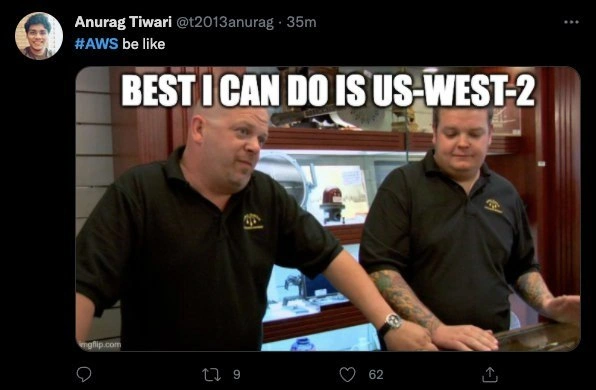
This is funny to developers because it flips expectations. We usually think of the cloud as endlessly flexible — you click a button and get a server wherever you want, anytime. But in reality, AWS is a huge collection of real computers in buildings. Those computers can all be in use, especially in a popular region. Single_region availability is the situation where only one region has what you need. It defeats the ideal of spreading out across many regions. It would be a bit like planning to have backup power generators in three cities, but then being told you can only put them all in one city because that’s the only place with space left. Newer developers learn that terms like “multi-region redundancy” aren’t just abstract goals — they depend on actual availability. And sometimes the only available option is one region you didn’t plan for. The meme is basically a friendly jab at AWS’s expense: even this ultra-sophisticated CloudInfrastructure has moments where it feels like a sparse store shelf, with Oregon being the last item in stock. When you see the text "BEST I CAN DO IS US-WEST-2" over the Pawn Stars guys, now you know: it’s saying AWS only has capacity in the Oregon region, take it or leave it, which is both frustrating and comical to cloud users.
Level 3: Cloud Pawn Shop
Picture a seasoned engineer on a call with AWS support at 3 AM, trying to launch resources in their usual region (say us-east-1 in Virginia) during a traffic surge. Instead of the expected elastic magic, they get a reply reminiscent of a Pawn Stars negotiation: “BEST I CAN DO IS US-WEST-2.” 😒 This meme nails that feeling. In the image, a pawn shop owner (from the famous History Channel show Pawn Stars) is usually haggling with a customer. Here AWS is personified as that shop owner behind the counter, and the developer is the desperate customer trying to get a good deal on capacity. The humor comes from the role reversal: developers think of AWS as a high-tech limitless platform, but it’s depicted as a guy shrugging and offering a single option, as if you walked into a store full of goods and they said “Sorry, only this one item is available.”
For veteran devs, this scenario hits a nerve. AWS regions are normally abundant with redundant Availability Zones and endless virtual machines, until suddenly they aren’t. Maybe you’ve hit a quota limit or, worse, the region itself has an InsufficientCapacity error for the instance type you need. (Yes, AWS can actually reply with Insufficient capacity when you try to start a new Amazon EC2 instance and the hardware isn’t free in that zone!) In such moments, AWS essentially tells you to try another region. It’s like asking for a luxury multi-region deployment and AWS countering with a bargain-bin solution: “We can’t give you that in N. Virginia, but have you considered Oregon, 3000 miles away?” The phrase “Best I can do is us-west-2” perfectly captures that absurd negotiation vibe.
This meme resonates because many in the industry have war stories of capacity crises. Perhaps us-east-1 (the infamous Northern Virginia region) was down or throttled — remember those headlines when half the internet goes offline because one AWS region has issues? Seasoned engineers have learned, sometimes painfully, that relying on a single region is risky. So, they plan for multi-region redundancy: databases replicated across continents, failover mechanisms, the works. But those plans assume AWS can actually provision resources in multiple places when needed. The joke here is that when push comes to shove, even AWS might respond with a shrug: only one region has any room left. It’s a bit of cloud humor about how reality undercuts ideal architecture.
Why us-west-2 specifically? This region (Oregon) is one of AWS’s largest and most established on the US West Coast. It’s known for having a ton of capacity and often lower utilization than the uber-popular us-east-1. In real incidents, when East Coast regions get overloaded or face outages, companies do sometimes frantically shift workloads westward. “Oregon or nothing” starts to sound like an AWS mantra in those moments. Senior devs chuckle because they’ve seen AWS service limits and availability quirks enough times. Multi-region deployment is touted as a best practice, yet here we are – it feels like bargaining in a cloud pawn shop: You wanted a globally resilient service? Best we can do is one region, take it or leave it. The comedic sting is in how this echoes real on-call conversations. It’s funny now, in retrospect, because we’ve been that tired engineer hearing an absurdly pragmatic answer from a cloud that’s supposed to be “automagic.” The meme encapsulates a shared understanding: for all the CloudInfrastructure sophistication, sometimes the cloud behaves like a grumpy shopkeeper with limited stock. And if you’ve ever been on the wrong side of an AWS capacity crunch, you can’t help but laugh (perhaps a bit bitterly) at how accurately “BEST I CAN DO IS US-WEST-2” sums it up.
Level 4: Infinite Cloud, Finite Capacity
At the theoretical level, this meme highlights a paradox of distributed cloud systems: cloud platforms promise virtually infinite on-demand resources, yet they are built on finite physical hardware. In distributed systems theory, we often discuss trade-offs like the CAP theorem (Consistency, Availability, Partition tolerance). Here, "CAP" takes on a cheeky double meaning because capacity itself becomes the limiting factor. No matter how globally distributed a cloud may be, each AWS region is an isolated pool of compute and storage. This isolation is by design – it contains failures, but it also means one region’s pool can run dry while others still have slack. The humor emerges from a fundamental truth: even in a massively scaled system, you can hit a resource ceiling, turning the illusion of endless capacity into a sudden "out-of-stock" error.
From a large-scale architecture perspective, being forced into a single region (like us-west-2) exposes the underlying physics and logistics behind cloud computing. Data has to obey the speed of light – if all your traffic is re-routed to Oregon, users across the world will feel the increased latency. Multi-region design is meant to mitigate failures, but achieving consistency and low latency across continents is non-trivial. Synchronous replication across regions is limited by network speed and reliability; the further apart the regions, the longer it takes to keep data in sync. It’s a bit like a distributed consensus problem: if only one region is available, there’s implicitly no consensus to reach – you have a single point of truth, which is simpler but also a single point of failure. Ironically, cloud architects preach redundancy and geographical diversity for high availability, but here the systemic constraint forces a corner-cutting: all eggs in one basket (or rather, one data center cluster). We’re reminded that behind the slick abstraction of an “infinite cloud” are real-world limits: power, cooling, rack space, supply chain for new servers – and yes, these can get fully used up. The meme exaggerates this scenario to comedy by implying AWS responds with the pragmatism of physics: “We’ve scaled to the cloud’s edges, but sorry, the best we can offer is what’s left in Oregon.” The lofty promise of global infrastructure meets the hard truth of capacity planning. In essence, it’s a tongue-in-cheek nod to the reality that even the cloud has constraints, akin to a cosmic joke on anyone who thought infinite scalability was truly infinite.
Description
A screenshot of a tweet from user Anurag Tiwari that says, '#AWS be like,' followed by a popular meme. The meme is the 'Best I Can Do Is...' format from the reality TV show 'Pawn Stars,' featuring Rick Harrison behind the counter of his shop. The superimposed text on the meme reads, 'BEST I CAN DO IS US-WEST-2.' The humor is targeted at experienced cloud engineers who have faced resource constraints on AWS. Often, a developer needs a specific type of EC2 instance in a primary region (like us-east-1 in Virginia) only to find that AWS has run out of capacity. The platform's effective response is to offer the instance in a different, potentially less convenient region like us-west-2 (Oregon). The meme perfectly captures this frustrating experience by likening the world's largest cloud provider to a pawn shop owner making a lowball, take-it-or-leave-it offer
Comments
10Comment deleted
I asked AWS for a high-capacity GPU instance for my ML model in my primary region. It told me the best it could do was an abacus in us-west-2 and a bill for inter-region data transfer
Built a multi-AZ, multi-region, self-healing architecture - AWS just said the only capacity left is us-west-2; guess our DR plan is now “hope the Cascadia fault respects the SLA.”
"We need multi-region for compliance." "Sure, here's us-west-2 with a CNAME pointing to it from Sydney."
You ask AWS for capacity in the region your data lives in; AWS, hand on the counter, offers Oregon - and unlike the pawn shop, the data transfer fee to walk away is yours
After years of architecting multi-region disaster recovery strategies with automatic failover across six continents, you realize AWS's answer to 'which region should I use?' is essentially the cloud equivalent of 'have you tried turning it off and on again?' - except it's always US-WEST-2, regardless of whether your users are in Singapore, your compliance requirements mandate EU data residency, or you're literally standing in an AWS data center in Sydney
Architect demands global HA; AWS calculator: 'Best I can do is us-west-2 Spot.'
We asked for global active-active; AWS offered us‑west‑2 and a reminder the control plane still wakes up in us‑east‑1
Asked for active/active across regions; got three AZs in us-west-2 - same blast radius, different letter
Please use English in this chat either add a translation, explain what you've written or don't use Russian Comment deleted
Wait us-east-1 is down again? Comment deleted