My Spaghetti Code: A Masterpiece to Me, a Horror to Others
Why is this CodeQuality meme funny?
Level 1: Not My Mess
Imagine you walk into your room and dump all your toys, books, and clothes in a big pile on the floor. It’s a huge jumbled mess. Later, your friend comes over and sees the room and goes, “Whoa! This is scary messy!” They’re kind of shocked and maybe a little afraid to even step in because there’s stuff everywhere, and who knows what might topple over. Now you’re feeling embarrassed because, well, you made that mess. But instead of admitting it, you hide behind the door and whisper, “Yeah, I wonder which crazy person did this?” pretending it wasn’t you.
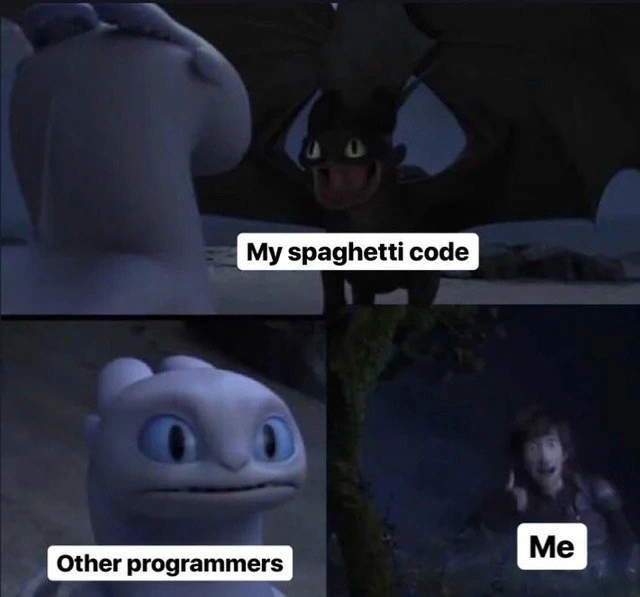
This meme is just like that, but with computer code. The “spaghetti code” is the big messy pile of toys (except the toys are lines of code all tangled up). The other programmers are like the friend who is shocked and scared to touch it. And the person labeled “Me” hiding is the one who made the mess, feeling shy and guilty, pretending they have no idea how things got so bad. It’s funny because we all know the truth: just like your parent or friend knows you made that mess in your room, everyone knows the programmer wrote their own spaghetti code. The humor is in the pretend innocence and the over-the-top horror of the situation. Basically, it’s saying: “Oops, I coded something so messy that it scares my friends, and now I’m hiding because I don’t want to admit I did it.” It’s a playful way to remind us to keep our stuff (and our code) a bit more tidy, or at least be ready to face the mess with a smile.
Level 2: Spaghetti Code Unraveled
Let’s break down what “spaghetti code” means in plain terms. It’s a nickname programmers use for code that is really messy and tangled. Imagine a program where the logic jumps all over the place, kind of like a bunch of spaghetti noodles in a bowl – it’s hard to follow one noodle from start to finish because it’s all jumbled. In a code context, that means if you try to read the program from top to bottom, you keep getting bounced around: this part calls that part, which triggers something else, maybe there’s a random global variable that changes how another function behaves, and so on. There’s no clear structure or organization. It’s the opposite of clean, straightforward code.
In the meme’s imagery, the black dragon (Toothless) labeled “My spaghetti code” represents that wild, unstructured program. Toothless might be cute, but here he symbolizes something daunting: a codebase that’s grown unwieldy. The white Light Fury dragon labeled “Other programmers” is showing how other developers feel when they see such code – her eyes are wide and she looks alarmed. That’s exactly how a programmer might react upon opening a source file that’s one giant function hundreds of lines long with no comments. It’s overwhelming. They’re thinking, “How am I supposed to understand this?” The bottom-right panel shows the original coder hiding behind a tree (“Me”), which is a funny way of saying the author is a bit ashamed or is pretending “Oh wow, who could have written this?!” even though it was them. This is a form of developer self-deprecation – making a joke at one’s own expense. Developers often do this when we know we didn’t do our best job: we poke fun at ourselves to diffuse the embarrassment.
Now, some key terms here: code quality is all about how easy code is to read, understand, and maintain. High code quality means the code is well-organized and clear; low code quality means it’s convoluted or inefficient. Spaghetti code is considered low quality because it’s so tangled that it’s hard for anyone else (or even the original author later on) to work with. Another term, technical debt, comes up a lot. This basically means shortcuts taken in code that will cause more work later – like taking on debt that you eventually have to pay back. For example, say you’re rushing to add a feature and you write it in a quick-and-dirty way without proper structure or tests. It works for now, but that messy implementation is your “debt.” Later, when something breaks or when you need to extend the code, you (or your teammates) will have to spend extra time cleaning it up – that’s “paying back” the technical debt with interest, often in the form of debugging headaches. Spaghetti code usually is a result of lots of little hacks and quick fixes accumulating. Each hack is like adding another noodle to the tangle. Over time, you end up with a whole pasta bowl of complexity that someone eventually has to untangle.
We also talk about code smells – these are warning signs in code that imply deeper problems. Think of a code smell like a bad odor in your fridge: the smell itself isn’t the problem, but it signals that something inside is rotten. Spaghetti code is a notorious code smell. When someone sees a huge function or a highly interdependent class that does too many things, alarm bells go off. It suggests violations of basic design principles (like the Single Responsibility Principle, which says each part of code should do one well-defined thing). If one function is handling user input, making database calls, sending emails, and doing calculations all in one, it’s doing way too much – that’s smelly. Other programmers know when they see that, they’re likely to encounter bugs or have a hard time adding new features. No one wants to touch it, because it feels like Jenga: remove or change one piece and the whole tower might collapse. This leads to real developer frustration.
For a junior developer or a student, how does spaghetti code happen? Often, it’s just a byproduct of learning or rushing. When you’re new to coding, you might write everything in one big block because you haven’t yet learned about splitting a program into functions or modules. Or if you’re under time pressure, you might copy-paste code and tweak it rather than designing a cleaner solution. It works, so you move on – but later, when you or someone else revisits it, it’s tough to untangle. A relatable example: maybe you wrote a game or a school project as one giant main() function. It started simple, but as you kept adding features, it grew and grew. By the end, that function maybe handled input, game logic, rendering, score calculation, all interwoven. If something went wrong in the final score tally, finding the bug meant sifting through that entire chunk of code. That’s stressful and time-consuming, exactly why we try to avoid spaghetti structures.
Let’s say we have a function that processes an order in an online shop, and it ends up doing a ton of things with lots of special cases (a bit of a contrived example, but it gives you the flavor):
# An example of spaghetti-like code in a single function
def handle_order(order):
process_order(order) # Step 1: process
if order.status == "PENDING":
approve_order(order) # Step 2: approve under certain condition
if order.has_issue:
fix_order(order) # Oops, found an issue, fix it...
order.status = "PENDING"
handle_order(order) # then recursively call itself (re-process)
if global_error_flag:
rollback_everything(order) # Some global state triggers a rollback
if order.status == "APPROVED" and not order.has_issue:
finalize_order(order) # Finish the order if everything is okay
# Many intertwined conditions and side effects above; it's hard to follow all the paths.
Imagine being a new developer tasked with understanding or modifying the handle_order function above. The logic is all over the place. There are multiple if checks that aren’t clearly related, a recursive call that sends you back to the start in some cases, and even a global flag (global_error_flag) that can alter the flow from anywhere. This is spaghetti-like because the “flow of control” is jumping and looping around unpredictably. There isn’t a clear, linear sequence of steps; instead, it’s like a choose-your-own-adventure where the story can loop back or branch off depending on obscure conditions. If you wanted to change how approval works, you’d have to trace through all these twists to see how altering one piece affects the others. There’s a lack of structure – for example, a better structured approach might separate the concerns (processing vs. approving vs. finalizing) into distinct functions or at least distinct sections with a clear order. In this spaghetti version, everything is jumbled together.
When other programmers encounter code like this, it can be daunting. They might literally say, “This code is spaghetti,” meaning they recognize it will be tricky to maintain. It’s not that the code doesn’t run – it might work okay – but working with it is time-consuming and risky. This is where relatable developer experience comes in: most developers have inherited code that made them go “Ugh, what is this?” It’s almost a bonding experience in the developer community to swap horror stories of bad code we’ve seen. And often, we include ourselves in those stories, because writing a bit of spaghetti code at some point is hard to avoid. Maybe you were the newbie who didn’t have time to learn best practices before delivering a feature, or you were handed an impossible deadline and had to slap something together at 2 AM. These things happen. What’s important (and part of what makes the meme funny) is that everyone recognizes it and can laugh about it now.
The “Me” hiding behind the tree in the meme symbolizes the author of the messy code feeling guilty or embarrassed. It’s like when you know you left a big mess but hope no one finds out it was you. In a team setting, this could be the developer who last touched that scary module trying to stay low-profile during the meeting where it’s discussed. It’s a joke, of course – in real life, teams try to avoid blame and focus on solutions (blameless culture is a thing in healthy engineering teams). But there is a grain of truth: no one likes being the person who wrote the confusing code that everyone else dreads. This meme takes that uncomfortable feeling and turns it into a funny visual parody. The takeaway for a newer developer is: CodeQuality matters. If you write cleaner code from the start (or actively refactor and improve it when you can), you not only make life easier for others, you save your future self from that cringe moment of “Oh no, did I really write this?” It’s why mentors and senior devs encourage habits like writing small functions, using clear names, adding comments for tricky parts, and not being afraid to rewrite things properly once you understand the problem. Those practices prevent the spaghetti monster from growing.
In summary, this meme is a light-hearted lesson. TechnicalDebt in the form of spaghetti code can sneak up on anyone. Other programmers will be “scared” of it because it’s genuinely hard to work with. And while it’s humorous to imagine hiding and saying “I don’t know who did this,” in real life it’s better to own the mess and clean it up. Every developer has to do cleanup duty at some point (often on code their past self wrote!). The good news is that we also have the tools to turn spaghetti code into well-structured code: by refactoring step by step, writing tests to ensure we don’t break things, and learning from those design mistakes. Until then, we cope with a bit of DeveloperHumor. We joke about the scary code dragons and our role in creating them, because if you can laugh at a problem, it feels a little less intimidating to fix.
Level 3: Taming the Code Dragon
This meme uses a How to Train Your Dragon scene to lampoon a classic programming nightmare: discovering your own spaghetti code has terrified your teammates. In the top panel, the black Night Fury dragon (Toothless) labeled “My spaghetti code” faces the white Light Fury. The Light Fury’s wide-eyed, alarmed expression (bottom-left) – captioned “Other programmers” – perfectly captures how fellow developers feel when they confront a monstrous tangle of code. Meanwhile, in the bottom-right panel, we see a human figure (Hiccup, the dragon’s trainer) hiding behind a tree labeled “Me.” This is the embarrassed developer, desperately hoping no one realizes they unleashed this code dragon.
The humor bites because it’s a scenario nearly every experienced coder recognizes. Spaghetti code refers to code so entangled and unstructured that its logic flows twist and turn like a bowl of noodles. There’s no clear architecture – just a snarled mess where functions call each other in convoluted ways, variables pop up out of nowhere, and execution jumps around unpredictably (think of liberal use of goto statements or deeply nested conditionals). One minute you’re in one part of the code, then you “jump” to another, then back – much like tracing one slippery noodle through an entire plate of pasta. This style of coding was notorious in the early days of programming (hence the term spaghetti code), and it remains a dreaded code smell in modern software projects. A code smell is any hint in the code of a deeper problem – and spaghetti code gives off an odor that senior engineers can sniff from a mile away.
Why do teams react with horror? Because spaghetti code is the antithesis of good CodeQuality and maintainability. In healthy code (sometimes jokingly called “ravioli code” or lasagna code for its well-contained layers), each module or function has a clear purpose and the flow is easy to follow. But in a spaghetti codebase, everything is tangled. Changing one line might have bizarre side effects in distant parts of the system. This creates a fragile system where software complexity is off the charts. Seasoned devs know that touching such a mess can be risky – one wrong move and you’ve broken something, perhaps in a completely unrelated module. It’s the kind of legacy code where a simple bug fix turns into a day-long adventure of unraveling dependencies. (Ever heard the phrase “pulling a thread and the whole sweater unravels”? In spaghetti code, pulling one noodle can knock over the meatballs somewhere else – i.e., break other features.) So when other programmers stumble upon it, their face mirrors that startled Light Fury: “Whoa, what is that?!”
Now, the author of this code – the developer hiding nervously behind the tree – is experiencing some classic DeveloperHumor and shame. It’s a tongue-in-cheek portrayal of developer self-deprecation. In real life, when a messy part of the system comes under scrutiny, you might hear nervous chuckles and comments like, “Yikes, who wrote this?” often from the very person who did! We’ve all been there: perhaps you wrote a quick-and-dirty patch at 3 AM to hotfix a production issue, promising yourself you’d refactor later, but “later” never came. Over time that patch accreted more hacks and became a full-blown monster. By the time your teammates encounter it, even git blame might point squarely at you, yet you jokingly pretend TechnicalDebt gremlins did it. Technical debt is exactly what led to this situation – those expedient shortcuts (like skipping proper design or not writing tests) were like borrowing time that you now owe with interest. The interest, in this case, is paid as confusion, debugging pain, and frantic Slack messages asking “Do you understand what’s going on in this function?!”
This meme highlights the gap between ideal practice and real-world codebases. Ideally, every developer strives to avoid CodeSmells and keep the codebase clean. We have code reviews, style guides, and pair programming – all meant to slay or tame these code dragons early. Yet in reality, deadlines, understaffed teams, or sheer inexperience can let a wild piece of spaghetti logic slip into production. It’s a relatable developer experience: the scary moment when a colleague opens that file (you know the one – the 1000-line God function with no documentation) and their jaw drops. In meetings or pull request discussions, the other programmers might react just like the Light Fury – shocked and concerned – while the original author breaks into a sweat, much like Hiccup nervously hiding and hoping to stay unnoticed. The DeveloperFrustration is real, but so is the comedic relief of sharing these moments. It’s common in DeveloperJokes and memes to exaggerate this dynamic: “We have met the enemy, and it is our own code.”
Interestingly, the problem of spaghetti code has been around as long as coding itself. Back in 1968, computer science pioneer Edsger Dijkstra wrote a famous letter titled “Go To Statement Considered Harmful”. In it, he argued that unrestricted use of goto (jumping arbitrarily around code) made programs impossible to understand – basically an early academic critique of spaghetti code. That letter helped jump-start structured programming, encouraging use of orderly loops and functions instead of chaotic jumps. The fact that we still use the term “spaghetti code” shows how enduring this issue is. Even with modern languages, frameworks, and best practices, any project can devolve into a tangled mess if we’re not careful. Complexity has a way of creeping back in. It’s almost a rite of passage for developers to look back at some old module they wrote and cringe.
At its core, this meme is funny because it’s true. The SoftwareComplexity monster (the dragon) is both frightening and familiar. And the image of the coder literally hiding behind a tree pretending “I don’t know who wrote this ugly code” is an exaggeration of that guilty feeling we get. It’s developer humor serving as a coping mechanism: we laugh at the absurdity of the situation to keep from crying about the real clean-up work ahead. In a sense, the meme is also optimistic – it implies the coder knows their code is scary and is ashamed, which is the first step to reform! After the laughter, maybe that developer will gather the courage to step out from behind the tree and refactor that beast into something more tame. CodeQuality can be improved, dragons can be trained, and even the gnarliest spaghetti can be refactored into manageable pieces… but until then, we’ll share jokes like this to ease the pain.
Description
This is a four-panel meme using the 'Toothless Presents Himself' format from the movie 'How to Train Your Dragon: The Hidden World.' In the top-left and top-right panels, the black dragon Toothless, labeled 'My spaghetti code,' is performing an awkward, goofy courtship dance for the white Light Fury dragon. In the bottom-left panel, the Light Fury, labeled 'Other programmers,' stares back with a look of utter confusion and disdain. In the bottom-right panel, the character Hiccup, labeled 'Me,' is hiding behind a tree, enthusiastically and encouragingly gesturing for Toothless to continue. The meme perfectly captures the dynamic of a code review for a piece of poorly written, tangled ('spaghetti') code. The author ('Me') sees their creation as functional and clever, proudly presenting it. However, their peers ('Other programmers') who must read, understand, and maintain it are horrified by its complexity and lack of structure, seeing it as the monster it truly is
Comments
7Comment deleted
I once showed my team a function I wrote that had seven nested loops and a dozen global variables. I called it 'The Engine.' They renamed it 'The Unspeakable Horror' and now we only refer to it in hushed tones during retrospectives
I call it architectural archaeology: when the team unearths my 2 000-line Perl script secretly powering the “stateless” microservice, I just tag it “vendor code - DO NOT TOUCH” and fade behind the Kanban board
The real architectural pattern here is the Observer pattern - where everyone observes your code is terrible, but you're implementing the Singleton pattern of being the only one who thinks it's fine because 'it works on my machine' and you understand the business context from 2018
Every senior engineer has been there: you inherit a codebase where the control flow looks like someone implemented goto statements in a language that doesn't support them, the dependency graph forms a perfect circle, and the only documentation is a comment that says 'TODO: refactor this mess.' You present it in the architecture review, and the room goes silent - not the contemplative kind, but the 'we're all mentally calculating the rewrite estimate' kind. The real kicker? It's in production, it's making money, and nobody wants to be the one to touch it. Welcome to the spaghetti code support group, where we're all just one merge conflict away from tears
My spaghetti code is one giant strongly connected component; everyone else freezes while I run before someone labels me both the SPOF and the runbook
I call it “exception‑driven control plane with temporal coupling”; reviewers call it “Big Ball of Mud,” then quietly declare a merge freeze
That rare code review where the author nods along with the 'rewrite it' verdict