The Niche Intersection of Compiler Design and Cross-Dressing
Why is this Compilers meme funny?
Level 1: Costumes & Computers
Imagine you’re watching a fun cartoon, and a character says, “I love it when people play dress-up in costumes… and then solve a giant math puzzle!” That would be pretty silly, right? This meme is funny for a similar reason. It takes something simple or playful (a boy dressing up as a girl, which is like a goofy pretend game) and suddenly adds something super complicated and serious (making a whole computer program that translates languages, which is really hard to do!). It’s an unexpected combo. Normally, someone might say, “Oh, I think it’s cute when characters wear different clothes.” Here they say, “It really excites me when they wear different clothes and then do a big tough computer project!” The two things just don’t usually go together, and that surprise is what makes it humorous. It’s like mixing a costume party with a rocket science project – your brain goes “huh, that’s weird… and kind of funny!” Essentially, the meme is joking that this character finds really nerdy computer work as thrilling as most people would find a fun dress-up scene. The idea of being “turned on” (really excited) by something as dry and brainy as building a compiler is so out-of-place that it makes us laugh. Even if you don’t know exactly what a compiler is, you can sense it’s something difficult and technical. So picturing that in a romantic or exciting context is just goofy. In plain terms: the meme is funny because it mixes a cute, relatable situation with an extreme nerdy task, creating a big surprise. It’s that simple mismatch that tickles our sense of humor – kind of like saying “I get butterflies in my stomach when I see someone doing homework really, really well!” It’s absurd, and that’s why it’s great.
Level 2: Cross-Dressing & Compiling
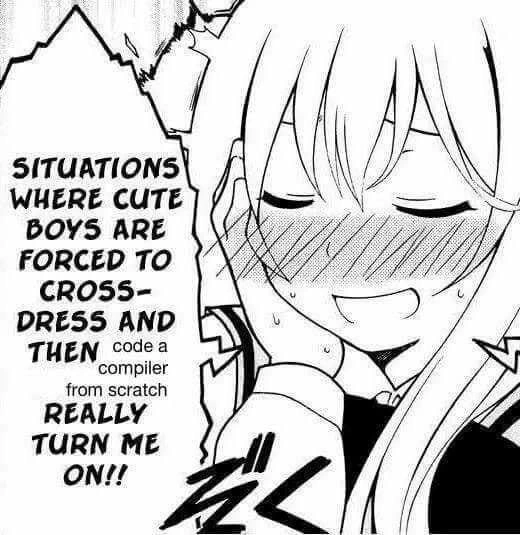
Let’s break down the elements of this meme in simpler terms. The image is a panel from a manga (a Japanese comic) in black-and-white style. We see an anime girl with long hair blushing furiously, with a delighted smile and sweat drops – the typical cartoon way to show she’s extremely excited or aroused. The speech bubble (with jagged edges for dramatic effect) has her exclaiming: “Situations where cute boys are forced to cross-dress and then code a compiler from scratch really turn me on!!” The funniest part is that the segment “code a compiler from scratch” has been edited into the text (notice it’s in smaller font). Originally, it probably was just the cross-dressing trope. Cross-dressing here means a boy dressed up in girls’ clothing – a common humorous/embarrassing scenario in anime stories. So normally, an anime fan might chuckle or get some fan-service enjoyment out of a “cute boy in a skirt” situation. That’s the setup.
Now the meme twist: adding “and then code a compiler from scratch.” To someone in programming, that phrase jumps out because it’s so specific and so nerdy. A compiler is a special program that translates code from one programming language into another form, usually into machine code (the 0s and 1s a computer can execute) or an intermediate bytecode. For example, a C++ compiler takes your C++ source files and turns them into an .exe program you can run. Writing a compiler from scratch means you, the programmer, are creating this translator program entirely by yourself, without using existing compiler frameworks. It’s a bit like if you decided not just to cook a meal, but to farm all the ingredients and build the kitchen tools too! In computer science terms, that involves a few big steps:
- Lexical Analysis – reading the raw source code text and breaking it into tokens (kind of like words and punctuation in a sentence). For instance, in the code
if (x < 5) { print(x); }, the lexer would identify tokens likeif,(,x,<,5,)and so on. - Parsing – taking those tokens and structuring them according to the grammar of the programming language. This is like diagramming a sentence to understand its parts of speech, but for code. The parser builds a tree structure (often called an AST, Abstract Syntax Tree) that represents the nested structure of the program (e.g., an “if statement” node containing a condition and a body).
- Code Generation – converting that structured representation into actual machine instructions (or into another lower-level language). This could mean spitting out assembly language or CPU opcodes or some bytecode for a virtual machine. Essentially, it’s where the magic happens to go from an abstract idea (“if x is less than 5, print x”) to something a computer’s processor can execute step by step.
Here’s a super simplified view in pseudo-code of what a tiny compiler’s workflow might look like:
// Pseudo-code for a simple compiler process:
function compile(sourceCode) {
tokens = lex(sourceCode); // 1. Lexical analysis: code text -> tokens
ast = parse(tokens); // 2. Parsing: tokens -> syntax tree (AST)
machineCode = generate(ast); // 3. Code generation: AST -> machine code (low-level instructions)
return machineCode;
}
Each of those steps is a complex sub-problem on its own, and doing it “from scratch” means the programmer writes all the code for all those stages by themselves. No built-in parser generator, no existing libraries – just you and your brain implementing everything from reading characters of the source file to spitting out working machine code. 😅 It’s one of the more challenging projects in computer science education. Many universities have a course where students implement a simple compiler as a capstone project, precisely because it forces you to understand programming languages inside-out. Tools and textbooks abound – a famous one is nicknamed the Dragon Book (because its cover has a dragon on it) which is the classic text on compilers. So yeah, writing a compiler is a bit of a legendary feat among programmers.
Now imagine an anime scenario that’s supposed to be exciting or risqué suddenly demanding that kind of feat! The meme is funny because it mixes a frivolous, tropey situation (boys in girls’ clothes, oh my!) with something absurdly academic (quick, implement a compiler!). It’s a huge, geeky non-sequitur. You’d never see that in a normal anime plot — that’s what makes it comedy gold for people in the know. It essentially says: “You know what really gets me hot and bothered? Not just cross-dressed cuties, but also a perfectly implemented LLVM backend in C++!” — which is such a ridiculous one-liner that you can’t help but laugh if you understand the reference.
For a junior developer or a student, the humor might also come from recognition: maybe you’ve struggled through a compiler construction assignment or heard seniors brag about making their own toy language. So you know that “code a compiler from scratch” is a big deal (and honestly, kind of intimidating!). Hearing it tossed in casually as if it’s on the same level as a playful dress-up scenario is just wildly out of place. It’s like the meme is combining two completely different contexts for excitement and crashing them together.
This is also a peek into developer culture where CodingHumor sometimes crosses over with pop culture. The context tags like manga_memes and weeb_developer_jokes hint that this is a joke for people who love both programming and anime. (For reference, “weeb” is slang for someone obsessed with anime/Japanese pop culture – many developers proudly identify this way.) So, a weeb developer sees this and goes, “that’s so me or my friend – gets hyped about nerdy stuff in an anime style.” The tag cross_dress_compiler literally names the two unlikely elements being mashed up. It’s a prime example of an AnimeReference used in a dev joke. On one side, you have the anime trope (cross-dressing boys making someone blush), and on the other side, you have a deep CS trope (the almighty compiler project). By all logic, these two would never meet – and that crazy intersection is exactly why the meme elicits a “LOL, wut?!” reaction. It’s a perfect inside joke for folks who happen to straddle both worlds: those who can appreciate a good shoujo manga blushing scene and know what a compiler’s phases are. If you’re new to either of those concepts, don’t worry – the humor is basically saying this is an absurdly geeky thing to get excited about. And in that, the meme is laughing with us about how passionate programmers can be about extremely technical challenges.
Level 3: Bishounen and Bytecode
From a senior developer’s perspective, this meme is hilariously relatable because it exaggerates a very niche form of excitement. In anime fandom, a classic trope might be “cute boys forced to cross-dress” as a spicy or comical situation. The meme escalates this trope to “...and then make them write a compiler from scratch,” which is a massive leap into nerd territory. It’s poking fun at how seasoned engineers sometimes romanticize big low-level projects. After years in the industry, many developers have a kind of reverence for the hardcore fundamentals – and building your own compiler is like a rite of passage or the ultimate geek flex. We joke that only the truly dedicated (or masochistic) programmer finds writing a whole compiler thrilling. So the panel’s punchline, “...really turn me on!!”, lands as comedic hyperbole: it merges a DeveloperHumor in-joke with an AnimeReference setup. The humor comes from that absurd contrast: cross-dressing is a known silly fanservice scenario, but suddenly throwing compiler_from_scratch into the mix is ridiculously unexpected. Experienced devs chuckle because it's so extra: it’s as if the meme is saying, “You know what’s even hotter than a typical anime fantasy? A perfectly hand-optimized parser!” 😂.
We recognize that coding a compiler from scratch is not a casual weekend project – it’s the kind of intense, low-level programming challenge that folks either encounter in a dedicated college course or as part of a language-design hobby. Most of us use compilers every day (for example, every time we run gcc or hit “Build and Run” in an IDE), but few of us have actually written one ourselves. Those who have, remember hours debugging parser conflicts or segmentation faults in our code generators. It’s a task that commands respect. So when the meme treats it like an ordinary turn-on, it’s inherently funny. It’s lampooning the way developers sometimes fetishize these foundational projects. We’ve all met that engineer who gets way too excited about things like writing a new programming language, building an OS kernel at home, or writing a compiler for fun. (Maybe that engineer is us… no shame! 😅) This panel is basically their wet dream, portrayed literally. The girl’s blushing, euphoric expression – sweat drops flying – is classic manga visual language for “overwhelming excitement.” And the excitement here is caused not by a typical romantic scenario but by an ultra-nerdy achievement. That’s the crux of the joke: treating a CS_Fundamentals accomplishment with the same giddy passion usually reserved for a steamy plot twist.
The edit itself is a love letter to weeb_developer_jokes. The original manga speech bubble was clearly hijacked: notice how the phrase “code a compiler from scratch” is in a slightly different font/style, pasted into the text. This kind of meme is common in dev circles – take a familiar anime or manga scene and inject some coding absurdity. It blends two subcultures. If you’re an anime fan and a programmer, you instantly get double the humor. It’s an AnimeReference colliding with insider programming knowledge. Terms like compiler or the concept of writing one are not everyday chatter unless you’re pretty deep into software. By mashing it up with a blushing anime character’s dramatic confession, the meme creates a comedic dissonance that senior devs find golden. Essentially, it’s laughing at ourselves: “Haha, only a programmer would think like this.” It also winks at the escalation format of memes – taking something normal (boy in a dress) and upping the ante to something outrageously specific (boy in a dress writing an LLVM back-end in C++). The categories listed (Compilers, CS_Fundamentals) show that even the community sees this more as a tech joke than an anime joke. It’s a reminder that in our world, a phrase like “from scratch” can be more exciting than any rom-com plot twist. The senior folks chuckle because, yeah, we do sometimes get more pumped about a clean AST traversal algorithm or a clever parser hack than we do about real-world drama. This meme captures that ironic self-own: it’s both celebrating and teasing the inner CS geek who finds beauty in code compilers as others do in cosplay. In short, bishounen (pretty anime boys) and bytecode make for one hilariously over-the-top combination, and anyone who’s spent nights battling compilers or reading the Dragon Book will appreciate just how spot-on that joke is.
Level 4: Syntactic Seduction
At the deepest layer, this meme plunges into compiler design theory under the guise of an anime joke. The phrase “code a compiler from scratch” is essentially a summoning spell for advanced computer science concepts. Building a compiler by hand means tackling the entire pipeline of translating one programming language into another (usually into machine code) with no shortcuts. This involves heavy CS_Fundamentals knowledge: formal grammars, automata theory, and low-level code generation. For example, the first stage of a compiler is lexical analysis, where source code is chopped into tokens (identifiers, keywords, symbols). Writing a lexer from scratch often means creating a bespoke state machine or using regular expressions – concepts rooted in formal language theory (regular languages, a.k.a. Type-3 in the Chomsky hierarchy). Next comes parsing: turning those tokens into a structured representation of the program. This typically requires a context-free grammar (Type-2 in the Chomsky hierarchy), handled by algorithms like recursive descent or LR(1) parsers. Manually implementing a parser means you’re effectively writing out grammar rules (think Backus–Naur Form) and building an AST (Abstract Syntax Tree) by hand. Then there’s semantic analysis (figuring out what the program means, checking types and scoping) and finally code generation: producing actual machine instructions or bytecode from that AST. Hand-coding a code generator involves understanding CPU architecture deeply – managing registers, assembling low-level instructions, maybe even dealing with optimizations and register allocation so the output runs efficiently. In short, “coding a compiler from scratch” means recreating what complex tools like GCC or LLVM do, but all by yourself. It’s an incredibly intricate, low-level endeavor, touching everything from theoretical computer science (automata, grammar) to practical systems programming (assembly and memory management). The meme’s absurd punchline deliberately invokes this CompilerDesign complexity as a sort of nerdy bliss. It’s implying that someone finds the nuances of lexical scoping and code-gen so enticing that it’s practically a fetish. The joke works on this deep level because it conflates an academic, hard-core programming challenge with the language of arousal – an unexpected collision of formal syntax and sensual excitement. In a way, it teases the idea of “fetishizing” low-level CS challenges: finding beauty and thrill in things like parse trees and opcode generation. Only in programming humor would references to context-free grammars and hand-rolled compilers be treated as an object of passion. This level of detail is the foundation of the meme’s comedy – it playfully frames esoteric compiler construction (something you'd read about in the legendary Dragon Book of compilers) as if it were an anime trope that could make a character blush. It’s a perfect storm of Compilers theory and comedic exaggeration.
Description
This is a black-and-white, single-panel meme taken from a manga. It features a character, drawn in a typical anime/manga style, with a hand on their cheek, blushing intensely with closed eyes and a slightly sweaty, ecstatic expression. A large, spiky speech bubble dominates the left side of the panel, containing the text: 'SITUATIONS WHERE CUTE BOYS ARE FORCED TO CROSS-DRESS AND THEN code a compiler from scratch REALLY TURN ME ON!!'. The humor is derived from its extreme and unexpected specificity, combining a niche anime trope (otokonoko, or cross-dressing boys) with a notoriously difficult and highly technical computer science task. For senior engineers, writing a compiler is a well-known rite of passage that signifies a deep understanding of programming language theory, parsing, and low-level machine code generation. The joke lies in the absurdly specific fetishization of this incredibly challenging intellectual endeavor, blended with a completely unrelated cultural trope
Comments
18Comment deleted
Forget LeetCode, the new FAANG interview is this: Implement a borrow checker for Rust, from scratch, while cosplaying as Astolfo. Your pull request will be judged on both code quality and authenticity
Call me old-fashioned, but nothing’s more attractive than a guy in a frilly dress debating whether his hand-rolled SSA optimizer should use linear-scan or graph coloring
The real cross-dressing here is pretending your hand-rolled recursive descent parser is actually an LR(1) automaton when the CTO asks about the compiler architecture during code review
Building a compiler from scratch is the software engineering equivalent of forging your own tools before building a house - technically impressive, educationally valuable, and a clear sign you've either achieved enlightenment or completely lost touch with practical deadlines. Most developers will spend their entire career using compilers without understanding the dark magic of recursive descent parsers, symbol tables, and register allocation. Those who do venture into compiler construction emerge forever changed, able to spot ambiguous grammars at fifty paces and inexplicably aroused by discussions of SSA form and peephole optimization
Forget the cross-dressing - the real fantasy is a “compiler from scratch” that ships this quarter with good error recovery, incremental compilation, deterministic codegen, and a sane ABI
Real romance is someone who hand‑rolls a lexer, writes a recursive‑descent parser, lowers to CPS or SSA, and still bikesheds register‑allocation strategies
Traps in skirts fighting the Dragon Book: where every shift-reduce conflict feels like a wardrobe malfunction
btw I'm planning on writing a shitty little interpreter for a shitty little lang - both completely designed by me. Comment deleted
Based Comment deleted
But crossdressed? Comment deleted
that's a cute stickerpack :) Comment deleted
I do have one language project underway. Ideally it will compile down to Datalog to have provably terminating execution. Not sure what counts as crosdressing for me since I'm nonbinary. But I certainly don't mind long striped socks. :-) Comment deleted
programmer socks you mean Comment deleted
So, you're octal, decimal or hexadecimal? Comment deleted
Unary ;-) I is just I Comment deleted
there is a great austrian children's book about this, and it's called "the little I-am-I" reminded me of that. Comment deleted
there is an english version, and they've translated it as "the little I-am-me" as it seems. Comment deleted
unicode ? Comment deleted