Skip to content
DevMeme
3282 of 7435
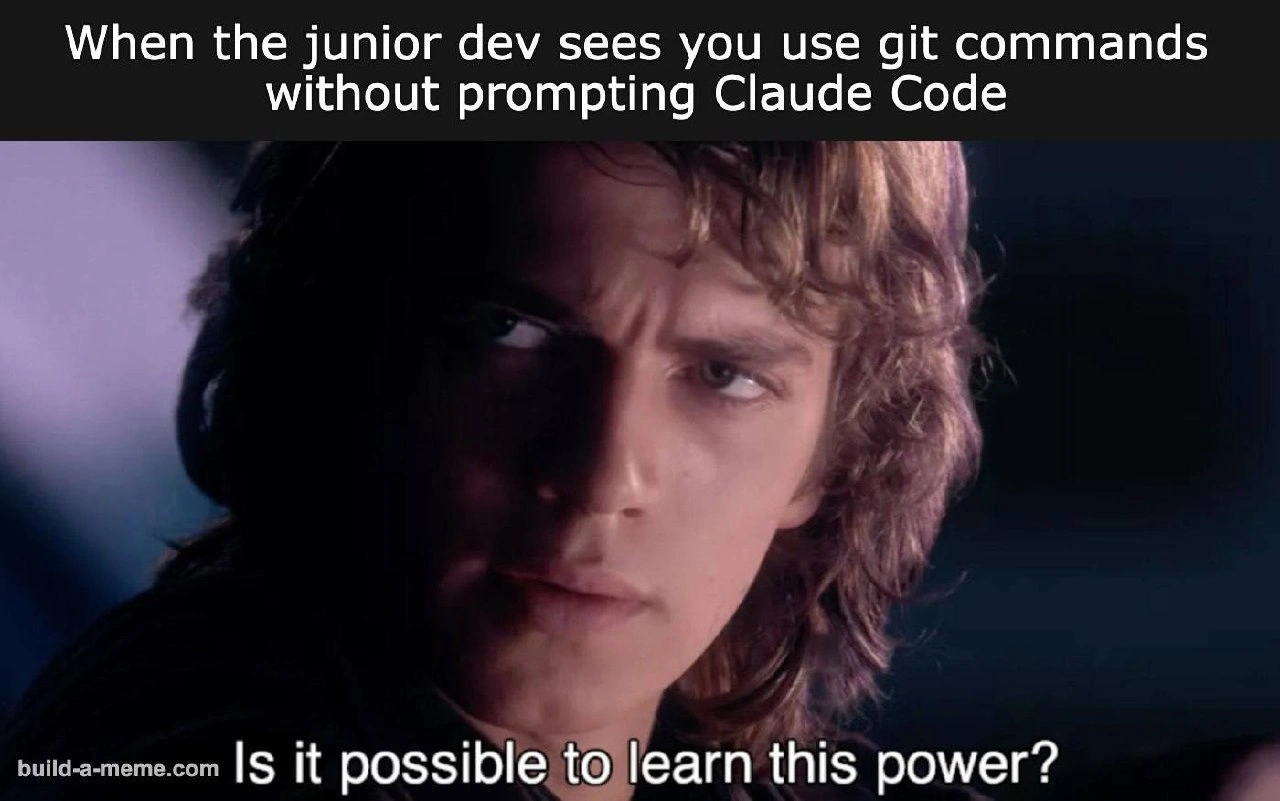
'Me and the Boys' Violating Best Practices by Committing Directly to Master
VersionControl Post #3606, on Aug 28, 2021 in TG

'Me and the Boys' Violating Best Practices by Committing Directly to Master

Why is this VersionControl meme funny?

Level 1: Breaking the Rules

Imagine you and your three best friends have a big school project due. The smart way to do it would be to have each person work on their part, check each other’s work, and then carefully put all the parts together. Instead, you all decide to be a little mischievous. You huddle together, all grinning, and without telling the teacher or double-checking anything, you each scribble your part directly onto the final poster board at the same time. You’re basically saying, “Who needs planning? Let’s just do it live!”

In that moment, you and your friends feel a rush. It’s fun to break the rules together – you’re laughing, feeling proud that you skipped the boring steps. This is exactly what’s happening in the meme. The developers are the group of friends, and the “final poster board” is the master branch (the main project). They’re all committing their code straight onto it without the usual checks (like having a teacher or friend review their work first). Their big grins in the picture show that they’re excited and proud of what they’re doing, just like you might be while sneaking around the rules.

But why is that funny? Because we all know what’s likely to happen next. 😅 It’s like when you all realize you might have messed up the poster with crooked or messy writing because no one double-checked. There’s a nervous understanding that trouble might be coming. Maybe the project will have mistakes, and the teacher will definitely notice. In the meme’s case, the team might have put buggy code into their main project, and sooner or later it’s going to cause a problem that everyone will see.

So, the humor is a mix of “Haha, we did it our way!” and “Uh-oh, we might get in trouble later.” It’s funny and relatable because everyone, even outside coding, knows the feeling of breaking the rules with friends – that thrilling team dare – and then realizing why the rules existed in the first place.

Level 2: Wild West Coding

Imagine a software project as a big collaborative book. The master branch is like the final published story everyone reads. Normally, developers don’t write directly in that final book without checks. They create their own chapters (feature branches), get those chapters reviewed by peers (via Pull Requests, often called PRs), run spell-check and grammar-check (automated tests through CI pipelines), and only then carefully merge their chapter into the main story. This ensures the final book (master) stays high quality and error-free.

In this meme scenario, though, our “boys” are skipping all that. They’re essentially writing in the final book with permanent marker without anyone looking over it. Committing code means saving your changes to the repository history. When you commit directly to master, you’re saving your changes straight into that main codebase for everyone. The meme’s text “Me and the boys committing directly to master” refers to a whole team doing this together and proudly so. It’s a bit like a group of pranksters bypassing pull requests (the usual approval process) and just saying “Ship it!” on their own authority.

Why is that a problem? A few key terms and concepts:

  • Version control (like Git) lets many developers work on code simultaneously. To avoid stepping on each other’s toes, devs often use branches. The master branch is the default one where finished code goes. Committing straight to master is like everyone painting on the same canvas at once.
  • Branch protection is a feature that can forbid direct changes to important branches like master. For example, on GitHub you can require that all changes to master go through pull requests with at least one approval, and that all CI checks (automated tests) pass. If branch protection is enabled and you try to push to master, you might get an error (e.g., “🚫 push rejected: approvals required”). In this meme, either those protections are turned off or the team found a way around them, effectively making master an open free-for-all.
  • Pull Request (PR): This is a formal way to ask, “Hey, I have some changes on my branch, can we merge them into master?” Other team members review the code in the PR, comment on issues, and finally approve it if it looks good. The PR process is a cornerstone of CodeReviews and helps maintain CodeQuality. The “boys” in the meme are bypassing PRs, meaning no one is reviewing their code snippets. They trust their own code blindly (or collectively agree not to bother with scrutiny).
  • Merge conflict: This happens when two people change the same part of a file on different branches (or one on master, one on a branch) and then those changes collide. Git can’t automatically decide which change to keep, so it throws a conflict that a human must resolve. If everyone is committing to master, merge conflicts can happen frequently, because Developer A might push a change, and Developer B, working in parallel, tries to push another change that overlaps. One of them will see a merge conflict error and have to fix it right on master, which is stressful and error-prone. It’s like two people editing the same paragraph of a Word document at the same time – the last one to save has to clean up the mess.
  • Continuous Integration (CI): These are automated tests and build checks that run on new code. Normally, CI runs on a PR or before merging to master, catching bugs early. If you commit straight to master, sometimes the only CI is after-the-fact. That means the bad code might already be in the main branch when tests run and discover a failure. Oops!

The image itself is a well-known meme format called “Me and the Boys” featuring a panel of Spider-Man’s cartoon villains. Each villain’s huge grin represents the mischievous joy of doing something that’s usually considered wrong. In this context:

  • Rhino, Vulture, Electro, Green Goblin (the characters shown) = “the whole team” of developers acting like a cheeky gang.
  • Their grins = the satisfaction and camaraderie of getting away with breaking the rules (codingculture sometimes jokes about this kind of thrill).
  • The phrase “committing directly to master” in the caption = the naughty act they’re bonding over.

To a newcomer, committing to master might not sound bad – after all, you got your code in, right? But now you can see why experienced devs wince at that idea. It’s risky. One unchecked bad commit can cause a lot of headaches:

  • If the app is deployed from the master branch, a buggy commit could crash the app for users until it’s fixed.
  • Other developers will pull the latest master to get everyone else’s changes. If master is broken, now everyone’s development environment might break. It’s like a cold that spreads to the whole team.
  • Without code review, there’s no second pair of eyes. Even the best developers make mistakes – a typo or a silly oversight can slip in. Code reviews and tests are there to catch those. Skipping them is asking for trouble.

Think of it this way: There’s the “proper process” versus “the boys’ process”:

Development Step Normal Workflow (with PRs & reviews) "Me and the Boys" Workflow (direct to master)
1. Create a branch Yes – each feature/bug fix on its own branch (e.g. feature/login-ui) Nah – work directly on master (one playground for all)
2. Write and commit code Commit to your feature branch freely. Commit straight to master 😈.
3. Open a Pull Request Yes – “Please review my code before it goes in.” No need – “It’s fine, just merge it!”
4. Code Review Peers review the PR, leave comments, catch issues. None. Only author’s eyes see the code before it ships.
5. CI Tests Run automatically on the PR; must pass before merge. Maybe runs after commit, or not at all before users see it.
6. Merge to master After approvals and passing tests, changes are merged in. Already happened at step 2 – changes are live on master immediately.
7. If something breaks Easier to pinpoint (one PR at a time) and revert that PR. Harder to untangle; multiple changes landed together directly. Good luck!

As you can see, the “direct to master” approach (right column) is like the Wild West of development – no laws, quick draws, and every person for themselves. The meme finds humor in that reckless approach. In a team setting, pushing straight to master is usually done only in emergencies (or by mistake). That’s why the idea of the whole team proudly doing it is both absurd and comical. It’s a collective facepalm moment for most developers, but the way the meme characters are beaming, you can’t help but chuckle. They know it’s wrong and risky, and that’s precisely why they’re grinning like a band of outlaws who just bypassed the sheriff.

So, the meme is basically shouting: “Look at us, living dangerously in our repo!” It highlights a coding culture joke: some teams (hopefully jokingly) behave like these cackling villains when they ignore best practices. Now you know that committing directly to master is a high-stakes gamble. It might feel empowering for a moment (no waiting on reviews or approvals!), but it can lead to plenty of regret once a bug slithers in. As a junior dev, if you ever feel the temptation to push straight to master and “be done,” remember these grinning villains – and think twice if you want to avoid their eventual fate (the inevitable cleanup and possibly writing apologetic post-mortems to the team 😅).

Level 3: Master of Disaster

At first glance, this meme is a darkly hilarious snapshot of version-control rebellion. It shows a dev team gleefully bypassing every safeguard by committing code straight to the master branch (the main code line) without any code review or testing gates. In a modern Git workflow, this is basically the “no seatbelt” approach to coding. The four grinning Spider-Man villains (Rhino, Vulture, Electro, and Green Goblin) perfectly capture that impish sense of “Heh, we’re getting away with it!” that the team feels. But seasoned developers know those grins won’t last. Why? Because pushing directly to master is like juggling live grenades – eventually one’s going to blow up in your face.

In a well-run project, the master (or main) branch is usually protected like a crown jewel:

  • Branch protection rules are enabled, so you can’t just git push origin master without approvals or passing tests. (Our “boys” probably went to settings and turned those off.)
  • Teams require pull requests (PRs) for any changes going into master – meaning someone else reviews your code first. (These guys say, “Reviews? Nah, we’re all geniuses here.”)
  • Automated Continuous Integration (CI) checks run test suites on every proposed change. (But hey, if you commit directly, you might skip CI, because YOLO, right?)

By bypassing pull requests and ignoring branch protections, the team is effectively saying: “We don’t need no stinkin’ code reviews or tests. Trust us!” This cavalier attitude is funny because it’s a well-known BadPractice in the industry – a trope of coding anti-culture. Every experienced dev has either seen or done this at some perilous point in their career. The humor comes from that mix of guilty thrill and impending doom: we recognize the hubris of it. It’s the software equivalent of a group of bank robbers taking a selfie during the heist – bold and foolhardy at the same time.

Let’s unpack the chaos that can ensue when “me and the boys” proudly go commit_directly_to_master:

  • Merge conflicts galore: If two developers push to master around the same time, their changes collide. Git will throw a fit, and someone’s grin will vanish as they manually untangle spaghetti code in a rush.
  • Broken builds: One reckless commit can accidentally break the build or failing tests on master. With no PR checks, that buggy code is now on the main branch, possibly deployed. Suddenly the whole team is firefighting production issues at 3 AM (and those villainous grins turn into faces of panic).
  • No code review = no safety net: The lack of peer review means code quality suffers. Typos, security vulnerabilities, inefficient algorithms – anything might slip in. (Heck, the meme’s caption even misspelled “committing” as “commiting” – a fitting little irony that underscores the sloppiness when no one double-checks!)
  • Technical debt acceleration: Quick’n’dirty commits pile up unchecked. Later, when something breaks, tracing which commit introduced the bug is harder because dozens of unreviewed changes landed at once. The team has essentially booby-trapped their own master branch.

Despite all this, the meme’s villains share a conspiratorial satisfaction. It’s that moment of “Ha, we deployed straight to production and nothing exploded… yet.” The image is from the classic “Me and the Boys” meme template – a 1960s Spider-Man cartoon panel of villains grinning together. In developer humor, these baddies represent coders acting like rogues. Here, they’re the branch_protection_disabled gang, the cowboy coders who deploy on a whim. The senior engineers in the room (the Spider-Man in this story) are left shaking their heads, knowing that with great power (to commit to master) comes great responsibility – or else great disaster.

Green Goblin-like Dev: “Pull requests? 😈 Nah, just merge it straight to master, we got this.”
Seasoned Dev (facepalming): “Bold move... Let’s hope we still have a working app by tomorrow.”

The meme strikes a chord because it exaggerates a real temptation in coding culture: skipping process for speed. It’s a comedic reminder that just because you can do something in Git doesn’t mean you should. Every git expert has war stories of someone bypassing the process and the catastrophic debugging session that followed. So those villainous grins? We laugh because we know they might be short-lived, and the real punchline might be an overnight hotfix marathon. In short, the team in this meme are the “Masters of Disaster” – proud of their momentary victory, blissfully ignoring the ticking time bomb they just armed in the repo.

Description

This meme uses the popular 'Me and the Boys' image, which features four supervillains from the 1960s Spider-Man cartoon (Rhino, Vulture, Electro, and Green Goblin) standing together and grinning mischievously. The caption above the image reads, 'Me and the boys commiting directly to master'. The humor lies in applying this image of a villainous gang to a universally condemned software development practice. In modern version control workflows (like GitFlow), the 'master' (or 'main') branch is sacred and represents the stable, production-ready version of the code. All development is supposed to happen on separate feature branches, which are then carefully reviewed and tested before being merged. Committing directly to master bypasses all these safety checks, risking bugs, breaking the build, and creating chaos for the entire team. The meme perfectly captures the reckless, rebellious thrill of doing something you absolutely know is wrong, portraying the perpetrators as a cackling squad of villains
Comments

13
Anonymous ★ Top Pick The fastest way to get a personal talking-to from the principal engineer is to commit to main with the message 'yolo'. The second fastest way is to then immediately force-push to cover your tracks
  1. Anonymous ★ Top Pick

    The fastest way to get a personal talking-to from the principal engineer is to commit to main with the message 'yolo'. The second fastest way is to then immediately force-push to cover your tracks

  2. Anonymous

    Force-pushing straight to master feels liberating - right up until the CI pipeline asks for a commit that’s now only in the reflog and the SOX auditor calls it “evidence tampering.”

  3. Anonymous

    The only thing more terrifying than a junior developer with sudo access is a team of senior engineers who've collectively decided that branch protection rules are 'just suggestions' and the staging environment is for people who lack confidence in their regex

  4. Anonymous

    Ah yes, the legendary 'Me and the Boys' squad - bypassing branch protection rules, skipping CI/CD pipelines, and force-pushing directly to master at 4:47 PM on a Friday. They're the same crew who think 'git rebase -i' is just a suggestion and that merge conflicts are someone else's problem. In their world, pull requests are for the weak, code reviews are optional, and rollback strategies are just pessimistic thinking. They've achieved what every engineering manager fears: a perfectly synchronized team effort in the complete wrong direction. The real kicker? They're probably all senior engineers who know better but have collectively decided that 'move fast and break things' means breaking the deployment pipeline itself

  5. Anonymous

    Direct commits to master: trunk‑based development where approvals are granted during the postmortem

  6. Anonymous

    Committing straight to master: our feature flags are just incident severities

  7. Anonymous

    Trunk-based development purists until the first un-reviewed hotfix nukes the CI pipeline

  8. @VladislavSmolyanoy 4y

    im the reason my company switched from direct master commits to pull requests

    1. @RiedleroD 4y

      hahahah I want to hear the story behind that

      1. @ozalexo 4y

        Merge conflicts, rebase.

    2. @slxvx 4y

      Same here

  9. @lexore 4y

    Conflicts? Push force. Not it's not my conflicts.

  10. @cptnBoku 4y

    Why was it even changed to 'main' smh smh

Use J and K for navigation