Obfuscating Inefficiency with Logarithms
Why is this CS Fundamentals meme funny?
Level 1: Fancy Costume, Same Person
Imagine you have a friend who normally talks very simply. One day, they start using big fancy words that no one usually uses, but they’re still saying the exact same things. It’s kind of funny, right? It’s like if your friend usually says, “I’m hungry,” but suddenly they phrased it as, “My stomach experiences a significant calorie deficit.” You’d probably giggle because it sounds unnecessarily complicated for the same idea. That’s what’s happening in this meme.
In the first picture, Winnie-the-Pooh is plain old Pooh, saying something simple (like just “two plus two equals four”). In the second picture, Pooh is wearing a tuxedo, speaking very grandly, but all he’s doing is saying the same thing in a needlessly fancy way (“the sum of two and two yields four”). It doesn’t change the fact that 4 is still 4 – he just dressed up the words. We find it funny because we can tell it’s the same idea with a “ fancy costume” on. It’s like someone wearing a tuxedo to a casual playground: they might look different on the outside, but they’re still the same person doing the same thing. In the end, the joke teaches a simple lesson: using bigger, fancier words (or math terms) doesn’t change what something really is. The idea inside remains the same, and that contrast is what makes us laugh.
Level 2: Fancy Notation, Same Complexity
Let’s break this down in plain terms. In computer science, Big O notation is a way to describe how an algorithm’s running time grows as the input size (n) grows. It’s a key part of CS Fundamentals and Performance discussions. For example, O(n²) (pronounced “O of n squared”) means if you double the number of things to process, the work roughly quadruples (since $(2n)^2 = 4n^2$). This is called quadratic time complexity. Many simple algorithms like basic sorting by comparison or a double nested loop run in $O(n^2)$ time. It’s workable for small inputs, but it gets slow fast as n increases.
Now, look at the meme’s two panels:
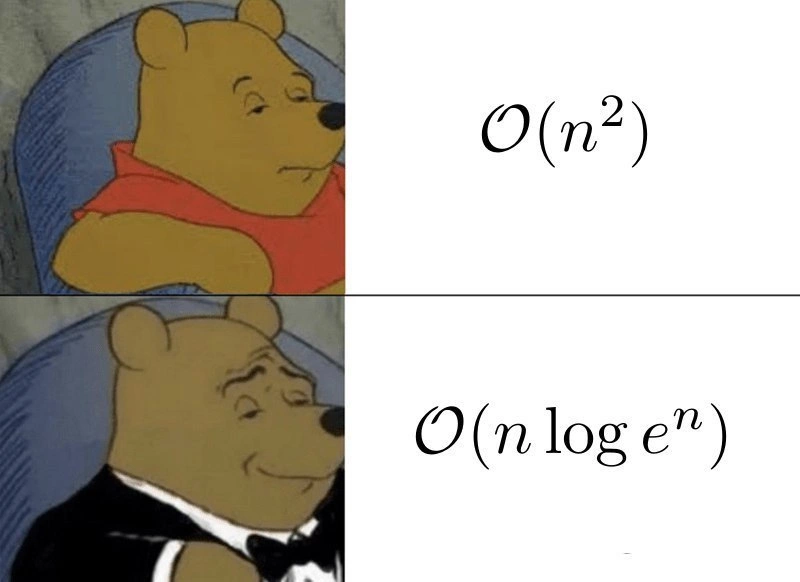
- The top panel just says O(n²), plain and simple. Winnie-the-Pooh looks bored, which humorously implies “nothing impressive here – just straightforward quadratic time.”
- The bottom panel says O(n log eⁿ), which at first glance looks much more advanced. Here Pooh is wearing a tuxedo and looking pleased with himself, as if this notation is posh and intellectual.
The punchline is that O(n log eⁿ) is actually the same exact complexity as O(n²). Let’s decipher O(n log eⁿ) step by step:
- The term log eⁿ means “the logarithm of $e^n$.” In computing, log often refers to the natural logarithm (base e, where e ≈ 2.71828) unless specified otherwise. Logarithms are basically the opposite of exponentials. So, logₑ(eⁿ) asks: “to what power must we raise e to get $e^n$?” The answer is n, because $e^n$ is e raised to the power of n.
- This means log eⁿ = n. You can think of it with a simpler example: $\log_{10}(10^3) = 3$ because $10^3$ is 1000 and log₁₀(1000) = 3. Similarly, logₑ($e^5$) = 5. So logₑ($e^n$) = n.
- Replace that back into the big O expression: O(n log eⁿ) becomes O(n * n) (since log eⁿ = n). And n * n is n². So it simplifies to O(n²).
In other words, O(n log eⁿ) is just a long-winded, dressed-up way of writing O(n²). There’s no hidden performance boost or difference in behavior – it’s purely a notation trick. In Big O, we also typically ignore constant factors or the base of the log. For instance, if the log were base 2 instead of e, $\log_2(e^n) = n \log_2 e$ which is roughly $1.4427 * n$ (since $\log_2 e ≈ 1.4427$). The big O would treat that as just $1.4427 * n^2$, and since constant multipliers (like 1.4427) don’t matter in Big O classification, it’s still $O(n^2)$. The top and bottom lines are truly the same complexity, different notation.
This meme is playing on the contrast between simple vs. fancy ways of saying the same thing. It highlights a bit of developer humor in the algorithms world: sometimes people can be tempted to use more elaborate mathematical notation thinking it sounds more impressive. The Winnie-the-Pooh images amplify this contrast. The top image (Pooh normal) represents the plainspoken truth (“quadratic time, nothing special”), while the bottom image (Pooh in a tuxedo) represents the exact same truth but dressed up to look sophisticated. This Pooh-in-a-tux format is a well-known meme template on the internet, used to joke about any scenario where someone says the same thing in a much fancier or over-the-top way. Here it’s applied to BigONotation.
For a concrete analogy from coding: imagine you wrote a sorting algorithm that uses two nested loops to compare items – that’s a classic $O(n^2)$ solution (like Bubble Sort). If a teammate asked about its performance, saying “It’s $O(n^2)$” is clear and honest. However, replying with “It runs in $O(n \log e^n)$ time” might momentarily sound like something clever or better (because it has a “log” in it, which people often associate with more efficient algorithms like $O(n \log n)$ mergesort). But once you do the math, it’s still just bubble sort’s quadratic time! The meme is poking fun at the idea of trying to make a slow algorithm sound faster by using elaborate math notation. It’s a bit like using a thesaurus to find complicated words for a simple statement – you’re not changing the meaning, only making it harder for others to parse.
In summary, this meme jokes about algorithm complexity analysis vanity. On the surface, $O(n log e^n)$ looks like a high-brow, complex formula (even using the fancy constant e and a logarithm to seem extra intellectual). But when you understand how logarithms work, you realize it’s one big gotcha: both panels say the algorithm grows at a quadratic rate. This humor resonates with programmers because it reminds us to focus on substance (how efficient an algorithm actually is) rather than getting caught up in superficial formalism. As far as your computer is concerned, whether you describe an algorithm as $O(n^2)$ or $O(n \log e^n)$, it’s going to take on the order of $n^2$ steps to run – the asymptotic performance is identical. The tuxedo doesn’t speed Pooh up; it just makes him look fancy.
Level 3: Quadratic in a Tuxedo
Seasoned developers will immediately smirk at this because we’ve all seen a bit of mathematical flexing like this in the wild. The meme cleverly combines a classic developer humor format with an inside joke about algorithm analysis culture. In the top panel, Winnie-the-Pooh sits in his normal red shirt, looking bored next to the plain CS_Fundamentals notation $O(n^2)$. This represents the straightforward truth: “Yep, it’s quadratic time complexity, nothing fancy.” In the bottom panel, Pooh dons a black bow tie and tuxedo with a smug, sophisticated grin. Beside him appears $O(n \log e^n)$ in elegant typeset. This is the same Pooh (same algorithmic reality) but now pretending to be high-class. It’s Winnie_the_Pooh_tuxedo_meme shorthand for taking something ordinary and presenting it ostentatiously. Everyone in on the joke recognizes that $O(n \log e^n)$ is just $O(n^2)$ wearing a three-piece suit.
Why is this so funny to those of us in software and algorithms? Because it satirizes a real tendency to equate fancier notation with smarter thinking. We’ve encountered colleagues (or our younger selves) who throw around complex jargon or needless formalism to sound knowledgeable. This meme calls out that impulse. By using asymptotic_notation_jokes, it highlights how absurd it is to rebrand a slow algorithm with highbrow math symbols and expect applause. In practical Performance terms, such rebranding is futile: a quadratic algorithm by any other name will still choke on sufficiently large input sizes. Imagine a code review scenario: a junior dev writes, “This runs in $O(n \log e^n)$ time,” perhaps hoping it will be mistaken for the more efficient $O(n \log n)$. Any senior engineer reading that will arch an eyebrow and simplistically reduce it to $O(n^2)$ — much like simplifying a fraction. We know that a sneaky $\log e^n$ factor doesn’t magically make an algorithm run faster; it’s the same time complexity ultimately. In the shared lore of programming, calling something $O(n^2)$ is calling it out for being potentially slow at scale (think of naive sorts or double nested loops), whereas $O(n \log n)$ sounds more palatable. So the meme jokes that someone might hide a dreaded quadratic algorithm behind a veil of logarithms and Euler’s constant, hoping it passes off as something more refined.
This brings to mind the broader pattern of over-engineering or needless complexity we’ve seen in tech. It’s like when a simple solution is described with enterprise buzzwords to impress management, or when a straightforward code snippet is refactored into an overly abstract design pattern just for bragging rights. Here, the “buzzword” is a convoluted Big O notation. It doesn’t fix the Performance problem; it merely decorates it. An experienced developer sees through this immediately and chuckles – it’s the classic “you can’t polish a turd” scenario, except with math. To put it more kindly: painting racing stripes on a minivan won’t turn it into a sports car. We know that whether you write $n^2$ plainly or as $n \log_e(e^n)$ with extra steps, the program is going to take roughly quadratic time to run.
The visual contrast of casual Pooh vs. fancy tux Pooh drives that point home. The normal Pooh face might as well be saying, “Your algorithm is $O(n^2)$, just admit it.” The tuxedo Pooh, with a self-satisfied smile, is the developer replying, “Actually, it’s $O(n \log e^n)$,” as if pronouncing a secret magic spell. The community humor here is in recognizing that smokescreen and collectively rolling our eyes. It’s a gentle roast of those who prioritize looking intelligent over being straightforward. After all, any interviewer or professor worth their salt in AlgorithmComplexityAnalysis would simplify that right back and perhaps ask, “So... that’s $O(n^2)$, correct?”
Importantly, the meme also underscores that asymptotic performance is what truly matters, not the notation’s fanciness. In real-world terms, if an algorithm is quadratic, it might become painfully slow with large datasets. You can label it however you want – the CPU will still have to grind through on the order of $n^2$ steps. By poking fun at this, the meme implicitly encourages honesty and clarity in describing algorithmic complexity. It says, “Don’t hide a bad time complexity behind elaborate notation.” And of course, it does so with a hearty wink to those of us who remember trying similar tricks when first learning Big O (perhaps thinking a professor wouldn’t notice an $n^2$ in disguise). The universal lesson: fancy notation can’t save you from same_complexity_different_notation reality. Or put more simply: you can put Pooh in a tuxedo, but he’s still Pooh – and $n^2$ is still $n^2$.
Level 4: Asymptotic Masquerade
In computational complexity theory, all that glitters is not gold – or in this case, adding a fancy log doesn’t change an algorithm’s growth rate. Big O notation (also called Landau notation) formalizes how functions scale: we care about the highest-order term and ignore constant factors or bases of logarithms. The meme’s second line $O(n \log e^n)$ is a textbook case of notational camouflage. Recall the mathematical identity: if you take a logarithm and an exponential of the same base, they cancel out. In fact, using base $e$ (Euler’s number, ~2.718) for the log gives a particularly clean result:
$$ \log_e(e^n) = n. $$
Thus $O(n \log e^n)$ simplifies algebraically to $O(n \cdot n)$, which is just $O(n^2)$. Even if the log were base 2 or 10, it wouldn’t really matter – $\log_{10}(e^n) = n \log_{10} e$ differs only by the constant factor $\log_{10} e$, and Big O swallows constants like candy. In other words, $n \log_{10}(e^n) = (\log_{10} e) \cdot n^2$, and a constant $\log_{10} e \approx 0.434$ doesn’t change the asymptotic class. Both expressions fall into the same polynomial time category (specifically quadratic time, degree 2). The AlgorithmComplexityAnalysis trick here is using an exponential-inside-a-log to inject an extra $n$ into the formula without raising the official “$n^2$” flag. It’s a cheeky exploitation of how logarithmic identities work, but it provides no Performance improvement whatsoever – it’s pure presentation.
From a theoretical standpoint, this is a BigONotation sleight-of-hand. We normally simplify complexity expressions to their most significant term; nobody in a serious algorithmics paper would leave $n \log e^n$ unsimplified, because it conveys the same information as $n^2$ in a far less transparent way. The humor takes root in the contrast between how complexity classes are formally defined versus how someone might dress them up: both $O(n^2)$ and $O(n \log e^n)$ describe the same growth rate, inhabiting the same equivalence class under Big O. It’s like proving $2+2=4$ in a convoluted manner – mathematically correct, but arguably overkill. By invoking the natural logarithm and Euler’s number (complete with that LaTeX-flavored styling), the meme adds an air of intellectual flair to a run-of-the-mill quadratic function. In essence, we’re witnessing an asymptotic masquerade: a simple $n^2$ dressed up in formal attire, strutting as if it’s something profound. The fundamental laws of growth rates ultimately cut through the pretense: no matter how you write it, an $O(n^2)$ algorithm will always scale quadratically.
Description
A two-panel meme using the 'Tuxedo Winnie the Pooh' format. In the top panel, a standard, unimpressed Winnie the Pooh is shown next to the Big O notation 'O(n²)', representing quadratic time complexity. In the bottom panel, a sophisticated, smug-looking Winnie the Pooh in a tuxedo and bow tie is shown next to the more complex-looking notation 'O(n log eⁿ)'. The humor is a mathematical in-joke for computer scientists and developers. Based on the properties of logarithms, log eⁿ simplifies to n * log e, and since the natural log of e is 1, the entire expression simplifies to n. Therefore, O(n log eⁿ) is mathematically identical to O(n * n) or O(n²). The meme satirizes the tendency to use overly complicated or obscure notation to make a simple, and often inefficient, algorithm sound more impressive than it actually is
Comments
7Comment deleted
Some call it O(n log eⁿ). I call it 'job security via cryptographic complexity notation'
Rebranding O(n²) as O(n log eⁿ) is the algorithmic equivalent of slapping “service mesh” on a decade-old monolith - the latency plot still looks like a parabola in a tux
When you realize half your team's 'optimized' algorithms are just O(n²) wearing a monocle and speaking with a British accent - same performance, triple the code review time, but it got past the architect who was impressed by the 'advanced mathematics'
When you refactor that nested loop into a divide-and-conquer algorithm and suddenly you're not just solving problems - you're doing it with *panache*. Sure, O(n log eⁿ) is mathematically equivalent to O(n log n), but writing it with Euler's number makes you feel like you just derived it from first principles during your morning coffee. It's the algorithmic equivalent of wearing a tuxedo to a code review: technically unnecessary, but it sends a message about your commitment to computational elegance
Code review translation: O(n log e^n) is just O(n^2) in black tie - great for slides, useless for the profiler
O(n²) for the prototype sprint, O(n log n) when the PM asks for 'scale' in the system design round
Resume-driven complexity: “Not O(n²), it’s O(n log eⁿ).” Looks like n log n on the slide - expand the log and it’s still quadratic