Skip to content
DevMeme
1440 of 7435
The Profound Deno-Node Anagram Revelation
Languages Post #1614, on May 20, 2020 in TG

The Profound Deno-Node Anagram Revelation

Why is this Languages meme funny?

Level 1: One-Sided Excitement

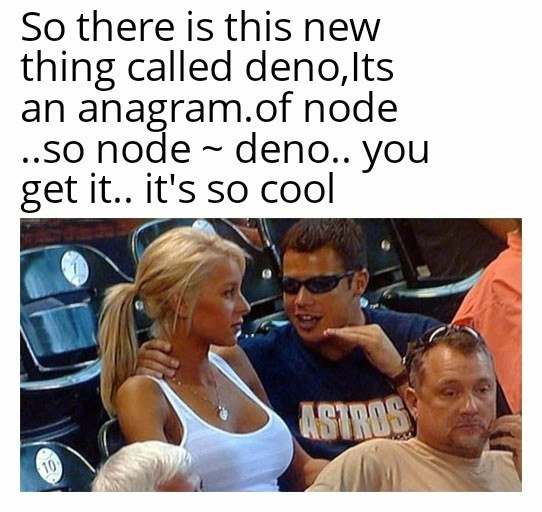
Imagine you’re at a baseball game with a friend, but instead of talking about the game, your friend is super excited about a new toy or gadget. They lean over and start telling you “This new toy is just like the old one but get this – its name is just the old name mixed up! Isn’t that awesome?” They’re practically bouncing in their seat with enthusiasm, waving their hands and grinning. Now, you on the other hand have no idea why that’s such a big deal. You’re just trying to watch the game and enjoy your day, but your friend keeps yammering on about this toy’s name and how cool it is. You might smile and nod a little, but inside you’re feeling kind of bored and lost. In this meme, the developer is like that excited friend. He found a neat little fact (the new programming tool “Deno” has a name made by scrambling the letters of “Node”, an older tool) and he thinks it’s the coolest thing ever. The lady next to him is like you at the game – she doesn’t really care and just wants to do something else. The picture is funny because you can see how one-sided the excitement is: one person is thrilled, the other is completely uninterested. We laugh because we’ve all seen or been in this situation – when someone is geeking out about something and the other person just doesn’t get what the fuss is about. Essentially, it’s showing that feeling when you really want to explain why something is awesome, but the person you’re telling is just politely stuck there, wishing you would finish. It’s a silly reminder that not everyone shares the same interests, and that’s what makes it humorous.

Level 2: A Node by Any Other Name

Let’s break down what’s going on in simpler terms. The meme is referencing Node.js and Deno, which are both environments for running JavaScript code outside of a web browser. If you’re a newer developer: Node.js is a popular runtime that lets you use JavaScript on the server side (for example, to build web servers or scripts). It’s been around since 2009 and is built on Chrome’s V8 engine (the part of Chrome that runs JavaScript). Over the years, Node.js became huge – almost the standard for server-side JavaScript – with millions of developers and a massive collection of libraries (packages on npm) to reuse code.

Now enter Deno: a newer runtime for JavaScript and TypeScript that came out in 2020. Fun fact – as the meme loudly points out – the name “deno” is literally just the letters of “node” rearranged (that’s what an anagram means). This isn’t a coincidence: Deno was created by the same person who originally created Node.js! His name is Ryan Dahl, and after about a decade, he wanted to address some things in Node he wasn’t happy with. So, Deno is sort of like Node’s younger sibling that learned from Node’s mistakes. Both Node and Deno do similar jobs (they allow you to run JavaScript code on your computer or server, not just in a browser), but they have different design choices and tools. Think of Node.js as a well-established car model – reliable but with some dated features – and Deno as the shiny new sports car model from the same designer, trying out new features and improvements.

Here are a few key differences (at a high level) that people talk about when comparing node_vs_deno:

  • Package Management: Node.js uses a package manager called npm (and package files like package.json with a node_modules folder to store libraries). Deno doesn’t use npm; instead, you import libraries directly by URL (similar to how browsers do). This was a bold change – no more giant node_modules directory, but it’s a different way to manage dependencies that newcomers have to get used to.
  • TypeScript Support: Node.js can run TypeScript if you set up a build step or use extra tools, but Deno has TypeScript support built-in. You can run a .ts file with Deno out of the box, and it will handle compiling it under the hood. This is awesome for developers who like TypeScript (which is JavaScript with added type safety).
  • Security: By default, Node.js scripts can do anything on your system that your user can (read/write files, open network connections, etc.) – which is powerful but can be risky if you run untrusted code. Deno, on the other hand, is more secure by default. It requires explicit permissions for certain actions. For example, if a Deno program wants to read your files or access the network, you have to give it a flag like --allow-read or --allow-net. If you run deno run my_app.ts without permissions, it won’t let the script do those potentially dangerous things. This sandboxing was designed to prevent accidents or malicious behavior.
  • Modularity and APIs: Deno uses modern JavaScript ES Modules (import/export syntax) from the start. Node.js historically used CommonJS (require() syntax), though Node now also supports ES Modules. Additionally, Deno provides certain top-level APIs (for example, for file access or creating servers) as part of its standard library, whereas Node relies on core modules and a huge ecosystem of npm packages. Deno’s philosophy is to have a batteries-included approach with a standard library of utilities, and it even has tools like a built-in tester and formatter.

In the meme, however, none of these technical details are being discussed. Instead, the focus is humorously on the name. The text says: “Its an anagram of Node… so node ~ deno… you get it.. it’s so cool.” This is the excited developer basically saying: “Look, the new thing is literally just Node with the letters shuffled!” It’s like a kid finding a secret code word. The anagram_reference is true – “deno” is “node” rearranged – but on its own that fact doesn’t tell you anything about why Deno might actually be cool or important. It’s a playful detail. The meme is making fun of the tendency in tech to sometimes focus on flashy or trivial aspects when hyping something new.

Now, why is he explaining this at a baseball game? The bottom image is known in MemeCulture as the “guy explaining at a baseball game” meme. In that photo, a guy in a Houston Astros shirt is leaning in and enthusiastically talking to a woman next to him, who looks completely uninterested (and a bit trapped!). This real-life candid photo became a popular meme template to joke about situations where one person is going on and on about something the other person doesn’t care about. It’s often used in tech jokes to show, say, a programmer trying to explain a nerdy concept to a non-tech friend or a scenario of one-sided enthusiasm. Here it fits perfectly: the developer is super hyped about Deno and is explaining it in detail (maybe for the third inning in a row), and the coworker/friend is sitting there like, “uh-huh, yeah, cool…” with a glazed look. The third person nearby is just awkwardly pretending not to listen. We all recognize this social dynamic – it’s both funny and a little cringey.

The categories listed (Languages, Tooling, IndustryTrends_Hype) give a clue to the meme’s themes. Languages and Tooling because Node.js and Deno are part of the programming tools we use (specifically in the JavaScript ecosystem). IndustryTrends_Hype because this meme is highlighting the hype around a new trend in the industry. In 2020, a lot of developers were extremely excited about Deno. It was trending on social media and tech blogs – people calling it the “Node killer” or saying “finally, a better Node.” This happens regularly in software development, sometimes called the “framework churn” or the “JavaScript fatigue” when every year there’s a new hot library or framework. For example, in front-end development, one year everyone was talking about Angular, then React, then Vue, and so on. It can be exhausting to keep up! In this case, it’s about a runtime, not a front-end library, but the hype felt similar.

So if you’re newer to development, the meme is basically a light-hearted warning: get ready for the constant stream of new “cool” tech and the people who won’t stop talking about it. Today it’s Deno vs Node; tomorrow it might be something else. The meme resonates because many of us have been on either side of this conversation. Maybe you just learned about a great new tool or a programming language and you’re excitedly explaining it to your friend who isn’t into tech – that friend might get as glassy-eyed as the woman in the meme. Or maybe you’ve had a coworker try to convince you that some new tool will solve all your problems and you’re skeptical or just tired of hearing it. The joke is that the explainer is focusing on something as insignificant as the name being an anagram, which implies maybe the explainer doesn’t even understand the deeper details either – they’re just riding the hype wave (they heard it’s cool, and the name trivia is the easiest thing to remember).

In summary, this meme is a playful jab at how developers can get overzealous about the latest trend. The NodeJS vs Deno rivalry was a hot topic, and here it’s distilled into one goofy guy’s monologue about a naming coincidence. The visual of the bored audience at a baseball game drives home how out-of-place and over-the-top this tech lecture is in that moment. It’s a reminder that while it’s great to be excited about new technology, not everyone around you will share that excitement – especially if you’re just explaining an anagram instead of why the tech is useful! This is developer humor at its finest: mixing a real tech reference (Deno’s anagram name, new runtime hype) with a universally funny social situation (one-sided enthusiasm).

Level 3: Hype Cycle At Bat

At first glance, this meme captures a classic scene in developer culture: the JavaScript hype cycle in full swing. It’s mid-2020 and the buzz about Deno is everywhere – a brand new runtime challenging the venerable Node.js. The meme’s text is literally an overexcited dev gushing: “So there is this new thing called Deno, it’s an anagram of Node… you get it… it’s so cool!” This overzealous explanation at a baseball game lampoons how developers latch onto shiny new tools and IndustryTrends_Hype. Seasoned engineers recognize this pattern all too well: every few years a new technology is touted as the next big thing that will replace the old guard. Here, Deno is that newcomer stepping up to bat, and Node.js is the incumbent in the dugout. The mere fact that “deno” is just “node” rearranged becomes a selling point for the excited techie in the meme – highlighting how absurd our enthusiasm can get over trivial facts when caught in a hype frenzy.

The guy explaining at a baseball game image (with the ASTROS shirt and the thoroughly uninterested woman) is an infamous meme format for one-sided lectures. In our scenario, it perfectly represents a developer passionately oversharing a niche tech insight to someone who couldn’t care less. The woman’s blank stare and the other spectator’s bored expression say it all: not everyone is thrilled about the latest JavaScript runtime. This scene is painfully relatable in tech circles – we’ve either been that excited explainer ranting about a new framework at an office lunch, or we’ve been the trapped listener nodding along like, “Please, I just wanted to watch the game.” The humor comes from that shared experience of tech enthusiasm meeting real-world indifference. The meme exaggerates how developers often assume everyone will be as impressed as they are by things like an anagram_reference Easter egg in a project name. It’s poking fun at our tendency to get way too excited about minor details of a new tool just because it’s new.

Beyond the social cringe, there’s a kernel of truth in the excitement over Deno. Created by Ryan Dahl (the original author of Node.js), Deno was essentially Node reinvented to address some long-standing regrets and pain points. Under the hood, Deno is built in Rust and uses the same V8 engine to run JavaScript (and TypeScript!), but with modern enhancements. By May 2020, Deno had hit version 1.0, setting off a wave of articles and discussions about how it might “fix Node’s mistakes.” This meme was posted right after that major launch, when Deno was at the peak of inflated expectations on the tech hype curve. Devs were thrilled about features like first-class TypeScript support, a more secure sandbox (no file or network access by default), and no need for the node_modules folder that every Node project accumulates like barnacles. In practice, Deno was essentially Node’s letters scrambled and features unscrambled – a playful name hiding a serious attempt to improve the developer experience.

However, a cynical veteran might chuckle because they’ve seen this movie before. The FrameworkChurn and TechHypeCycle tags hint at the broader joke: today it’s Deno vs Node, yesterday it was Angular vs React, and tomorrow something else will claim the throne. The meme subtly acknowledges that, yes, Deno’s name is a clever anagram of Node (we developers love our little naming gags), but beyond the name rearrangement, the real question is whether Deno will truly dethrone Node or just join the ever-growing pile of “cool new things” that had their 15 minutes of fame. Experienced devs know that migrating an entire ecosystem is no small feat – Node.js has a decade of community, packages, and real-world deployment behind it. So while the meme’s guy is hyping Deno like it’s the second coming of JavaScript, the veteran in us can’t help but think: “Sure, kid, we’ll see if this is a home run or just another foul ball in the long game of tech evolution.” The humor is equal parts DeveloperHumor and gentle reality check. We laugh because we’ve been there: enthralled by a new tool’s promise (even its MemeCulture-ready name), only to later discover that every technology has trade-offs and that the old and the new will likely coexist for a long time. In short, Deno is Node shuffled around – both in name and in how history might just be repeating itself, with enthusiastic early adopters and skeptical onlookers in the stands.

For those deeply in the know, the meme might also hint at specific technical “regrets” of Node that Deno tries to solve. Dahl famously listed things he wished he’d done differently in Node (like using promises instead of callbacks, or securing module imports). Deno_runtime was built to right those wrongs. It ships with a permissions system (no more accidental rm -rf / from a random package), uses ES Modules (import statements) instead of Node’s older CommonJS require(), and has first-class TypeScript support so you don’t need to bolt on a compiler. From a senior perspective, these are substantial improvements – it’s as if Node’s architecture was refactored with a decade of hindsight. But the meme isn’t focusing on any of these nuanced details; instead, it highlights how the marketing buzz often overshadows concrete benefits. The dev in the meme reduces all that complexity to “Deno is an anagram of Node... so cool!”, which is a deliberately silly oversimplification. It’s like capturing that exact moment in the hype cycle when excitement outpaces rational explanation. We chuckle because we know the LanguageComparison should be about architecture and performance, yet here it’s basically about the branding. It’s a gently satirical take on how tech discussions at meetups or on Twitter sometimes sound – lots of excitement, not a lot of substance. And hey, the anagram is kind of cool in a geeky way, but maybe not cool enough to justify interrupting a baseball game!

To sum up the senior-engineer take: this meme is both a roast and a celebration of developer enthusiasm. It encapsulates how a new runtime (Deno) can send waves of excitement through the dev community (especially those working with NodeJS and JavaScript), sometimes to the point of comedic excess. The visual joke (guy enthusiastically mansplaining at a ballgame) reinforces the idea that tech folks often have this almost comical eagerness to explain why the latest tool is amazing – whether or not the audience wants to hear it. The meme lands because it’s too real: we laugh at the overzealous Deno fan because many of us were that person at some point, and we also empathize with the bored listener because, let's face it, not everyone shares our niche obsessions. It’s a humorous snapshot of the TechHypeCycle in action, reminding us that in tech, as in baseball, there’s always a next inning – or a next framework – on the way.

Description

A meme using the 'Bro Explaining' or 'Mansplaining' format. The image shows a young man in sunglasses and a Houston Astros t-shirt leaning in to speak earnestly to a blonde woman in a white tank top, who appears disinterested. In the foreground, an older man looks away with a pained or uncomfortable expression. Superimposed at the top is the text: 'So there is this new thing called deno, Its an anagram. of node ..so node ~ deno.. you get it.. it's so cool'. The humor comes from the overly enthusiastic explanation of a trivial piece of tech trivia - that the name of the JavaScript runtime 'Deno' is a simple anagram of 'Node'. For experienced developers, this is a well-known, mildly clever fact, but the meme satirizes the act of presenting it as a mind-blowing revelation, perfectly capturing the dynamic of a tech enthusiast boring someone with niche details


Comments

7
Anonymous ★ Top Pick Wait until he finds out Ryan Dahl, the creator of both, just shuffled the letters around. It's the software equivalent of turning your underwear inside out and calling it a new pair
  1. Anonymous ★ Top Pick

    Wait until he finds out Ryan Dahl, the creator of both, just shuffled the letters around. It's the software equivalent of turning your underwear inside out and calling it a new pair

  2. Anonymous

    “Sure, Deno is just Node rearranged - too bad shuffling the letters of our 900-service Node fleet won’t magically add sandboxed permissions, trim the npm supply chain, or delete that one left-pad fork from 2016.”

  3. Anonymous

    After 15 years of fixing Node's callback hell, permission model, and package.json nightmares in production, watching junior devs discover Deno's 'revolutionary' anagram is like watching someone reinvent the wheel but with better TypeScript support and actual security defaults - same V8 engine, different regrets

  4. Anonymous

    Ah yes, Deno - because after a decade of callback hell, promise chains, and npm's left-pad incident, what the JavaScript ecosystem really needed was a runtime whose primary selling point to some developers is that it's a clever anagram. Never mind the actual architectural improvements like built-in TypeScript support, secure-by-default permissions, or eliminating node_modules black holes - let's get excited about the letters rearranging! It's the software equivalent of being impressed that 'listen' and 'silent' are anagrams while ignoring whether the audio driver actually works

  5. Anonymous

    Rearranging letters is O(1); migrating an org from Node to Deno is O(n·politics) - but try explaining that between innings

  6. Anonymous

    Deno: Node rearranged with URL imports - because nothing screams 'secure runtime' like CORS errors in your monorepo CI

  7. Anonymous

    Adopted Deno because it’s an anagram of Node - welcome to Levenshtein-driven development

Use J and K for navigation