The True Apex of Project Management Methodologies
Why is this Agile meme funny?
Level 1: When Someone Wants It Now
Imagine you’re assigned to build a treehouse with your friends. One friend suggests, “Let’s build a little bit of the treehouse each day and see how it’s going, so we can change things if we need to.” That’s like the Agile approach – a step-by-step, flexible plan. Another friend says, “No, let’s decide exactly what kind of treehouse we want, draw all the plans first, and then build it all in one go without changing the plan.” That’s like the Waterfall approach – a big upfront plan with no changes.
Now, imagine while you’re still figuring it out, an adult runs in and shouts, “I don’t care how you do it, just finish the entire treehouse TODAY!” They want the whole thing done immediately. Everyone starts panicking, grabbing wood and nails frantically without any real plan because someone demanded it right now. This is what the bottom part of the meme is joking about. It’s as if the person who’s screaming for instant results thinks they have the smartest idea ever – but we can see it’s actually a pretty crazy way to do things.
The reason this is funny (and a bit silly) is because it shows the opposite of a good plan. It’s making fun of situations where people skip all planning and expect magical results instantly. We laugh because we know building something great (like a treehouse or a software app) usually requires either a careful plan or at least some step-by-step work. If someone just yells “Do it now!” and you try to do everything at once in a rush, the result will probably be a shaky treehouse (or a buggy program). The meme uses the “big brain” pictures to sarcastically say: Look, the biggest brain idea is to have no plan and just panic! It’s poking fun at how ridiculous that is. Even if you’re not a software developer, you know that rushing a complex job in a panic is not really a genius move – and that’s exactly the cheeky joke this meme is making.
Level 2: Agile, Waterfall, ASAP
Let’s break down the three terms in this meme and why they escalate in such a ridiculous way:
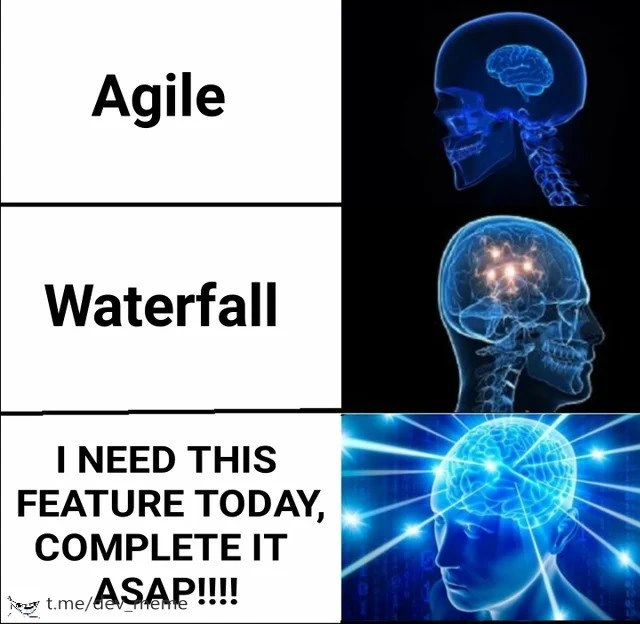
Agile – This refers to the Agile methodology, a modern approach to software development. In Agile, teams work in short cycles (often called sprints, usually 1-2 weeks long) and regularly deliver small, working pieces of the product. The idea is to adapt quickly to change and get feedback often. For example, in Agile you have frequent check-ins (like daily stand-up meetings) and you plan just a bit at a time (maybe one sprint ahead). The meme shows “Agile” in the top panel with a small calm brain, implying this is the baseline or “small brain” state. Agile is generally considered a smart way to handle changing requirements – but in the meme’s sarcastic tone, it’s portrayed as the least enlightened of the three states (don’t worry, that’s part of the joke).
Waterfall – This is the older Waterfall model of software development. It’s called Waterfall because work flows downward through distinct phases, like a waterfall. First you gather all the requirements, then design the whole system, then implement (code) everything, then test it all at the end, and finally deploy. It’s very plan-driven and assumes you can nail down all needs at the start. Changes late in the process are hard (imagine trying to tweak the foundation of a house when the roof is already on). In the meme’s middle panel, “Waterfall” is next to an image of a brain with more glow and sparks, suggesting this older method is somehow a bigger-brain idea than Agile – an exaggeration meant to be humorous. In reality, Agile was created partly because strict Waterfall planning often didn’t match the unpredictable nature of software projects. But here the meme is setting up a contrast where even Waterfall’s heavy planning looks moderately sensible compared to what’s coming next.
"I NEED THIS FEATURE TODAY, COMPLETE IT ASAP!!!!" – This giant block of text in the bottom panel isn’t an official methodology at all. It represents a panic-driven demand from a panicked boss or client. Let’s unpack it: A feature is a specific functionality or addition to the software (for example, “a new login screen” or “dark mode theme”). When someone says they need a feature today, they’re basically asking the developers to design, code, and ship a new capability in mere hours. ASAP stands for “As Soon As Possible,” which in corporate-speak usually means “right now, if not sooner.” The all-caps and multiple exclamation marks convey that this request is being screamed urgently. There’s no consideration of feasibility, no planning, just pure pressure. In the meme image, this text is paired with an over-saturated neon-blue brain exploding with light – the ultimate “galaxy brain”. This implies that, in the joke, bypassing all process and demanding instant results is being labeled as the most evolved or enlightened state of mind (obviously meant ironically).
The humor here comes from familiarity. New developers quickly learn about Agile and Waterfall as two opposite ways to manage projects. Agile is supposed to be flexible and modern, Waterfall is more traditional and rigid. However, no one teaches you about the unofficial third style you’ll inevitably encounter: panic-driven development. This is when a stakeholder (a person with interest in the project, like a manager or client) suddenly requests a change or new feature last-minute, ignoring whatever plan was in place. It’s not taught in textbooks because it’s really a bad practice, yet it happens in the real world. The meme exaggerates it to an absurd level to make a point. For someone new to software teams, imagine it like this: Agile is “let’s plan in small bits and keep adapting,” Waterfall is “let’s plan everything then do it,” and the last one is “no plan at all, just do it right now!” The meme is saying this last approach is treated as if it’s a brilliant idea – which is funny because it’s usually chaos. In reality, such last-minute feature requests are a nightmare for developers and often lead to rushed, buggy work. The meme’s over-the-top imagery and text lampoon the misaligned expectations of certain managers who think yelling for immediate results is the peak of smart project management.
Level 3: Management by Panic
This meme hits home for any senior developer who’s survived a few death-march projects. At first glance it’s the familiar “expanding brain” format – each row implying a more enlightened state of mind – but the twist is pure sarcasm. The rows label three project management approaches: Agile, Waterfall, and finally a full-on screaming rush request. The punchline is that the most “galaxy-brain” enlightened state is a manager skipping both Agile and Waterfall and going straight to “I need it today!” chaos. It’s poking fun at a common industry anti-pattern: when all the carefully groomed backlogs, sprint plans, and stand-up meetings fly out the window because a high-level stakeholder wants a new feature ASAP.
Every veteran developer has felt this. You might be midway through a two-week sprint (the heart of Agile Scrum practice) when suddenly a product owner or VP barges in with a “critical” last-minute feature request. Cue the panic-driven development mode: priorities are instantly reshuffled, the team is asked to crunch (work overtime under pressure), and any notion of a systematic process is effectively trampled. The humor here is that this scenario is so absurd yet so relatable – it’s the ultimate “works on my machine” of project management. Waterfall was often criticized for being too rigid and slow to adapt, and Agile was supposed to save us by embracing change, but even Agile assumes some structure. In reality, many teams end up practicing a warped hybrid we jokingly call “Panic-driven development (PDD)”: no design documentation, no iterative planning, just an email or Slack message from a panicked manager at 4 PM saying everything must be delivered by EOD.
The meme’s third panel text in all-caps perfectly captures the tone of those manager expectations: it’s basically a digital-age “DROP EVERYTHING!” battle cry. The reason engineers smirk (or groan) at this image is because we’ve lived it. We recognize the “ultimate enlightenment” facial expression as the look on a manager’s face when they think bypassing the entire SDLC process is an act of genius. It satirizes the idea that ignoring planning and good practice is somehow more advanced. In truth, this panic mode leads to all-nighters, last-minute commits with titles like FixUrgentIssue_final_FINAL.cpp, and deploys that break at 3 AM. The stakeholder expectations are completely misaligned with reality, yet it’s a scenario that plays out in tech companies big and small. The shared trauma is real: features promised to clients without consulting the dev team, managers setting deadlines that defy physics, and developers heroically (or masochistically) trying to deliver miracles.
By ranking “I NEED THIS NOW!” above formal methodologies, the meme jabs at both Agile humor and management humor. It implies that some higher-ups genuinely act as if panic is a plan. Seasoned devs laugh (perhaps a tad bitterly) because they know the truth: whenever a project is run by sheer panic and unrealistic deadlines, you’re effectively trading short-term illusion of progress for long-term pain. It’s both cathartic and painfully accurate to see that dynamic lampooned as the "ultimate brain" stage. After all, nothing screams ProjectManagement absurdity like treating last-minute feature requests as the pinnacle of wisdom.
Level 4: The Deadline Paradox
In the grand Software Development Life Cycle (SDLC), this meme showcases a darkly comic inversion of project management wisdom. Decades of software engineering research have warned us about the folly of compressing timelines without mercy. The classic Mythical Man-Month principle (coined by Fred Brooks in 1975) taught that adding more pressure or people to a late project often makes it later. In other words, you can't produce a baby in one month by getting nine women pregnant – and similarly, you can't deliver a complex feature in a day just by yelling louder. Yet here we are: the bottom panel’s “ultimate enlightenment” depicts a manager achieving a supposed galaxy-brain state by simply demanding “I NEED THIS FEATURE TODAY, COMPLETE IT ASAP!!!!”. This is the deadline paradox in action – the belief that ignoring all process and engaging in pure panic will somehow outperform structured methodologies like Waterfall or Agile.
From a theoretical standpoint, this is akin to trying to defy the Iron Triangle of project management (fast, good, cheap – pick two). By insisting on fast above all else (finish it today!), you implicitly sacrifice quality and sanity. There’s even a name for the inevitable fallout: technical debt. Panic-driven coding – rushed hacks to satisfy an unrealistic deadline – incurs a debt that must be “paid back” later via bug fixes, refactoring, and endless developer headaches. Over time, that debt interest ballooning can mean the quick solution wasn’t quick at all. In fact, Hofstadter’s Law neatly states: “It always takes longer than you expect, even when you take into account Hofstadter’s Law.” The enlightened neon-blue brain in the meme is a tongue-in-cheek jab at this truth: the supposedly “most evolved” project mindset (skipping design, coding everything overnight) is actually a well-known recipe for disaster. Experienced engineers have seen this paradox play out time and again – the more frantically you try to force software out the door, the more entropy and delays you create in the long run. The meme’s absurd hierarchy is an insider nod to those hard-earned lessons in software project physics.
Description
An 'Expanding Brain' meme with three panels, satirizing software development methodologies. The first panel pairs the word 'Agile' with an image of a normal-sized, calm brain in a blue X-ray style. The second panel shows 'Waterfall' next to a brain with several glowing hotspots, indicating more activity or complexity. The final and most enlightened panel displays the text 'I NEED THIS FEATURE TODAY, COMPLETE IT ASAP!!!!' next to a 'galaxy brain' image, where the brain is brightly illuminated with rays of light emanating from it. This meme humorously suggests that the ultimate, most transcendent form of project management isn't a structured methodology like Agile or Waterfall, but the chaotic reality of urgent, high-pressure demands from stakeholders. The joke resonates with developers who know that no matter the official process, it often gets overridden by last-minute, 'emergency' requests. A watermark for 't.me/dev_meme' is visible at the bottom of the last panel
Comments
7Comment deleted
We've transcended Agile. Our methodology is called 'Panic-Driven Development.' Sprints are measured in hours and story points are directly proportional to the manager's blood pressure
Agile says “iterate”, Waterfall says “plan”, but the true galaxy-brain SDLC is “quantum delivery”: requirements, build, deploy, and post-mortem all collapse into one Slack ping - “ship it by EOD.”
After 20 years in the industry, I've realized that no matter how many SAFe certifications you collect or how perfectly you implement Kanban, every methodology eventually converges to the same universal constant: 'The CEO just promised this to a client at golf yesterday.'
The real Agile methodology: Sprint planning on Monday, stakeholder panic on Friday, and somehow the 'quick fix' you deployed at 11 PM becomes the most critical production feature that can never be refactored because 'it works and we have no time.' Bonus points if they ask for it to be 'enterprise-ready' by EOD
Turns out our delivery model isn’t Agile or Waterfall - it’s preemptive multitasking: every exec DM is an IRQ that context-switches the whole org, invalidates the sprint, and thrashes the cache
Agile, Waterfall… and then Executive-Driven Development: requirements materialize at 5pm, we hotfix to prod, and the postmortem becomes the spec
The ultimate SDLC pattern: methodologies converge at 'Water-Scrum-Panic-Fall' under client gravity