Skip to content
DevMeme
1525 of 7435
The Unspoken Alliance of Programmers and Comedians
DevCommunities Post #1705, on Jun 15, 2020 in TG

The Unspoken Alliance of Programmers and Comedians

Why is this DevCommunities meme funny?

Level 1: Short and Sweet

Imagine a computer programmer and a comedian giving each other a big high-five because they both love doing something in just one simple step. The programmer solves a hard problem with one line of code, and the comedian makes everyone laugh with one quick sentence. Even though coding and comedy are totally different, it's funny to see them bond over being short and clever. It’s the surprise of two very different people finding out they share the same little superpower – keeping things short and sweet – and that unexpected connection makes us smile at this meme.

Level 2: Brevity vs Clarity

At a more straightforward level, this meme is saying that both programmers and comedians like to use one-liners. Here's what that means in each world:

  • One-liner (code) – Writing an entire operation or logic in a single line of code. Developers sometimes do this to be concise or show off a clever trick. It’s common in quick scripts or programming challenges to compress code as much as possible.
  • Code golf – A friendly programming competition (often seen on forums) where people try to solve a problem in the fewest characters or lines of code. The result is usually extremely short, highly optimized code – often baffling one-liners – that sacrifices readability for brevity.
  • One-liner (joke) – A very short joke, usually just one sentence long. It delivers the setup and punchline almost at the same time. Comedians known for this style get laughs with just a few words by using a clever twist or pun in a single line.
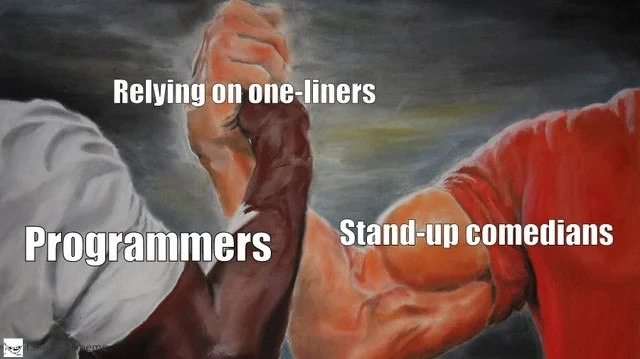
  • Predator handshake meme – An image template taken from an '80s action movie (Predator) where two muscular characters clasp hands mid-air. Online, people use it to show two different groups united by a common idea. In this meme, the arms are labeled "Programmers" and "Stand-up comedians," and their common bond is relying on one-liners.

Now, why do programmers rely on one-liners? Often it's for fun or to show skill. In everyday coding, most of us spread code out for clarity. But sometimes you'll see (or write) a crazy one-line command that does a lot at once. It can feel like a cool trick or a flex of knowledge. However, if you pack too much into one line, it can hurt code readability – that is, how easy the code is for a human to read and understand later.

For example, consider a quick task in Python: collecting the squares of even numbers from 0 to 9. We can do it the regular way, or cram it into one line:

# Normal multi-line approach:
squares = []
for x in range(10):
    if x % 2 == 0:          # check if x is even
        squares.append(x**2)
print(squares)  # Output: [0, 4, 16, 36, 64]

# One-liner approach using a list comprehension:
squares = [x**2 for x in range(10) if x % 2 == 0]
print(squares)  # Output: [0, 4, 16, 36, 64]

In the one-liner version, the entire loop and if condition are condensed into a single line. It does the same thing (producing [0, 4, 16, 36, 64] as output), but it's more compact. This shows the appeal of one-liners: they can make code short and elegant.

However, notice that the multi-line version, with the loop and if spelled out, might be easier for someone who's new to programming to follow. The one-liner using the list comprehension is concise and “clever,” but a beginner might have to pause and puzzle over what it's doing. This highlights the usual advice: code is read more often than it's written, so clarity often wins over clever brevity in real projects. In other words, there's a trade-off between being terse and being understandable – that's the brevity vs clarity dilemma.

Now apply that idea to comedy. A one-liner joke gets to the laugh quickly, whereas a longer joke might take time to set up but could be easier to follow. The meme’s text "Relying on one-liners" is pointing out that programmers sometimes lean on super short code and comedians lean on super short jokes to get the job done. It's a playful comparison: we don’t usually compare writing code to telling jokes, so it’s amusing to see them literally hand-in-hand here. It also gently pokes fun at the code-golf mentality: writing extremely concise code is a bit like delivering a punchline – it's impressive and satisfying when it works, but you have to know what you're doing for it to land well!

Level 3: Brevity Arms Race

Programmers and Stand-up comedians might seem like they have nothing in common, but this meme plays on a surprising overlap: their shared love for the one-liner. In the image (the famous Predator handshake meme format), a white-sleeved developer arm and a red-sleeved comedian arm clasp hands with camaraderie over the caption "Relying on one-liners". It’s a visual high-five between two very different professions, celebrating the power of being concise and punchy.

For programmers, a one-liner means packing a lot of logic into a single line of code. It's an art form in certain dev communities: think of code golf, where the goal is to solve problems in as few characters as possible. A seasoned coder might squish what would normally be a whole function into a terse, elegant (or sometimes completely inscrutable) one-liner. Pythonistas, for example, will turn a multi-loop operation into a single list comprehension, and shell script gurus chain grep | sed | awk commands into one magical pipeline. These feats trigger a mix of admiration and alarm in peers – admiration for the cleverness, alarm because such code can be a nightmare to read the next morning.

Stand-up comedians, meanwhile, live by the power of the one-liner joke. Imagine a comic who sets up and delivers a laugh in just a single sentence. The best one-liners pack a surprise twist or a clever pun with no filler. Each word is carefully chosen, just like a developer chooses each symbol in a code one-liner. The comedic punchline often relies on brevity as much as wit – it's about stripping away everything except the funny. A great one-liner can floor an audience with a dozen words or less.

So what makes this meme so spot-on? It highlights that both writing code and writing jokes involve a craft of extreme conciseness. Both developers and comedians obsess over how to express a lot with very little. In a programmer's world, it's squeezing functionality down to an elegant snippet – perhaps to show off in a programming humor forum or just for the joy of a clever solution. In a comic's world, it's trimming a joke to only the funniest core. The handshake is hilarious because it’s unexpectedly true: whether it’s a programming competition or an open-mic night, a killer one-liner gets respect in both arenas.

Of course, there's an undercurrent of be careful what you wish for. In software, relying on one-liners can become a double-edged sword. It's a classic case of brevity vs clarity: the shorter your code, the more you risk others (or future you) not understanding it. That 300-character chained expression might impress in a code golf contest, but in a code review for real CodeQuality it might earn a raised eyebrow. Seasoned engineers often quip, "Just because it fits in one line doesn’t mean it’s readable." Many a heroic hackathon one-liner has been refactored into 10 well-commented lines in production, sacrificing brevity for maintainability (usually with a # expanded for clarity comment left by a weary maintainer).

Similarly, not every joke works as a one-liner – some punchlines need a story. A comedian who forces everything into one sentence might end up with a few confused listeners. Both fields know that sometimes you have to expand a bit for the message to land. But when that perfect one-liner does land? It's gold. In a sense, a code one-liner is a programmer's punchline – it's the payoff of all the problem-solving setup delivered in one witty statement. The meme captures that unlikely kinship brilliantly. It’s winking at us with the message: if you can deliver it in one line, why waste a second? Two muscle-bound arms locked in agreement say it all – the coder and the comic both live for that short-and-sweet triumph.

Description

A meme using the 'Epic Handshake' format from the movie Predator, which shows two muscular arms clasping hands. The left arm, belonging to a white man, is labeled 'Programmers.' The right arm, belonging to a black man, is labeled 'Stand-up comedians.' The central point where their hands meet is labeled 'Relying on one-liners.' The meme creates a humorous parallel between the two professions by playing on the double meaning of 'one-liner.' For comedians, it's a short, witty joke. For programmers, it's a single line of code that performs a complex operation. This resonates with developers who appreciate the elegance and cleverness of concise code, but also understand the potential for such code to be unreadable and difficult to maintain

Comments

7
Anonymous ★ Top Pick A junior's one-liner gets a laugh during standup. A senior's one-liner gets a pained look during a code review six months later
  1. Anonymous ★ Top Pick

    A junior's one-liner gets a laugh during standup. A senior's one-liner gets a pained look during a code review six months later

  2. Anonymous

    Shipping a 200-char ternary inside a lambda is basically crowd work - gets applause on merge day, but when prod heckles at 3 AM you’re the punchline

  3. Anonymous

    The real handshake happens when you find that one Stack Overflow answer from 2011 that still works perfectly in production, written by a user who deleted their account years ago - the true unsung heroes of our git blame histories

  4. Anonymous

    The real joke is when your 'clever' one-liner becomes a production bug at 3 AM, and suddenly you're debugging regex that looked brilliant after your fourth coffee but now reads like ancient Sumerian. At least comedians can blame the audience when their one-liner bombs - we just get a stack trace and a Slack message from the on-call engineer asking 'what were you thinking?'

  5. Anonymous

    We both rely on one‑liners: theirs gets laughs; ours becomes a mission‑critical cron piping sed|awk|jq that only works with LC_ALL=C

  6. Anonymous

    One-liners crush in the demo; by the postmortem we’ve rewritten them into seven lines with logging, retries, and a bus factor greater than one

  7. Anonymous

    One-liners: proving readability is for juniors since 'works on my machine' became an architecture pattern

Use J and K for navigation