Skip to content
DevMeme
4484 of 7435
They cloned Google interviews but forgot the compensation line in production
Interviews Post #4922, on Oct 10, 2022 in TG

They cloned Google interviews but forgot the compensation line in production

Why is this Interviews meme funny?

Level 1: Tough Puzzle, Tiny Prize

Imagine your friend makes you play a really hard game – like a puzzle that takes a lot of time and brainpower – and tells you that if you win, you’ll get a reward. You spend all day working on this super tough puzzle because you think the prize will be really big (after all, the game was as hard as a big competition’s). But when you finally solve it, your friend gives you just a little piece of candy. 😕 Meanwhile, another kid down the street has a game that’s just as hard, but their prize for winning is a huge bag of candy. Which game would you rather play? Probably the one with the huge reward! The first friend is left scratching their head, wondering why no one wants to play their game. It’s funny because it’s obvious to us: if you ask someone to do something really difficult, you’ve got to give them a really good prize. In the same way, the meme is saying a company made their job interview as hard as Google’s (that’s the hard game/puzzle) but offered only a small reward (a much smaller salary). Of course, the best players (engineers) will go play for the company that gives the big reward instead. The mismatch is so clear that it’s silly – and that’s why we laugh!

Level 2: Whiteboard Imitation, Salary Limitation

At its core, this meme highlights a hiring mismatch that even a junior developer can find absurd once it’s pointed out. The company in the comic copied Google’s interview process – which typically means very challenging technical interviews. For context, Google (and other FAANG companies like Facebook, Apple, Amazon, etc.) are famous for their tough technical interview process. Candidates often face multiple rounds of coding exercises where they might have to write code on a whiteboard or solve complex algorithm problems under time pressure. These are the sorts of brain-teasers and coding challenges you’d find on sites like LeetCode (a popular platform to practice interview questions). It’s common to hear about needing to reverse linked lists or traverse binary trees on the spot – stuff that might feel like a college algorithm exam. This style of interviewing can be stressful and demanding, so companies that use it usually do so to filter for engineers with strong CS fundamentals and problem-solving skills.

Now, here’s the catch the meme points out: Google doesn’t put candidates through that whiteboard interview wringer for nothing. They offer extremely competitive compensation – meaning a very high salary, plus bonuses, stock options, great benefits, the works. In other words, there’s a big reward at the end of the challenge. The term FAANG compensation gap refers to the huge difference between what those top-tier companies pay versus what smaller or more traditional companies offer. Salary band mismatch in this context means the job’s pay range is way lower than what someone with the required skills could get elsewhere (like at Google). So if a company requires a candidate good enough to pass a Google-style interview, but the salary band they’re offering is, say, typical of a much easier job, that’s a mismatch. It’s like listing a job for a “world-class chef” but offering the pay of a fast-food cook – the expectations and the reward don’t line up.

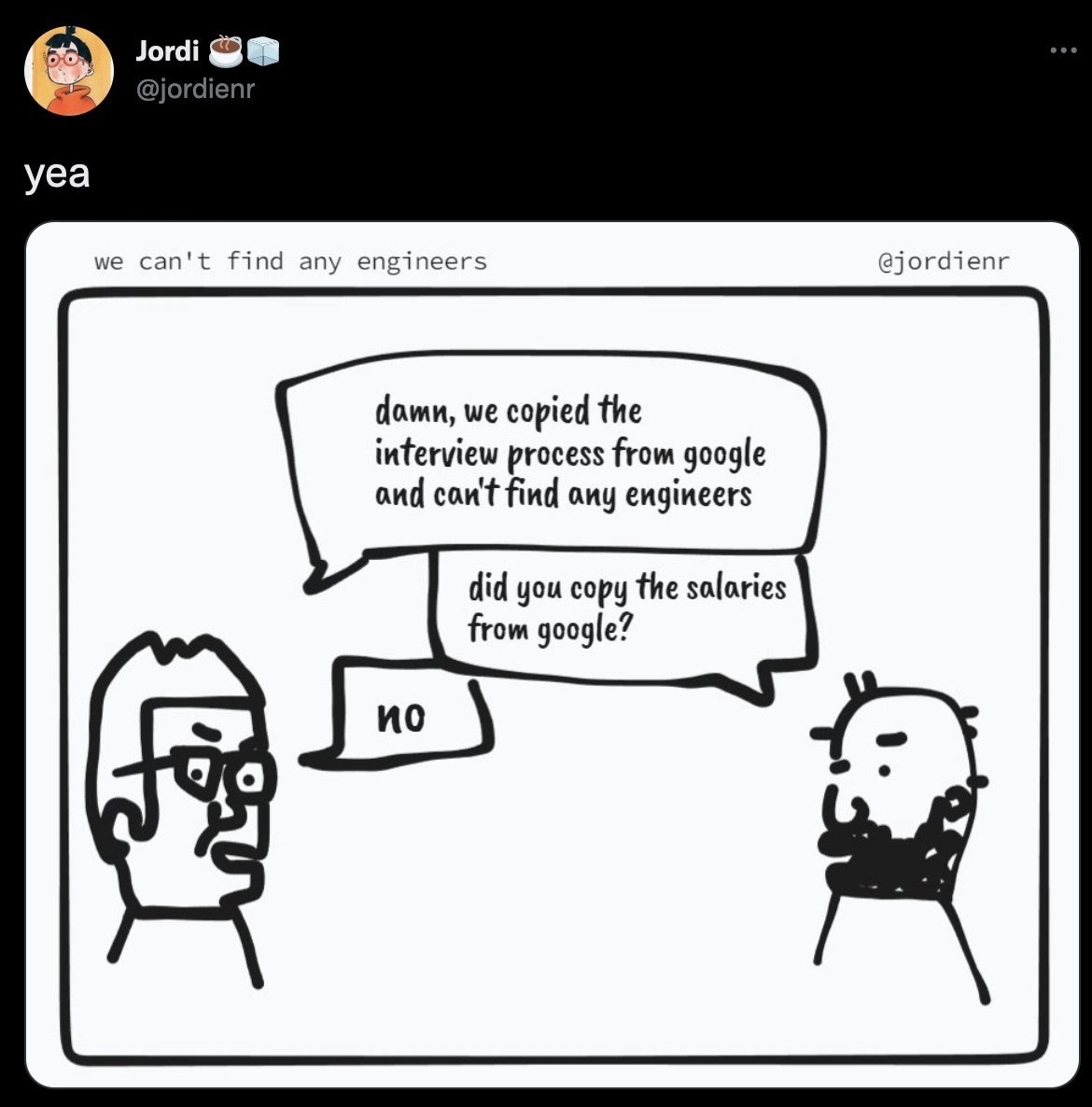
In the comic, one manager says, “we copied the interview process from Google and can’t find any engineers.” This is the company complaining that despite using a tough interview process (copied from a famous tech giant), they’re not getting people to accept the jobs (or even qualify). The other manager asks, “did you copy the salaries from Google?” – essentially, Did you also copy the part where you pay candidates like Google would? When the first manager simply replies, “no,” it immediately explains why they can’t find any engineers. InterviewHumor like this lands because it’s a facepalm moment: of course you won’t hire many people if you expect them to jump through hoops without a fair reward. This is a case of misaligned expectations. The company expected that mirroring a famous hiring process would magically yield top talent, but they ignored the incentive part of the equation.

For a junior developer or someone new to industry culture, think of it this way: lots of companies admired how Google hired brilliant people and thought, “hey, if we ask tough questions and make candidates write tricky code on a whiteboard, we’ll hire brilliant people too.” So they implement these interview processes sometimes called “leetcode interviews” or “whiteboard tests.” But unlike Google, many such companies don’t have a huge budget for total compensation. If you’re early in your career, you might have encountered entry-level interviews where you had to grind through coding problems (maybe you practiced on LeetCode or HackerRank beforehand) and then discovered the salary offer was underwhelming. That discrepancy can be pretty disappointing. You might have thought, “Wow, I went through all that for this offer?” This meme is poking fun at exactly that scenario. It’s InterviewProcess humor meets CorporateCulture satire – basically calling out a company for copying the hard part of hiring (challenging interviews often seen at big tech firms) but skipping the generous part of hiring (the high pay and benefits those firms give).

Let’s break down a few terms and elements to ensure everything’s clear:

  • Google interview process: Typically involves several rounds – e.g., an initial phone screen with coding, on-site interviews including data structure and algorithm problems, possibly system design for senior roles, and behavioral questions. It’s designed to be difficult; many candidates prepare for months.
  • Whiteboard interview: A style of technical interview where you literally write code on a whiteboard (or in a shared Google Doc/online editor without auto-complete). It tests your problem-solving and coding from scratch. It’s become symbolic of tough tech interviews.
  • LeetCode gatekeeping: LeetCode is a website with hundreds of coding problems. “Gatekeeping” refers to using something as a strict barrier. In many tech circles, there’s a complaint that companies use LeetCode-style questions as a gatekeeper – if you can’t solve a bunch of algorithm puzzles quickly, you can’t get the job – even if the job itself may never require those exact puzzles. This practice can filter out otherwise good engineers who perhaps haven’t trained on timed puzzles, thus “gatekeeping” the job for only those who have.
  • FAANG-level compensation: FAANG is an acronym (Facebook, Apple, Amazon, Netflix, Google) representing the tech giants known for high pay. FAANG-level compensation means salaries plus bonuses and stock totaling very high amounts (often six figures for new grads, and much more for experienced folks). Non-FAANG companies often offer considerably less. In the comic’s terms, “copy the salaries from Google” means offering similarly big bucks.
  • Misaligned expectations: This phrase means what one side expects versus what the other side offers are not in sync. The company expected they’d get top engineers by doing difficult interviews; the engineers expect top pay if they pass a difficult interview. Both expectations clash when the company’s offer doesn’t meet the candidates’ expectations.

So, the whole joke can be summed up: Company makes interviews hard like Google’s, but doesn’t pay like Google. Company is then baffled that no one wants the job. For a junior dev, it’s a lesson in both HiringProcess strategy and a bit of cynicism: when you’re job hunting, the toughest interview might imply a great reward – but always check that the reward (offer) actually matches the effort. And if you’re ever on the hiring side, remember that if you want top talent to join, you have to give them a reason (be it salary, exciting work, or usually both). As the meme shows, ignoring that compensation factor will just lead to empty chairs and exasperated hiring managers. 😉

Level 3: High Bar, Low Ball

The cartoon scenario hits a nerve in tech hiring: a company clones Google’s interview process – those infamous whiteboard coding gauntlets and algorithm riddles – yet balks at offering Google-level pay. The left stick-figure manager laments “we copied the interview process from Google and can’t find any engineers.” It’s a scene seasoned developers know too well. Why? Because setting a high hiring bar without a high reward is a recipe for unfilled jobs. Shockingly, if you make candidates invert binary trees and traverse linked lists under pressure, they expect compensation worthy of that effort. The humor comes from an obvious misalignment: Google can demand elite performance because it dangles elite rewards (massive FAANG salaries, juicy stock options, prestige projects). A smaller company copying the technical interview process but offering a bargain-bin paycheck is like demanding Olympic-level athletes compete for a participation trophy. Senior engineers see this and chuckle (or cry) in recognition: we’ve watched companies raise the hiring bar sky-high and then low-ball the offer, sincerely confused why top candidates disappear.

This industry satire pokes fun at a common anti-pattern: cargo-cult hiring. Companies mimic Big Tech’s rigorous hiring process – multi-round coding tests, system design whiteboards, tricky algorithm questions (often pulled from sites like LeetCode) – believing it’s a magic formula for top talent. But they forget a crucial line in the code of hiring: the part where you match the compensation to the challenge. It’s as if they deployed to production with a missing environment variable: everything looks right on the surface, yet nothing works. The meme’s punchline (“did you copy the salaries from Google?” “no”) is delivered in a deadpan bubble, underscoring the facepalm-worthy oversight. Copying Google’s interview complexity without Google’s salary bands is like shipping a feature and forgetting to enable it in config – the system’s not gonna behave as expected.

Real-world veteran perspective: Many of us have sat through meetings where management complains “we can’t find any engineers!” while insisting on LeetCode gatekeeping for even mid-level roles and offering mediocre pay. We’ve seen HR agonize over a “talent shortage,” when from the trenches it looks more like a salary_band_mismatch problem. The FAANG compensation gap is enormous – top-tier firms pay total packages that double or triple what an average company might offer for the same role. So when a non-FAANG company uses the same interview process (complete with obscure dynamic programming challenges and architecture grills), the few candidates who clear that high bar often politely say “no thanks” to the offer. After enduring a grueling interview marathon, any engineer capable of passing it likely has options at companies that won’t low-ball them. It’s a classic case of misaligned expectations: the company expects Google-caliber hires on a startup-caliber budget. As the cynical joke goes, “if you pay peanuts, you get monkeys” – or in this case, you get no one at all because the monkeys didn’t even pass the coding test.

To seasoned devs, the humor has an edge of truth: we’ve watched companies over-engineer their hiring funnel thinking it guarantees high-quality engineers, only to filter out all their viable candidates. It’s darkly funny how they’ll scratch their heads and blame everything except the obvious. The meme captures this absurdity perfectly in one exchange. The lesson practically writes itself in code:

# Pseudocode for the hiring strategy in question:
process = clone(Google.interview_process)
salary  = set_budget("well below Google")   # Oops, didn't clone Google.salary

if process == "ultra-rigorous" and salary == "bargain":
    print("We can't find any engineers!")  # Surprise, surprise...

In production, leaving out a critical config like Google.salary yields a failing pipeline, and in hiring it’s no different. Veteran engineers immediately get the joke: it skewers that do as Google does mentality, minus the parts that make Google, well, Google. The comic’s minimalist style (just two bewildered managers and a couple of speech bubbles) only amplifies the punchline. We don’t need detailed art – the scenario itself is the star. The left manager’s final tiny “no” in the speech bubble is the resigned admission of guilt: they forgot the compensation line, and now their hiring process is DOA. It’s a “you got exactly what you paid for” moment, served with a side of schadenfreude for every dev who’s ever walked away from a stingy offer. 🥜💸

Description

Screenshot of a tweet by user Jordi (@jordienr) with the caption “yea.” Inside the tweet is a minimalist black-and-white doodle comic framed by a rounded rectangle. Top margin text reads “we can't find any engineers” on the left and “@jordienr” on the right. Two stick-figure managers face each other: the left figure wears glasses, the right has a stubbly beard. Speech bubbles contain all dialogue: Left figure: “damn, we copied the interview process from google and can't find any engineers”. Right figure replies: “did you copy the salaries from google?”. A smaller bubble from the left answers: “no”. The humor highlights companies adopting FAANG-style whiteboard gauntlets without mirroring FAANG-level total compensation, a mismatch senior engineers instantly recognize from countless recruiting cycles

Comments

6
Anonymous ★ Top Pick Copy-pasting Google’s four-round whiteboard flow without pasting their L5 stock grant is like open-sourcing your API spec and forgetting to expose any endpoints
  1. Anonymous ★ Top Pick

    Copy-pasting Google’s four-round whiteboard flow without pasting their L5 stock grant is like open-sourcing your API spec and forgetting to expose any endpoints

  2. Anonymous

    We implemented Google's entire interview process except the part where they pay enough to make inverting a binary tree on a whiteboard while explaining your childhood trauma seem reasonable

  3. Anonymous

    Ah yes, the classic startup playbook: implement Google's 6-round algorithm gauntlet with system design, behavioral interviews, and take-home assignments, then act shocked when candidates ghost you after discovering the 'competitive salary' is equity in a pre-seed company and the 'unlimited PTO' policy that nobody actually uses. Pro tip: you can't `git cherry-pick` just the interview rigor from FAANG's compensation strategy - it's a monorepo, and the salary bands are tightly coupled dependencies

  4. Anonymous

    Copying Google’s interview without Google’s total comp is like implementing Raft without leader election - everyone waits for consensus, but no offer ever commits

  5. Anonymous

    Rigorous interviews filter talent; sub-market salaries filter them right back out - classic zero-sum hiring algo

  6. Anonymous

    Copying Google’s hiring gauntlet without matching total comp is like deploying Kafka with a single partition and no consumers - lots of ceremony, zero throughput

Use J and K for navigation