Skip to content
DevMeme
6325 of 7435
Software Estimation Skills in the Wild
ProjectManagement Post #6936, on Jul 3, 2025 in TG

Software Estimation Skills in the Wild

Why is this ProjectManagement meme funny?

Level 1: Biting Off Too Much

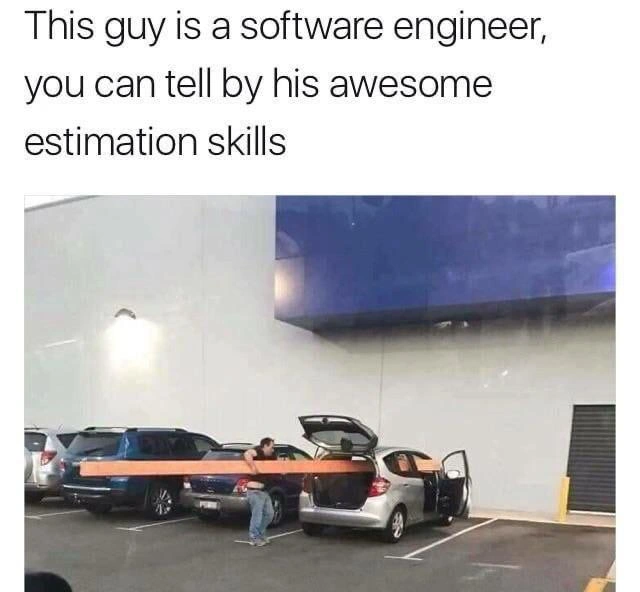
Imagine trying to shove a giant toy into a tiny toy box – no matter how you twist it, it just won't fit. This picture is funny for the same reason: the man thought he could fit a huge piece of wood into a small car, and it's clearly not working. It's like when you bite off a piece of food that's way too big for your mouth – you instantly realize it was a bad idea and you probably look pretty silly. We laugh because we've all been a little too confident and tried to do something impossibly ambitious like this. The humor comes from that "uh-oh" moment everyone recognizes, when you suddenly see that your grand plan just isn't going to pan out, exactly like this guy with his oversized plank and undersized car.

Level 2: Big Task, Small Sprint

If you're newer to software development, let's break down the joke. This meme uses a normal everyday scenario to illustrate a classic Agile development problem: underestimating work. In the photo, a man is trying to load a very long plank of wood into a small hatchback car. The plank is sticking out absurdly far, meaning it clearly doesn't fit. This is a funny visual way to say "whoops, we planned something really badly."

In software, teams often work in sprints. A sprint is a short, fixed period of time (usually 1 or 2 weeks) in which a team tries to complete a set of tasks or user stories. Before a sprint starts, there’s a sprint planning meeting: the team discusses what work to do and estimates how hard each task will be. Instead of hours, they use story points – an abstract measure of effort and complexity (e.g. a small bug fix might be 1 point, adding a medium feature might be 5 points, a huge project might be 13 points). There’s also something called T-shirt sizing for rough estimates: labeling tasks as Small, Medium, Large, etc. An Epic in Agile terms means a big feature or project that is so large it should be split into smaller tasks across multiple sprints.

Now, think of the long wooden plank as a huge software task – maybe a big new feature or an entire project. And the tiny car represents the sprint (and the team's capacity within that sprint). In the meme, the engineer thought he could fit the plank in the car. Similarly, during sprint planning, teams often assume they can fit a large amount of work into a sprint. This is a common rookie mistake: under-scoping (underestimating) the work. You plan a task thinking "Oh, this will be quick and easy," but once you start, you realize it's much bigger and harder – just like realizing the plank is way too long only after trying to shove it in.

The caption jokes about his "awesome estimation skills" because, well, they're actually pretty terrible here. This is a bit of project management humor that anyone in software can relate to. Developers notoriously struggle with time estimation. For example, you might say "I can finish this coding task in 2 days" and then discover new bugs, unexpected complications, and it ends up taking a week or more. There's even a running joke that one of the hardest problems in programming is estimating how long things will take.

In Agile, teams track how many story points they usually finish in a sprint (that's called their velocity). Say a team normally completes about 20 points in two weeks – that's like the car only fitting a certain length of plank safely. If the team tries to take in 40 points of work (a plank twice as long), they're going to have a bad time – work will stick out "unstable," meaning it won't all get done or it'll cause problems. In reality, when teams overcommit like this, developers end up rushing, working overtime, or pushing unfinished work to the next sprint (like leaving the car trunk open and the plank hanging out, hoping it doesn't fall off on the way).

The key terms and analogies here are:

  • Estimation: The process of predicting how much effort or time a task will take. It’s notoriously hard to get right in software, much like eyeballing that plank length was hard.
  • Sprint: A short development cycle (often 2 weeks) with a set scope of work. Think of it as the car's trunk space – a limited capacity.
  • Story Point: A unit to estimate task size/effort (not a direct hour count, but relative sizing). For instance, a 1-point task might be very simple, a 5-point task is medium complexity, and an 8 or 13-point task is large. The plank was probably a "13-pointer" being forced in as if it were a 5.
  • Epic: A very large story or project, which ideally should be broken into smaller pieces. If the plank is an epic piece of work, the smart move would have been to cut it into smaller planks that fit, just as a big project should be split into bite-sized tasks.
  • Deadline Pressure: The stress to deliver by a certain date (like the end of the quarter). Under deadline pressure, teams sometimes take on more work than they should, hoping for the best, which often leads to situations like this meme.

So in simpler terms: the guy in the picture is doing what software teams do when they grossly underestimate a project. He's trying to do something too big, too quickly given his constraints. Every junior developer eventually encounters this. Maybe you promise to implement a whole feature in one week because it looked straightforward, and then you're still debugging it the next week. The meme is a light-hearted way to say, "Yep, we've all been that guy." It’s a reminder that planning and sizing things correctly is important – otherwise, you'll end up like the person in the parking lot with a plank sticking out of your car, feeling a bit silly.

Level 3: Scrum vs Physics

The moment a seasoned dev sees this image, there's a knowing sigh. The meme's caption introduces our protagonist as "a software engineer" with "awesome estimation skills" – dripping with sarcasm that makes any senior developer smirk. We’ve all witnessed this situation in real life sprint planning. Agile teams love to boast about velocity, yet here we have an epic-length plank trying to cram into a hatchback of a sprint.

In other words, this guy just attempted to fit a 13-point story into a 2-week sprint (the car's trunk) like it was a trivial 3-pointer. The absurd board sticking out of the window is a perfect visual metaphor for overcommitting under deadline pressure. It’s the unstoppable force of ambitious requirements (that long board) meeting the immovable object of limited capacity (that tiny trunk). Spoiler: physics and reality win every time.

This scenario screams "t_shirt_sizing_fail" – in Agile, we sometimes size tasks with T-shirt labels (S, M, L, etc.). Here someone clearly labeled an XL feature as a Medium and only realized the mistake once they tried to load it. Picture a planning session where a big feature was mistakenly downplayed. The team optimistically said, "Sure, we can squeeze that in," much like eyeballing that plank and thinking, "It'll fit if we angle it just right." Spoiler #2: it doesn't fit.

Software estimation is infamously tricky. There’s even a classic adage known as Hofstadter’s Law:

Hofstadter's Law: It always takes longer than you expect, even when you take into account Hofstadter's Law.

Seasoned engineers chuckle (or groan) at how true that is. We consistently underestimate how long things will take – just like our friend with the plank. He thought loading it would be no big deal, akin to a dev thinking a complex feature is "maybe a day's work." Fast-forward to reality: the board is dangling out dangerously, and that "one-day task" has spiraled into a week-long scramble. Story points gone wrong, indeed.

Why is this so relatable? Because unrealistic deadlines and AgileHumor go hand-in-hand. Teams commit to delivering too much in a sprint thanks to optimism, pressure from higher-ups, or plain old miscalculation. It’s a running joke in project management: the gap between a deadline and reality is usually a few all-nighters. We've all had that sprint where everyone silently knows the scope is too large, but no one wants to be "the pessimist" who says it. So we nod, load up the sprint like a clown car, and hope for the best.

And yet, as the title wryly notes, we "somehow ship every quarter." How? Usually through heroic measures and plenty of duct-tape solutions. Imagine our determined engineer strapping the plank down with rope, tying a red flag on the end, and driving home at 5 mph with hazard lights on. In software terms, that's like burning the midnight oil, hacking together hotfixes, and cutting scope at the last minute just to claim "We delivered!" The feature (plank) technically ships, but it might be hanging by a thread — or in this case, by the open tailgate.

This meme hits a nerve because it’s a painfully relatable developer experience. It pokes fun at how we keep making the same estimation mistakes sprint after sprint. We laugh, but it’s a knowing laugh. The image perfectly encapsulates the Agile planning comedy of errors: SprintPlanning meets the real world. For a senior dev, it's both funny and a gentle reminder: measure twice, cut once… or you’ll end up in the parking lot looking as ridiculous as this guy, wondering where it all went wrong.

Description

A two-panel meme. The top panel contains black text on a white background that reads, 'This guy is a software engineer, you can tell by his awesome estimation skills'. The bottom panel is a photograph taken in a parking lot, likely outside a large hardware or furniture store. In the photo, a man is struggling to fit a very long, thick wooden beam or plank into a small, silver hatchback car. The car's trunk and a side door are open, but the beam is comically oversized for the vehicle, sticking out many feet. This meme serves as a visual metaphor for the notorious difficulty software engineers have with accurately estimating the time and effort required for their tasks. The man's gross miscalculation of physical space is humorously equated to a developer underestimating the complexity of a project, a common experience that leads to missed deadlines and 'scope creep'
Comments

15
Anonymous ★ Top Pick He clearly estimated the task in story points but measured his trunk capacity in ideal man-days
  1. Anonymous ★ Top Pick

    He clearly estimated the task in story points but measured his trunk capacity in ideal man-days

  2. Anonymous

    Somewhere a PM just converted that eight-meter plank into a "quick half-day task" - and the architect signed off because it fit in the Gantt chart

  3. Anonymous

    This is what happens when you estimate a task as 'small' without checking if it fits in your current sprint capacity - suddenly you're blocking three other teams and the PM can't back out of the parking garage

  4. Anonymous

    This is what happens when you estimate a 2-story point task as a 1-pointer because 'it's just moving some data between two containers' - technically correct, catastrophically underestimated, and somehow still in production

  5. Anonymous

    Classic dev estimation: 'It'll fit in one sprint' - until velocity parks it in the next quarter

  6. Anonymous

    Classic planning-poker: it's a 3-point task, right up until it spans two cars, blocks the release train, and turns 'split across sprints' into tight coupling

  7. Anonymous

    Proof that story points don’t convert to cubic feet - P50 in planning, P95 in parking, parallelized across two hatchbacks

  8. @Algoinde 1y

    He should sprint instead

  9. @ZgGPuo8dZef58K6hxxGVj3Z2 1y

    Unironically I have the best estimates of math and stats such topics in my work. And I still underestimate time needed for a project

  10. @einbetungzahl 1y

    always multiply by a fudge factor

    1. @Dark_Lord_of_Debian 1y

      2 x 0 = 0

    2. @SamsonovAnton 1y

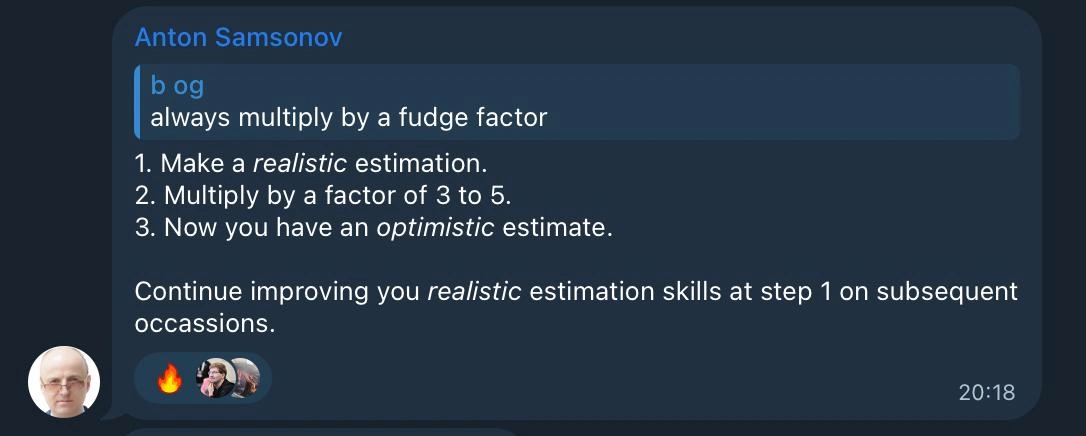
      1. Make a realistic estimation. 2. Multiply by a factor of 3 to 5. 3. Now you have an optimistic estimate. Continue improving you realistic estimation skills at step 1 on subsequent occassions.

  11. @paranoidPhantom 1y

    Bro is almost Pythagoras

  12. @M_Ali_S_S 1y

    When css doesn't load

    1. Deleted Account 1y

      css added 'if' command

Use J and K for navigation