Skip to content
DevMeme
6324 of 7435
When FOSS Projects Get Very Enthuastic About Their CoCs
OpenSource Post #6935, on Jul 3, 2025 in TG

When FOSS Projects Get Very Enthuastic About Their CoCs

Why is this OpenSource meme funny?

Level 1: Playing by the Rules

Imagine you're joining a new club where everyone is building a giant LEGO castle together. You're excited to add your own blocks and make the castle better. But the moment you pick up a brick, the club leader rushes over with a big list of rules. They insist, "Before you add anything, remember: be nice, share your pieces, no yelling!" They make sure you agree to all these rules every single time you try to put a brick on.

Of course, it's good to be nice and share – those rules are important so everyone gets along. But it feels a little silly if you have to pause and hear the same lecture every time you add a block. You might start thinking, "I already know the rules... can we just build the castle now?"

This meme is joking about a similar situation in programming. The "club rules" here are like the project's Code of Conduct – guidelines to ensure everyone behaves well. The maintainers (the project leaders) keep reminding contributors (people who want to help with the code) about these rules over and over, even when all you want to do is fix something in the code. It's funny because it's a bit over-the-top. We all agree being respectful is good, but getting the rulebook waved in your face every time you try to help can feel awkward and frustrating.

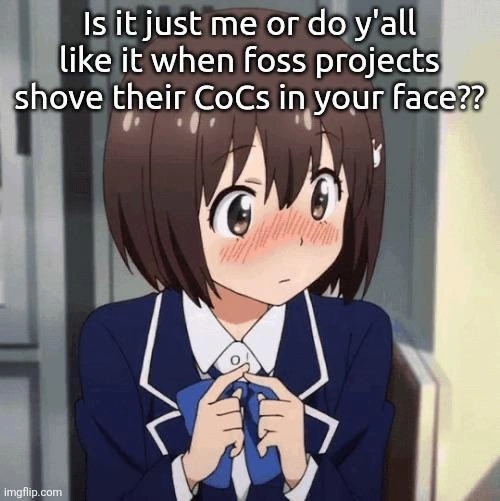
So, the picture of the blushing, side-glancing girl and the caption are basically saying: "Is it just me, or do others also feel it's a bit much when a project constantly pushes its 'be nice' rules at you?" It's a playful way to vent that sometimes, we just want to get to the coding part without a lengthy reminder of the manners we already know.

Level 2: The Open Source Rulebook

Let's break down what's happening. In free and open-source software (FOSS) projects, a maintainer is like the project lead or janitor who keeps everything tidy. They manage contributions from other developers, reviewing code and making decisions. A Code of Conduct (CoC) is basically a set of rules about how people should behave when participating in the project. Think of it as the community's etiquette guide: be respectful, no harassment, be inclusive, etc. Many projects put this in a file named CODE_OF_CONDUCT.md in the repository so everyone can read it. It's there to ensure the community stays friendly and respectful, especially since open source teams often include people from all over the world.

Now, a pull request (PR) is when someone proposes changes to the codebase. You submit your code and the maintainers review it. Ideally, they'd focus on your code quality: does it fix the bug? Are there tests? Is the code style correct? But this meme jokes that, instead of diving into those technical details first, some maintainers immediately wave the Code of Conduct at you. In some projects, when you open a PR, you'll get an automatic message or checklist reminding you to read the Code of Conduct or agree to it. For example, you might see a message saying, "By contributing to this project, you agree to abide by our Code of Conduct." It's a bit like being prompted with contributor guidelines pop-ups whenever you try to contribute.

The meme's text says: “y'all like it when FOSS projects shove their CoCs in your face??” – in plainer language: "Do you guys also get annoyed when open source projects aggressively push their Codes of Conduct at you?" The person is being sarcastic. They're noticing that some projects emphasize their behavior rules very strongly, maybe even more than the actual code discussion. This is funny to developers because it's a common experience: you just want to make a contribution or fix a bug, and you're immediately met with a reminder about the rules, as if you were about to misbehave.

There's a bit of culture clash here. In the past, open source communities were sometimes very informal – people might argue strongly or use harsh language in bug discussions and it was considered normal (though not always pleasant). Today, there's a big movement to make developer communities more welcoming and civil, which is what the Code of Conduct is for. But the meme is pointing out that the pendulum can swing too far. When maintainers bring up the CoC in every single PR (every time you try to contribute), it can feel a little bureaucratic or overzealous. It's as if the project is saying, "Hello, welcome, but first read these 10 rules!" every single time.

For a new developer or someone new to open source, this can be confusing or even discouraging. You might wonder, "Did I do something wrong? I just wanted to contribute code, why are they immediately talking to me about rules of behavior?" Often nothing is wrong – it's just a standard procedure the maintainers follow to remind everyone of the community guidelines. They probably had some issues in the past with people being rude or breaking rules, so now they are extra cautious.

The anime girl in the image looks shy and embarrassed, which matches the feeling of a contributor who is a bit taken aback that the first feedback on their code is essentially a lecture on manners. The humor comes from that contrast: the serious tone of a Code of Conduct being enforced versus the contributor thinking, "I was just trying to help with the code, why am I being scolded about my manners?"

In short, the meme is highlighting how sometimes open source maintainers focus on the social rules (the CoC) so much that it overshadows the technical contribution. It’s a friendly poke at that dynamic in the programming world.

Level 3: Policing Pull Requests

In modern Open Source culture, maintainers often act like hall monitors for project behavior, making sure the Code of Conduct (CoC) gets as much attention as the code itself. This meme humorously highlights a scenario where a contributor opens a pull request (PR) to improve something technical, but the maintainer responds by waving the project's CoC banner at them – figuratively "shoving it in your face." The tension here is between code quality and community guidelines. Seasoned engineers in developer communities have seen this pattern: a flashy CODE_OF_CONDUCT.md file proudly displayed at the top of the repo, sometimes before any real documentation or installation guide. It's a bit of repo bureaucracy that can feel ironic when the codebase might be on fire with bugs, yet maintainers are busy enforcing polite language and inclusive terminology in commit messages.

This is poking fun at the virtue signaling some maintainers might do. A cynic would say: they'll merge a commit adding a "Be Nice" clause to the CoC faster than a commit fixing a memory leak. The phrase "shove their CoCs in your face" itself is a cheeky double entendre (the acronym CoC isn't lost on anyone here) underlining how overzealous the enforcement can feel. Instead of focusing on the technical content of a PR, certain projects relentlessly remind contributors about the contributor guidelines and CoC in every comment. It's as if the maintainer is saying, "Your code may be great, but did you use a friendly emoji and inclusive language in the discussion?"

From an experienced perspective, this is all too real. We've been in FOSS projects where even a trivial one-line patch triggers a boilerplate reply:

Thank you for your contribution! Please make sure to read and adhere to our Code of Conduct.

Or maintainers might have a PR template that forces you to check a box like:

- [x] I agree to follow the project's Code of Conduct

before they even look at your code. It's community governance taken to an almost comical extreme – as if a PR is entering a sacred space where the first priority is chanting the rules of decorum. The humor here comes from relatability: many devs have seen a project that, perhaps after some past drama, now overcompensates by preaching about "respect and inclusion" at every turn. Meanwhile, the actual code review might be an afterthought. This is a classic case of maintainer politics and priorities: keeping up a pristine inclusive image ("look, we have a strong CoC!") sometimes overshadows discussing whether the algorithm in that PR runs in $O(n^2)$ or $O(n \log n)$.

At its core, the meme calls out a contradiction: open source was once the wild west of coding – rough edges, passionate debates on mailing lists, maybe a few F-bombs dropped by a stressed maintainer at 3 AM. But now many projects have formalized community dynamics with codes of conduct to prevent toxicity. Contributor Covenant-style CoCs became standard after some high-profile flame wars and inclusivity battles in tech. It's undeniably a good thing to make communities welcoming; even the grizzled veterans agree no one wants a repeat of the Linux kernel mailing list meltdowns. However, the satirical twist is that some projects go so far that the process (enforcing nice behavior) feels overbearing compared to the product (writing good code). It's like an overzealous HOA in a neighborhood: sure, the lawns are tidy, but maybe they're issuing fines for the color of your curtains while the house foundation is cracking.

In summary, at the senior dev level, the meme gets a knowing chuckle because it captures how open source culture can sometimes swing from one extreme to the other. Where once there were no rules and chaos reigned, now every contribution comes with a side of FOSS governance lectures. The image of the embarrassed anime girl ironically asking if others "like it" is dripping with sarcasm – she’s voicing what many think but feel too shy or polite to say outright: "Are we really doing this CoC song-and-dance every time we change a semicolon?" It's a playful jab at the maintainers who may need to remember that good code and good community can coexist without turning every PR into a mini HR training session.

Description

An anime meme featuring a female character with short brown hair in a school uniform. She has a shy, flustered expression, blushing heavily and fidgeting with her blue necktie or bow. The image is overlaid with white, bold text that reads, 'Is it just me or do y'all like it when foss projects shove their CoCs in your face??'. The humor is derived from a deliberate and provocative double entendre. 'CoC' is a standard acronym for 'Code of Conduct,' which are rule sets governing behavior in open-source communities. However, 'CoC' is also a vulgar slang term for a penis. The meme uses this ambiguity, paired with the suggestive anime image, to satirically critique what some perceive as the overly aggressive, performative, or sanctimonious implementation of Codes of Conduct in the Free and Open Source Software (FOSS) world
Comments

12
Anonymous ★ Top Pick The fastest way to start a flame war in a FOSS project isn't a debate over tabs vs. spaces, it's a pull request to update the CoC
  1. Anonymous ★ Top Pick

    The fastest way to start a flame war in a FOSS project isn't a debate over tabs vs. spaces, it's a pull request to update the CoC

  2. Anonymous

    Sure, I’ll sign your CoC - right after you add a CONTRIBUTING.md that compiles on something newer than GCC 4.8

  3. Anonymous

    After 20 years in tech, I've seen more heated debates about Code of Conduct enforcement than actual code reviews - though both involve people getting surprisingly passionate about proper insertion of semicolons and respectful discourse

  4. Anonymous

    Ah yes, the modern FOSS experience: you just want to submit a two-line typo fix, but first you must acknowledge the 47-page Code of Conduct, sign the CLA, read the contributing guidelines, install pre-commit hooks that enforce commit message formatting per RFC 2119, and attend a mandatory diversity training webinar. Meanwhile, the actual maintainer hasn't responded to issues in 8 months because they're burned out from moderating CoC violations in a project with 3 active contributors

  5. Anonymous

    You know a project’s mature when CODE_OF_CONDUCT.md has stricter enforcement than semantic versioning - and more uptime than the CI

  6. Anonymous

    FOSS CoCs: because nothing says 'merge-friendly' like a 5k-word social contract before your first PR

  7. Anonymous

    Nothing says “open source” like green tests and a red check because you didn’t tick the CoC acknowledgment - 100% compliance coverage, 0% contributor throughput

  8. @anonusernametg 1y

    Really tempted to share this with my coworkers, but I'll refrain

    1. @lilfluffyears 1y

      Do it :3

  9. アレックス 1y

    I LOVE COC'S I LOVE UNIMPEACHABLE MICROSOFT HR HAVING TOTAL AUTHORITY ON EVERY FOSS PROJECT

  10. @Johnny_bit 1y

    CoC can go and suck my coc.

  11. @RiedleroD 1y

    bruh

Use J and K for navigation