The Computer Degree Money Maker
Why is this Career HR meme funny?
Level 1: Not A Cash Button
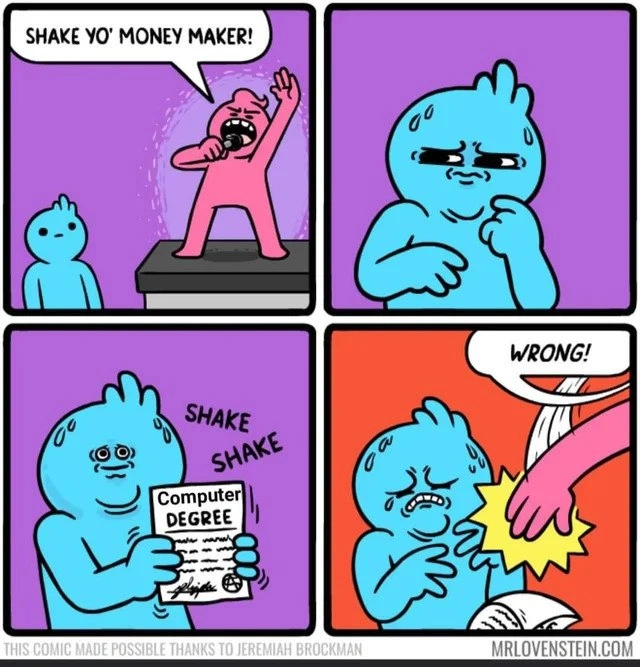
This meme is like someone showing a school certificate and expecting coins to fall out of it. The joke is that learning computers can help you get a good job, but the paper by itself does not do the work. You still have to prove you can build things, solve problems, and handle the messy parts people actually pay for.
Level 2: Degree Meets Market
A computer degree usually means formal study in computer science, software engineering, information systems, or a related field. It can be valuable because it teaches foundations that last longer than one framework trend. For example, a graduate may understand algorithms, complexity, memory, networking, databases, and how programming languages are structured.
The meme jokes that the character thinks the degree itself is what makes money. That is the misunderstanding. A degree is a signal. It tells employers that someone completed a program and probably learned important concepts. But employers still want evidence that the person can do the job. That evidence might come from internships, projects, open-source work, interviews, previous jobs, or a clear explanation of how they solve problems.
Academic vs industry is a common early-career shock. In school, assignments often have clear requirements, small codebases, and known grading rules. In industry, requirements change, old systems have strange constraints, and the best solution may be the one that is boring enough for the whole team to maintain. That is why AcademicVsPracticalSkills appears in this kind of humor: classroom knowledge matters, but it has to be connected to real development habits.
The comic's WRONG! is exaggerated. A degree is not worthless. It just is not a magic money button. It is more like a key that may unlock some doors, while experience, communication, timing, and persistence decide how many of those doors actually open.
Level 3: Credential Liquidity Crisis
The comic starts with a performer shouting:
SHAKE YO' MONEY MAKER!
The blue character thinks, then proudly presents a document labeled:
Computer DEGREE
with SHAKE SHAKE written beside it. The final panel delivers the slap and the verdict:
WRONG!
The humor comes from treating a computer degree as the obvious financial asset, then immediately rejecting it. In developer terms, the degree is supposed to be the "money maker" because software careers are culturally associated with high salaries, stable demand, and upward mobility. The comic punctures that idea by showing that a credential alone is not the same thing as employable skill, career leverage, or a guaranteed offer.
This is not anti-education so much as anti-magical thinking. ComputerScienceEducation can teach algorithms, data structures, operating systems, databases, compilers, discrete math, software engineering practices, and the discipline of surviving group projects with one person who commits only after the deadline. Those are real assets. But hiring does not pay for the diploma as an object. It pays for demonstrated ability in a messy market: solving problems, communicating trade-offs, reading existing code, shipping maintainable work, learning tools quickly, and not turning every if statement into an architecture review.
The slap is funny because it captures CareerExpectations colliding with DeveloperReality. Students are often sold a simplified story: get the degree, enter the industry, make money. The actual path has more variables:
- Local job market and timing.
- Internship access and project experience.
- Interview preparation, especially data structures and system design.
- Practical familiarity with tooling, version control, testing, deployment, and debugging.
- Soft skills that are not soft when a production incident has five teams arguing in one chat.
- Debt, opportunity cost, and the gap between academic assignments and industry codebases.
The Computer DEGREE in the panel is drawn like a certificate being physically shaken, which makes the metaphor beautifully dumb. A degree can open doors, but it does not emit cash when waved at the room. The industry has enough credentialism to make the joke recognizable, and enough practical gatekeeping to make the slap feel earned.
The deeper satire is aimed at the way tech culture packages itself. Bootcamps, universities, online courses, recruiters, and social media all have versions of the same promise: learn the right thing, unlock the career. Sometimes that is true. Often it is incomplete. A degree is part of a portfolio of signals, not the whole engine. If the portfolio has no projects, no internships, no ability to talk through trade-offs, and no evidence of learning beyond grades, the "money maker" may need several rounds of refactoring.
Description
A four-panel Mr. Lovenstein comic shows a pink performer on a stage shouting "SHAKE YO' MONEY MAKER!" while a blue character watches. The blue character thinks hard, then proudly holds up a document labeled "Computer DEGREE" while the sound effect says "SHAKE SHAKE." In the final panel, the performer slaps the blue character with the speech bubble "WRONG!" and the footer reads "THIS COMIC MADE POSSIBLE THANKS TO JEREMIAH BROCKMAN" and "MRLOVENSTEIN.COM." The technical humor comes from the gap between the promised financial upside of a computer science credential and the awkward reality that a degree alone is not the same thing as career capital, practical skill, or market timing.
Comments
1Comment deleted
The degree can make money; it just has to finish amortizing four years of compiler trauma first.