Skip to content
DevMeme
656 of 7435
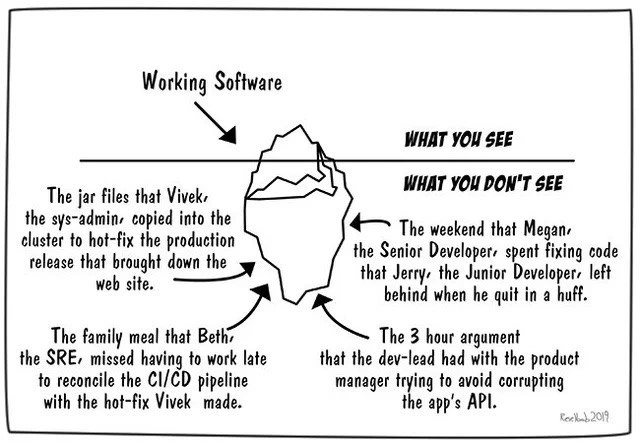
The Iceberg of 'Working' Software
OnCall ProductionIssues Post #744, on Oct 16, 2019 in TG

The Iceberg of 'Working' Software

Why is this OnCall ProductionIssues meme funny?

Level 1: Below the Surface

Imagine you’re watching a magic show. The magician on stage pulls a rabbit out of a hat, and it looks effortless and fun. The audience claps, thinking, “Wow, that was a neat trick!” – that’s like seeing working software: it’s the cool app or game and everything seems to just work. But what you don’t see is everything that happened backstage to make that trick work: the hours of practice the magician did, the assistant crouched behind the table quietly putting the rabbit in place, maybe the couple of failed tricks earlier that day that they had to quickly fix. The meme is using an iceberg to show this idea. The small part of the iceberg above water is the success everyone notices, and the huge part under water is all the hard work, fixes, and even struggles that nobody notices. It’s funny in a way because it’s true for so many things: like how you see a duck gliding smoothly on a pond (looks easy), but underwater the duck’s legs are paddling furiously to keep it going. In the same way, when you use your favorite app or visit a website and it works, there were probably people working really hard behind the scenes – maybe even late at night – to fix problems and keep it running smoothly. The meme makes us laugh a bit because it’s a picture of that truth: you see the nice result, but under the surface there’s a lot going on that you’d never guess. It’s saying, “Things aren’t as simple as they appear – there’s more effort and adventure under the surface!”

Level 2: Hidden Complexity

At first glance, the meme shows a simple iceberg with "Working Software" as the small visible tip and a huge hidden section of text under the water labeled "What You Don’t See." It’s highlighting the idea that a functioning app or website (the part everyone sees) is supported by lots of unseen work and complexity. Let’s break down those hidden parts in practical terms, especially for those newer to the industry:

  • “Working Software” (Visible Tip): This is the final product or feature as it appears to users or managers. It’s the website loading correctly, the app feature functioning, the service responding. When everything looks okay on the surface, people assume the development process was smooth. But often, that smooth-running software is like a swan gliding on a lake – calm above water, frantic paddling below. The iceberg analogy is saying that beneath any visible success in Production, there’s a lot of unseen support work.

  • Hot-fix JAR Files in Production: One hidden item is “the jar files that Vivek, the sys-admin, copied into the cluster to hot-fix the production release that brought down the website.” Let’s unpack that:

    • A JAR file (Java ARchive) is basically a package of compiled Java code – think of it like an .exe for Java or a zip containing a bunch of classes and libraries. It’s how Java applications (or pieces of them) are shipped.
    • Sys-admin (system administrator) is a job role for managing servers and infrastructure. Vivek is the person responsible for keeping the servers running. In many modern teams this might be a DevOps engineer or an SRE (Site Reliability Engineer), but the idea is the same: someone who deploys and maintains the system.
    • Cluster in this context means a group of servers or nodes that the application is running on. Imagine the website isn’t on just one computer, but spread across many to handle more users.
    • A hotfix is an urgent, small fix applied to a live system to patch a critical problem. It’s like when you quickly tape up a leaking pipe – it’s not a full repair, but it stops the immediate damage. Here, the production release (the new version of the software that went live) had a serious bug that “brought down the website”, meaning the site crashed or became unusable. A hotfix was needed fast to bring it back.
    • So Vivek manually copied some JAR files into the servers in that cluster to replace the broken parts with fixed versions. Normally, deploying software is done through a CI/CD pipeline (an automated process), but a manual copy indicates this was an emergency. Essentially, instead of going through the usual safe deployment steps, he directly intervened, updating files by hand on the live servers. This is a bit risky and not standard procedure, but in a pinch it’s what saved the day.
    • The phrase highlights ProductionIssues and a bit of corner-cutting: the kind of quick fix you don’t advertise but is sometimes necessary when every minute of downtime counts. It’s hidden because all the user sees is the site eventually coming back up; they don’t know a sysadmin was hurriedly uploading JARs at midnight.
  • CI/CD Pipeline Firefighting (SRE’s Late Night): Another hidden item says, “The family meal that Beth, the SRE, missed having to work late to reconcile the CI/CD pipeline with the hot-fix Vivek made.” This points to consequences of that manual hotfix:

    • SRE stands for Site Reliability Engineer. This is a role focused on keeping services reliable and available, often by automating processes and responding to incidents. Beth is the one responsible for the overall system health and deployment process.
    • CI/CD pipeline refers to Continuous Integration/Continuous Deployment pipeline. Think of this as an automated assembly line for code changes: developers put code into source control, and the CI/CD system builds it, tests it, and if all is good, deploys it to production. Tools like Jenkins, CircleCI, or GitLab CI are common here. When everything is working, you can deploy new code at the press of a button (or even automatically on each merge).
    • When Vivek did the manual hotfix, he effectively stepped outside this pipeline. The pipeline’s record of what’s deployed (and what should be deployed) no longer matched reality. For example, the pipeline might think version 2.3 of the app is running, but actually it’s version 2.3 + a manual patch. This mismatch can cause problems: the next time the pipeline runs (say, for the next release or an automatic daily deploy), it might overwrite or conflict with the hotfix.
    • Beth’s task to “reconcile the CI/CD pipeline” means she had to integrate that hotfix back into the official codebase or deployment process. She might need to commit Vivek’s changes into the source code repository, rebuild a proper release that includes those JAR fixes, and ensure the pipeline knows about it. In short, turning that one-off patch into a permanent part of the code so that future deployments won’t undo it.
    • Missing a family meal and working late is highlighting the personal sacrifice – Beth had to stay late at work (or on her laptop at home) instead of being with family, because production issues often demand immediate attention. The OnCall aspect is implied: even if she wasn’t formally on-call, she felt responsible to jump in. Many in DevOps or SRE have stories of getting paged or messaged during dinner or in the middle of the night.
    • This part of the iceberg shows the BuildPipeline pain point: keeping that automated pipeline running smoothly is a job in itself. When something falls outside the normal process, it takes a bunch of behind-the-scenes work to set it right again. A junior developer might not anticipate this, but once you work on real deployments you learn how crucial and delicate the pipeline can be.
  • Senior Developer’s Weekend Refactor: The iceberg’s text continues: “The weekend that Megan, the Senior Developer, spent fixing code that Jerry, the Junior Developer, left behind when he quit in a huff.” Here we see a story of technical debt and maintenance work:

    • Junior Developer vs Senior Developer: A junior dev (Jerry) is someone newer to the industry, possibly with less experience in writing clean or maintainable code. A senior dev (Megan) has more experience and often ends up mentoring others and fixing tough issues. When Jerry “quit in a huff,” it implies he left suddenly, possibly due to some frustration, and probably did not properly hand over his work or ensure his code was in good shape.
    • The code Jerry left behind could be incomplete features, bugs, or just poorly written sections that nobody else fully understands. When he left, that knowledge walked out the door. This is unfortunately common: if documentation is lacking and only the original coder knows how something works, the team is in trouble when that person exits abruptly.
    • Megan spending her weekend fixing code means that this wasn’t scheduled work but something urgent or important enough that she had to devote personal time to it. Perhaps Jerry’s code was causing errors or failing tests, or it became critical to fix for the next release now that he’s gone.
    • This highlights technical debt: a concept where quick-and-dirty solutions or leftover problems accumulate and eventually someone has to pay back that “debt” by fixing things properly. Jerry might have taken shortcuts or simply left a mess, and now Megan is paying the price (in time and effort) to clean it up.
    • For a newer developer, it’s a lesson: code doesn’t disappear when you quit – someone else will inherit it. And for teams, it’s why knowledge sharing and code reviews are important. In the meme, the humor (tinged with sadness) comes from how relatable this scenario is. Many of us have either been Megan (fixing someone else’s mess) or even been Jerry at some point (writing something quick without realizing the burden it puts on others). It’s an invisible effort because users just see the software continue to work normally; they have no idea one of the devs lost a weekend making sure a hidden bug didn’t bite them.
  • Dev Lead vs Product Manager API Debate: The last underwater item is “the 3 hour argument that the dev-lead had with the product manager trying to avoid corrupting the app’s API.” This exposes some internal team dynamics and why communication is also a huge part of software engineering:

    • Dev Lead (development lead) is the person in charge of the technical direction of the project, often a senior developer or engineering manager who balances code concerns with project goals.
    • Product Manager is a person who decides what the product should do and what features it should have, often driven by user needs, market demands, or business goals. They prioritize features and set deadlines, but may not always know the technical intricacies.
    • An API (Application Programming Interface) is how different software components or clients interact with your application. Think of it as the menu of a restaurant: it defines what’s available and how to request it. Other apps or parts of the system rely on that API staying consistent. If you “corrupt” an API, that suggests making a change that breaks its contract – for example, changing the format of data it returns, removing a field that external clients expect, or adding something in a way that could cause confusion or errors. Breaking an API can cause other services or customer integrations to fail. It’s usually done with great caution (use versioning, deprecate things gradually) if done at all.
    • The dev lead likely spent 3 hours explaining these consequences to the product manager, who probably was pushing for a quick change ("corrupting" in this sense might mean a change that is expedient but not well-designed). The dev lead’s job in that moment is to act as the guardian of the codebase’s long-term health, while the product manager is likely concerned about a short-term deliverable or a client request.
    • For someone new to the field, it might be surprising that a large part of a senior engineer’s day can be meetings and discussions, not just coding. Here we see an example: a long meeting to convince the product manager not to implement a risky change. The product manager likely saw adding/changing the API as a simple tweak to make a stakeholder happy. The dev lead understood it could break existing functionality or add a maintenance burden.
    • This kind of argument is invisible externally because if it’s resolved well, nothing actually changes in the product – which is the point. They avoided a bad decision. It’s like preventing a fire versus fighting one; if they succeed, nobody smells smoke, so it looks like nothing was ever wrong.
    • The humor and relatability here comes from how exhausting and common this scenario is in software teams. It’s a bit of office politics and a bit of technical education rolled into one. Junior devs might not be in those meetings yet, but eventually they see that part of the job is advocating for good engineering practices, even if it means telling non-technical colleagues “no” for the sake of the product.
  • “What You See” vs “What You Don’t See”: The line splitting the iceberg is explicitly labeled in the meme. This drives home the overall message: the surface success of a project (the feature is delivered, the site is up, the app works) is supported by a vast hidden complexity underneath (the late nights, hotfixes, arguments, and fixes we just explained). As a junior or someone early in their career, it’s important to realize successful software isn’t just writing code and done – it’s also deployment, maintenance, collaboration, and iteration. There’s a lot happening behind the scenes to make sure that code you wrote keeps working in the real world.

In summary, each item under "WHAT YOU DON’T SEE" corresponds to real-world tasks and challenges:

  • Manual emergency fixes that bypass normal procedure (risky but sometimes necessary).
  • Extra work to realign automated systems after an emergency change.
  • Developers spending personal time to repair or improve code that wasn’t initially done right.
  • Intense discussions to prevent bad decisions and guard the quality of the software.

None of these are obvious to an end user or even to other departments, but engineers know they’re often the bulk of the work. It’s like an iceberg indeed – the coding of a feature might be just the tip, and everything else (testing, debugging, deploying, fixing, convincing others what not to do) sits beneath the surface. Recognizing this hidden effort is a part of growing as a developer. Initially you might only think about the code you have to write; with experience, you learn to anticipate and appreciate all these other aspects. That’s why this meme resonates with so many in tech – it humorously validates that what newbies might find surprising is actually par for the course in a dev team. It says, “Don’t be fooled by the calm appearance of a working app; there’s a storm of activity and struggle that made it possible.”

Level 3: Production Underbelly

The Iceberg of Hidden Work: Seasoned engineers chuckle (or cringe) at this iceberg meme because they've lived it. The tip labeled "Working Software" floats serenely above water – that’s the polished product stakeholders see. But lurking below is a titanic mass of invisible engineering overhead: emergency fixes, sacrificed weekends, on-call nightmares, and heated debates that never make the status reports. This is the Production underbelly, where DevOps ideals meet cold reality. The humor hits hard because every bullet under "WHAT YOU DON'T SEE" is a war story in tech:

  • Midnight Hotfixes: The meme mentions “the jar files that Vivek, the sys-admin, copied into the cluster to hot-fix the production release that brought down the web site.” Sound absurd? Welcome to OnCall hell. In theory, no one should scp random JAR files into a live cluster at 2 AM. In practice, when a new deployment breaks the website and customers are screaming, you do what you must. Vivek’s manual JAR drop is the ultimate ProductionIncident quick fix – a hotfix deployed outside the normal pipeline. Senior devs know this scenario by heart: a critical bug slips through, and DevOps principles (immutable infrastructure, automated deployments) get thrown overboard to save uptime. It’s funny in that dark way because we’ve all seen the “it’s fine, I’ll just patch it real quick” approach come back to bite later. Vivek’s one-off fix bypassed code review, continuous integration, and probably a few safety checks, but hey, the site is back up – management claps, unaware that a ticking time bomb has been buried in Prod.

    # Vivek's late-night hotfix (bypassing the CI/CD pipeline, not exactly by the book)
    cp /home/vivek/patch.jar /opt/app/lib/webapp.jar 
    systemctl restart webapp.service 
    # Fingers crossed... Production is up with a manual patch!
    
  • SRE Sacrifices & Pipeline Mayhem: Next, “the family meal that Beth, the SRE, missed having to work late to reconcile the CI/CD pipeline with the hot-fix Vivek made.” This is classic DevOpsHumor with a grim twist: the SRE (Site Reliability Engineer) is supposed to keep systems stable and maintain a life, but reality had other plans. Beth’s nice evening? Gone, thanks to that unscheduled fix. Why? Because the CI/CD pipeline (the automated build-and-deploy system) is now out of sync with production. The code running in Prod isn’t what the pipeline expects – a recipe for DeploymentPainPoints. Beth has to firefight the build system, maybe faking a version or quickly committing Vivek’s change to source control, otherwise the next deploy or auto-scaling event will wipe out the hotfix. This is invisible toil that users never notice: if she succeeds, nothing changes visibly; if she fails, the site breaks again. The humor is in the painful relatability: every ops engineer knows the irony of implementing a "quick fix" – you inevitably spend hours afterward cleaning up the mess so that "continuous deployment" can resume without blowing up. Beth’s story is an OncallNightmare: pager goes off at dinner, now she’s SSH’d into a server with a cold slice of pizza on the desk, muttering about how “this wasn’t in the job description.” It’s funny because it’s trueProduction emergencies don’t respect work-life balance.

  • Legacy Code and Lost Weekends: Then we have “the weekend that Megan, the Senior Developer, spent fixing code that Jerry, the Junior Developer, left behind when he quit in a huff.” Ah yes, the unpaid-interest on TechnicalDebt. This hits on two painfully common themes: inheriting messy code and the cost of turnover. Jerry’s last act of defiance was likely leaving a gnarly module or half-baked feature that only worked on his machine. Maybe there were comprehensive unit tests no tests at all, maybe the code was an inscrutable maze – now it’s Megan’s problem. She’s the Senior Developer on cleanup duty, giving up her weekend to refactor and fix whatever time-bomb Jerry left ticking. The humor here is the sheer inevitability: ask any senior dev how they spent their last “free” weekend and you’ll get a dozen stories of debugging someone else’s bizarre code or untangling a logic knot left by a hurried junior. Megan’s silent heroics remain underwater in the iceberg – management sees the project moving along by Monday, but not the fact that she was in git rebasing reality on a Sunday afternoon. This encapsulates HiddenComplexity: the code was “done” in the eyes of others, but making it truly work (and not crash production) required an invisible marathon of work. Seasoned teams laugh (and wince) at this because who hasn’t opened a file at 11 PM on a Saturday and whispered, “What was this person thinking?!” while fixing a bug that nobody knew about until it almost brought down the app.

  • API Wars and Office Politics: Lastly, “the 3 hour argument that the dev-lead had with the product manager trying to avoid corrupting the app’s API.” This part of the iceberg is pure invisible negotiation – not code, but crucial engineering work nonetheless. A stable API contract is like a sacred promise to users or other services: you don’t break it on a whim. But product managers, under pressure from sales or customers, sometimes demand quick changes: “Just slip in this new field, it’s a small tweak!” The dev lead knows that “small tweak” could violate assumptions, introduce bugs, or create a versioning nightmare. So what happens? A lengthy meeting (or five) behind closed doors, debating why you can’t just do that. The meme’s humor lies in imagining that intense discussion: three hours of whiteboard scribbles, SDK dependency graphs, client impact analysis – all to defend the integrity of the system against a potentially corrupting change. In the end, maybe the product manager reluctantly agrees not to shove a square peg in a round API hole. The users see a consistent, well-behaved app (nothing new, nothing broken), completely unaware that their dev lead basically slew a dragon in a conference room to keep it that way. For senior engineers, this scenario is so real it hurts: you end up expending engineering effort on arguments and education, trying to prevent short-sighted decisions. It’s a hidden labor that doesn’t produce code but saves the project from chaos. The cynical laugh comes from recognition – we’ve all sat in that meeting that ran way over, fighting for technical sanity while thinking “I can’t believe I have to explain why we shouldn’t break our API on a Friday.”

    Product Manager: "We promised the client a new field in the response by Monday. Let's just add it quick."
    Dev Lead: "If we jam that in, we’ll break half our integrations. The API is versioned for a reason."
    Product Manager: "It’s a minor tweak... surely it won’t matter?"
    Dev Lead: "It will matter. We need to do this properly or not at all."
    (3 hours of debate later, the API remains intact – and nobody outside the room ever knows why it took grit to keep it that way.)

Why It’s Hilarious (and Tragic): The meme brilliantly contrasts “WHAT YOU SEE” vs “WHAT YOU DON’T SEE.” In software, outsiders only see the features working, the demo succeeding, the {green checkmarks} in monitoring. But engineers see the whole iceberg of effort underneath. It’s a shared joke about HiddenComplexity: every smooth demo or seemingly stable app likely has a story of DeploymentPainPoints, late-night hotfixes or arduous bug hunts. The humor lands because it validates a truth every developer learns: building software that “just works” often involves unsung heroics and messy compromises below the waterline. In other words, the final product is supported by a mountain of code, sweat, and possibly tears that no one applauds. Seasoned devs laugh at this iceberg meme to keep from crying – because they know the BuildPipeline only tells half the story, and the other half is crouched in the dark with a pager at 3 AM applying a band-aid patch or negotiating with stubborn stakeholders. It’s cathartic: if you know, you know. And unfortunately, we know.

Description

A black-and-white cartoon illustrating the iceberg meme format applied to software development. The image is divided by a water line. Above the water, the visible tip of an iceberg is labeled 'Working Software' under the heading 'WHAT YOU SEE.' Below the water, the much larger, submerged part of the iceberg is labeled 'WHAT YOU DON'T SEE' and has arrows pointing to various sections, each describing a hidden problem or sacrifice. These descriptions are: 'The jar files that Vivek, the sys-admin, copied into the cluster to hot-fix the production release that brought down the web site.', 'The weekend that Megan, the Senior Developer, spent fixing code that Jerry, the Junior Developer, left behind when he quit in a huff.', 'The family meal that Beth, the SRE, missed having to work late to reconcile the CI/CD pipeline with the hot-fix Vivek made.', and 'The 3 hour argument that the dev-lead had with the product manager trying to avoid corrupting the app's API.' The cartoon effectively visualizes the immense, unseen effort, compromises, and human cost required to keep software running, which is often invisible to outsiders or management
Comments

7
Anonymous ★ Top Pick They call it 'working software' because the alternative, 'a fragile coalition of last-minute hacks, weekend heroics, and a looming API disaster held off by one very tired dev lead,' doesn't fit neatly on a status report
  1. Anonymous ★ Top Pick

    They call it 'working software' because the alternative, 'a fragile coalition of last-minute hacks, weekend heroics, and a looming API disaster held off by one very tired dev lead,' doesn't fit neatly on a status report

  2. Anonymous

    Sure, it’s ‘just a simple feature’ - right up until your iceberg backlog melts all over the SRE’s Friday night

  3. Anonymous

    The real iceberg is discovering that Vivek's jar file hotfix from 2019 is now load-bearing infrastructure that three microservices depend on, and removing it triggers a cascade failure that somehow affects the billing system

  4. Anonymous

    The iceberg perfectly captures what every architect knows: 'working software' is just the tip - beneath lies a Mariana Trench of emergency hotfixes, CI/CD pipeline archaeology, junior dev code that's now your problem, and three-hour API design debates that could've been resolved with a RFC. The real kicker? Stakeholders only see the tip and wonder why estimates are always 'too high.'

  5. Anonymous

    Behind every “it works in prod” moment is an scp’d JAR, a canceled SRE dinner to rewire CI/CD, a weekend of code archaeology, and three hours of API governance to dodge versioning purgatory

  6. Anonymous

    Uptime was just eventual consistency between 'scp jar to cluster' and a three-hour API treaty with the PM

  7. Anonymous

    Hotfixes deliver availability at the cost of team consistency - CAP theorem hits the SRE roster harder than any cluster

Use J and K for navigation