Skip to content
DevMeme
657 of 7435
Contributing to the Open Source Motherland
OpenSource Post #745, on Oct 17, 2019 in TG

Contributing to the Open Source Motherland

Why is this OpenSource meme funny?

Level 1: One Small Favor, Lifetime Membership

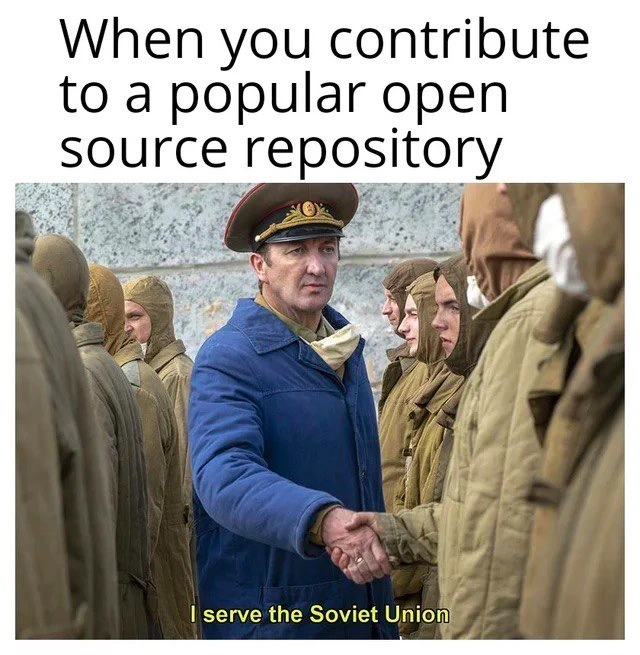
Imagine you help your friend’s group just once – say you join in to paint a community fence because they were short on volunteers that day. You do a good job and everyone’s happy. But then, to your surprise, next week the community leader knocks on your door with a paintbrush and says, “We’re painting the town hall now, comrade. Ready to serve again?” Suddenly, by helping out that one time, you’ve become the go-to helper for every painting project! This meme is joking about that feeling. In tech terms, you fixed one tiny thing in a big community project (like adding one puzzle piece to a huge puzzle) and now they kind of expect you to help with the whole puzzle. It’s funny because it’s an exaggeration – nobody can actually force you to keep helping. But it feels like you joined an army of helpers without meaning to. The picture of the stern officer shaking a soldier’s hand with the caption “I serve the Soviet Union” is like a super-serious version of saying “Yup, I’m part of this team now!” All because of one good deed. The humor comes from how dramatic that sounds compared to the small thing you actually did. It’s a way to laugh at the surprise responsibility that sometimes follows a simple act of helping out. In short, doing one helpful thing can make everyone treat you like a loyal member of the club – unexpected, a bit overwhelming, but also kinda proud at the same time, which is exactly what the meme is capturing in a playful way.

Level 2: Pull Request Pledge

Let’s break down what’s happening here in simpler terms. The meme talks about contributing to a popular open source repository. An open source repository is a public codebase – like a project on GitHub – where anyone can view, use, and contribute code. Think of famous examples like the Linux kernel, React, or a widely used JavaScript library on npm. These projects are maintained by people (maintainers) but rely on the community to help improve them. When you use an open source project, you’re downstream – you benefit from whatever upstream (the main project) provides. If you find a bug or need a new feature, you might contribute upstream (to the original project) so that everyone, including you, gets the benefit. Contributing usually happens through a mechanism called a Pull Request (PR). A pull request is like saying, “Hey, I made some changes on my copy of the project; would you like to pull these changes into the main project?” It’s a formal way to propose a patch or improvement. The meme’s top text, “When you contribute to a popular open source repository,” is describing that exact scenario: you opened a PR to suggest a fix or feature in a project that many people know and use.

Now, normally you might think: I’ll submit my pull request, the maintainers will review it, merge it, and we all move on happily. But the joke here is that sometimes, by doing this, you unintentionally become part of the maintainers’ team. Why would that happen? Well, popular projects often have more work (issues, bug reports, feature requests) than the maintainers can handle alone. As a newcomer, especially if you fixed something important, you’ve proven you can help. Maintainers might start asking for your input on similar problems. This process is informal but common. For example, if you fixed a bug in the database module of a project, the next time someone files an issue (a bug report) about that module, the project team may tag you in the discussion: “Hey @new-contributor, since you worked on this part, do you have thoughts on this issue?” This is issue triage in action – basically sorting and handling incoming issues. You’ve gone from contributor to volunteer bug-squasher pretty quickly!

Let’s define a few terms and context mentioned:

  • Upstream vs Downstream: Upstream refers to the main project repository where original development happens. Downstream refers to forks or users of that project. If you maintain your own project that uses a library, that library is upstream from you. Contributing upstream means giving your changes back to the source project.
  • Code ownership: In open source, there’s not always a formal owner for each file (though some projects do have code owners). But practically, the person who writes or significantly changes some code becomes the go-to person for it. Others see them as knowledgeable about that part. It’s like fixing a bike – now everyone thinks you’re the bike expert.
  • Bus factor: This is a slightly morbid but important concept. The bus factor of a project is the number of people who could get hit by a bus (i.e., disappear or become unavailable) before the project is in serious trouble. A bus factor of 1 means only one person really knows the system; if they’re gone, no one else can easily pick up the pieces. Popular open source projects try to have a higher bus factor by getting more people involved who understand the code. When you contribute a PR, you potentially raise the bus factor — there’s now one more person familiar with the project (you!). That’s one reason maintainers value contributions: they distribute knowledge and responsibility.
  • Maintainer burnout: This refers to maintainers getting overwhelmed and exhausted. Imagine managing a project that thousands of people use. Every day you get new bug reports, feature requests, and questions. Many maintainers do this in their free time, on top of their regular jobs. Burnout is when maintainers feel they can’t keep up anymore, leading them to step away for their own well-being. One antidote to burnout is new contributors helping out. So when you contributed that one PR, maintainers might be eager to encourage you to do more — any help is welcome! Sometimes they might jokingly (or seriously) say, “We’ve added you as a collaborator so you can help manage issues you’re interested in.” It’s both a compliment and a responsibility.
  • Contributor License Agreement (CLA): For some big projects (often those run by companies or foundations), if you want to contribute, you’re asked to sign a CLA. This is basically you stating, “I permit this project to use my code under their license, and I won’t claim ownership later.” It’s a legal safety net to ensure the open source project has rights to use your contribution. It can feel a bit like paperwork – you literally sign an agreement – which is humorously akin to signing up for the project’s cause. In the meme’s exaggerated scenario, it’s as if signing a CLA is swearing an oath of loyalty.
  • OSS feudalism (Open-Source Software feudalism): This is a critical nickname some use to describe how open source can sometimes feel. In feudal times, a few nobles owned the land and lots of peasants worked the land. In OSS terms, a few maintainers “own” or control the project and many contributors (often unpaid) do a lot of the work like coding, bug-fixing, support, etc. The relationship isn’t truly exploitative like historical feudalism (contributors choose to help), but the meme plays on the similarity: you freely offered a bit of labor (one PR) and now find yourself part of the “land’s” workforce. The phrase “upstream proletariat” from the title is joking that contributors become the working class for the upstream project.
  • Community and culture: Open source isn't just about code, it's about people. When you contribute, you join a developer community. This can be really rewarding – you make developer friends, learn from others, and improve software for everyone. But community culture also means shared expectations. For instance, if you contribute regularly, you might be expected to follow the community’s norms: review others’ code, answer user questions, attend project meetings, etc. That’s the culture part of OpenSourceCulture. The meme is riffing on how just intending to scratch your own itch (fix the bug that’s bothering you) can lead you to inadvertently adopt a whole community and its culture. It’s like attending one meetup and ending up on the organizing committee without planning to.

So, when you “contribute to a popular open source repository,” you might experience this funny phenomenon: you start off doing something small and altruistic, and then suddenly you’re addressed like a loyal soldier of the cause. The bottom caption “I serve the Soviet Union” is a dramatic way to say “I am dedicated to this group effort.” Obviously contributing code isn’t as extreme as pledging yourself to a country, but in tech-jargon, sometimes we jokingly call each other “OSS comrades” or say “Welcome to the collective” when someone joins a big project. The meme exaggerates that feeling, making it instantly recognizable to anyone who’s been through it. It’s humorous because most of us never intended to sign up long-term — it just kind of happens. One day you’re a user, the next day you’re reviewing other people’s pull requests on that project because “well, I sort of maintain this now.”

If you’re a newer developer, don’t worry: you can contribute to open source without being trapped 😊. Maintainers are generally grateful for any help. You won’t actually be forced to do more if you don’t want to. The meme is playing up the surprise responsibility aspect for laughs. But indeed, contributing can open doors: you might find yourself more involved simply because you now care about the project and know how it works. In open source communities, even a single contribution is a big deal — it’s how trust is built. Over time, that trust can turn into more privileges (like being able to merge others’ PRs, label issues, etc.). This meme just humorously frames that positive progression (becoming a core contributor) as a sudden conscription. It’s like the project is saying, “Thanks comrade, we’ll take you from here – suit up!”

Level 3: Conscripted by a Commit

In the world of open source, sending in a single pull request can feel like signing up for a tour of duty. One minute you’re a casual user fixing a typo or a small bug, the next you’re being saluted as Comrade Maintainer. Seasoned developers chuckle at this meme because it captures an inside joke: you don’t just make a code contribution, you accidentally volunteer for ongoing service. Why is this so relatable? Popular projects often run on a shoestring team of maintainers juggling hundreds of issues. The moment a newcomer shows promise, maintainers are eager to rope them in welcome them aboard. It’s like an OSS (open-source software) draft – you make one contribution, and suddenly you’re in the army now, soldier. The top text of the meme sets this up: “When you contribute to a popular open source repository.” The image then delivers the punchline with a Soviet officer’s fervor: “I serve the Soviet Union.” It’s a hyperbolic analogy: by merging that PR, you’ve implicitly pledged allegiance to the project and its community. You have become part of the upstream proletariat, a worker in the open-source collective.

This joke lands so well among veteran devs because it’s funny and painfully true. Many of us have stories of a “quick fix” PR that led to maintainers saying “Great, you know this part of the code now – mind helping with these other issues?” Suddenly you’re doing issue triage on a project you didn’t even know existed last week. Issue triage means sorting through incoming bug reports and feature requests, trying to reproduce them, labeling them, maybe politely telling users to update their version or read the docs. It’s vital but thankless work that maintainers usually handle. When a fresh contributor appears, maintainers often see relief on the horizon. That’s why this meme’s Soviet officer is so enthusiastic shaking the soldier’s hand – it mirrors a maintainer energetically greeting a new volunteer: “Welcome, comrade! Your efforts are now part of the greater good of our codebase.”

From an experienced perspective, there’s also an underlying commentary on code ownership and the unwritten rules of open source. If you touch a piece of code, congratulations, you just became the expert on it. By submitting a PR, you implicitly take ownership of that change. Other users and contributors will start @-mentioning you: “Hey, this feature you added is great, but I found a bug…” or “Could you review this related PR since you worked on that module?” It’s the “you built it, you bought it” principle – or as developers joke, “You break it, you own it; you fix it, you own it too.” The meme exaggerates this to a lifetime commitment: you fixed one bug, now you’re expected to serve the project forever. It pokes fun at the feeling of being conscripted by your own good deed.

There’s some dark humor here about maintainer burnout and the sustainability of open source projects. The term bus_factor comes to mind: how many people need to get hit by a bus before the project is in trouble? Many popular libraries have a bus factor of 1 or 2 – just a couple of overworked heroes keeping the lights on. When you contribute a PR, you effectively raise the bus factor, even if only by a bit. Maintainers often half-jokingly think: “Ah yes, another soul to share the burden!” They might invite you to become a collaborator or add you to the AUTHORS file after just a few solid contributions. It’s flattering, but also a little scary – akin to being battlefield-promoted because the platoon is short-handed. The meme’s Soviet imagery wryly captures that collectivist vibe: in open source, the community is a collective and every coder is a comrade-in-arms building “The People’s Code.” There’s even a tongue-in-cheek term OSS feudalism floating around: a few powerful maintainers (the lords) presiding over an army of volunteer contributors (the vassals) who do much of the work hoping for code glory or just a solution to their own problem. Here, the “upstream proletariat” (a phrase from the title) is essentially the myriad of contributors who serve the upstream project out of necessity or altruism, much like citizens serving a state.

Let’s not forget the subtle nod to the formalities like the Contributor License Agreement (CLA). Some big projects won’t even merge your code until you sign a form basically saying “I hereby pledge this contribution to the collective, no strings attached.” It’s not exactly “I serve the Soviet Union” in ideology, but it is a kind of paperwork allegiance to the project’s governance and license. The meme exaggerates an innocent act (a single PR) into a lifelong oath of loyalty. Seasoned devs laugh because they know the feeling. Sure, in reality you can contribute once and disappear – but if the project is important to you (say, it’s an upstream dependency your own app relies on), you’ve almost conscripted yourself. You’ll inevitably be back to fix another bug, respond to a review comment, or update your patch when the codebase changes. In for a penny, in for a pounding keyboard.

In summary, the humor works on multiple levels for experienced developers. It’s referencing that initial pride of getting a PR merged into a famous repository – followed swiftly by the realization that you’re now part of that project’s story. “One of us! One of us!” The once-distant maintainers become your comrades, and your casual contribution becomes an ongoing commitment. Just as the soldier solemnly declares, “I serve the Soviet Union,” you find yourself jokingly declaring, “I serve the Open Source Union.” It’s absurd, it’s ironic, and it’s a little too real. Every time we click that “Create Pull Request” button, this meme is a reminder: do you know what you’ve signed up for, comrade? 😅

Description

A meme using the "I serve the Soviet Union" format from the HBO miniseries Chernobyl. The image displays a man in a Soviet-era military officer's uniform with a serious expression, shaking hands with a subordinate soldier. The scene is somber and formal. The top of the image has white text that reads, "When you contribute to a popular open source repository." At the bottom, yellow subtitle text states, "I serve the Soviet Union." This meme humorously compares the act of contributing to a large, established open-source project to the solemn, selfless, and often anonymous duty of serving a vast state. For experienced developers, it captures the feeling that one's individual contribution, while meaningful, is a small part of a massive collective effort, often done for the good of the project rather than for personal recognition or glory
Comments

7
Anonymous ★ Top Pick That feeling when your one-line fix gets merged into a repo with 10,000 unanswered issues. You don't do it for the glory; you do it for the main branch
  1. Anonymous ★ Top Pick

    That feeling when your one-line fix gets merged into a repo with 10,000 unanswered issues. You don't do it for the glory; you do it for the main branch

  2. Anonymous

    Congrats on the merged PR - your complimentary pager for midnight CI failures ships next week, comrade

  3. Anonymous

    Your PR fixing a typo in the README gets merged faster than the one refactoring the entire authentication system because the maintainer knows exactly which one won't break prod at 3am

  4. Anonymous

    The irony here cuts deep: you spend your evenings debugging someone else's memory leaks, writing comprehensive tests for features you'll never use, and meticulously documenting edge cases - all while the maintainer's GitHub Sponsors page remains conspicuously empty. Meanwhile, your employer's proprietary codebase, which actually pays your mortgage, gets the 'good enough' treatment. It's the ultimate tragedy of the commons: we've collectively built the infrastructure that runs the modern internet, yet somehow convinced ourselves that 'exposure' and a green contribution graph constitute fair compensation. At least the Soviet Union provided housing

  5. Anonymous

    Open source is where a one-line typo fix enrolls you for life: CODEOWNERS auto-assigns you, Dependabot pings forever, and your mentions adopt a five-year plan

  6. Anonymous

    Merging a three-line fix into a top OSS lib is how you become the unpaid SRE for Fortune 500 build pipelines - please file CVEs under “comrade maintainer” and respect our backward-compatibility five‑year plan

  7. Anonymous

    Popular OSS PR: One style violation and you're off to the rebase gulag, comrade

Use J and K for navigation