Skip to content
DevMeme
872 of 7435
Soft Serve Or Classifier Drift
AI ML Post #986, on Jan 22, 2020 in TG

Soft Serve Or Classifier Drift

Why is this AI ML meme funny?

Level 1: Looks Like Dessert

Imagine sorting pictures into two piles: ice cream and dogs. Most are easy, but then someone gives you photos of wrinkly dogs that look like swirled ice cream. The joke is that a computer might be fooled by the shape and color, even though a person can eventually notice which ones are pets and which ones are dessert.

Level 2: Classifier Confusion

Machine learning systems learn patterns from examples. In an image classifier, the model receives images and labels such as "dog" or "ice cream." During training, it adjusts itself so its predictions match those labels more often.

This image is tricky because the dogs and ice cream share several visual features. They are similar colors, both have folds or swirls, and many are photographed close up. If the model focuses only on those features, it may confuse one class for the other. A better model should also use shape, surrounding objects, animal parts, and other context.

For newer developers, the lesson is that training data needs difficult examples. It is not enough to test a model on obvious dogs and obvious ice cream. You also need examples that look confusing, because those are the cases that reveal whether the model learned the real concept or just memorized surface patterns.

Level 3: Wrinkle-Based Inference

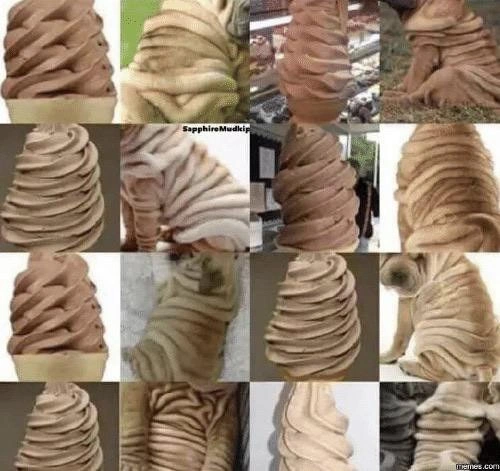
The image is a grid of beige and brown swirls. Some squares show soft-serve ice cream, and others show wrinkled dogs curled or folded in ways that imitate the same spiral texture. The post message calls it:

How to bully machine learning training

That is a good description because the collage is basically a tiny adversarial dataset for image classification. A human eventually uses context clues: cone edges, dog ears, paws, background, lighting, and body shape. A weak model, or a model trained on a lazy dataset, might instead latch onto easy visual shortcuts like tan color, curved ridges, vertical swirl shape, and soft texture. That is how you get a classifier that confidently learns "wrinkled beige spiral equals dessert," which is funny until someone asks why the pet detector keeps recommending toppings.

The senior ML lesson is shortcut learning. Models do not learn meaning just because the labels contain meaning. They learn statistical patterns that reduce loss on the training data. If the training set for "ice cream" overrepresents swirled cones on plain backgrounds, and the training set for "dog" underrepresents heavily wrinkled curled dogs, the decision boundary may be shaped around texture instead of semantic object identity. The model is not stupid in a human way; it is faithfully optimizing the wrong evidence. Very professional, very dangerous, and somehow still everyone calls the notebook "final_v7".

This is why dataset preparation and model evaluation matter as much as architecture choice. You need hard negatives, diverse examples, augmentations that do not destroy labels, and test sets containing exactly these annoying edge cases. A confusion matrix that looks clean on easy validation images can collapse when two classes share texture and color. The collage makes that failure visible: the classes are semantically obvious, but visually entangled.

The joke also works because it exposes the gap between pattern recognition and understanding. A neural network can be powerful without knowing that one object melts and the other has a tail. That is not a moral failing; it is the job description. The developer's job is to build the training and evaluation process so the model cannot get away with the wrong shortcut.

Description

A square collage shows many close-up beige and brown swirled shapes arranged in a grid. Some tiles are soft-serve ice cream cones, while others are wrinkled Shar Pei-like dogs whose folded skin and curled bodies closely resemble the ice cream texture; a small central watermark appears to read "SapphireTwilight" and the bottom-right corner has a "memes.com" watermark. The humor comes from the visual ambiguity: humans can eventually separate dessert from dog, but a naive image classifier might latch onto swirl texture, color, and silhouette instead of semantic context. For ML practitioners, it is a compact joke about feature leakage, brittle classification boundaries, and datasets that look clean until the edge cases start wagging.

Comments

1
Anonymous ★ Top Pick A model that learns `wrinkle == dessert` is just one production rollout away from recommending a cone with a tail.
  1. Anonymous ★ Top Pick

    A model that learns `wrinkle == dessert` is just one production rollout away from recommending a cone with a tail.

Use J and K for navigation