The Disconnect of Studying Software Engineering
Why is this Learning meme funny?
Level 1: No Computer, No Coding
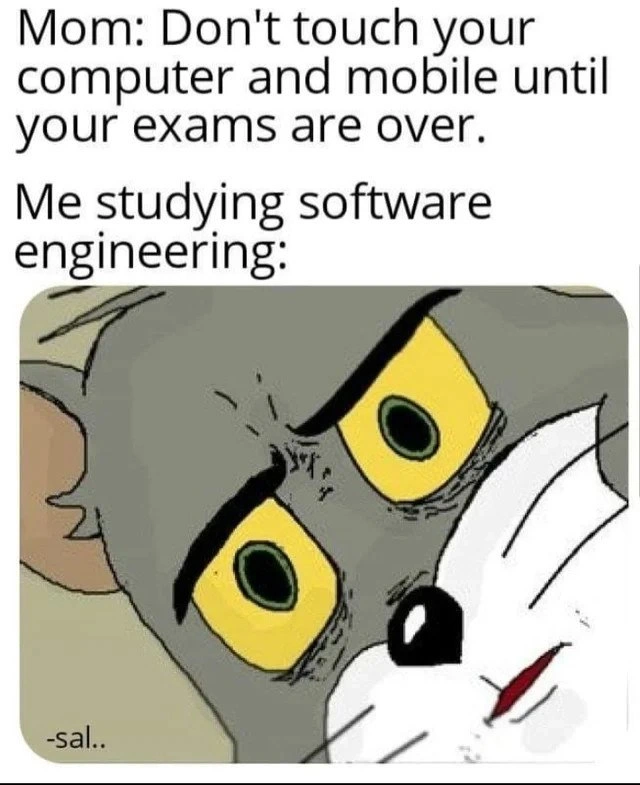
Imagine you have a big piano recital coming up for music class, but your mom says you’re not allowed to touch a piano until after the exam. You can read the sheet music and imagine the notes, but you can’t actually press the keys to hear anything. You’d probably feel pretty scared and shocked, right? 😧 How are you supposed to get better at piano if you can’t practice on a piano?! That’s exactly the situation in this meme. The student is studying programming, which is basically telling a computer what to do by writing instructions (code). But the mom has banned the computer and phone, which are like the main instruments you need to practice coding. The picture of Tom the cat with huge, wide eyes shows how the student feels inside: completely stunned and worried. It’s funny in a silly way, because everyone knows you need your tools to practice — it’s like telling a soccer player they can’t use a ball before the big game. The rule doesn’t make sense, and that nonsense is what makes us laugh. We feel a bit sorry for the student, but we also recognize the “oh no!” moment. In simple terms: if you take away the computer from a kid who needs to code, you get a panicked face just like Tom’s, and that’s the joke!
Level 2: Handwritten Code Blues
This meme shows a situation every programming student can sympathize with. A mom thinks she’s helping her kid focus by banning the computer and mobile phone until exams are over. The twist is that her kid is studying software engineering, a field where those “distracting gadgets” are actually the main tools for studying. The top text sets up the scene with Mom’s rule, and the image below (Tom the cat looking absolutely shocked) is labeled as the student’s reaction. It’s a perfect illustration of “Wait... what? How am I supposed to study without a computer?!”
To understand the student’s horror, let’s break down why a computer (and related tools) are so critical for a software engineering student:
- Computer (PC/Laptop): This is the primary device needed to write and run code. In software studies, you don’t just read about programming – you actually practice by coding on a computer. Without access to a computer, a student can’t execute any programs they write. It’s akin to a science student being locked out of the lab. No computer means no way to verify if your solution actually works.
- IDE (Integrated Development Environment): An IDE is an application where developers write code. Think of it as a super smart notebook for coding. For example, Visual Studio Code or IntelliJ are popular IDEs. They help by highlighting mistakes (typos, syntax errors) in your code with red underlines, auto-completing commands, and sometimes even suggesting fixes. An IDE often has a built-in run and debug feature, so you can test your program right there. If you forget a semicolon or misspell a variable, the IDE will usually point it out immediately. Without an IDE, the student loses these helpful features, making coding much harder.
- Compiler: A compiler is a program that takes the code you wrote (in languages like C++ or Java) and translates it into machine language (binary instructions) that the computer can execute. If there are errors in your code, the compiler will fail and show error messages explaining what went wrong (and where). It’s like a language translator and strict grammar teacher in one. In many courses, students write code and then compile it to see if it runs. If Mom says “no computer,” the student can’t run the compiler to test anything. They’d be writing code “in the dark,” only able to hope it’s correct.
- Test Rig / Environment: This refers to any setup needed to test the code in action. For instance, if the exam involves writing a mobile app, the student’s phone might act as a test device to try the app. If it’s a web programming course, the “test rig” could be a local server on the laptop that lets them run the website locally. In robotics or hardware-related assignments, it might be an actual device or circuit. Essentially, it’s whatever environment or equipment is required to run and verify the project. By confiscating the phone and computer, the parent has also taken away the student’s test environment. There’s no way to run the app on the phone or launch the project on a server — meaning the student can’t check if their code behaves as expected in real conditions.
With all these tools gone, the poor student is stuck studying theoretical material: reading textbooks, looking at printed code in notes, or writing code on paper with no way to run it. For a subject like history or biology, textbooks might be enough. But in programming, learning by doing is key. You learn a concept, then you try writing a small program to apply it. If you make a mistake, you run the program and get feedback (maybe a crash or an error message) and then you fix it. That cycle of writing and testing is how skills develop. Take away the ability to test, and the learning curve becomes much steeper. The student basically has to mentally simulate everything. That’s why we call it “handwritten code blues” – it’s the anxious, gloomy feeling of writing code out by hand, unsure if it’s right.
Early-career developers or students often have stories of this kind of scenario. Maybe it was a programming exam where they had to write code on paper. Many can recall the stress of double-checking your brackets and semicolons by eyeball, because you know you won’t get a second chance to run this on a machine. It’s a uniquely nerve-wracking academic experience in computer science. You end up practicing by tracing the code in your head, almost hearing the imaginary compiler. If you’re off by one character, the whole thing fails when finally tested – but you won’t know until it’s too late. That’s exactly why the student in the meme (represented by Tom) looks like he’s seen a ghost.
Now, let’s talk about Tom’s face. Tom is a cartoon cat from the classic Tom & Jerry series, and his wide-eyed, furrowed brow look here has become a staple reaction image in memes. Essentially, it visualizes extreme shock or “You’ve GOT to be kidding me!” feelings. By using Tom’s iconic expression, the meme communicates the student’s internal scream without words. It’s a funny visual exaggeration of the disbelief and panic that a software engineering student would feel in that moment. Even if someone isn’t familiar with coding, they can probably relate to that face — it’s the look you’d have if you suddenly found out something essential was taken away right when you need it most. For developers, it’s doubly relatable because we’ve literally had that face when code doesn’t compile or when environment access is revoked.
This meme falls into developer culture zeitgeist and general student humor at the same time. It’s common in tech circles to joke about how non-developers (like some managers or parents) don’t quite get what we do on the computer. Here, the parent assumes the computer and phone are just temptations pulling the student away from studying. The student knows the truth: those devices are part of studying. The clash of these viewpoints is comedic. It’s a relatable developer experience for anyone who’s had to convince their family that staring at code on a screen for hours is homework and not leisure. Essentially, the meme is taking a real-life misunderstanding and amplifying it in a humorous way that both students and professional devs find amusing. It’s that mix of frustration (ugh, parents don’t get it!) and recognition (yeah, been there) that makes the joke land so well.
Level 3: Paper Programming Paradox
At the top of this meme, a strict command is issued:
Mom: "Don't touch your computer and mobile until your exams are over."
Underneath, the caption “Me studying software engineering:” introduces the punchline: a close-up of Tom (the cat from Tom & Jerry) with bulging yellow eyes and a stunned expression. The humor hits immediately for anyone in software engineering. It highlights a paradox: a well-meaning parent bans "distractions" like a computer and phone, not realizing these are the essential tools a software student must use to study. This contradiction is the core of the joke. In the realm of DeveloperHumor, it’s a scenario of pure DeveloperFrustration: the very thing you’re examined on (coding) requires the devices that have been confiscated!
Seasoned developers can practically feel the panic behind Tom’s wide-eyed stare. It’s the same look you’d have if someone yanked away your keyboard and IDE the night before a coding project is due. Many of us remember StudentLife moments of handwritten code anxiety: being forced to write out code on paper or a whiteboard, hoping it works once finally typed in. It’s a rite of passage in programmer DeveloperCulture – from college exams to technical interviews – where you’re asked to produce syntax-perfect code with no machine to run it on. Tom’s alarmed face embodies that nightmare scenario. Without a computer, your brain effectively becomes your compiler, and it’s a notoriously buggy one.
Why is this so relatable? Because software development relies on a tight feedback loop: you write code, run it, see what breaks, and iterate. That’s core to a good developer experience (the DX that educators and tools try to optimize). Take away the computer, and that loop is broken—learning stalls. It’s like trying to debug blindfolded. You can’t actually compile your program or execute test cases in a REPL environment to catch mistakes. Small errors that an IDE or compiler would instantly flag might go unnoticed. For example, imagine a student attempting a quick Java snippet from memory:
// Code written without an IDE or compiler to test
class StudySession {
public static void main(String[] args) {
System.out.println("Practicing for exam") // Oops, missing semicolon!
}
}
Without an IDE’s red underlines or a compiler’s error message, a tiny mistake (see the missing semicolon ; above) would slip by. The student might feel confident on paper, only to get a rude surprise when they finally run the code on a computer. This paper-programming peril is what makes the scenario ironically funny and painfully accurate. The mom’s device ban transforms a practical learning process into a high-wire act of theoretical studying, exponentially increasing the LearningCurve for the student.
From a senior perspective, the meme also nods to a generational gap in understanding technology. Parents often equate computers and phones with Facebook, YouTube, or games — optional distractions during study time. In many subjects, that might be true. But in a software engineering degree, the computer is more like a laboratory. It’s where you practice coding, run experiments, and hone your craft. Telling a software student “no computer” before a coding exam is like telling a chemist “no lab equipment” before a chemistry exam. It’s absurd! The result? The student is left with nothing but theory and handwritten notes, and a mounting sense of exam_deadline_stress. Tom’s aghast expression says it all: “How am I supposed to work under these conditions?!”
This absurdity lands well with experienced devs because we’ve all been there in some form. Maybe our laptop died the night before a deadline, or company policy blocked access to Stack Overflow when desperately needed. The relatable developer experience here is the feeling of being expected to deliver software without the necessary hardware or software tools – a scenario bound to induce panic, but one we laugh at in hindsight. The meme cleverly exaggerates this to an extreme: a parent-imposed parental_device_ban right during crunch time. It’s funny now, but in the moment? Absolutely terrifying. And that blend of terror and comedy resonates deeply in developer culture, where we cope with frustration by sharing a laugh about it.
Description
A meme using the 'Unsettled Tom' or 'Concerned Tom' format from the cartoon 'Tom and Jerry'. The text at the top sets up a scenario: 'Mom: Don't touch your computer and mobile until your exams are over.' Below this, the context is given: 'Me studying software engineering:'. The image is a close-up of Tom the cat's face, looking highly suspicious and concerned, with wide, yellow, darting eyes and a furrowed brow. A small signature, '-sal..', is visible in the bottom-left corner. The humor arises from the complete misunderstanding of what it means to study software engineering. For a student in this field, a computer is not merely a distraction but the essential tool for learning, practicing, and completing assignments. The parent's well-meaning but ignorant command is impossible to follow, and Tom's expression perfectly captures the student's bewildered and frustrated reaction to the absurdity of the request

Comments
7Comment deleted
Sure, I'll stop using my computer. I'll just write my compiler in a notebook and run the test suite in my head. What could possibly go wrong?
Sure Mom, I’ll just run this Kubernetes cluster in my notebook margin - hope the invigilator brought extra pens for the Helm charts
It's like telling a surgeon not to touch any sharp objects while preparing for their medical boards - except in our case, the computer IS the patient, the scalpel, AND the operating room all at once
Ah yes, the classic catch-22 of software engineering education: 'Just study without your computer' - because clearly, we're supposed to mentally compile code, debug with our minds, and run unit tests using pure imagination. It's like telling a surgeon to study medicine without touching any medical equipment, or asking a pilot to learn flying without ever seeing an aircraft. But sure, Mom, I'll just whiteboard my way through distributed systems architecture, mentally trace through recursive algorithms, and visualize database normalization forms using nothing but paper and sheer willpower. Meanwhile, my IDE sits there gathering dust, my Stack Overflow tabs remain unvisited, and my localhost:3000 grows cold and lonely. The real kicker? When exam time comes and you realize the practical coding portion requires... wait for it... an actual computer
“No devices until exams are over” is the purest stakeholder requirement: ship software engineering without the toolchain - no laptop, no Git, no compiler; call it air‑gapped agile
“Don’t touch your computer till exams are over” is the pedagogical version of “resolve the incident without touching the logs” - great if we’re grading on imagination
SE exams offline? That's like refactoring without version control - pure masochism for the monorepo in your head