A Very Literal Pointer Implementation
Why is this CS Fundamentals meme funny?
Level 1: Pointless Advice
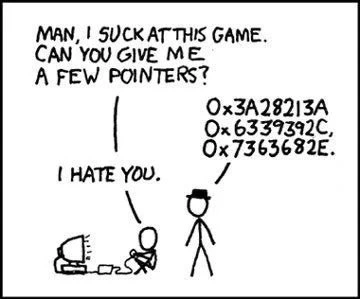
Imagine you’re playing a video game and you’re having a really hard time beating a level. You turn to your friend and say, “I’m so bad at this game. Can you give me a few pointers?” By “pointers,” you just mean some tips or hints to help you do better. But instead of telling you how to defeat the boss or where to find a power-up, your friend scribbles down a bunch of strange numbers like “0x3A28213A” on a piece of paper and hands it to you. These numbers look totally random and make no sense to you. You’d probably stare at that paper and then stare at your friend, feeling completely confused. Essentially, your friend acted like you literally asked for “pointers” as in pointing locations or coordinates, not advice. It’s as if you asked for help and they responded in a secret code that only they understand. Not very helpful, right? In the comic, that’s why the little gamer character eventually says, “I hate you.” He’s annoyed because he wanted advice, but his buddy was just being cheeky and gave him a useless answer.
The joke here is all about a mix-up in meaning. The word “pointer” can mean two things: in normal use it means a helpful hint, but in computer talk it can mean a kind of address or reference number. So the friend in the comic is playing a prank by answering with the wrong kind of pointer on purpose. It’s like if you asked your teacher for a pointer on your homework and they started giving you GPS coordinates instead of actually helping with the problems. You’d feel frustrated because you just wanted a simple hint, and they gave you something that sounds like gibberish. The humor comes from us, the audience, understanding that the friend is intentionally misunderstanding the request just to be silly. The gamer doesn’t find it funny at all (he just wanted help), but we laugh because we see the playful twist on words. In the end, it’s a simple idea: one friend asked for advice, and the other friend jokingly gave him nonsense instead, all because of a word that can mean two different things. It’s a little tale of a helpful request turning into a goofy misunderstanding.
Level 2: Not That Kind of Pointer
Let’s break down the joke in simpler terms. The confusion all revolves around the word “pointer.” In everyday language, asking for pointers means asking for tips, advice, or guidance. For example, “I suck at this game, can you give me a few pointers?” really means “Can you give me a few hints on how to get better at this game?” But in computer programming (especially in languages like C or C++), a pointer has a very specific meaning: it’s a variable that holds a memory address. In other words, a pointer “points” to a location in the computer’s memory where some data is stored. It’s a fundamental concept in low-level programming and MemoryManagement. You can imagine memory as a giant numbered grid (like an expansive set of mailboxes), and a pointer is like a slip of paper that says “go look at mailbox #1234 for the value.” The number 1234 would be the address. In code, such addresses aren’t usually expressed in plain decimal; instead, we use hexadecimal (base-16) notation, which is what those 0x... numbers in the meme are. The prefix 0x is a common way to denote that the number following it is in hex format. Hex uses digits 0-9 and letters A-F to represent values, and it’s very handy for representing memory addresses because it can compactly display large binary numbers.
So, when the friend in the comic replies with 0x3A28213A (and the other similar values), he’s literally giving out numerical memory addresses – the kind of thing you’d see if you asked a C program to print out the pointer value stored in a variable. To someone who isn’t a programmer (like our gamer), that reply looks like complete nonsense or some kind of cryptic code. It’s as if he asked for help and the friend responded in another language! No actual advice about the game was given. The joke is that the programmer friend intentionally interpreted “pointers” in the computer sense and responded with purely technical gibberish. This is why the gamer is upset and says “I hate you.” The friend’s answer was technically correct (those are pointers of a sort), but totally unhelpful in context. It’s the kind of cheeky literal answer that only makes sense to the programmer and leaves the other person feeling lost.
To put it in context with a concrete example, consider the C programming language. If we have a variable and we take a pointer to it, printing that pointer will yield a memory address often shown in hex. For instance:
#include <stdio.h>
int main() {
int score = 100;
int *p = &score; // p is a pointer to the memory address of 'score'
printf("Pointer to score: %p\n", (void*)p);
return 0;
}
Running this might output something like:
Pointer to score: 0x7ffeefbff4c8
Here 0x7ffeefbff4c8 is an example of a memory address (the exact hex value will differ each run). It’s the computer’s internal reference for where the integer value 100 is stored in memory. This is exactly the kind of thing the bowler-hatted friend gave: a bunch of %p style pointer outputs! By providing raw hex pointers, he basically treated the request as if the gamer had asked, “Can you give me a few memory addresses?” which is obviously not what was meant. It’s a classic inside joke among developers – we find it funny because we’re used to the concept of pointers in code and how inscrutable those values look on their own. We also recognize that no non-programmer would ever find those hex numbers useful.
A bit more about why this is humorous for tech folks: low-level programming concepts like pointers are notoriously tricky for beginners to grasp, but once you learn them, they stick with you. So the phrase “give me a pointer” can’t help but trigger that nerdy reflex. Many of us remember learning about pointers and feeling a bit confused at first (“Wait, it’s a variable that holds the address of another variable?”). In our minds, pointers are tied to things like addresses, NULL (zero) pointers, or even dreaded bugs (like accidentally using a bad pointer and causing a crash). So when someone says “pointers,” a seasoned C coder half-jokingly might think of those 0x... addresses or the act of pointing to memory. This comic plays on that exact reflex. The gamer on the left with the controller is using “pointer” in the normal way, but the programmer on the right with the hat flips it to the technical meaning.
It helps to know that the comic’s simple black-and-white stick figure style is very much like XKCD, a famous webcomic beloved by programmers. In XKCD, there’s a character often depicted with a black hat (sometimes called Black Hat or Hat Guy) who is known for his sarcastic, literal, and sometimes cruel humor. This meme mirrors that dynamic: Black Hat-type character hears “pointers” and can’t resist giving an obnoxiously literal answer. The text “0x3A28213A” etc., doesn’t have any obvious meaning to the gamer – it’s there to signal “this is a technical answer.” It might as well be random hexadecimal_pointers pulled from memory. The gamer’s reaction, “I hate you,” is the punchline that grounds the situation in reality: the friend’s joke went over their head and just frustrated them. If you’ve ever asked a super technical friend a simple question and gotten back an answer filled with jargon that you didn’t understand, you know exactly how that gamer feels! The humor comes from us (the meme viewers) understanding both sides: we get the computing reference and we see why, in a normal context, it’s a ridiculous and unhelpful thing to say. In short: the friend gave pointers, just not the kind of pointers that were asked for.
Level 3: Addressing the Problem
At first glance, this comic sets up a classic case of programmer pedantry colliding with everyday language. A frustrated gamer asks, “Can you give me a few pointers?” The word “pointer” has a double meaning here, and the humor comes from exploiting that ambiguity. In normal English, a pointer means a tip or piece of advice – essentially the gamer is asking for help or hints to play better. But to a low-level programmer (especially a C developer), a pointer is something entirely different: it’s a direct reference to a memory location. So the tall figure in the bowler hat (evoking the mischievous xkcd black-hat character) responds with a string of values that look like memory addresses in hexadecimal: 0x3A28213A, 0x6339392C, 0x7363682E. These are examples of raw hex data that a programmer might recognize as the kind of output you’d see when printing out pointer values or memory contents. The poor gamer was expecting gaming pointers (tips), but instead got literal pointers in C — as in actual memory addresses. Talk about addressing the wrong problem!
This joke hits home for experienced developers because it’s chock-full of inside jokes about how programmers think. First, there’s the LanguageQuirk: a common word like “pointer” has a very special meaning in programming. Seasoned devs have a habit of accidentally (or deliberately, as in this case) interpreting words in their technical sense. It’s a form of geeky wordplay. Ask a C programmer for “a pointer,” and don’t be shocked if they quip back with something like 0xDEADBEEF – that’s a familiar GeekHumor pattern. Here the tall friend’s reply is pure DeveloperHumor: instead of useful gaming tips, he’s spewing out what appear to be memory addresses. The notation 0x... is instantly recognizable to programmers as “this is a hex number.” In C and many other languages, pointers are often displayed in hex format (base-16) because it’s the conventional way to represent memory addresses (which are just numeric locations in RAM). So those odd strings beginning with 0x are basically him giving out “addresses” – literally a few pointers. It’s a pun taken to the low-level programming extreme.
What makes this especially funny to the programming crowd is how useless and absurd those hex pointers are in context. If you’ve ever debugged C code, you know that seeing a raw pointer value like 0x6339392C by itself is meaningless without context – it’s just an address in memory, not a magical cheat code or tip that will help you beat a game. By throwing hex at a gamer, the bowler-hatted troll is being knowingly unhelpful. It’s programmer pedantry at its finest: he’s technically giving “pointers,” just not the kind that was asked for. This kind of literal interpretation gag is reminiscent of classic xkcd-style humor, where the “Black Hat” character often takes someone’s request and twists it into a nerdy prank. The gamer’s deadpan response, “I HATE YOU,” is perfectly relatable – it captures that exasperation when a friend (especially a know-it-all programmer friend) responds to a sincere plea for help with a smug bit of wordplay instead of an answer. Many of us have been on one side or the other of that exchange, which is why it hits a nerve and elicits a laugh (and maybe a groan).
Diving a bit deeper, there’s also a touch of CS_fundamentals nostalgia here. Pointers in C are one of those topics that every computer science student grapples with. They’re powerful but can be confusing – a source of countless bugs and “I hate this” moments during debugging. The meme taps into that shared experience: the mere sight of those 0x hex values can trigger memories of chasing a wild pointer bug or deciphering a segmentation fault. It’s the ultimate inside joke for C veterans – as if the friend is teasing, “Here, have some raw memory addresses to figure out!” In reality, giving someone raw pointers with no context is like handing them the location of treasure on a map but in a code only a cartographer can read. No wonder the gamer is slumped over in defeat. The contrast between a simple ask (game tips, please?) and the obtuse answer (random-looking hex numbers) highlights the absurd literalism that programmer humor adores.
One more meta-joke here: many programmers seeing those specific hex values might instinctively try to decode them (we just can’t resist!). Do those hex codes translate to ASCII text? If you treat them as 32-bit chunks: 0x6339392C turns into the characters "c99," and 0x7363682E becomes "sch." – it almost looks like it might spell something (perhaps a sly nod to C99, the 1999 ISO C language standard, followed by “sch.”?). Or maybe it’s just gibberish meant to look convincingly pointer-ish. This extra layer – the temptation to find meaning in the hex – is itself part of the geeky fun. It’s as if the meme is daring the technically inclined to overthink it. Inside joke within an inside joke, anyone? Ultimately, whether or not the hex hides a secret message, the core joke stands on its own: the developer quite literally “gave a few pointers,” just not in the way the gamer hoped. It’s a perfect storm of LanguageQuirks and nerdy literalism, resulting in “I hate you” – a sentiment every onlooker understands, even as we chuckle at the ridiculousness.
Description
A classic black-and-white, stick-figure comic from the webcomic xkcd. On the left, a stick figure sits on the floor in front of a CRT monitor, looking frustrated. They say, "MAN, I SUCK AT THIS GAME. CAN YOU GIVE ME A FEW POINTERS?". Standing next to them is another stick figure wearing a black hat, who responds by providing three lines of hexadecimal numbers: "0x3A28213A", "0x6339392C", and "0x7363682E". The person on the floor simply replies, "I HATE YOU.". The humor is a technical pun based on the double meaning of the word 'pointer'. In everyday language, a pointer is a tip or hint. In low-level programming (like C or C++), a pointer is a variable that stores a memory address, often represented in hexadecimal format. The character in the hat has deliberately chosen the technical, literal interpretation, offering useless memory addresses instead of helpful gaming advice, much to the gamer's annoyance. This is a quintessential developer in-joke
Comments
7Comment deleted
The correct response should have been `&player.skill`. Be careful not to dereference it though, it's probably a null pointer
Classic dev move: translating casual advice requests into SEGFAULT waiting to happen
Those pointers are probably pointing to uninitialized memory in production, which explains why the game crashes - just like how your carefully crafted memory management strategy falls apart the moment marketing promises a feature that requires dynamic allocation in your embedded system with 2KB of RAM
This is the programming equivalent of asking your senior engineer for career advice and getting back a stack trace. The beauty here is that anyone who's spent time in C/C++ knows that 'a few pointers' is never just a few - it's a segfault waiting to happen, a memory leak in the making, and the reason we now have Rust. The real joke? Those hex addresses are probably more helpful than most code review comments you'll get on a Friday afternoon
Asking a C dev for “a few pointers” gets you three unaligned hex addresses and a follow‑up SEGV, not coaching - mentorship via undefined behavior
Mentorship, C edition: you ask for pointers, they hand you raw addresses with no ownership and now you’re on the hook for the segfault and the emotional memory leak
Ask a kernel dev for gaming tips: get hex pointers straight to segfault city