Skip to content
DevMeme
3626 of 7435
Thoughtful Questions or Just a Password Reset?
Security Post #3964, on Nov 23, 2021 in TG

Thoughtful Questions or Just a Password Reset?

Why is this Security meme funny?

Level 1: Trick Questions

Imagine you have a secret that only you are supposed to know – like a special password to unlock your tablet or a secret code to get into your clubhouse. Now think of a sneaky person who wants to find out that secret. They won’t just come up to you and say “Tell me your password.” That would be too obvious, right? Instead, they act super friendly and start a normal chat. It’s like if someone at school started talking to you and said, “Hey! I love dogs. Do you have a pet?” You say, “Yeah, I have a dog!” Then they ask, “Aw, what’s your dog’s name?” You might happily answer, “My dog’s name is Fluffy.”

Now, here’s the trick: suppose the password for your tablet or the code to your bike lock is actually your dog’s name (many people choose something like that because it’s easy to remember). By casually asking about your dog, that “friendly” person just figured out your secret code! They acted like they were just being nice and chatty, but really they wanted that information. You thought you were just talking about pets, but you accidentally gave away a key detail that can be used to get into your stuff.

That’s exactly what’s happening in the meme. The girl in the joke isn’t truly interested in how the guy’s day is going. Instead, she’s asking him sneaky questions that sound personal but could actually be the answers to his account passwords or reset questions. It’s like if someone asks you, “What’s your mom’s last name?” or “Which street did you live on when you were little?” out of nowhere. Those things are sometimes used as backup passwords for online accounts. Sharing them with a stranger is like giving away a secret answer that only you should know.

The reason this is funny is because it’s so obvious to us (the readers) that she’s up to no good. It’s like watching a cartoon where a character puts on a silly disguise that the audience can see through immediately, even if the other character cannot. We’re laughing because we recognize the “disguise.” We know those odd questions are trick questions. The poor guy in the scenario might just think, “Oh, she’s really interested in me,” but we’re thinking, “No dude, don’t answer that! It’s a trap!”

In simple terms: the meme is a joke about not giving away your secrets just because someone asks nicely. Even if they seem friendly, some questions are just too personal and suspicious. It teaches a little lesson: if a new friend or anyone at all starts asking things like your special childhood details, you might want to pause and wonder why they really want to know. Sometimes, a question isn’t just a question – it’s the key to something private, and you should keep those keys to yourself unless you’re sure it’s safe.

Level 2: Phishing in Plain Sight

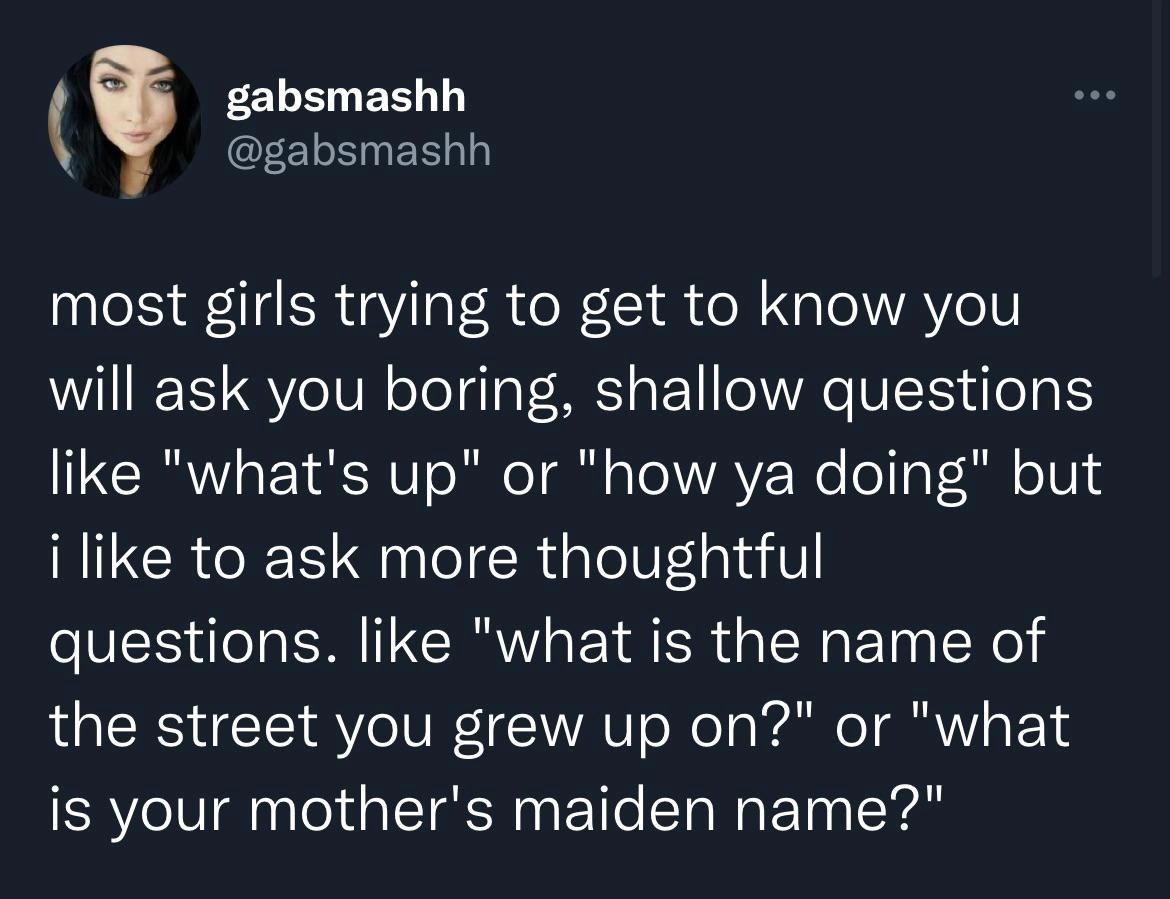
Let’s break down the joke in simpler terms. The meme shows a tweet where a girl says she likes to ask “more thoughtful questions” to get to know someone, and then she gives examples: “What is the name of the street you grew up on?” and “What is your mother’s maiden name?” If those questions sound oddly specific, it’s because they are. They’re classic security questions that many websites use to help verify your identity. For instance, when you forget your password, a site might ask you one of these questions that you set up earlier. The idea is that only you (the true account owner) would know the answer. This is a form of knowledge-based authentication – basically, proving who you are by answering a personal question.

Common examples of security questions include:

  • “What was the name of your first pet?”
  • “What street did you grow up on?”
  • “What is your mother’s maiden name?” (your mother’s last name before marriage)
  • “What was the make and model of your first car?”

You’ve probably seen questions like these when creating an account or resetting a password. They seem like harmless personal trivia. However, the meme jokingly shows someone asking these in normal conversation, which immediately hints that something phishy is going on.

Now, let’s define a few terms from the security world that relate to this meme:

  • Social engineering: This is a fancy term for tricking people into giving up confidential information or doing something insecure. Instead of hacking a computer through code, a social engineer “hacks” the person’s trust. For example, they might pretend to be from tech support and ask for your login credentials. In the meme, the girl is (jokingly) acting like a social engineer: she’s trying to get the guy to reveal personal security info by making it sound like friendly chat.

  • Phishing: A very common type of social engineering. Phishing usually refers to sending fake emails or messages that look legitimate to fool someone into sharing their passwords, credit card numbers, or other private data. The term comes from “fishing” because scammers dangle bait (a compelling story or fake website) and hope you bite. You’ve probably seen phishing emails – like those pretending to be your bank saying “Your account is in danger, click here to login”. In our meme’s scenario, there’s no fake email, but the concept is the same: one person is fishing for sensitive answers. She’s just doing it with a smile and personal questions rather than a scary email. It’s phishing hidden in plain sight – it doesn’t look like a scam since it’s wrapped in casual, friendly conversation.

  • Authentication: This means verifying who you are. When you log in to an app or website, you authenticate by providing credentials (usually a username and password) to prove your identity. Security questions come into play during authentication when you’ve lost your password or need an extra check. For example, if you click “Forgot my password,” a site might authenticate you by asking, “What’s your mother’s maiden name?” If you answer correctly, it trusts that you are indeed the account owner and lets you reset the password. The meme’s punchline is that by answering those questions to a stranger, you’d be handing over the exact info they need to impersonate you in an authentication process.

  • Security awareness: This refers to how knowledgeable or alert people are about potential security threats in everyday life. Someone with good security awareness would recognize that it’s unusual for a new acquaintance to ask these personal questions, and they’d be cautious or refuse to answer. The joke in the meme doubles as a little security awareness reminder: it makes you laugh, but also think, “Hey, if someone ever asks me that out of the blue, that’s fishy!” In other words, it’s raising awareness through humor.

  • Sensitive data exposure: Sensitive data is any information that should be kept private because if the wrong person gets it, they could misuse it. Things like your passwords, your social security number, or answers to your security questions are sensitive data. “Exposure” means that data is revealed or leaked to someone who shouldn’t have it. In the meme, if the guy were to answer those questions, he’d be exposing sensitive data about himself. It might not seem as sensitive as a password, but since those answers can be used to get into accounts, they are indeed sensitive. It’s akin to giving away a spare key to your house.

Now, tying it all together: The tweet is funny because the girl’s “more thoughtful questions” are blatant attempts to get answers that are normally used for account security. In a normal conversation, asking someone “What’s your mother’s maiden name?” would be an oddly specific and personal question – a big red flag. Most people would never think a friendly chat could actually be a password reset exploit, but that’s exactly what it could turn into. If the guy in the meme spills these answers, someone could go to his accounts (email, bank, etc.), click “Forgot password,” and attempt to reset the password by answering those questions correctly. Voila – they’ve essentially tricked him into handing over the keys to his digital life without him realizing it.

For a junior developer or anyone new to security, the meme is essentially illustrating how attackers bypass technical defenses by targeting the human side. You could have the best firewall or encryption, but if Bob in Accounting cheerfully tells a scammer his 401k account’s security answers over the phone, those tech defenses were bypassed with zero hacks – just conversation. It’s a reminder that data privacy isn’t just about what you do online, but also what you share with others in daily life. Personal details can be as good as passwords in the wrong hands.

So, in simple terms: The meme jokes that this girl is basically a hacker in disguise, asking a guy things only a trusted service should. It’s making fun of how people can be tricked if they’re not careful. The takeaway for us is understanding why those questions are important and why you should be guarded if someone casually asks you them. If you ever encounter someone asking you these “getting to know you” questions that match your account recovery questions, alarm bells should ring. It’s the kind of joke that also teaches a lesson: stay alert, because sometimes a friendly stranger may just be phishing for your secrets.

Level 3: When Flirting is Phishing

On the surface, this meme is written like a witty tweet about dating, but any seasoned developer or security professional will immediately see the red flags. The tweet’s author jokes that unlike other girls who ask “what’s up?”, she prefers more meaningful questions like “What is the name of the street you grew up on?” or “What is your mother’s maiden name?”. Of course, to those in the know, these aren’t thoughtful in a romantic sense – they’re literally the stereotypical security questions websites use for account recovery! The humor lands because it’s an absurdly direct example of social engineering hiding in plain sight. It’s as if a hacker threw on a wig and said, “Tell me about yourself… like, all the info I’d need to bypass your login.”

Why do tech folks find this so funny (and a tad horrifying)? Because we’ve seen this trick a hundred times in less obvious forms. It’s basically a phishing attempt dressed up as small talk. Phishing usually happens through scam emails or fake websites, but here the meme imagines it in a personal conversation. The attacker isn’t bothering with a fake login page or a spoofed email from your bank – she’s pretending to be an interested friend, doing some friendly reconnaissance on you. The tweet exaggerates it to the point of comedy: no real scammer would be quite this blatant on a first meeting. But by being overt, it lets everyone in on the joke. We immediately think, “Who on earth gets to know someone by asking that?!” and then the realization hits: someone trying to steal your secrets, that’s who.

This blend of dating banter with underhanded data mining is hilarious because it’s true to life, just usually more subtle. In reality, a social engineer might pepper these questions throughout a longer conversation or glean them from your social media over time. They might say, “Oh wow, you have siblings? I love big families – was your mom’s last name different before marriage?” in a casual tone. The victim might not suspect a thing and happily divulge, thinking they’re bonding. The meme cuts straight to the chase for comedic effect, which makes the security savvy reader smirk. It’s basically a nerdy inside joke: “Hey, those aren’t pick-up lines, those are password reset questions!” And if you’ve ever had to design or answer those security questions, you instantly recognize them.

We can all relate to this because many of us have encountered people oversharing personal details online without realizing the risk. Think about those viral social media quizzes that ask things like, “Your first pet’s name + the street you grew up on = your superhero name!” – they seem like silly fun, but they’re essentially harvesting answers to security questions under the guise of entertainment. Tech professionals often groan when they see friends posting those, because it’s basically casual phishing on a mass scale. This tweet captures that exact idea in one-on-one form. It’s the classic security awareness cautionary tale, but turned into a dating joke.

From an industry perspective, the meme is poking fun at a well-known anti-pattern in authentication: reliance on personal Q&A. Everyone in security knows these questions are a weak link, yet they persist in many systems. And everyone in tech has likely heard stories of accounts breached because the attacker guessed or obtained the victim’s security question answers. One famous case was a hacker accessing a public figure’s email by correctly answering where she met her spouse – something gleaned from an interview. Another notorious example: some attackers have simply called up a phone company or help desk, impersonating a customer, and provided these personal details to authenticate as them. Once past that checkpoint, the attacker can reset passwords or get further access. So when we see someone in a meme essentially volunteering to give those answers away, it strikes a chord. We laugh, but also nod, thinking “yep, this is exactly how people get owned.”

Let’s not forget the DataPrivacy angle: information like your mother’s maiden name or childhood street might seem mundane, but they’re part of your personal security profile. The meme’s joke format is a sneaky reminder that what we consider innocent small talk can actually be sensitive data exposure. If a random person you just met started asking for your mother’s maiden name out of the blue, most of us would feel uneasy – that instinct is correct! In a professional setting, we’re trained to question such inquiries: Why do they need to know that? The tweet is funny because it’s an obvious breach of social norms, highlighting the hidden motive. It exaggerates a scenario to make the lesson crystal clear: don’t give out private info just because someone asks in a friendly way.

For developers and IT folks, there’s an extra layer of recognition here. We’ve likely implemented or at least encountered these security questions in systems we use. We know that when a user clicks “Forgot Password,” the system might ask for a pre-set answer like your birth city. So we’re acutely aware that if those answers leak, it’s as bad as a leaked password. Seeing someone effectively ask for that data with a smile is the ultimate “OMG no” moment, wrapped in humor. It reminds us of all the internal meetings or security audits where this exact weakness is discussed. How many times have we heard colleagues sigh, “Users will literally give away their password if you just ask nicely…”? This meme is that sentiment distilled: the “nice ask” for the password reset answers.

The interplay of flirtation and hacking also taps into the absurd contrast – dating is built on building trust and sharing, whereas hacking is about exploiting trust and stealing. So the meme sets up a scenario where those two worlds collide. It’s both funny and a bit spooky to imagine. You chuckle because it’s presented as a joke, but you also can’t help thinking, I hope nobody actually falls for this! Spoiler: people do, which is why the joke exists. In security breach postmortems, it’s almost cliché to find out the breach started with a well-meaning person who thought they were just being helpful or polite.

In essence, this meme resonates with developers and security-conscious folks by taking a common hack technique – phishing for security answers – and placing it in a context we’d never expect it (a date or casual chat). It’s the contrast that makes it humorous and the authenticity that makes it insightful. We’re laughing at the “phisher” in the joke being so brazen, and at the same time laughing at ourselves because we know that in real life these tricks work precisely when people don’t recognize them. The next time someone asks out-of-the-blue, “hey, by the way, what was your high school mascot?” you’ll hopefully hear this tweet’s voice in your head and think twice. That mix of comedy and caution is what makes this meme a standout in security humor – it’s funny because it’s true, and it’s teaching a lesson without being preachy.

Level 4: The Human Attack Surface

At the highest level, this meme underscores a fundamental truth of cybersecurity: even the strongest system can be undone by the human factor. In security architecture, we often talk about attack surfaces – and humans themselves are an attack surface. This tweet humorously highlights how attackers exploit knowledge-based authentication (KBA) by targeting our personal knowledge. KBA relies on secrets that you, the user, are supposed to know but others wouldn’t – for example, the answers to those common security questions like your mother’s maiden name or the street you grew up on. Decades ago, such questions were considered reasonably private – a kind of secondary password only you could provide if you needed to verify your identity. But over time, the cracks in this method have become obvious. Why? Because humans are predictable and our personal data has become increasingly public.

In fact, to a security researcher, this “more thoughtful questions” joke is pointing straight at the weakest link in many authentication flows. Consider some well-known weaknesses of these supposedly secret questions:

  • Not Truly Secret: Many “secret” answers aren’t really secret at all. Your mother’s maiden name might be in public records or on your social media profile. The name of your first pet? Chances are you’ve mentioned Fluffy or Spot on Facebook or in conversation. Attackers do their homework – a tactic called OSINT (Open-Source Intelligence) – to scrape such personal info from the web.
  • Easy to Guess: Even without research, the answers are often guessable from limited choices or common trends. For example, a lot of people’s favorite color is blue blue, and many might answer “pizza” to a favorite food question. An attacker can script a few guesses and often hit the mark.
  • Socially Exploitable: Here’s where social engineering comes in – instead of technically hacking a system, an attacker hacks your trust. It’s shockingly effective: why brute-force a security answer if you can just ask the person in a friendly way? The meme’s scenario is a tongue-in-cheek example of this casual phishing approach. A clever attacker might not be as blunt as the joke implies, but the principle stands: people can be tricked into revealing their own security answers, especially if the question is posed in a disarming, personal context.
  • Reused and Recyclable: People tend to reuse not just passwords, but security question answers too. If one website gets breached and your security Q&A leaks (say, from an old forum or a lesser-secured app), attackers will try those answers elsewhere. Unlike a strong password, these answers are pieces of your life story – they don’t change easily. You can change a compromised password, but you can’t easily change your mother’s maiden name or the street you lived on as a child.

All these points reveal a core issue: relying on personal trivia for authentication is inherently risky. As systems have evolved, the industry has recognized this. Modern security design favors multi-factor authentication and one-time codes over static personal questions. Instead of just “something you know” (like a password or those security answers), we add “something you have” (a phone authenticator app or security token) or “something you are” (fingerprint or face ID). These additional factors are much harder for an attacker to get via a simple conversation. In fact, contemporary guidelines (like those from NIST) discourage using weak security questions at all, precisely because of how easily sensitive personal data can be obtained or guessed.

From a theoretical perspective, the meme lampoons the trust model of knowledge-based security. We assume those personal questions are shared secrets between you and the service – but if an attacker can trick you into sharing that secret with them, the model fails completely. It’s a human hack: rather than cracking encryption or bypassing a firewall, the “hacker” just sweet-talks their way past security. This highlights the famous adage: security is only as strong as the weakest link. Often, that weakest link is human psychology – curiosity, kindness, complacency – which attackers exploit. It’s both amusing and sobering that in an age of sophisticated exploits, one of the most effective attack strategies is still simply asking nicely for the keys.

To put it in perspective, legendary hackers have long noted how effective this tactic is. Kevin Mitnick, for example, famously used social engineering to bypass technical security – he’d call people on the phone, pretend to be an authority, and ask for passwords or confidential info. Why pick a digital lock when you can just persuade someone to hand you the key? The meme’s joke is basically a playful nod to this reality. It reminds us that while we can harden software and encrypt data, you can’t patch human gullibility as easily. The “girl” in the tweet is essentially performing an exploit on human trust, extracting authentication secrets under the guise of innocent questions.

In summary, at this deep technical level, the humor works because it exposes a design flaw in security practices: knowledge-based authentication is vulnerable by design, and an attacker’s easiest entry point is often through the person, not the code. The meme takes that concept and wraps it in a joke – making us grin, then nod in agreement. It’s a lighthearted illustration of a serious principle: the war for data isn’t only fought with code and crypto, but also with conversation. And sometimes, as this meme shows, breaching security can be as simple as asking the right “thoughtful” question.

Description

The image is a screenshot of a tweet from the user 'gabsmashh' (@gabsmashh) on a dark background. The tweet text reads: 'most girls trying to get to know you will ask you boring, shallow questions like "what's up" or "how ya doing" but i like to ask more thoughtful questions. like "what is the name of the street you grew up on?" or "what is your mother's maiden name?"'. The humor is derived from the unexpected twist where the 'thoughtful questions' are instantly recognizable to anyone in tech as standard security questions used for password recovery and account verification. This plays on the constant vigilance required in the digital age against social engineering and phishing attacks. For an experienced developer, it's a wry nod to how cybersecurity concerns have permeated even our understanding of social interactions, making one suspicious of seemingly innocent questions
Comments

16
Anonymous ★ Top Pick I'm not saying I have trust issues, but if you ask for my mother's maiden name on a first date, you'd better be prepared to answer with the MD5 hash of your favorite childhood pet's name
  1. Anonymous ★ Top Pick

    I'm not saying I have trust issues, but if you ask for my mother's maiden name on a first date, you'd better be prepared to answer with the MD5 hash of your favorite childhood pet's name

  2. Anonymous

    She asked for my mother’s maiden name; I replied with a WebAuthn challenge - if you can’t handle a FIDO2 handshake, we’re not establishing a session

  3. Anonymous

    The real red flag in dating isn't commitment issues, it's when they ask for your first pet's name and favorite teacher on the first date - either they're planning to reset your passwords or they're using deprecated KBA that NIST deprecated in 2017

  4. Anonymous

    When your dating profile doubles as a penetration testing reconnaissance phase. Pro tip: if she asks for your first pet's name and the city where you were born on the first date, she's either really into you or really into your AWS root account. Either way, enable MFA before responding

  5. Anonymous

    KBA: the only 'second factor' attackers can brute-force with OSINT and small talk; use WebAuthn

  6. Anonymous

    Why phishing emails when Tinder skips straight to password reset Q&A over drinks?

  7. Anonymous

    KBA is basically letting an attacker pivot from Shodan to Facebook - ship WebAuthn, not small talk

  8. @zherud 4y

    What is the name of your first pet.

  9. @Roman_Millen 4y

    "girls trying to get to know you" — what parallel universe is that from? 🤔

  10. @MrZarei 4y

    or like : Whats your ex's name 😂

    1. @RiedleroD 4y

      > What's your ex's name? > Oh really? Well, that's just bad taste then.

      1. @MrZarei 4y

        👌😁

  11. @karim_mahyari 4y

    What's programming here? Is she a dev or sth

    1. @sylfn 4y

      read questions again, they are sometimes being used for password restoring

      1. @karim_mahyari 4y

        Oh, didn't get that. Thanks

  12. @callofvoid0 4y

    seems dark

Use J and K for navigation