The Joy of Coding vs. The Avalanche of Everything Else
Why is this DeveloperProductivity meme funny?
Level 1: No Time to Code
Imagine you’re really excited to play your favorite game after school. You sit down to start playing, smiling because you finally have free time. But just then, your mom says, “Come set the table for dinner.” Okay, you do that quickly and come back to your game. You grab the controller… and now Dad calls, “Can you help me carry in the groceries?” You sigh but go help with the groceries. You return again, press start, and ring ring – your teacher is calling to remind you about homework due tomorrow. By the time you handle all these things, it’s bedtime and you never really got to play. Frustrating, right? In this meme, the developer (who loves coding like you love your game) keeps getting pulled away by meetings, emails, emergencies, and other chores. It’s like a tag-team of distractions body-slamming the poor developer’s chance to have fun coding. The picture is funny because it’s drawn as a goofy wrestling match, but the feeling is easy to understand: it’s what happens when you have too many things to do and no time left for what you really wanted to do.
Level 2: Flow Interrupted
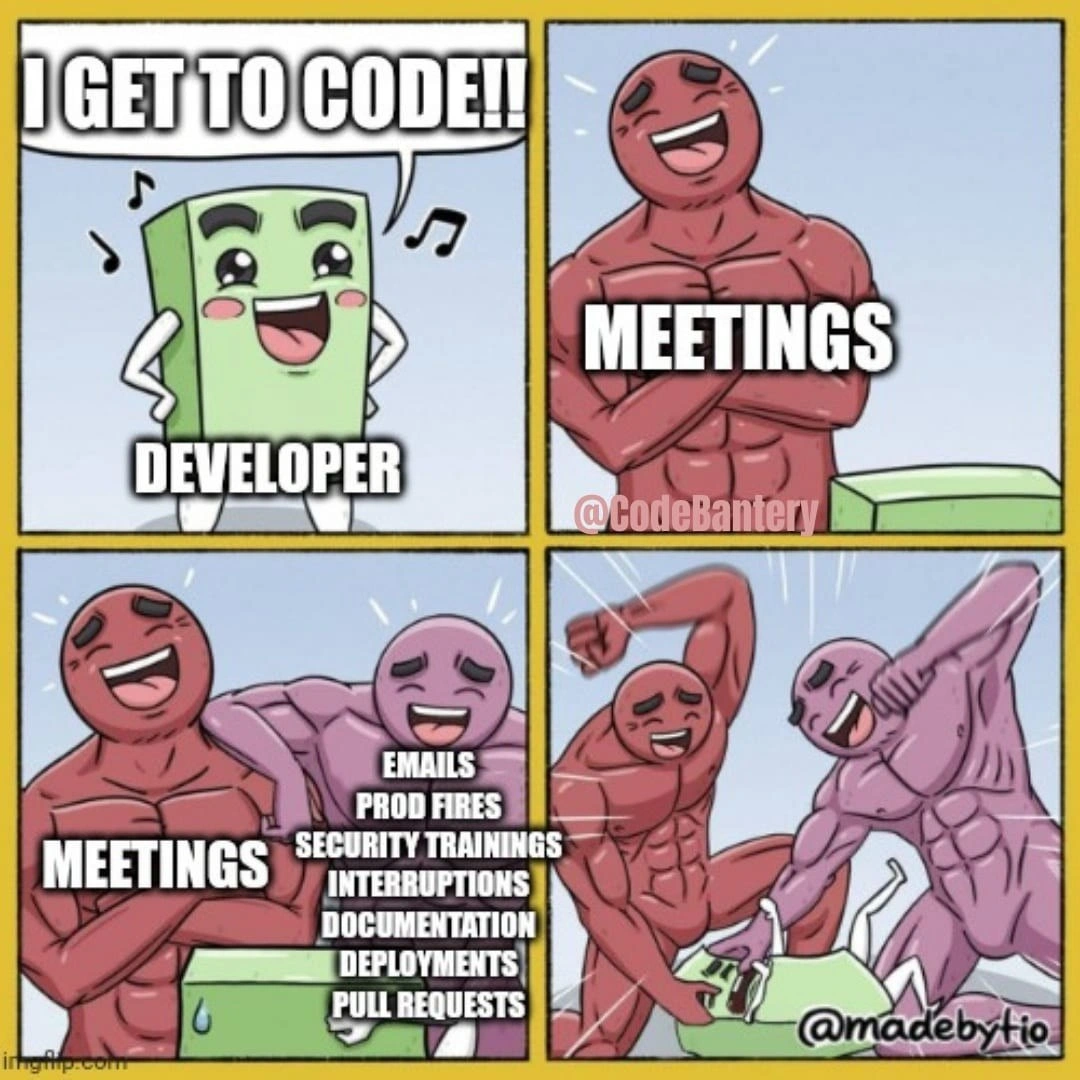
For a newer developer (or someone outside tech), let’s break down exactly what’s happening here. The meme is four panels showing a simple story:
Panel 1 (Dev excited to code): The green rectangle character labeled “Developer” is super happy, saying “I get to code!!” with musical notes around — meaning they finally have a chance to do the programming work they love.
Panel 2 (Meetings appear): Suddenly a big red muscular character labeled “MEETINGS” stands arrogantly with arms crossed next to the developer’s little green desk. This represents the moment when scheduled meetings start taking over the developer’s time. Meetings in real life are those gatherings or calls (like team sync-ups, planning sessions, daily stand-ups) that developers have to attend. They’re often important for communication, but here it’s depicted as a cocky villain because every meeting is time NOT spent coding. The @CodeBantery watermark suggests this scene is a tongue-in-cheek jab at corporate life.
Panel 3 (All the other tasks): Now that red Meetings guy teams up with a purple friend. The purple figure has a bunch of white text labels on it: “Emails, Prod Fires, Security Trainings, Interruptions, Documentation, Deployments, Pull Requests.” These are all the other tasks that hit a developer during the day:
- Emails: Reading and replying to emails from managers, teammates, or customers. It can eat up time, especially if you have to answer questions or coordinate things.
- Prod Fires: Short for “production fires.” It’s slang for urgent problems in the live product or website (“fire” as in crisis). For example, if the company’s app goes down or a serious bug is affecting users, developers must drop everything to fix it. This is high-priority emergency work.
- Security Trainings: These are those obligatory training sessions or online courses companies make everyone do, to learn about security, privacy, or compliance. (Think of those videos about not clicking phishing links or the quizzes about password safety.) Necessary, but not exactly fun coding time.
- Interruptions: This means any random interruption during work. It could be a teammate asking a quick question at your desk (or via chat), a manager calling you, or any unplanned task that stops your flow. Even a five-minute “hey can you help me real quick?” can break your focus.
- Documentation: Writing or updating documentation – like how to use a software feature, or recording what your code does for future reference. It’s a valuable part of the job (helps others and your future self), but it takes time and often isn’t as exciting as coding new features.
- Deployments: The process of releasing your code to an environment (like pushing new features to the production server). Deployments can be stressful and time-consuming – you have to coordinate, run build tools or scripts, monitor for issues, etc. During a deployment window, you can’t really do other coding; you’re ensuring everything goes smoothly.
- Pull Requests: In team coding, when someone finishes a chunk of code, they open a pull request asking teammates to review it. Reviewing PRs (pull requests) means reading someone else’s code changes, testing them, and giving feedback. It’s an important part of collaborative development (it helps catch bugs and share knowledge). But like everything else here, reviewing others’ code takes away from writing your own code at that moment.
In the meme, all these items are written on the purple character. That signifies everything besides meetings that a developer has to juggle. Notice they’re literally clinging to Meetings in panel 3, both characters laughing – it’s like all these duties are ganging up together. The watermark @madebytio implies the artist is adding their twist, showing how universal this pile-on feels.
Panel 4 (The slam): The climax: the purple “All Other Tasks” figure lifts the red “Meetings” figure and slams him down onto that little green desk (which either is the poor Developer or at least their workspace). In essence, the multitude of tasks (purple) even overwhelms the meetings (red) and together they crush the developer’s coding time. Think of the green desk as the coding space/time which just got smashed. It’s a dramatic cartoon way to say, “These tasks completely wrecked my plans to code today.”
So what’s the point? The meme humorously shows schedule_overload for a developer. It’s highlighting context switching, which is when you have to jump between different tasks and can’t stick to one long enough. Developers really value getting “in the zone” – that deep focus where you can hold a lot of code logic in your head (often called flow state). But if your day is segmented into a dozen little pieces, it’s super hard to reach that flow. Just as you get into coding, a meeting interrupts. After the meeting, you try to code again, but oh no, an urgent email or a Slack message pops up. Then you refocus, but soon it’s time for another meeting or you remember you must finish that mandatory security training module. Each context switch makes you spend extra time just recalling where you left off in the code. It’s like if you were reading a story but someone makes you stop every other sentence; by the time you return, you’ve forgotten the plot! This constant stop-and-go is terrible for developer productivity.
For a junior developer or someone new to the industry, it might be surprising just how little of your day might be pure coding. In school or personal projects, you might code for hours straight. But in a real workplace, collaboration and maintenance tasks take a significant chunk of time. Meetings are meant to coordinate work (like daily stand-ups where everyone says what they’re working on, or planning meetings to decide the next features). Emails keep you in the loop with other departments or users. On-call duties mean when something breaks in production, you drop everything to fix it (that’s the prod fire scenario). Code has to be reviewed (hence pull requests), and deployments have to be overseen. Even writing documentation and doing trainings is necessary to keep knowledge sharable and systems secure. All of these are part of a developer’s responsibilities in addition to coding. The meme is basically a funny exaggeration of a common complaint: “I have so many meetings and tasks that I feel blocked from coding!” If you’ve ever heard a developer joke that their job feels like “meeting, emailing, and ticket wrangling” with coding squeezed in the cracks, that’s exactly what’s being illustrated. It’s calling out the developer_vs_meetings struggle.
The context-switching problem is also why terms like “meeting overload” or too_many_meetings get thrown around in tech. If you’re new, you might wonder why people groan when another meeting invite appears — it’s because every meeting is a break in that precious focus time. Companies often encourage communication and teamwork (hence all the meetings and emails), but there’s a balance to strike. When communication overhead gets too high, developers end up coding in off-hours to actually get things done, which isn’t healthy. That’s why you’ll see productivity tips like blocking “makers time” on your calendar or having meeting-free afternoons. The meme uses humor to convey this message: the more stuff (meetings, emails, fires, etc.) you pile on, the less actual building (coding) gets done. And it definitely resonates with any junior dev who’s had their first experience of a day where writing code seemed impossible because of constant interruptions.
Level 3: Context Switch Smackdown
This meme paints a painfully familiar scenario for developers: a cheerful coder (the little green rectangular Developer character) is so excited humming “I GET TO CODE!!”. But lurking right next panel is a hulking red figure labeled MEETINGS, arms smugly folded, ready to block that coding joy. The humor hits hard because every experienced dev knows this feeling — just when you’re pumped to dive into the codebase, your calendar pops up with yet another meeting invite. Here, Meetings is personified as a buff wrestler, symbolizing how meeting overload can overpower a developer’s day. It’s a classic CodingLife satire: the enthusiasm to write code vs. the reality of office obligations.
The meme then upends our expectations in panels 3 and 4 with a wrestling-style twist. The red MEETINGS gets a tag-team partner: a purple character covered in a list of other typical developer interruptions – “Emails, Prod Fires, Security Trainings, Interruptions, Documentation, Deployments, Pull Requests.” These aren’t random; they’re basically a roll-call of all the things that hijack a programmer’s focus. In panel 3, Meetings and this Everything Else buddy are laughing together, basically saying, “Haha, you thought you’d code? Think again!”. By panel 4, the purple figure literally body-slams the red MEETINGS onto the poor green desk (which represents the developer’s workspace). This absurd slam is the meme’s punchline: it’s not just meetings preventing coding – even the meetings themselves get wrecked by higher-priority chaos (like a production outage), and either way the developer’s coding time gets crushed. It’s a MeetingHumor smackdown where the losers are unfortunately the dev’s concentration and developer productivity. The visual metaphor is over-the-top (a full wrestling takedown), but it nails an emotional truth. It’s portraying the daily battle with too_many_meetings and surprise tasks as an epic tag-team match. And like in any unfair fight, the coder’s focus is pinned to the mat.
Behind the comedy is a real technical truth about context switching. In computing, when a CPU switches tasks, there’s a cost: saving state, loading new state – it’s overhead that slows down throughput. Engineers often compare this to a developer switching from coding to a meeting and back again. Each time you stop writing code to jump into a Zoom call or chase an urgent bug, your brain has to swap out the “code context” and later page it back in. That mental context-switch is like invalidating your CPU cache – your flow state gets disrupted. Experienced developers know that if you have, say, a one-hour coding window between back-to-back meetings, you’re not going to crank out much significant work. The meme’s extreme depiction of a Context Switching Smackdown highlights that reality: constantly bouncing between tasks body-slams your flow. There’s even a famous concept of the Maker’s Schedule vs Manager’s Schedule (coined by Paul Graham) which senior devs often reference. Developers (makers) prefer long uninterrupted stretches to code deeply, while managers operate in hourly blocks with frequent meetings. Here the developer’s day has been forced into a manager-style chopped-up schedule, and it’s agonizingly unproductive. The schedule_overload shown is basically a maker’s worst nightmare: every time you try to focus, something else jumps in the ring.
This meme resonates as DeveloperHumor because it exaggerates a common workplace dynamic to absurd heights. The red “Meetings” being pile-driven by “Prod Fires” and friends is funny and painfully accurate. It hints at those days where you think “At least the afternoon meeting got canceled” – but that relief is short-lived when a prod fire (production outage) blows up your whole afternoon instead. DeveloperFrustration comes through in the subtext: the poor green developer doesn’t even get to appear in the last three panels; they’ve effectively been reduced to a green desk smashed under the weight of duties. It’s a comical way to show the dev getting completely blocked_from_coding by the endless onslaught of responsibilities. Every seasoned engineer has war stories of such days. You start out optimistic to tackle a feature, then get sucked into a morning of meetings. During lunch, an urgent email or a pager alert for a failing server (“prod fire”) lands. The afternoon brings a surprise security training video you have to finish before a deadline. Then a teammate pings you with “Could you quickly review my pull request?”, and of course the deployment to production you scheduled gets done last thing, eating into your evening. At that point, your brain feels like it’s been in a cage match. This cartoon cleverly captures that collective experience — a bit of WorkplaceHumor that engineers share with a knowing, bittersweet laugh.
Notably, even the solution isn’t simple, which adds to the meme’s senior-level grin. It’s tempting to say “just decline meetings and you’ll get to code,” but often you can’t. Many meetings are necessary for communication and alignment (you can’t exactly skip the sprint planning or the design review with your team). The other tasks are equally non-negotiable: you can’t ignore a production outage, you shouldn’t postpone critical compliance trainings forever (unless you enjoy HR’s chase), and code doesn’t deploy itself without oversight. So the schedule overload is a systemic problem. Companies try things like “No-Meeting Wednesdays” or block out “focus time” on calendars to guard coding hours, but in practice, fires and ad-hoc tasks still pop up. The meme’s wrestling metaphor humorously suggests that all these obligations are effectively teaming up against your poor coding time. It’s an exaggeration, yet it feels so true. That mix of catharsis and commiseration is why developers are tagging this meme with MeetingOverload and developer_vs_meetings. We laugh because otherwise we’d cry — seeing “coding time” get body-slammed is funny in a cartoon, but it hits close to home after a week of fragmented workdays. In short, this panel of buff, brawling chores perfectly sums up the modern dev’s predicament: our passion for coding is strong, but the onslaught of meetings and miscellaneous tasks is even stronger, often suplexing our best intentions by 3 PM.
Description
A four-panel comic based on the 'Pillarmen' or 'Awaken, My Masters' meme format from JoJo's Bizarre Adventure, illustrating a developer's typical day. In the first panel, a cheerful, green, box-like cartoon character labeled 'DEVELOPER' exclaims, 'I GET TO CODE!!' with musical notes in the air. The second panel introduces a giant, muscular, red humanoid figure labeled 'MEETINGS' looming menacingly. The third panel shows the 'MEETINGS' figure joined by a similarly muscular purple figure, which represents a list of other tasks: 'EMAILS', 'PROD FIRES', 'SECURITY TRAININGS', 'INTERRUPTIONS', 'DOCUMENTATION', 'DEPLOYMENTS', 'PULL REQUESTS'. In the final panel, both muscular figures are gleefully beating up the small developer character. The meme humorously captures the core frustration of many software engineers: the desire to engage in 'deep work' and write code is constantly thwarted by a barrage of meetings, administrative tasks, and urgent operational duties, leading to context switching and reduced productivity
Comments
8Comment deleted
The only thing that scales faster than our production services is the number of meetings required to discuss scaling our production services
My calendar is basically a Kubernetes node: Meetings hog all the CPU, prod fires spin up privileged pods, security drills add sidecars, and the one lonely container named “Actual Coding” keeps getting OOM-killed
The real distributed system challenge isn't CAP theorem - it's trying to maintain code consistency while your brain is partitioned across 47 different Slack threads, three production incidents, and a mandatory security training that could've been an email
The irony is that we've built asynchronous systems that can handle millions of requests per second, yet we still can't figure out how to let developers work asynchronously without scheduling synchronous meetings to discuss why our async processes aren't working. Meanwhile, that 'quick sync' just cost you two hours of flow state and the mental context of which microservice was throwing the 503
We practice MDD - Meeting‑Driven Development; per Little’s Law, with WIP=meetings and cycle time=email threads, throughput ≈ 0 LOC/sprint
Coding builds features; prod fires, PRs, and trainings build biceps - and that sweet SRE glow-up
imo reviewing PRs isn't too bad Comment deleted
Support Comment deleted