Skip to content
DevMeme
3309 of 7435
The Sleep-Deprived Developer's Journey into Mordor (aka Yesterday's Code)
Debugging Troubleshooting Post #3633, on Sep 2, 2021 in TG

The Sleep-Deprived Developer's Journey into Mordor (aka Yesterday's Code)

Why is this Debugging Troubleshooting meme funny?

Level 1: Even Wizards Need Sleep

Imagine you're trying to solve a really hard puzzle or finish your homework very late at night. You're so tired that the pieces all look the same and you even start forgetting what you were trying to do. You might stare at a puzzle piece and think, "Where does this go?" or look at a math problem and say, "I don't even remember how to do this." This meme is joking about exactly that feeling, but in the world of computer programming. It shows a very wise wizard named Gandalf looking confused and saying, "I have no memory of this code," as if he forgot what he was working on. The funny idea here is that even someone as smart and magical as a wizard can get totally lost if they're exhausted. The text above the wizard is a message that basically says: the best way to fix a problem in your code is to get a good night’s sleep. In simple terms, when you're really tired, your brain gets foggy and you can’t think straight – you might even forget things you knew. But after you sleep and rest, you return fresh and suddenly everything is much clearer. It’s like magic: the confusing puzzle pieces now fit together, and the homework question that made no sense last night is easy in the morning. So the meme is both funny and true to life. It’s telling us that sometimes the smartest thing to do when we’re stuck and frustrated is just go to bed. Even a great wizard needs to rest to figure things out, and so do we. After a good sleep, we can remember what we’re doing and solve problems much more easily – almost as if the answers appeared overnight!

Level 2: Code Amnesia

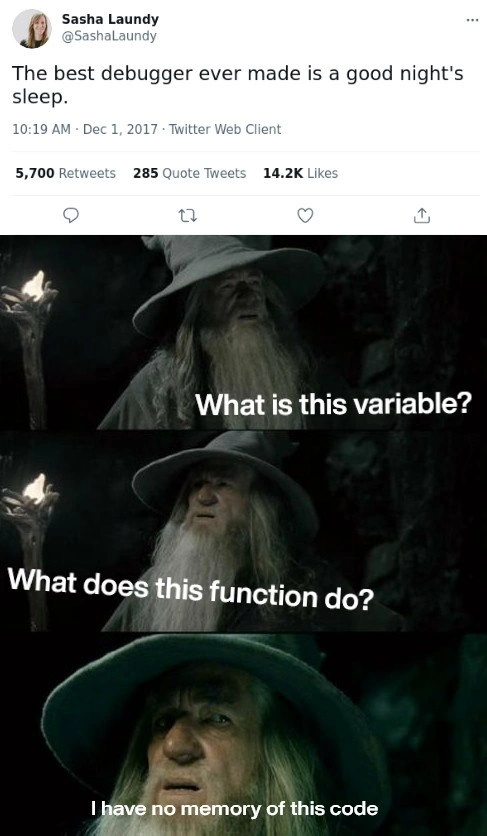
This meme shows a relatable scenario for developers, framed in a fun way. At the top, we have a screenshot of a tweet (a short public message on Twitter) from a programmer named Sasha Laundy stating that "the best debugger ever made is a good night's sleep." In programming, a debugger is a tool or program that helps you find and fix errors in your code by letting you inspect variables, step through code line by line, etc. So saying a good night's sleep is the best debugger is a humorous claim that sometimes stepping away and resting does more to solve a tricky problem than any software tool can. Below the tweet, the meme uses scenes of Gandalf (the wise wizard from The Lord of the Rings movies) looking confused and lost. The text over Gandalf’s images has him asking very basic programming questions: "What is this variable?", "What does this function do?", and finally "I have no memory of this code." These are things a developer might mutter when they're looking at code that they don't understand or don't remember writing.

Let’s break down the programming terms being referenced:

  • A variable in code is like a container that holds some value or data. It has a name so you can refer to that data later. For example, if a program has a variable called speed = 10, that means there's a piece of data named "speed" storing the number 10. When Gandalf (the developer) asks "What is this variable?", it implies he’s looking at a variable in the code and cannot remember or figure out what it's for. Maybe it’s named poorly or he’s so tired that he forgot its purpose.
  • A function is a reusable chunk of code that performs a specific task or calculation. You can "call" (run) a function whenever you need that task done. For instance, you might have a function calculateTotal() that adds up a list of numbers. When Gandalf asks "What does this function do?", it means he's staring at a function in the code and honestly doesn't know what its role is. Perhaps the function name isn’t clear (like process() or handleData() which are vague) or he hasn’t looked at this code in a long time.
  • "I have no memory of this code" is pretty straightforward: the developer cannot recall writing the code or the code’s logic at all. This phrase is directly spoofing a famous moment in Lord of the Rings where Gandalf says, "I have no memory of this place," indicating he's lost in the mines. In the meme, it humorously suggests the developer is totally lost in their own program, as if the code base is a dark, labyrinthine mine and even the wise wizard is bewildered by it.

Why would a programmer ever forget their own code or be unable to answer such basic questions about it? There are a few common reasons:

  1. Time lapse: If the code was written a long time ago (say, months or years), the person may simply not remember the details. Code can be complex, and our memory fades if we don't revisit it.

  2. Lack of clear naming or comments: If variables and functions have unclear names (like x, data, or doStuff()), it’s not obvious what they represent or do just by reading them. Without descriptive names or comments (notes in the code explaining things), even the original author can get confused later. For example:

    # Code written in a rush at 2 AM
    value = 42
    def process():
        return value * 2
    
    # Next morning, the developer is scratching their head:
    # "What is 'value'? What does 'process' do?" - They honestly forgot the purpose.
    

    In this snippet, value is a variable and process() is a function, but their names are so generic that they don't reveal intent. Looking at this cold, you might not know why you're doubling that value or what it's used for. That would definitely make you ask, "What is this variable? What does this function actually do?"

  3. Fatigue or sleep deprivation: When you’re extremely tired, your brain doesn’t form memories or think clearly. If you wrote some code late at night, you might literally not remember the next day what you did or why. Also, when you're exhausted, reading code feels much harder; you keep rereading the same line and nothing clicks. This meme really emphasizes the fatigue aspect. The joke is that the developer’s mind is so foggy (like Gandalf in a dark cave) that even their own code looks unfamiliar.

The tweet at the top is offering a solution to this problem: sleep. The phrase "sleep on it" is common advice meaning take a break from the problem and rest; you'll have a fresh perspective later. In the context of programming, many of us have experienced this: you're stuck on a bug or you're so confused by the code late at night, but after getting a good night's sleep, the problem suddenly seems obvious and much easier in the morning. That’s why the tweet calls sleep "the best debugger ever made." It humorously suggests that no debugging tool or technique is as effective as just being well-rested. When you wake up, you often find you can identify the mysterious variable or recall what that function does. Your brain performs better when it's not exhausted.

The Gandalf panels underscore how silly and helpless we can feel when we try to continue debugging in a state of exhaustion. Gandalf is a symbol of wisdom, yet here he's blankly admitting "I have no memory of this code." It’s funny and relatable because every developer, even the experienced "wizards" of coding, sometimes sits in front of their screen utterly baffled by something they themselves wrote. The meme is basically saying: “Hey, we’ve all been there – staring at code like a zombie, not remembering a thing. Don’t worry, it’s not that you’re dumb, you’re probably just tired. Go get some rest!”

This ties into a bit of advice about developer productivity and mental health: Taking care of yourself (like getting enough sleep) is crucial in programming. If you push yourself too hard and ignore rest, you end up with DebuggingFrustration — lots of errors and confusion. New developers often feel like they have to solve the problem right now, even if it's late. But as this meme humorously points out, sometimes the smartest move is to close the laptop, get some sleep, and come back with a clear mind. Even a legendary wizard needed a break to find his way; likewise, your brain will work much better after recharging. In fact, there’s a known trick among programmers called "rubber duck debugging" – where you explain your code out loud to a rubber duck or any inanimate object as if it were listening. The act of explaining can reveal mistakes. But honestly, if it’s 3 AM and you find yourself needing to ask a toy duck why your code isn't working, it's probably a sign that you should just call it a night. You’ll likely solve the unsolvable bug in minutes after some quality sleep, because your mind will be fresh. So, the big takeaway for a newcomer is: don't underestimate the power of rest. It might feel like you're Superman staying up to fix code, but even Superman needs sunlight – and you need sleep to recharge your mental superpowers.

Level 3: Cache Miss at 3 A.M.

This meme perfectly skewers a truth every seasoned developer knows: after enough LateNightCoding, your brain starts behaving like a buggy program with a memory leak. The top panel is a tweet from software educator Sasha Laundy proclaiming, "The best debugger ever made is a good night's sleep." Below it, we see Gandalf in the Mines of Moria (from Lord of the Rings) looking utterly perplexed in three successive frames. Each frame captions Gandalf with a programmer's internal monologue: "What is this variable?", "What does this function do?", and finally "I have no memory of this code." It's a nerdy double-reference: Gandalf's famous line "I have no memory of this place" is repurposed to depict a coder's brain fog. The juxtaposition lands as comedic gold: even a wise wizard (think "senior developer" archetype) is shown fumbling with code like a sleep-deprived junior dev. The humor works on two levels – it's referencing an iconic movie scene and nailing a daily reality of debugging under fatigue.

On an industry level, this meme highlights the irony that debugging isn't always about fancy tools or superior intellect; often it's about mental clarity. A veteran engineer will chuckle (and maybe wince) because they've been Gandalf asking "Who wrote this goblin code?" only to realize it was them, at 3 AM, after the 5th cup of coffee. The meme’s core joke is that no IDE plugin or logging framework can save you when you’re running on fumes – you start questioning fundamentals of your own code. The questions “What is this variable? What does this function do?” are funny because they’re so basic that of course the author should know the answers. If Gandalf – the ultimate wise old mentor figure – can’t recall the code, what hope do we mere mortals have when we’re sleep-deprived? It’s an exaggeration of that panicked confusion a developer feels when staring at mysterious legacy code (or even last week’s code) and nothing makes sense. In reality, this happens when you dive back into a complex module you wrote months ago, or when you've been staring at the screen far past midnight. The code might as well have been written in Elvish runes for all you recognize it. “I have no memory of this code” is a comical way to admit “I have no idea what I was thinking when I wrote this.” Every programmer has experienced that surreal moment of code amnesia, where you open a file and genuinely wonder who the heck implemented this nonsense... only to git blame and discover your own name.

But why is a good night's sleep dubbed the "best debugger"? There's some real cognitive science under the hood of this joke. When you've been debugging for hours, especially late at night, your working memory and attention are depleted – it's like your brain's RAM is full and every thought swap hits the disk (a mental cache miss). You read the same code 10 times and miss the obvious bug because tunnel vision has set in. Sleep deprivation creates diminishing returns: the more you stare, the less you see. In extreme cases, you literally forget what your own code does, just as Gandalf seems to forget the very spells he himself wrote. Seasoned developers have learned the hard way that the most productive thing you can do when stuck is often to step away. Get some sleep, take a walk, let your subconscious work on it. There's a well-worn joke in engineering teams: "Spent 5 hours debugging at night, fixed it in 5 minutes next morning." It rings true because our brains do a lot of background processing when we're rested. During REM sleep, your mind is essentially performing a garbage collection on the day's information overload – consolidating important bits into memory and sweeping out the useless clutter. This is the biological equivalent of defragmenting a hard drive or clearing your RAM. No wonder that bug or elusive variable suddenly becomes clear after you reboot yourself overnight. Your brain awakens with a cleared stack and fresh perspective, instantly spotting that missing semicolon or flawed logic that was invisible at 2 AM. In short, sleep is like a secret debugging superpower. 💤

From a senior developer's perspective, this meme also wryly comments on tech culture and developer productivity. In many workplaces (or during passion projects), there's an unwritten heroism about pulling all-nighters and crushing code with sheer willpower. But the reality is that sleep deprivation will turn even a Gandalf-grade guru into a confused apprentice. Cutting sleep to chase a bug can be counterproductive – you introduce more bugs or make no progress because your cognitive skills are impaired. It’s the programming equivalent of diminishing returns: after a certain hour, each additional line of code you write (or read) while exhausted has a high chance of being wrong or not registering in your memory. The tweet highlights this with elegant simplicity: instead of reaching for another debugging tool or cranking out more print statements, maybe the best tool is a pillow and a solid 8 hours of rest. It's a humorous slap on the wrist to developers who glorify hustle at the expense of health. The meme’s punchline carries a gentle "take care of yourself" message. After all, how many horror stories begin with "It was 4 AM and I decided to deploy..."? Even the best debugger (whether hardware or wizard) is useless if the human driving it is running on empty. So the entire collage is, in a tongue-in-cheek way, advocating for sanity in coding practices: fix the bug in your brain (fatigue) before fixing the bug in the code. And honestly, who can argue? Even Gandalf would nod sagely and send the dev to bed rather than fight a Balrog of a bug half-asleep.

Description

This meme combines a screenshot of a popular tweet with a three-panel comic format. At the top, a tweet from Sasha Laundy (@SashaLaundy) states, 'The best debugger ever made is a good night's sleep.' Below this, the meme uses the 'Gandalf in the Mines of Moria' or 'I have no memory of this place' template from 'The Lord of the Rings'. In the first panel, a confused Gandalf is captioned with 'What is this variable?'. The second panel shows him looking even more puzzled, with the text 'What does this function do?'. The final panel is a close-up on his bewildered face, captioned, 'I have no memory of this code'. The meme humorously illustrates the consequence of ignoring the advice in the tweet. It perfectly captures the all-too-familiar experience of a tired developer returning to their own work and finding it completely alien, as if written by a stranger. This feeling of 'code amnesia' is a universal pain point for senior developers who've experienced the effects of burnout and cognitive overload

Comments

11
Anonymous ★ Top Pick The best debugger is a good night's sleep. The second best is `git blame`, just to confirm the hobbit who wrote this incomprehensible mess at 3 AM was, in fact, you
  1. Anonymous ★ Top Pick

    The best debugger is a good night's sleep. The second best is `git blame`, just to confirm the hobbit who wrote this incomprehensible mess at 3 AM was, in fact, you

  2. Anonymous

    When the codebase starts feeling like Moria and you’re Gandalf muttering “I have no memory of this code,” it’s time to `git checkout -b pillow`; Future-You can fight the Balrog after eight hours of stack restoration

  3. Anonymous

    After 20 years in the industry, I've learned that the subconscious mind runs background garbage collection on technical problems while you sleep - it's basically a JVM for your brain, except it actually works and doesn't require tuning heap sizes at 3 AM

  4. Anonymous

    Ah yes, the classic debugging workflow: Step 1 - Write brilliant code at 2 AM. Step 2 - Sleep on it (literally). Step 3 - Wake up to discover you've invented a new form of job security through aggressive obfuscation. The real question isn't 'What does this function do?' but rather 'Why did past-me think a variable named `tmp2_final_ACTUAL` was self-documenting?' Sleep may clear the bugs, but it also performs an aggressive garbage collection on your working memory - turns out your brain doesn't implement persistent storage for context. This is why senior engineers insist on documentation: not for others, but for the stranger you become after a weekend

  5. Anonymous

    Best MTTR hack: run an 8-hour GC on the human heap; after sleep, tmp2 finally reveals itself as domain_event_payload

  6. Anonymous

    My cheapest performance tool is REM: it flushes the human instruction cache so morning-me can diff yesterday's 'x' into 'customer_segments' and delete the 3am workaround

  7. Anonymous

    Sleep: the only debugger that enforces total context eviction, turning your commits into a stranger's legacy code

  8. dev_meme 4y

    Do you like forgetting things spontaneously ?

  9. @adhdnigga 4y

    No.Lies. I slept 2 days and my bug didn't disappear

    1. ẞonny 4y

      Thats not enough

    2. @azizhakberdiev 4y

      U should have a GOOD sleep

Use J and K for navigation