Sleep Sort: The O(wtf) Asynchronous Sorting Algorithm
Why is this CS Fundamentals meme funny?
Level 1: Wait for It...
Imagine you have a bunch of alarm clocks, each with a different number written on it. You set each alarm clock to ring after that many seconds. So, the clock labeled "1" will ring after 1 second, the one labeled "8" rings after 8 seconds, the one labeled "42" after 42 seconds, and so on. Now, when you listen to the bells, which one goes off first? The clock set to 1 second rings first, then the 2-second alarm, then 8 seconds, then 38, 39, 42... and finally the one set for 111 seconds rings last. You hear the ringing in order from the smallest number to the largest number. In a playful way, you’ve just "sorted" those numbers by using time! The smallest number made its sound first and the biggest number made its sound last. It’s a silly method (normally, you'd just compare numbers directly to sort them), but it does work: by waiting different amounts of time, each number kind of "took its turn" in ascending order. This is exactly what the meme’s code does with printing numbers – each number waits for its own value in milliseconds before saying "here I am!", so the little ones come out first and the big ones come out later. It's like making the numbers line up by telling them "wait your number of milliseconds before stepping forward." Pretty funny way to do it, right? In the end, it's showing that sometimes in coding, you can solve a problem in a zany offbeat way just for a laugh, even though you'd never do it that way for real!
Level 2: Sleep Sort Trick
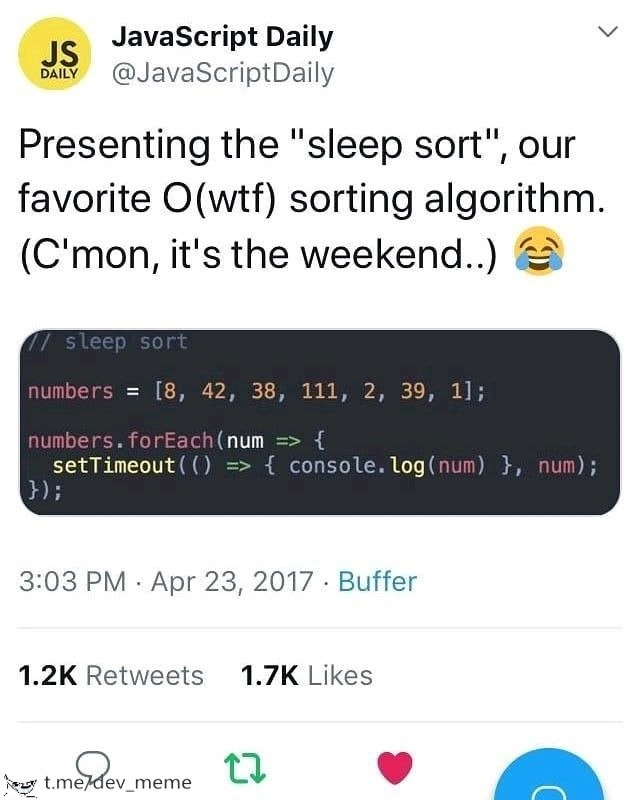
Let's break down what's happening in this code and why it's funny. We have a JavaScript snippet labeled // sleep sort. The code is:
numbers = [8, 42, 38, 111, 2, 39, 1];
numbers.forEach(num => {
setTimeout(() => {
console.log(num)
}, num);
});
What does this do? It goes through each number in the array and uses setTimeout to print (console.log) that number after num milliseconds. In JavaScript, setTimeout(fn, delay) is a built-in function that schedules fn (a callback function) to run after the given delay (in milliseconds). It’s a classic asynchronous programming feature: the function returns immediately, and the actual work (fn) happens later, "in the background" so to speak. Here, the callback simply logs the number. So, for example, the number 8 will get printed after 8 ms, 42 after 42 ms, 1 after 1 ms, and so on. All these timers are set almost instantly one after the other because forEach is looping through the array normally. Then as time goes by, each scheduled task "wakes up" and prints its number to the console.
The result? The numbers get printed out in increasing order of their value:
1
2
8
38
39
42
111
Why in sorted order? Because a smaller number means a shorter wait. The number 1 triggers after 1 millisecond (practically immediately), 2 triggers after 2 ms, then 8 after 8 ms, ... up to 111 ms for the largest number. So the sequence of console outputs appears sorted from the smallest to largest number without any conventional sorting logic! This is the trick: it uses time delays as a sneaky substitute for sorting comparisons.
Now, in a typical scenario, how do we sort an array of numbers? Usually by using a sorting algorithm like bubble sort, merge sort, or by calling JavaScript's built-in numbers.sort() method. Those methods rearrange the elements by comparing numbers to each other and swapping or partitioning until everything is in order. They have well-defined time complexities (like O(n log n) for good algorithms, meaning roughly proportional to n times the logarithm of n, where n is the number of elements). Big O notation is a way for computer scientists to describe how the runtime of an algorithm grows as the input size grows – for instance, O(n) means if you double the number of elements, the time roughly doubles. O(n²) would mean doubling the input could quadruple the time (since $2^2=4$). It's a fundamental concept in CS_Fundamentals and AlgorithmComplexityAnalysis that helps us compare algorithm efficiency.
So where does O(wtf) come in? Of course, "O(wtf)" isn’t a real complexity class – it’s a joking way to say "this doesn’t fit the usual categories, and it's probably super inefficient." In the sleep sort code, the number of operations JavaScript performs is actually not that high (it does one setTimeout for each element, so that's O(n) scheduling operations). However, the overall time you wait for all results to appear is determined by the largest number in the array (because that one takes the longest delay). If the largest number is, say, 5000, the whole thing takes just over 5 seconds to complete printing. If the largest number were 5 million, you'd be waiting ~5,000 seconds (which is about 83 minutes!). This is very different from normal sorts, where the time depends on how many items, not how big the numbers are. Describing that in Big O terms is awkward – you might say it's O(n + M) where M is the maximum number value (in milliseconds). But that’s not a standard scenario in algorithm analysis; normally we consider the number of comparisons or swaps, not actual time delays based on data magnitude. So the tweet just humorously calls it O(wtf) to imply "some ridiculous, outlandish complexity."
Let’s talk about the event loop and asynchronous nature of this. JavaScript (in browsers and Node.js) runs your code on a single main thread. It doesn't normally pause or "sleep" in the middle of code without freezing everything. Instead, functions like setTimeout schedule work to be done later, allowing the main thread to finish its current tasks and then handle those scheduled tasks when their time comes. Think of the event loop as a queue manager: it keeps track of events and callbacks that need to run, like timers finishing or incoming network data, and processes them one by one. In this sleep sort, once the forEach loop schedules all the timeouts, the main script is essentially done, and the event loop will spend the next ~111 milliseconds picking up each timeout’s callback and printing the number. The key is that those callbacks enter the queue in order of their delay – a shorter delay means the event comes sooner. This is a nifty LanguageQuirk of JavaScript: you can leverage the timing system to order events.
For a junior developer, the humor here comes from realizing that this code is abusing a timer mechanism to accomplish a task (sorting) that is usually done with comparisons. It's like using a wrench to hammer a nail – it might work, but it's not the intended tool for the job. The tweet explicitly says "C'mon, it's the weekend" with a laughing emoji, signaling that this is a light-hearted experiment, not a best practice. On weekends or in coding communities, developers often share these kinds of CodingHumor snippets to surprise and amuse:
- "Sleep sort" is actually a known joke in coding circles. In languages where you can create threads or processes easily, sleep sort means launching a bunch of threads, each sleeping for a duration proportional to the number they're given, then printing. The idea is similar: tasks wake up in increasing order of the numbers. It's funny because it’s so wildly inefficient and relies on real time passing.
- In JavaScript, true multithreading is not common (web workers exist but are heavy), so using
setTimeoutis an idiomatic way to achieve the same effect without threads. This highlights a Language characteristic: JavaScript is single-threaded with an async event loop, so it handles many timers just fine without actually running them in parallel threads. - The code itself is very short and clever. A newcomer might need a moment to trace it: "Wait,
setTimeoutwithnum... that prints after num ms... oh! So the smallest number prints first!" That "aha" moment is both educational (showing how async timers work) and amusing (because it's a contrived way to sort). It showcases a bit of LanguageQuirks (like no direct sleep, using arrow functions, etc.) and reinforces understanding of how JavaScript's timing works.
One should also note: this code doesn't produce a sorted array in memory; it just prints the numbers in sorted order. If you were asked to actually return a sorted list, this approach would be pretty useless without extra work to capture the output in order. It's purely a demonstration. In real life, if you needed sorted data, you'd use the proper Array.sort() or a sorting algorithm. But the AlgorithmHumor here is about doing it the wrong way for laughs and a bit of geeky insight.
To sum up the technicalities in simpler terms: sleep sort leverages time delays as a sorting mechanism. The complexity joke O(wtf) underlines that it's not practical when analyzed with Big O notation. And the use of setTimeout and the event loop is a neat JavaScript example of asynchronous programming: tasks scheduled now happening later. It’s a perfect storm of computer science fundamentals meets language-specific behavior, put together in a playful way. No one’s actually going to sort numbers this way in production – but understanding why it works is a great exercise for a junior dev. It forces you to think about how timers and concurrency can influence output order. And if nothing else, it's a memorable reminder that just because something can be done in code doesn't mean it should be done (especially if its time complexity makes you say "WTF?!" 😅).
Level 3: O(wtf) Notation
Big O notation is the bread-and-butter of algorithm analysis, but here the tweet jokingly labels the complexity as O(wtf). Why? Because this so-called "sleep sort" throws conventional complexity out the window. In a normal sorting algorithm (say, QuickSort or MergeSort), we'd talk about $O(n \log n)$ time complexity. In sleep sort, however, the runtime is bounded by something bizarre: the size of the data values themselves. If one number is extremely large, the algorithm literally waits that long to finish! This isn't anything you'd find in a CS textbook – hence the tongue-in-cheek O(wtf) classification. It’s a humorous nod that seasoned developers recognize: "this algorithm’s performance is off the charts (in a bad way), so let's call it O(wtf) for laughs." The meme even highlights it’s a weekend joke, implicitly warning CS_Fundamentals purists not to take it too seriously.
"Presenting the 'sleep sort', our favorite O(wtf) sorting algorithm. (C'mon, it's the weekend..)" 📜
That tweet from JavaScript Daily set the tone: this is lighthearted AlgorithmHumor. The code snippet shows a JavaScript twist on an old joke algorithm. Each number in an array is used as a delay in setTimeout. Essentially, the code schedules console.log(num) to run after num milliseconds for every element. There's no complex comparison logic, just the event loop and timers doing all the work. To a senior developer, the humor shines through because we know what’s happening under the hood: JavaScript's single-threaded asynchronous runtime is being abused creatively repurposed. The event loop processes timer callbacks in order of their scheduled delay, so the smaller the number, the sooner its console.log fires. The output appears sorted because time itself has been used as the sorting key!
This combination of elements is hilarious to experienced devs for multiple reasons:
- Unorthodox technique: Instead of comparing and swapping values like normal sorting algorithms, it literally waits different amounts of time per value. It’s sorting by procrastination! 🕒
- Performance anti-pattern: The total wall-clock time depends on the largest number. If one number is
1000000, you're waiting a million milliseconds (~16.7 minutes) for the sort to complete. That’s an absurd trade-off – something a serious system would never do on purpose. - Big O inside joke: We usually express running time with formulas like $O(n)$ or $O(n \log n)$. Seeing O(wtf) in a fake "complexity class" tells us: "This algorithm's complexity is so bad or weird, it's not even worth computing properly." Everyone in on the joke knows to chuckle at that.
- JavaScript quirk: JavaScript doesn’t have a built-in
sleep()that pauses execution, so usingsetTimeoutis the idiomatic way to delay actions. The meme leverages this LanguageQuirk to make the trick work in just a few lines. A senior dev seessetTimeout(..., num)and immediately grasps: the outputs will be spaced out bynummilliseconds. Clever, yet totally impractical for real use. - Shared experience: Many devs have seen esoteric "joke" sorts like Bogosort (randomly shuffle until sorted) or the infamous "sorting network" made of plumbing pipes. Sleep sort joins that pantheon of quirky solutions you’d never use at work, but maybe tried for fun at 3 AM. It’s a collective wink—CodingHumor that says, "we all know this is silly, but isn't it fun to poke at the rules?"
From an architectural perspective, this code exploits the environment rather than algorithmic efficiency. The asynchronous programming model in JavaScript means scheduling a bunch of timers is non-blocking – the program can set them all up almost instantly. The heavy lifting (or rather, heavy waiting) happens outside the main thread. The event loop, part of JavaScript’s runtime, will wake each timer's callback when its time comes. In effect, it’s like delegating the sort to the timing system. There's a kind of geeky beauty here: the code is super short and uses no explicit sorting logic, yet it prints sorted numbers. It’s almost like event-loop sorcery or a parody of a distributed system where each number “reports back” after a delay. But any senior engineer will also note how fragile this is. For instance, if two numbers are very close or identical, real timers might fire nearly at the same time – could the outputs jostle out of perfect order? In practice JavaScript timers have a minimum delay resolution and queue order, so equal delays might still maintain insertion order, but it's not something you'd bet your paycheck on. And if those numbers were user ages or something not guaranteed to be small, this "algorithm" would be laughably impractical.
In short, this meme resonates with experienced devs because it’s a friendly roast of both algorithm complexity analysis and JavaScript’s event loop quirks. It highlights a contrived solution that technically works while violating all good sense about performance. We’ve all seen code that makes us go "WTF?" – here it’s intentional and celebrated. The 1.2K retweets and 1.7K likes suggest that a lot of programmers got a weekend chuckle out of this sorting by sleeping stunt. It’s the kind of thing that reminds us that programming isn’t only about serious architecture and optimal algorithms; sometimes it’s about having fun with the tools and thinking outside the box (wayyy outside, in this case). After all, who hasn’t daydreamed of sorting algorithms that do the job while we literally sleep? 😴
Description
A screenshot of a tweet from the 'JavaScript Daily' Twitter account (@JavaScriptDaily). The tweet text reads: 'Presenting the "sleep sort", our favorite O(wtf) sorting algorithm. (C'mon, it's the weekend..)'. Below this is a dark-themed code block with a JavaScript snippet commented as '// sleep sort'. The code initializes an array `numbers = [8, 42, 38, 111, 2, 39, 1];` and then iterates over it, calling `setTimeout` for each number, with the number itself as the delay. The callback function for the timeout is `console.log(num)`. A watermark for 't.me/dev_meme' is visible at the bottom. The meme explains 'sleep sort,' a notoriously impractical sorting algorithm that works by exploiting asynchronous timers. For each number in the input array, it sets a timeout equal to the number's value. The JavaScript event loop then ensures that the callbacks (which print the numbers) execute in ascending order of their timeout duration. It's a joke about finding clever but absurd solutions, and its 'O(wtf)' complexity label perfectly captures its status as a piece of programming folklore rather than a serious algorithm

Comments
7Comment deleted
Sleep sort is the only algorithm where its performance is directly proportional to the magnitude of the input values. It's also the only one that can be DDoS'd by the number 2147483647
Sleep sort: where the runtime caps at 2³¹-1 ms, because by the time setTimeout overflows the business requirements will have pivoted twice
Sleep sort: the only algorithm where "it works on my machine" depends on your CPU load, and the correctness proof requires a discussion about whether JavaScript timers respect the principle of causality
Sleep sort: the only algorithm where performance degrades linearly with your dataset's maximum value, and where sorting [1, 2, 1000000] means you're committed to waiting 16 minutes for results. It's technically O(n + max(array)) time complexity, but we prefer O(wtf) because it more accurately captures the architectural review committee's reaction when you propose using setTimeout delays as a comparison function in production
Sleep sort in JS: outsourcing compare() to setTimeout - works until GC pauses, timer clamping, and the 2^31−1 ms cap remind you you’re benchmarking the event loop, not a sorting algorithm
Sleep sort: Outsourcing complexity to JS's event loop, because why merge when you can just nap your way to sorted?
Sleep sort: converting sorting into O(max(input)) wall-clock and delegating correctness to timer jitter - enterprise-grade O(wtf)