Skip to content
DevMeme
6418 of 7435
Your Usual 9am: 252 Slack Messages and 41,049 Unread Emails
Communication Post #7039, on Aug 15, 2025 in TG

Your Usual 9am: 252 Slack Messages and 41,049 Unread Emails

Why is this Communication meme funny?

Level 1: Too Much on Your Plate

Imagine you wake up in the morning and go to have breakfast, but instead of food, two servers bring you messages. One server has a big tray with 252 people all trying to talk to you at once. The other server has an even bigger tray stacked with 41,049 letters for you to read. That’s a crazy amount of messages! It’s like overnight, while you were sleeping, a whole bunch of people were passing notes and writing you letters, and now they’re all piled up, waiting for you. You haven’t even had your cereal yet and already there’s this mountain of stuff to pay attention to. It feels overwhelming, right? Kinda funny, too, because no one could ever read that many letters or listen to 252 people at once. This picture makes a joke out of that feeling. It’s saying, “Every morning, this is what a developer’s day starts with – a plate full of notifications (messages and emails) served as the usual order.” It’s humorous because it’s an exaggeration, but it also shows how grown-ups in tech jobs feel when they log onto their computer each day: a bit like being handed way too much to handle, all at once.

Level 2: Notification Avalanche

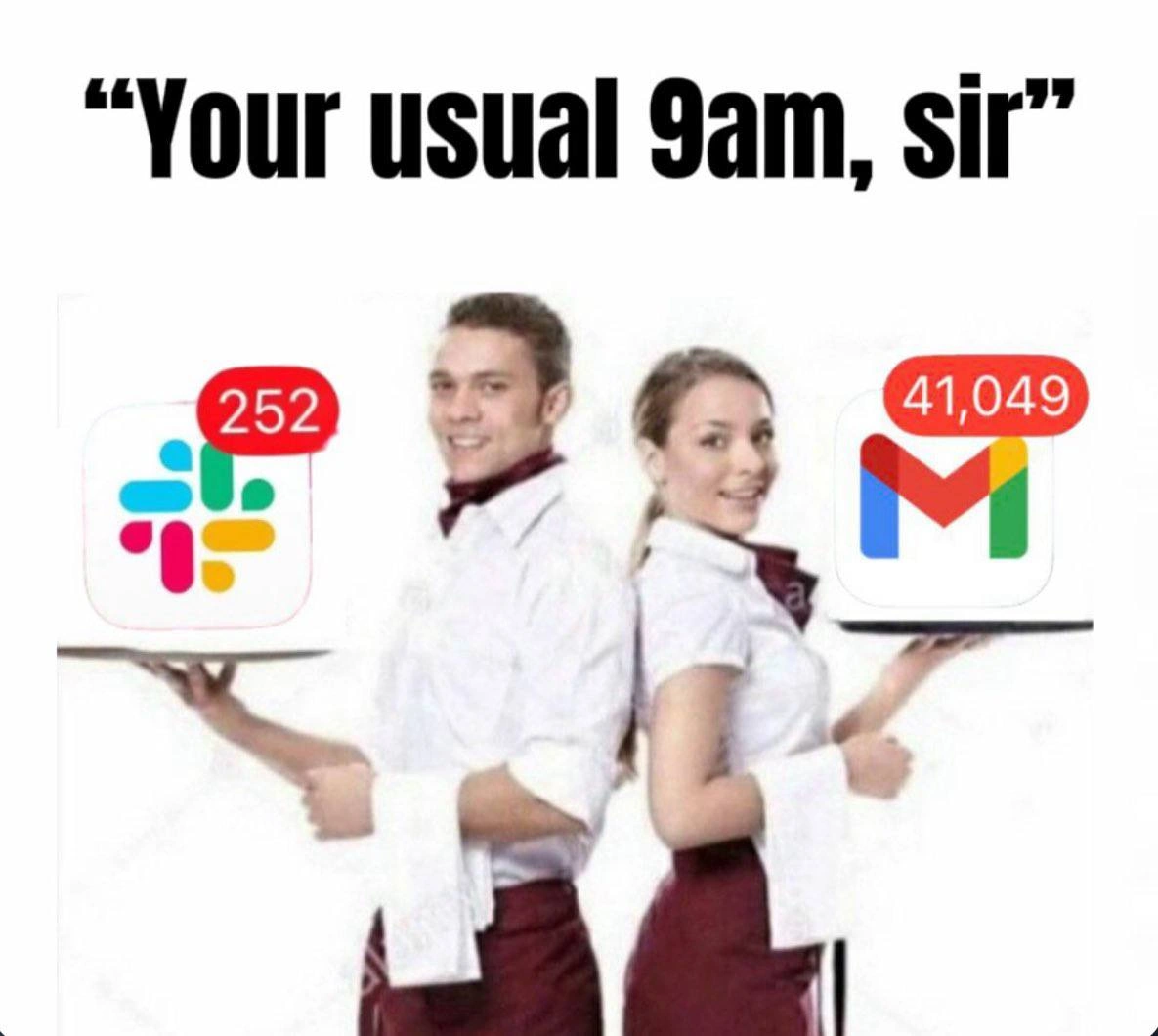
Every developer who’s worked in a busy team (especially while RemoteWorking) can recognize this scenario. The meme shows two waiters presenting Slack and Gmail icons on trays, each with giant red notification badges: Slack has 252 unread messages, and Gmail has 41,049 unread emails. The caption says “Your usual 9am, sir”, as if this overwhelming pile of notifications is a normal, expected start to the day. This is poking fun at the morning routine alerts that many of us face in the tech world.

Let’s break down the pieces:

  • Slack (252): Slack is a popular workplace chat application used in software companies for team communication. Think of it like a big group chat program with many channels (rooms) for different topics or teams. The red badge with 252 means there are 252 unread notifications or messages. That number is enormous for Slack! It suggests that since the person last checked, hundreds of messages have come in. In a real scenario, this could happen if you’re part of many active channels or if you were offline while teammates in other time zones kept discussing things. For example, maybe you signed off at 6pm, but your coworkers in another country kept a conversation going all night – by morning you have a stack of Slack messages waiting. Slack usually shows a badge count for mentions (times when someone tags you directly, like @yourname) or direct messages. So 252 could imply you were mentioned a lot or have many direct chats to catch up on. In any case, it screams “you missed a lot!”

  • Email (41,049): The Gmail icon with 41,049 is showing the count of unread emails in the inbox. Gmail is a very common email service. 41k unread emails is an exaggeration, but not by much for some folks! It basically means this developer long ago stopped trying to read everything in their inbox. Many of those emails are likely automated or not urgent:

    • For example, notifications from project tools (like ticket updates, build results, security scans) often send emails daily.
    • Newsletters, company-wide announcements, and mailing list discussions can also clutter a developer’s inbox.
    • Over a few years of work, if you don’t aggressively archive or delete, the unread count can indeed climb into the tens of thousands.
    • It’s also possible this person relies on Slack and ignores email mostly, so those emails just accumulate. The meme calls the idea of ever catching up to Inbox Zero (having zero unread emails) basically a myth or joke. “Inbox zero” is a productivity concept where you keep your inbox empty by handling each email (reply, file, or delete). But in fast-paced environments, achieving that is like chasing a unicorn 🦄. Seeing 41,049 unread emails is the death of inbox zero – clearly this person gave up on trying to read everything!
  • “Your usual 9am” presentation: The image visually compares the morning flood of notifications to a fancy restaurant serving a regular order. The waiters are dressed professionally with trays, which is humorous because it’s treating something stressful (notification overload) as a refined, expected daily treat. This implies that for many developers, starting the day overwhelmed by Slack and email is as routine as having a cup of coffee. Except, instead of coffee, it’s a double-shot of anxiety. The phrase “sir” is just part of the joke’s formal tone – anyone can relate, not just men. It’s like the workplace saying, “Here’s your daily dose of chaos, enjoy!” with a polite bow.

Now, why is this funny (and frustrating) for developers?

  • Remote Work and Communication Overload: In the era of working from home, developers might not see teammates in person, so tools like Slack and email became the lifeline for all conversations. This can lead to over-communication. People send more messages to make sure everyone stays in the loop. By morning, you have a backlog of discussions to read. It’s like everyone had a meeting without you while you slept! For instance, in a distributed team, one part of the team may chat late into their evening (your night). When you log in at 9am your time, there’s a full novel’s worth of chat history waiting.
  • Alert fatigue: This term means getting so many alerts or notifications that you become tired of them and start to ignore them. Imagine your phone buzzing constantly – at some point you stop jumping at each buzz. For developers, constant Slack pings (especially if many are not important) cause this fatigue. The first few you might read carefully; by the 50th, you skim; by the 200th, you’re almost desensitized. The meme exaggerates it (252 Slack alerts, wow!), but it highlights a real feeling: “I can’t possibly read all this, but it keeps coming.”
  • Developer frustration and lost productivity: Every time you shift to check a message or email, that’s a break in concentration. Developers need focus to solve problems and write code. If every morning starts with an hour of just reading messages and emails, that’s an hour not spent coding or engineering. And it’s mentally draining. Many junior devs are surprised to learn how much of their day can get eaten by communication instead of actual coding. The meme depicts that shock with humor – it’s funny because it’s true, you sometimes feel like a full-time message reader instead of a programmer! This can lead to frustration. You might think, “I just want to build things, but I’m stuck in Slack and Outlook hell.” It’s a common early-career realization that communication is a big part of the job, but here it’s shown in its most extreme form.
  • Coping mechanisms (or lack thereof): Developers try different ways to cope. Some will set Slack to Do Not Disturb mode for the first hour of the morning to get a little quiet time. Others create filters to sort emails automatically into folders, so they only check important ones. But even with tricks, the sheer volume can be too high to realistically manage every single message. Often, you have to prioritize: respond to a few critical Slack threads, flag a couple of emails from your boss, and then mark all as read or just mentally ignore the rest. The meme’s huge numbers imply that a lot is simply being left unread – and that’s normal now. It’s making fun of the fact that nobody can actually chew through that much info daily, yet it keeps coming daily like a buffet you didn’t ask for.

In summary, this meme uses exaggeration to highlight a real pain point in software engineering teams: the constant barrage of digital communication that greets us each day. By framing it as a classy breakfast “special,” it humorously contrasts the formal, almost elegant presentation with the chaotic reality of notification overload. It resonates with any developer who has ever opened their work apps in the morning only to feel instantly overwhelmed. You laugh at the absurdity (252 Slack pings, seriously?), and then you laugh a second time because you remember your own Slack had 50+ unread messages just yesterday. It’s a comedic reminder that in modern tech work, staying on top of messages is a job in itself – one that can definitely make anyone crave another cup of coffee before diving in.

Level 3: Alert Fatigue Feast

By 9:00 AM, a senior developer’s day is already served: a heaping platter of Slack pings and a mountain of unread emails. This meme captures the notification overload that has become routine in modern development teams. It’s presented tongue-in-cheek as a fancy breakfast special, but any experienced dev recognizes the bitter aftertaste of AlertFatigue in this so-called meal. The waiter’s line “Your usual 9am, sir” drips with irony – it’s usual indeed for remote leads and tech leads to start the day buried under messages.

In a RemoteWorkCulture heavily reliant on chat and email, mornings often begin with a feast of alerts waiting on your platter:

  • Slack – the group chat app where “work happens” – might show a red badge with 252 by morning. That means hundreds of messages across various channels piled up overnight. Some are trivial (a new GIF in #random at 11:47 PM 🤦), others might be critical (server outage discussions at 2 AM). In Slack’s real-time world, if you disconnect for a few hours, you return to discover you’ve “missed” entire conversations. It’s asynchronous communication turned into a synchronous deluge at login time. The result? A digital interrupt storm as soon as you open your laptop. Each ping is like a little software interrupt to your brain’s CPU, forcing a context switch. Handle 252 of those, and your mental cache is thoroughly invalidated before you’ve even sudo apt-get’ed your first coffee.
  • Email – supposedly the more “mature” communication form – isn’t any kinder. That Gmail icon with 41,049 unread emails is an exaggeration, but not by much for many senior devs. Decades of subscription lists, auto-generated build reports, endless CC’d threads (“Reply All” hell), and system monitoring alerts accumulate into a permanent five-digit unread count. Long ago you might have believed in the Inbox Zero myth, but eventually most give up and let the backlog grow like kudzu. At this point, the inbox isn’t a to-do list, it’s a graveyard of notifications. If something’s truly important, someone will ping again (probably on Slack… or schedule a meeting 🙄). That 41k represents an inbox bankruptcy declared in silent resignation.

The humor here comes from just how relatable this overload is to those in the industry. It highlights a core Communication problem: we’ve introduced multiple channels to stay “in sync”, but end up out-of-focus. A senior engineer knows this constant barrage is a productivity killer. It’s practically an anti-pattern for DeveloperProductivity. Real work (you know, coding) requires concentration and flow, but focus time gets sliced and diced by a hundred tiny pings. It’s the knowledge-work equivalent of an OS thrashing under too many interrupts – you spend more time handling context switches than executing actual tasks. The result: by noon, you’ve “worked” all morning yet written zero lines of meaningful code.

Why does this happen? A mix of cultural and systemic factors:

  • Remote work escalation: Since 2020, remote teams have leaned on Slack hard. Every quick question, status update, or shower thought that might’ve been a tap on the shoulder in the office is now a Slack message. Multiply that by a global team (with different time zones) and you wake up to an overflowing buffet of messages. It’s like everyone left sticky notes on your desk while you were sleeping.
  • Over-communication vs. missing out: In distributed teams, people err on the side of over-communicating to ensure everyone’s informed. Every decision, big or small, gets a Slack thread and an email summary and a calendar invite for a follow-up Meeting. The intention is good, but the outcome is information overload. You have multiple notification channels all dinging you about the same thing. By the time you see it, you might have Slack messages and emails and meeting reminders about one issue — three plates served for the price of one.
  • Slack’s design: Slack makes it frictionless to message someone – or everyone (@here, @channel) – in an instant. It’s a double-edged sword. Urgent production issue at midnight? Ping the on-call dev in Slack and wake them up. But Slack doesn’t distinguish between a life-or-death alert and a casual meme drop; if you’re mentioned or if you follow a noisy channel, it all piles into that little red badge. The next morning, urgent server crash reports and trivial chatter all arrive intermixed on your tray. No wonder critical info gets lost in the noise.
  • Email legacy and neglect: Meanwhile, email persists for formal announcements, external contacts, and all the automated noise that isn’t hip enough for Slack. Build servers, monitoring systems, and project management tools still love sending emails. Many devs simply stop reading most emails unless they expect something specific. (The joke is that SELECT * FROM Emails WHERE unread=true; returns 41,049 results — time to drop that table, figuratively). Searching through emails after the fact becomes the coping strategy. It’s faster to hit Ctrl+F in Gmail for that one error log or design doc than to manually sift thousands of unread messages. The unread count becomes a number you ignore — until a meme like this rubs it in your face.
  • Alert fatigue is real: Originally a term from healthcare and ops (think on-call pager alerts), AlertFatigue now plagues developers’ daily tools. When you see notifications constantly, you start tuning them out. The first few Slack pings might get your attention; the hundredth gets your eye-roll. Red badge with “252”? You sigh heavily and click “Mark All as Read”, essentially declaring defeat. The danger is obvious: you might miss genuinely important communications because it all blurs together. But human brains have limits — there’s only so many flashing red lights we can react to before we go numb.

For the battle-scarred engineer, this meme is funny-’cause-it’s-true. It satirizes how normalized this chaos has become. The fancy waiter presentation adds a layer of dark humor: it’s as if the company is politely serving you stress on a silver platter every single morning. DeveloperFrustration here is both humorously exaggerated and uncomfortably authentic. We laugh, but it’s a knowing laugh with a side of weary head-shake.

Ultimately, “Morning special: 252 Slack pings with 41k unread emails” is a pointed commentary on our industry’s communication overload. It pokes at the absurdity that the first task of the day isn’t coding or designing – it’s digging out from under a pile of messages. Until we find better balance (or invent an AI to triage our inboxes 🤖), many of us will keep getting “the usual” every morning: an all-you-can-eat buffet of alerts, served with a bittersweet smile.

Description

A meme showing two waiters (male and female) standing back-to-back presenting trays like fine dining servers. The text reads '"Your usual 9am, sir"'. The male waiter presents the Slack app icon with a notification badge showing 252 unread messages. The female waiter presents the Gmail app icon with a staggering 41,049 unread emails. The meme perfectly captures the morning ritual of every knowledge worker: opening your laptop at 9am to be immediately overwhelmed by a mountain of overnight messages and emails waiting to be processed

Comments

11
Anonymous ★ Top Pick Inbox Zero practitioners seeing 41,049 unread emails: 'That's not email, that's a distributed denial of service attack on my productivity.'
  1. Anonymous ★ Top Pick

    Inbox Zero practitioners seeing 41,049 unread emails: 'That's not email, that's a distributed denial of service attack on my productivity.'

  2. Anonymous

    My 9 AM breakfast is a platter of 252 Slack DMs asking for status updates and an inbox with 41,000 emails, mostly just to let me know the build *didn't* fail for once

  3. Anonymous

    I keep telling management that context-switching costs, but apparently the daily stand-up now starts with a diff of my unread counts

  4. Anonymous

    The real senior engineer flex isn't having inbox zero - it's having trained your team so well that your 41,049 unread emails are all automated CI/CD notifications you can safely ignore because the Slack channel would've pinged you if anything actually broke

  5. Anonymous

    The real architectural decision isn't microservices vs monolith - it's whether to declare email bankruptcy and start fresh at zero, or embrace the 41K unread as a distributed system of 'eventual consistency' where you'll eventually get to them... eventually. Meanwhile, Slack's 252 represents the actual SLA your team expects: sub-hour response time, because apparently 'async communication' only applies to your codebase, not your colleagues

  6. Anonymous

    9am: Slack (252) is the hot Kafka topic, Gmail (41,049) the data lake; unfortunately the only consumer group is me and my backpressure policy is 'mark-all-as-read'

  7. Anonymous

    Notification counts scaling horizontally without a cluster: Teams after one unread weekend

  8. Anonymous

    At scale, communication is a distributed queue with no backpressure - Slack is the hot path, Gmail the cold storage, and my CPU is pinned at 100% context switching

  9. @f0cu53d 11mo

    41К емаils 😭

    1. @Xaz16 11mo

      99% about new AI power of $service_name

    2. @qtsmolcat 11mo

      Ikr rookie numbers

Use J and K for navigation