Dockerised API: Therapist Meme With Literal Shipping Containers Labeled API
Why is this Containerization meme funny?
Level 1: The Box Monster
Imagine you're a kid who's built a huge stack of toy boxes in your room. You're a bit afraid it might wobble and fall on you. Your parent comes in and says, "Don’t worry, that stack isn’t going to hurt you. It’s not a real threat." But then you glance over and – oh no – you actually see those boxes teetering and about to tip over! Suddenly it sure looks real (and a little scary). This meme is like that. The "therapist" tells the person not to worry about something technical, that it's “not real and can’t hurt you.” Then the meme shows a silly picture of giant containers with "API" written on them, like huge metal boxes, appearing right in front of an office. It’s as if the imaginary fear came to life in the silliest way. The reason it’s funny is the surprise: you’re told there’s no monster, but then the “monster” shows up anyway – big, obvious, and kind of ridiculous. It’s a goofy way of saying, "See? The thing I was worried about turned out to be real after all!"
Level 2: Containers All The Way Down
At a simpler level, this meme is joking about Docker containers and how we run our software in them. Let’s break it down. An API (Application Programming Interface) here refers to a web service or backend server that provides data or functionality (for example, a service that returns user info or processes orders). When we say a "Dockerised API," we mean that this API service is packaged and running inside a Docker container. Docker is a popular tool in software development used for containerization – which basically means bundling an application with everything it needs (libraries, runtime, etc.) into one isolated unit (a container). This makes it easy to deploy that app on any server, because the container carries its own environment. It’s a bit like how a shipping container lets you transport goods anywhere: the container has standard hooks and size, so ships and trucks can handle it without caring about the contents. Docker does the same for software, standardizing how we ship code.
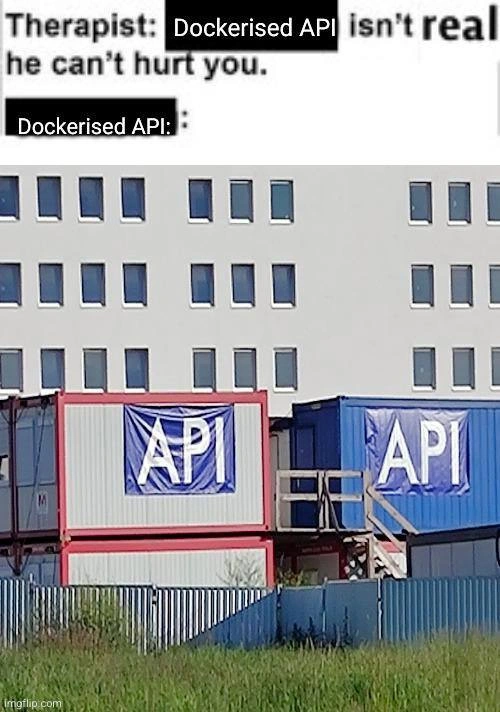
Now, the meme uses a common funny format: Therapist: "X isn’t real, it can’t hurt you." / X: (followed by a picture of X looking very real and usually scary). In this case, the therapist says “Dockerised API isn’t real; he can’t hurt you.” That’s the setup. The punchline is the next panel, labeled “Dockerised API:”, showing a photo of two huge shipping containers stacked next to an office building, each with a big banner reading “API”. This image is a literal visual pun. In tech, we call software packages "containers," and Docker’s logo is actually a whale carrying shipping containers – so the joke imagines a Docker container as if it were a physical shipping container. The therapist claims it isn’t real, but the image humorously suggests it is real – and it’s enormous and right outside!
For someone new to this, think of it like a cartoon. A Docker container for an API is supposed to be just a virtual thing running on a computer. It doesn’t have a physical form. But here we see actual metal cargo boxes labeled "API", making it look like the API is physically inside these giant containers. It’s exaggerating to make a point: the problem the developer fears (having their software boxed into too many containers) has become as big and solid as a stack of freight boxes you can touch. It implies that what should be a small software detail has grown into a huge physical-like obstacle.
The mention of the therapist is just a playful setup – there's no real therapist involved with coding! It's a meme format to highlight someone being in denial versus reality. The developer (who is worried about his project’s setup) is being told by the "therapist" that they're worrying over nothing (“it can't hurt you”). But the second panel – the giant "API" containers – reveals what the developer is imagining: a very real, very intimidating version of his problem. In software terms, perhaps a simple app was broken into many parts and put into too many containers. The team might have gone a bit microservices crazy – meaning they split one application into a bunch of tiny services, each running in its own container. That can lead to container sprawl – basically having so many containers that it's hard to manage them all. For a newcomer: imagine instead of one big program, you now have 50 little programs all in separate boxes. It can work, but now keeping track of everything is a lot harder, like having 50 moving pieces instead of one.
So why do developers and IT folks find this funny? Because it’s relatable and a bit of an "inside joke." People in DevOps (developers/operations) often joke that using Docker and splitting applications into microservices is supposed to make things easier, but sometimes it makes things more complicated. The meme turns that feeling into a silly picture: your simple API ended up as a towering stack of containers outside. It’s the kind of joke you’d see on DevOps message boards or forums (DevOps engineers are the folks who handle both developing the software and running it on servers) where they share war stories. When the caption says the therapist "underestimates the threat," it means outsiders or non-technical people might say "Oh, those containers and services aren’t a big deal," but the folks who actually deal with deploying the app know it can indeed be a headache. The photo with the shipping containers labeled "API" basically shouts, "Look, this did become a big deal – we took this container thing way too far!"
In summary, the meme plays on the word "container" in two ways – as a tech term and a real object – to get a laugh. And it points out a lesson: just because something runs in a container doesn’t guarantee smooth sailing. Piling on too many containers for one project can make your life as messy as having a bunch of giant shipping boxes cluttering your yard. The humor comes from showing that extreme scenario in a literal way, so even a newcomer can chuckle at how absurd it looks.
Level 3: Cargo Cult Containerization
The meme hits on a painful truth wrapped in a joke. It uses the classic therapist format: the top panel has the therapist reassuring, "Dockerised API isn't real; he can't hurt you." In the bottom panel, reality strikes with a punchline – an ominous photo of two full-size shipping containers stacked outside an office, each emblazoned with a giant "API". In other words, the "Dockerised API" turned out to be very real and physically massive. The humor here is a literal visual pun: in software, we talk about "containerized APIs" using Docker, and Docker's whole metaphor is based on shipping containers. So the meme takes that metaphor to absurd lengths: What if your overzealous containerized microservice actually manifested as actual shipping containers looming beside your workplace?
For seasoned engineers, this lands as dark DevOps humor. It's poking fun at the trend of microservice architecture and extreme containerization. The therapist, like some well-meaning but naive manager, says "It can't hurt you" – implying the developer’s fears are irrational. But any SRE who’s been on call at 3 AM knows that's wishful thinking. We’ve all heard some variation of "Don’t worry, that won’t happen in production" right before everything goes sideways. This meme exaggerates that scenario: the "Dockerised API" isn't just in your head; it's a double-stack of steel cargo containers ready to flatten your on-call sanity.
The image literally shows two big containers with "API" labels, which is hilarious because in tech, a Docker container is supposed to be a lightweight, ephemeral instance of your app. Yet here we have not one but two gigantic containers – implying our simple API has ballooned into a stack of containers so large it's like dealing with actual freight. It's a jab at how deploying a simple API has become absurdly complex with modern container orchestration. What used to be a single service is now a Hydra of Docker containers: you start with one, then it pulls in a dozen sidecars, adapters, and proxies until your production environment looks like a shipping yard.
Let’s be honest: over-containerization is a real deployment pain point. Engineers jump on the Docker and microservices hype train thinking "we'll just containerize everything, it'll be fine." Next thing you know, you're maintaining a sprawling cluster of 50+ containers just to serve one application. The meme perfectly captures that feeling with a tongue-in-cheek visual: if each container were a hefty steel box, you’d literally be stacking them in the parking lot. It's calling out the unspoken truth that all those tiny services add up to one giant, heavy system – the dreaded distributed monolith in physical form.
This therapist clearly never handled a Kubernetes outage. "He can’t hurt you" – oh, if only. The veteran Ops engineers reading this are nodding in grim solidarity. They remember that one containerized API that was supposed to make life easier but instead turned into a nightmare of broken CI/CD pipelines, missing dependencies, and mysterious network issues. In reality, that "Dockerised API" can absolutely hurt you: it can wake you up with a pager at ungodly hours, break half the other services when it fails, and eat up all your server resources. When a simple REST API is split into a dozen Docker containers and scattered across a cluster, troubleshooting becomes like chasing ghosts in the machine. At that point, you might as well be wrestling a literal shipping container.
Consider how a straightforward app gets containerized in practice. It often starts innocently:
# Initially, maybe just one container for the main API service:
docker run -d myapp/api-server:1.0
# But then microservice fever hits...
docker run -d myapp/auth-service:1.0 # handles user authentication
docker run -d myapp/data-service:1.0 # separate data API
docker run -d myapp/notifications:1.0 # handles sending notifications
docker run -d myapp/logging-sidecar:1.0 # sidecar for logging
docker run -d myapp/metrics-exporter:1.0 # sidecar for metrics
# ...and so on, stacking up containers like shipping crates ...
What started as a single API is now an entire fleet of containers. Managing this feels like juggling shipping containers: one wrong move and something important comes crashing down. The meme’s double-stacked crates labeled "API" illustrate that beautifully. It's a literal double-stack deployment. If one of those containers in the stack tips over (i.e. a service fails), you worry the whole pile might collapse. Sure, in theory each microservice is independent, but in practice they're often as tightly coupled as boxes in a stack – when one slips, the others slide with it.
The comedy has a bite of truth: developers sometimes adopt new tech (like Docker) without fully realizing the operational overhead. We all love using containers for their portability, but running dozens of them in production can be an ops nightmare — you get container sprawl, where keeping track of all the pieces is as hard as tracking physical shipping containers across the world. (Ever lose a container at sea? Try losing a container process in a misconfigured cluster — neither is fun.) The term "cargo cult" fits because some teams treat containers as magic boxes that will solve everything, copying patterns without understanding them, much like cargo cultists mimicking rituals hoping for airplanes full of goods. In this meme, that mentality resulted in a very concrete (and comically oversized) problem.
So, when the therapist says "it isn't real," the seasoned dev laughs nervously. The Dockerised API might not be a literal monster under the bed, but it can sure feel like one when your Kubernetes cluster starts faltering or your network policy misroutes requests. The pain is real, the sleepless nights are real, and thus the meme hits a nerve. It's using absurdity to validate the engineer’s anxiety: Yes, this thing you're afraid of is real and it can hurt you. Just ask anyone who’s had a critical service go down during peak traffic — that friendly "API" can turn into a freight train of trouble real quick.
In short, containerization is awesome until it's not. The meme wryly acknowledges that an API jammed into a container (or a dozen containers) can become a beast if mishandled. It's both a joke and a cautionary tale: if you stack your tech debt high enough, don't be surprised when it shows up as a double-decker container haunting your nightmares (and your production environment).
Description
A two-panel meme using the 'Therapist: X isn't real, he can't hurt you' format. The top text reads 'Therapist: Dockerised API isn't real, he can't hurt you.' Below, 'Dockerised API:' reveals a photo of actual shipping containers in a yard, each with large blue banners reading 'API' on them. The visual pun connects Docker containers (software) with physical shipping containers (the metaphor Docker is named after), making the abstract concept hilariously literal. Watermark: imgflip.com
Comments
10Comment deleted
Docker documentation says containers are 'lightweight and portable.' These API containers look like they need a crane and a customs declaration
I see they've finally shipped the API. Let's hope the ingress controller knows which port to forward to, or we'll have a literal port mapping conflict on our hands
It starts with one lightweight sidecar, and next thing you know the facility needs a harbor master and 200 gig of YAML to keep the two ‘simple’ endpoints afloat
After 15 years of explaining to executives that containers aren't actual shipping containers, someone finally went ahead and deployed their API gateway to the loading dock. Still has better uptime than our Kubernetes cluster during certificate rotation
When the architect said 'let's containerize everything,' nobody expected the infrastructure to literally look like a shipping yard. That moment when your microservices architecture has more containers than a Maersk terminal, and you realize the real orchestration challenge isn't Kubernetes - it's explaining to finance why your AWS bill looks like you're running a logistics company
Therapist forgot: that Dockerized API just autoscaled into a replica swarm that OOMKilled your entire node pool
Therapist says a Dockerised API can’t hurt you; Kubernetes politely disagrees when a miswired readinessProbe and restartPolicy: Always turn your SLO into a backoff strategy
We containerized the API; now it needs a service mesh, four sidecars, and three ingress rules just to reach port 8080 - tell the therapist to bill our YAML
The therapist did that Comment deleted
it's the podman dev Comment deleted