The 'Small Refactoring' That Bypassed All Safeguards
Why is this BuildSystems CICD meme funny?
Level 1: Skipping the Safety Check
Imagine you’re going on a bike ride just around the block, and you decide not to wear your helmet because it’s “such a short trip, what could go wrong?” Skipping your helmet might save a minute, but if you take a tumble, you’ll really wish you had that protection. This meme is joking about the same kind of idea, but with computer code. The programmer thought her change to the code was so small and safe that she turned off all the “safety checks” (like tests and reviews) meant to catch mistakes. It’s funny because she’s so sure nothing bad will happen that she basically ignores all the rules – like a kid tying up the crossing guard to jaywalk. We all know that’s a silly thing to do! The humor comes from knowing those safety steps are there for a good reason: skipping them, even once, is asking for trouble (and a good lesson in why the rules exist). In simple terms, the developer in the picture took off her code’s seatbelt, and we’re just waiting to see the wacky (and likely painful) consequences.
Level 2: Guardians of Code Quality
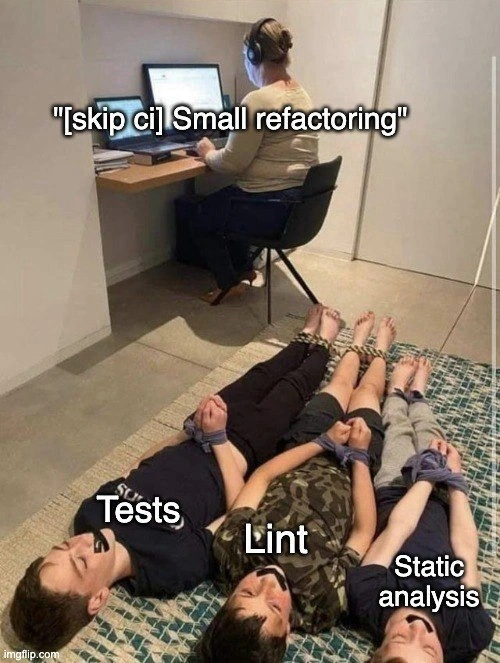
Think of your project’s automated checks as guardians or gatekeepers that protect the codebase. Whenever you push new code, a CI (Continuous Integration) pipeline kicks in to run a series of quality checks. This usually includes running tests, linters, and static analysis tools. The meme shows a programmer literally tying up these guardians — labeled "Tests", "Lint", and "Static analysis" — which is exactly what happens when someone uses the "[skip ci]" flag to bypass a build. Let’s break down what all this means:
Continuous Integration (CI): This is a practice and system where every time code is committed, an automated build process runs. It’s part of CICD (Continuous Integration/Continuous Delivery) pipelines common in modern software teams. The CI server (for example, Jenkins, Travis CI, or GitHub Actions) will automatically compile the code (if needed) and run a predefined set of checks to ensure nothing is broken.
[skip ci]flag: Many CI systems listen for special keywords in commit messages. Writing"[skip ci]"(or"[ci skip]") in your commit message is like telling the build system “don’t run the pipeline for this commit.” This feature is intended for cases like updating documentation or minor non-code changes where running tests isn’t necessary. In the meme’s text, the developer wrote"[skip ci] Small refactoring", which means she deliberately instructed the CI to do nothing for that commit. It’s a bypassing_ci_checks trick that essentially gives her a green light without actually performing any of the work.Small refactor: A refactor means changing the structure or names in code without changing its functionality (for example, renaming a function, splitting a big function into smaller ones, etc.). It’s called small here to imply it’s a trivial change. The joke is that calling it small is often an excuse to justify not running tests (“Surely this tiny cleanup can’t break anything!”). But even a tiny refactor can introduce bugs if you accidentally modify something you didn’t intend to. Normally, after refactoring, you rely on tests to confirm everything still works as before. Skipping CI in a refactor means you’re not verifying that assumption at all.
Tests: These are automated pieces of code that check if the rest of your program is working correctly. For example, if you have a function
add(a, b), a test might calladd(2, 2)and expect to get4. When you change code, tests will catch if you inadvertently broke the expected behavior. In the image, “Tests” is one of the kids tied up. By skipping tests, the developer ensures none of the test suite runs. That’s like saying “if I don’t run the tests, then nothing can fail,” which is obviously dangerous logic. If her small refactor did break theaddfunction to mistakenly return5for2+2, she wouldn’t know until much later when someone else runs the tests or, worse, a user encounters the bug.Lint: A linter is a static code analysis tool that checks your code for style issues, common mistakes, or departures from best practices. For instance, it might warn about an unused variable, a missing semicolon, or a variable name that doesn’t follow conventions. Linting rules (like LintingRules in teams) keep the codebase clean and consistent. If you skip lint, you might introduce sloppy code or minor errors. It’s like skipping the proofreading of an essay: not catastrophic at first, but it could allow typos or grammatical mistakes to slip in. In the meme, “Lint” is the second kid tied up, meaning the developer turned off those code style and correctness checks.
Static analysis: This refers to more advanced code analysis tools that examine the code without executing it, to find potential bugs or security issues. Examples include type checkers or security scanners. They might catch things like a function that can sometimes return
nullwhen it shouldn’t, or a piece of code that could lead to a crash under certain conditions. “Static analysis” is the third kid in the picture, representing tools like SonarQube, Coverity, or even a language’s compile-time checks. By gagging static analysis, the developer won’t get warnings about deeper issues introduced by the refactor. For a junior developer, think of static analysis as an experienced reviewer that scrutinizes your code’s logic in detail – skipping it means losing an opportunity to catch subtle mistakes early.
In a normal workflow, these tests and checks act as quality gates: if any gate fails (a test doesn’t pass, or the linter finds an error), the CI pipeline will mark the build as failed. This prevents bad code from being merged or deployed. It’s a safeguard to maintain CodeQuality. When the developer used the skip flag, she essentially opened all the gates without checking – a shortcut that shoves code through without inspection. The label “tied_up_quality_process” is a perfect description: the processes that usually yell “Stop, there’s a problem!” have been tied up and can’t speak.
For someone new to development, this scenario is a cautionary tale. You might have encountered those frustrating moments when you push code and the BuildPipeline (say on GitHub or GitLab) complains: maybe a test failed or the linter demanded a change like “use === instead of ==”. It’s tempting to think, “Ugh, these checks are overkill for my tiny change. Can’t I just ignore them?” The meme humorously shows what ignoring them looks like — it’s bound and silenced tests on the floor. Sure, you can bypass the rules temporarily (like using [skip ci] or disabling a linter rule), but you do so at your own risk. The whole point of CI is to catch issues early. Even a small refactor can introduce an unexpected bug, and your future self or teammates will be thankful the tests caught it right away.
In summary, the developer in the meme took a quality_gate_shortcut. She’s essentially saying, “Trust me, I don’t need the babysitter this time; nothing will break.” But skipping those automated Testing and analysis steps is like assuming you’re infallible. The humor (and horror) for developers comes from knowing that this confidence is often misplaced. It’s funny on a meme, but in real life, bypassing your CICD checks can lead straight to a deploy disaster. The lesson for any developer, junior or senior: Don’t tie up your tests and tools – they’re there to help, even when you’re pretty sure you won’t need them.
Level 3: Quality Gate Hostages
Ever seen a developer so confident in a “harmless” code change that they effectively tie up all the quality gatekeepers and push code straight to production? That’s exactly what’s depicted here. The commit message prefix **[skip ci]** is basically a magic bypass that tells the CI/CD pipeline “Don’t bother running my checks.” In the image, our fearless developer sits coding while the automated safeguards — Tests, Lint, and Static analysis — are literally bound and gagged on the floor. It’s a darkly funny metaphor for how some engineers bypass CI checks under the innocuous excuse of a “small refactoring.”
Why is this so humorous (and horrifying) to experienced devs? Because we’ve all seen how “just a small refactor” can snowball into a colossal bug. Those tests lying tied up would normally scream if the refactor accidentally broke something critical. But with [skip ci], they’ve been silenced. It’s the software equivalent of covering your car’s “Check Engine” light with tape — if you don’t see the warning, there must be no problem, right? :smirk: The developer has basically put the build pipeline in a sleeper hold, preventing it from running the unit tests, integration tests, or any of the safety nets that catch regressions. This is Continuous Integration turned into Continuous Ignorance.
Each “hostage” on the rug represents a layer of defense:
- Tests: These verify that code behaves as expected. Tying them up means if our small refactor actually broke the login feature or caused a memory leak, nobody knows until production catches fire. It’s Schrödinger’s Build: both passing and failing at the same time, because you refused to open the box (or in this case, run the tests).
- Lint: Linters enforce coding standards and spot certain bugs (like an unused variable or a missing import). Gagging the linter lets you slip in all kinds of sloppiness. Maybe that refactor left a debug print or a variable named
tempthat should’ve been removed — normally the linter would nip that in the bud. Now it’s free to sneak into your codebase, accumulating technical debt. - Static analysis: Advanced analyzers examine code without running it, warning about issues like null-pointer dereferences, type mismatches, or security vulnerabilities. Skipping static analysis is like skipping an X-ray at the doctor after a fall. Sure, maybe nothing’s broken... or maybe you’ve introduced a subtle bug that will hide until it causes a crash later. The meme visually shows “tied up quality processes” — as if the developer said, “Shh, don’t tell me if anything’s wrong.”
The text "[skip ci] Small refactoring" itself is satirical. It’s common for devs to downplay changes by calling them small refactors, implying no behavior change. But any seasoned engineer knows that even a one-line change can bring down an app if it’s the wrong line. The CI pipeline (Continuous Integration pipeline in a BuildSystem) exists exactly to guard against that kind of hubris. By appending the skip_ci flag to her commit, this developer essentially stuck her fingers in her ears singing “LA LA LA, I can’t hear you” to all the quality alarms. The humor comes from that mix of brazenness and folly: it’s a quality gate shortcut taken to an absurd extreme, portrayed as a hostage situation.
In real life, this scenario triggers PTSD for many of us: there’s the memory of that one teammate who was in a rush and pushed code with failing tests or lint disabled. The commit sailed through, but hours later an on-call engineer is awakened by pager alerts because the “harmless refactor” caused a runtime error. Cue the witch-hunt in the morning stand-up when everyone discovers the [skip ci] in the commit history. “It worked on my machine,” the culprit says sheepishly, to a chorus of groans. We’ve learned (the hard way) that skipping the build pipeline’s checks is like removing a smoke detector’s batteries — you might not be interrupted by annoying beeps, but you also won’t be warned when a real fire starts.
The industry has these quality gates in place for a reason. Continuous Integration, automated testing, linting rules, static code analysis – they’re the safety harnesses of modern development. This meme nails the absurdity of deliberately unhooking that harness. It pokes fun at the overconfidence behind “trust me, it’s fine, we don’t need to run tests this time.” The DeveloperHumor here lands because it’s a scenario both terrifying and comically reckless, one that veteran developers have seen play out disastrously. In short, “[skip ci] Small refactoring” is the battle cry of someone about to learn why those tied-up “kids” (Tests, Lint, Static analysis) were in the room in the first place. CodeQuality and karma have a funny way of striking back when you least expect it.
Description
A meme depicting a person wearing headphones, engrossed in work on a laptop and a second monitor at a desk. An overlay text reads, '"[skip ci] Small refactoring"'. In the foreground, three children are lying on the floor, bound with their hands and feet tied and black tape over their mouths. Each child is labeled with a key software quality process: 'Tests', 'Lint', and 'Static analysis'. The image humorously personifies automated quality checks as children being silenced and ignored. The joke lands with experienced developers who understand the temptation to use '[skip ci]' in a commit message to bypass the CI/CD pipeline for what seems like a trivial change. It satirizes the misplaced confidence and the dangerous practice of disabling the very safety nets designed to catch bugs, formatting issues, and code smells, often with disastrous consequences
Comments
7Comment deleted
Every time you use '[skip ci]', a QA engineer somewhere feels a chill and doesn't know why. It's the ghost of the production bug you just created
Adding “[skip ci] small refactor” is the engineering equivalent of a payday loan - every test, linter, and analyzer you gagged is quietly compounding interest in prod
The same developer who adds [skip ci] for "just a small refactoring" is the one who'll spend three days debugging why production is down, only to discover they renamed a variable that 47 other services were depending on through reflection
Ah yes, the classic '[skip ci] Small refactoring' commit - where 'small' means you've restructured half the codebase, renamed 47 functions, and introduced a subtle type coercion bug that won't surface until 3am on a Saturday. Meanwhile, your test suite, linter, and static analysis tools are lying face-down on the floor wondering why they even exist. It's the software engineering equivalent of 'I'll just quickly reorganize the entire kitchen while my spouse is out' - technically a refactor, but the blast radius suggests otherwise. Pro tip: if you need to skip CI, it's not small refactoring, it's a cry for help that your future self will answer with a 4-hour debugging session
When '[skip ci]' becomes your build strategy, you’ve reinvented continuous integration as continuous speculation - and the next RCA will read like archaeology
"[skip ci] small refactor" - turning branch protection into branch suggestions and PagerDuty into QA
Small refactor? More like the spark that ignites a distributed system's CAP theorem nightmare when tests are left hog-tied