Skip to content
DevMeme
1082 of 7435
The existential dread of O(2^n)
CS Fundamentals Post #1216, on Mar 31, 2020 in TG

The existential dread of O(2^n)

Why is this CS Fundamentals meme funny?

Level 1: Double Trouble

Imagine you’re trying to clean up your room, but for every single toy you put away, two new toys suddenly pop out of nowhere and scatter on the floor. You pick up 1, and 2 more appear... then you pick up those 2, and 4 more appear... The mess just keeps doubling and soon it’s completely out of control. 😱 No matter how fast you try to clean, the pile of toys grows faster than you can handle. You’d probably end up in the corner of the room, pulling your hair and screaming in confusion because it feels impossible to ever finish the job.

That’s pretty much the feeling this meme is conveying in programmer terms. The developer is freaking out because they found something in the code that grows out of control (just like those multiplying toys). It’s a funny way to show how overwhelmed and scared you feel when a problem keeps getting twice as bad every time. Even if you don’t know anything about code, you can understand that this kind of doubling trouble is bad news – and that frying pan won’t be much help!

Level 2: When Complexity Attacks

Let’s break down why that O(2^n) is so scary. Big O notation is a way developers describe how fast or slow an algorithm runs as the input size grows. It’s like a label for the speed of code. For example, O(n) means if you double the number of things to process, it takes roughly twice as long. O(n^2) means if you double the input, it takes about four times as long (since $2^2 = 4$). Now, O(2^n) means that if you increase the input even a little, the work explodes dramatically – doubling the input size makes the run time square itself (because $2^{2n} = (2^n)^2$). In simpler terms, this is called an exponential time complexity, and it’s one of the worst kinds of growth. Even going from n = 10 to n = 20 (just doubling the items) can shoot the required steps from about 1 thousand to about 1 million. By n = 30, we’re talking roughly 1 billion steps. You can imagine how quickly that becomes impossible to finish in a reasonable time!

In a code review (when developers check each other’s code for mistakes or issues), seeing an algorithm with exponential complexity is a big red flag. It suggests that the code might work fine for small cases but will completely bog down or fail for slightly larger cases. Typically, we try to keep algorithms efficient – like O(n), O(n log n), maybe O(n^2) at worst – so the program can handle growth. But O(2^n) stands out as a potential performance problem. It’s like a warning sign flashing, "Careful: this might run forever if you feed it too much input!"

To give a concrete example, consider a naive way to compute Fibonacci numbers (where each number is the sum of the two before it). If we do it with straightforward recursion and no optimizations, it ends up recalculating a lot of the same values many times over, leading to an exponential number of steps:

def fib(n):
    if n <= 1:
        return n
    return fib(n-1) + fib(n-2)  # Each call branches into two more calls

This little function fib(n) has a worst-case runtime on the order of roughly $2^n$. Why? Because for each number it calculates, it ends up calling itself twice (except at the base case). So fib(5) might call itself maybe 15 times, but fib(40) would recurse literally billions of times! It’s incredibly inefficient. The fix is to use a better approach – for example, using a simple loop or memoization (caching results) – so that you don’t repeat all that work. In other words, you optimize the code to avoid that exponential blow-up.

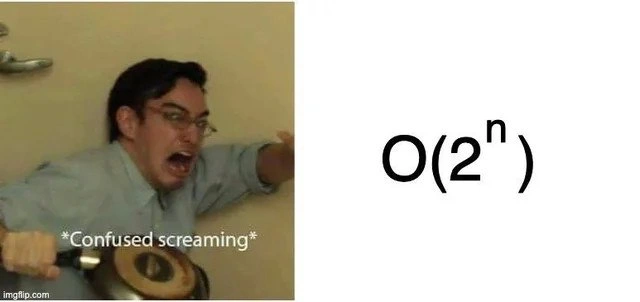
Now think of the meme: the developer’s reaction (essentially confused screaming in panic) is because they realize the code has this kind of explosive growth in runtime. The left image shows him in a defensive crouch with a frying pan – as if he’s trying to fend off something dangerous. The scary thing here isn’t a physical monster, but the performance issue hidden in the code. He’s acting out what we feel inside: "Oh no, if the input gets any bigger, this program might never finish!" It’s both funny and relatable. The Big O notation on the right (O(2^n)) is basically the “villain” of the joke. You have to know a bit of CS fundamentals to get it: that term signifies a terribly slow algorithm. So the meme is a bit of developer humor – it’s poking fun at how programmers react when they spot code that could turn into a real slowdown nightmare. Even if you don’t know the math behind it, you can tell he’s scared of that formula. But if you do know, you’re probably nodding along, thinking, "Yikes, I’d panic too if I saw that in our code!"

Level 3: Big O Jump Scare

Picture yourself in a code review, calmly scrolling through a colleague’s code, when suddenly you stumble on a function that has all the telltale signs of O(2^n) runtime. Cue internal screaming. This meme nails that exact moment. In the left panel, a developer-like figure is literally backed into a corner, holding up a frying pan in a defensive stance. The subtitle text reads:

*Confused screaming*

This perfectly captures a mix of shock, panic, and disbelief – basically the performance anxiety every developer feels upon spotting an exponential algorithm lurking in their codebase.

The right panel reveals the "attacker": the stark text O(2^n). It’s comically portrayed as the horror monster jump-scaring our panicked developer. And honestly, for seasoned coders, seeing that notation in a code review is a jump scare. It calls back to those CS classes and algorithm complexity analysis drills where you learn that exponential growth is terrifying. We’re taught early on that anything beyond polynomial time is usually a problem, and here it is, staring you in the face in a real codebase. The meme humorously exaggerates the reaction – brandishing a frying pan as if the Big O itself is about to attack – but it’s only a slight exaggeration. Seasoned devs really do get a chill down the spine when they realize a piece of code might take 2^n steps to complete for larger n.

Why such a visceral reaction? Because we know performance issues lurk down that path. An algorithm with exponential complexity can work okay for small inputs (say n = 5 or 10), which lulls you into a false sense of security. But if someone ever tries n = 20 or 30, the execution might grind to a halt or bring down a system. Developers swap war stories of programs that ran fine in testing, but when faced with a slightly bigger dataset, suddenly started taking hours or just crashed. So when a reviewer spots something like a double recursive call or a brute-force combination generator (classic sources of 2^n behavior), alarm bells ring. It’s a "nope, nope, nope!" moment.

This meme resonates because it dramatizes a very real scenario: algorithmic Big O fear. It highlights how even a dry concept like Big O notation can inspire dread when you’ve been bitten by it before. The frying pan-wielding coder is basically every senior engineer internally when they discover a hidden exponential-time trap in the code. There’s also a hint of confusion in that caption – as in, "Why on earth is there an O(2^n) here? Did someone really implement a brute force solution? Are we missing a better approach?" That mix of fright and bewilderment is genuine. Often the next step in real life is a tense discussion: Can we refactor this? Is the input size guaranteed to be tiny? Did we just inherit a ticking performance time bomb?

The humor works on a couple of levels. Non-developers see a guy screaming at some weird notation – which is absurd in its own right. But developers see a relatable horror story: the abstract concept of exponential runtime turned into the boogeyman. It's like a coder's version of a horror movie jump-scare. One moment you’re innocently reviewing code, the next moment O(2^n) pops out and you practically fall off your chair. The frying pan is the cherry on top: as if you could swat away bad complexity with kitchenware. If only fighting slow algorithms were that simple! In reality, the "weapon" would be a refactoring or a new algorithm, but the meme opts for a physical gag to make us laugh.

Ultimately, this panel combination is tapping into a shared understanding among programmers. We all get that O(2^n) is bad news. The instant terror and scramble (screaming, defensive stance) is exactly what it feels like when you realize the code might blow up in runtime cost. It’s both a cautionary tale (don’t let exponential algorithms slip in!) and a bit of commiseration (we’ve all been there, and it’s scary yet darkly funny in hindsight). By mixing an academic concept with a visceral reaction, the meme perfectly captures developer humor: it’s specific, it’s nerdy, and it’s hilariously true.

Level 4: Combinatorial Explosion

In the realm of computational complexity theory, encountering O(2^n) signals the dreaded specter of an exponential time complexity. This notation means that as the input size n grows, the algorithm’s required steps increase on the order of $2^n$ – in other words, each additional input bit or element can double the workload. Soon, the number of operations explodes astronomically: handling 30 items might demand over a billion steps ($2^{30} \approx 1.07 \times 10^9$), and 40 items pushes it to about a trillion ($2^{40} \approx 1.10 \times 10^{12}$). Such growth dwarfs even the worst polynomial-time algorithms and quickly outpaces any realistic hardware capacity.

Exponential-time algorithms are notorious because they often arise from brute-force solutions to combinatorially hard problems. If you spot $O(2^n)$ in a code review, it likely indicates the code is enumerating an explosively large solution space – maybe checking every subset, permutation, or binary decision pattern. Classic NP-hard problems (like the Traveling Salesman or Subset Sum) have brute-force solutions that run in $2^n$ (or worse), reflecting this combinatorial explosion of possibilities. Unless there’s a clever optimization or a breakthrough in algorithm design (hello, P vs NP), there’s no avoiding that exponential blow-up for exact solutions to such problems.

In Big O notation terms, $O(2^n)$ is an asymptotic upper bound signifying that the worst-case runtime grows exponentially with n. Big O focuses on the dominant factor – here $2^n$ – and ignores constant multipliers. It’s basically saying that beyond some threshold, doubling the input size will square the runtime. For contrast, doubling n in an $O(n^2)$ algorithm roughly quadruples the work; but doubling n in an $O(2^n)$ scenario makes the runtime go from manageable to practically impossible. Even Moore’s Law (which historically doubled CPU counts every couple of years) can’t save you here – hardware improvements add linear or polynomial factors, but an exponential algorithm’s demands rise far faster. No amount of micro-optimizations or caching will fundamentally rescue an algorithm with true exponential complexity once n grows large.

To make it concrete, consider a naive recursive Fibonacci function. Without memoization, computing Fibonacci of n this way requires obscene amounts of redundant work. Each call spawns two more calls (except at the base cases), leading to roughly $2^n$ function calls. For example, fib(40) in such an implementation would recurse on the order of $2^{40}$ times (which is about one trillion calls!) – completely infeasible in practice. This is why we apply dynamic programming or find smarter algorithms whenever possible: to tame an exponential process into a polynomial one. In the Fibonacci case, a simple loop or memoized recursion brings it down to O(n), which is a night-and-day difference.

When a seasoned developer spots O(2^n) lurking in code, it’s like finding a ticking time bomb. It usually means one of two things: either the code is tackling an inherently intractable task (where exponential time is unavoidable), or someone coded a brute-force solution where a better approach exists. The terror comes from knowing that such an algorithm can turn even moderate input sizes into unresponsive, grinding programs. It’s the textbook definition of a performance worst-case scenario. Hence the instinct to recoil in horror (or brandish a frying pan in self-defense) at the very sight of that ominous $2^n$ term.

Description

A two-panel meme. The left panel features a well-known image of the character Filthy Frank (Joji) in a state of sheer panic, holding a pan and screaming, with the caption '*Confused screaming*'. The right panel contains only the text 'O(2^n)' in a standard monospaced font on a white background. This text represents exponential time complexity in Big O notation, a core concept in computer science for analyzing algorithm efficiency. The humor lies in the visceral, panicked reaction to a purely mathematical expression. For experienced developers, encountering an algorithm with O(2^n) complexity is a horrifying discovery, as it implies the runtime will grow exponentially with the input size, rendering it completely unusable for any non-trivial dataset and guaranteeing a performance disaster

Comments

7
Anonymous ★ Top Pick A junior dev sees O(2^n) and thinks 'let's optimize it later.' A senior dev sees O(2^n) and has flashbacks to the last time the billing alert system melted
  1. Anonymous ★ Top Pick

    A junior dev sees O(2^n) and thinks 'let's optimize it later.' A senior dev sees O(2^n) and has flashbacks to the last time the billing alert system melted

  2. Anonymous

    Code review: finds an O(2^n) loop in the request path of a ‘serverless’ function - suddenly the only thing scaling elastically is our AWS bill and the CFO’s heart rate

  3. Anonymous

    When the junior dev's "quick optimization" involves nested loops over the power set and you realize the code review is going to outlive the heat death of the universe

  4. Anonymous

    When you realize your 'elegant recursive solution' has O(2^n) complexity and production is processing arrays of size 50. Time to dust off that dynamic programming textbook and explain to the PM why the server has been running for three days straight on what should have been a simple feature

  5. Anonymous

    Every O(2^n) starts as “n is small” and ends with Finance asking why the autoscaler bought us a new region

  6. Anonymous

    O(2^n) in the hot path turns code review into capacity planning

  7. Anonymous

    When PM says 'n is small' but your backtracking hits n=35 and the cluster melts

Use J and K for navigation