The Sisyphean Task of Resolving Broken Dependencies
Why is this Dependencies meme funny?
Level 1: Running in Circles
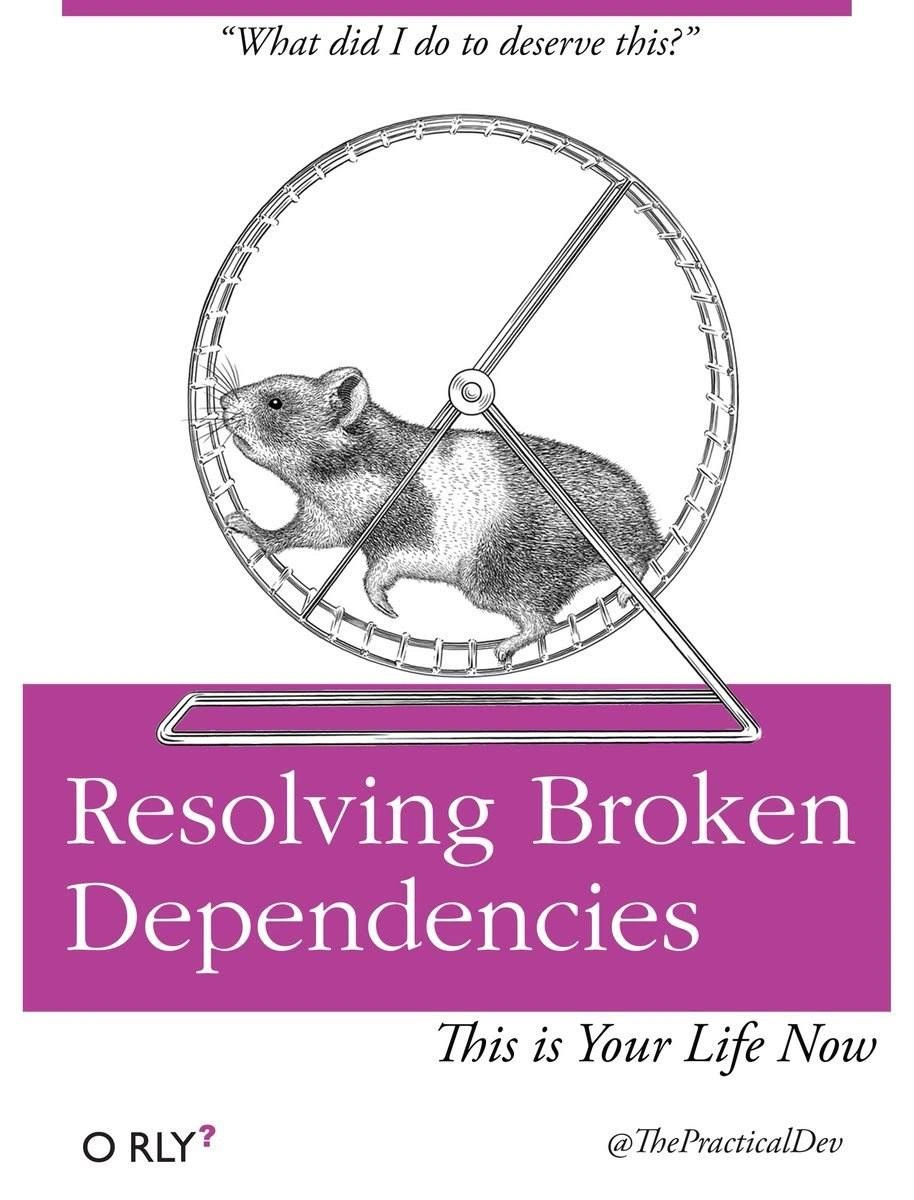
Have you ever seen a hamster running on a wheel and realized that no matter how fast it goes, it doesn’t actually get anywhere? This meme is joking that being a programmer can feel just like that. Imagine you’re trying to build a big LEGO tower, but every time you add a new piece, another part of the tower falls apart. You fix the fallen part, then something else tumbles down again. It can start to feel endless, like you’re running in circles. The picture shows a hamster on an exercise wheel to symbolize that feeling. The hamster is asking, “What did I do to deserve this?” which is a funny way of saying he’s frustrated and confused about why he’s stuck in this situation. When the meme says “This is Your Life Now,” it’s exaggerating that feeling of being stuck in a never-ending task. It’s as if someone told you that cleaning your room was now your life forever – you’d laugh because that’s such a dramatic, hopeless statement about something pretty ordinary (even if annoying). We find it funny because it’s true enough to recognize but exaggerated enough to laugh at. Developers often fix one problem only to see another pop up, and seeing it compared to a hamster wheel is a lighthearted way to say, “Yep, sometimes my job feels like that.” Even if you’re not a coder, you can relate to the joke: it’s like doing chores that never end, and you just have to sigh and say, “Well, I guess this is my life now!”
Level 2: Fix One, Break Another
For a newer developer, let’s break down what’s going on here. In software, a dependency is any external code or library that your project needs to work. Instead of writing everything from scratch, you might use existing packages – for example, a library for making web requests or a framework for building a UI. Managing these libraries is done by package managers (like npm for Node.js, pip for Python, or Maven/Gradle for Java). They automatically download the right versions of those dependencies as specified by your project. Dependency resolution is the process of figuring out which version of each library to use so that all the pieces fit together. Now, broken dependencies occur when something in that chain goes wrong: maybe a required package is missing, or two libraries require conflicting versions of a third one. This leads to what developers grimly nicknamed “dependency hell” – a situation where you’re stuck dealing with errors related to these packages over and over. It’s a form of CodingFrustration where instead of writing new code, you’re babysitting the code you pulled in.
Imagine you have a project that uses Library A and Library B. If A needs version 1 of Library C, but B needs version 2 of Library C, you’ve got a problem – the build system won’t know which one to choose, because it can’t satisfy both requirements at the same time. That’s a simple example of a dependency conflict. The error messages you get in these situations can look scary. For instance, running npm install might yield an error like “Could not resolve dependency: Package X needs Y in version 1.x, but package Z needs Y in version 2.x.” In plain terms, it’s telling you “Two parts of your app disagree about which version of Y to use, so I, the package manager, don’t know what to do.” When such a conflict or missing piece happens, your build fails – meaning the process to compile or set up your project can’t complete successfully. In a CI/CD pipeline (Continuous Integration/Continuous Deployment system), which is a server that automatically builds and tests your code after each change, a broken dependency will cause the pipeline to turn red (fail) as well. It’s frustrating because it often feels like these things break for no good reason – one day it was fine, the next day something updated or vanished and now nothing works. That’s why the meme’s hamster is a perfect analogy: it captures the feeling of running in circles, working hard to fix things but ending up in the same place repeatedly.
Now, about the meme’s style and text: it’s a parody of an O’Reilly book cover. O’Reilly Media is a famous publisher of programming books, and their covers always feature a detailed black-and-white drawing of an animal. Developers recognize them on sight – for example, there’s the classic “Learning Python” book with a python snake on the cover. In the meme, the usual animal illustration is replaced with a hamster on a wheel. That hamster represents a developer (or anyone) stuck in an endless loop of problems. The top of the image has a quote “What did I do to deserve this?” – this isn’t a real quote from some expert, it’s the anguished cry of any developer who’s spent hours wrestling with a broken build. It sets a dramatic, humorous tone: the hamster (i.e., the developer) is questioning their life choices. The big title “Resolving Broken Dependencies” is written in the same style as an official book title, which makes it extra funny because it sounds like a skill you’d have to formally learn from a textbook. And then in smaller italic text, the meme says “This is Your Life Now”. That line is a bit of dark humor — it’s like saying “get used to it, this is going to keep happening.” It resonates with anyone who’s experienced package management woes: after the tenth time fixing the same kind of error, you start to feel like it really is your life now. Finally, the bottom left has “O RLY?” instead of “O’Reilly”. O RLY? is internet slang for “Oh, really?” expressed with sarcasm – it’s both poking fun at the publisher’s name and echoing the disbelief we feel when yet another dependency breaks. The bottom right credit “@ThePracticalDev” is the creator’s handle (The Practical Dev is known for coding humor content). All these elements together create a DeveloperHumor inside joke: it looks like a serious tech book at first glance, but every bit of text on it is a nod to the frustratingly endless task of keeping your project’s dependencies working. Even if you’re new to coding, you can probably relate to the feeling of doing a lot of work and seeming to get nowhere – that’s exactly what this meme is about, and why it’s both funny and a little painful at the same time.
Level 3: Wheel of Suffering
Look beyond the cute hamster and you’ll see every seasoned developer’s personal nightmare: Dependency Hell. The meme nails a universal experience in software development – that soul-crushing loop of fixing one broken dependency only to have two more take its place. It’s styled as an O’Reilly book cover parody, which is perfect because O’Reilly’s real books are bibles for mastering tough tech topics. Here, instead of a majestic animal gracing the cover of “some cool technology in 24 hours,” we get a frantic hamster on an exercise wheel fronting “Resolving Broken Dependencies”. The subtitle “This is Your Life Now” in cursive might as well be written in the blood, sweat, and tears of build engineers everywhere. It’s a grim, tongue-in-cheek acceptance that wrangling dependencies isn’t a one-time battle – it’s a chronic condition of modern development. The top quote reads:
“What did I do to deserve this?”
That line drips with the despair and DeveloperFrustration felt during a 3 AM build failure. It’s the rhetorical question we’ve all asked when a fresh npm install suddenly starts spitting out 20 lines of incomprehensible errors. The humor cuts deep: what did we do to deserve this? All we wanted was to use some open-source library to save time, and now we’re trapped in build purgatory. The meme serves up RelatablePain on a silver platter – every dev from juniors to seniors has been that hamster, eyes wide, frantically running in place to fix the build, wondering which coding deity they offended. The O’Reilly parody publisher logo “O RLY?” (text-speak for “Oh, really?”) at the bottom left is the icing on the cake. It’s as if the universe itself is sarcastically responding to our plight: “Oh, really, you thought updating one package would be simple? O RLY?”
This wheel of suffering scenario is painfully common in real projects. Perhaps you update one library to patch a security flaw, and suddenly your build system (be it Maven, Gradle, npm, or Cargo) blows up with BuildFailures. One of your other packages wasn’t ready for that update and now nothing compiles. You then scramble to update that second package or find a version combination that works. In the meantime, maybe a third dependency breaks because it had a transitive dependency on the first one you updated! It’s like a cruel game of whack-a-mole: fix one, another pops up. Experienced devs are nodding knowingly here – we’ve lived this. Each “quick update” turns into an afternoon of reading GitHub issues and Stack Overflow posts, trying weird incantations like --force or deleting node_modules and package-lock.json (the software equivalent of turning it off and on again).
And let’s not forget the CI/CD pipeline aspect – this is BuildSystems_CICD after all. In a continuous integration setup, it’s Monday morning and your pipeline is suddenly red. What happened? You haven’t changed your code since Friday, but upstream, one of your dependencies quietly rolled out version 2.0.0 over the weekend and it doesn’t play nice with your app. Now your automated build is essentially that hamster wheel, running tests on a broken foundation over and over, each run failing in the same spot. You dig into the logs to find a gem like:
ERROR: Cannot resolve dependency "X@^1.2.0"
Required by "[email protected]", but "[email protected]" is incompatible with "[email protected]" required by "[email protected]".
# Translation: Library Y pulled in a new version of X that conflicts with Z's expected version of X.
# You're stuck until you find a version of X that satisfies both, or update Z... which might break something else.
It’s a RelatableDevExperience reading cryptic hieroglyphics like that. The hamster wheel turns faster: you try pinning versions, or upgrading group packages in lockstep. Maybe you resort to a PackageManagement nuclear option: delete the lock file and update everything (cross your fingers!). That often leads to a different set of breakages — new wheel, same hamster. The CodingFrustration is real.
Historically, this problem is so persistent we gave it names. In the old days of Windows we had “DLL Hell” – one app’s installer would replace a system DLL with a different version, and suddenly another application would crash. Java folks coined “JAR Hell” for classpath version conflicts when multiple JAR files contained the same classes at different versions. Now we just say “Dependency Hell” to cover all such nightmares. Whatever you call it, the pattern is the same: you’re stuck disentangling other people’s code and version decisions instead of writing your own feature. It’s almost a rite of passage in a developer’s career – the day you spend 8 hours fighting dependency issues and realize this is what real-world coding can entail. The meme hits home because it mocks that realization. The faux-official book title suggests that “Resolving Broken Dependencies” is such a common struggle, it deserves its own manual – an O’Reilly animal book you never wanted, but absolutely need. The pictured hamster is us, the developers, expending energy but not moving forward, trapped by an unforgiving DependencyResolution loop. It’s funny in a dark way: we see ourselves in that hamster.
Why do we put up with this? Because the alternative – not using third-party libraries – is even worse. Modern software is built on layers of open-source packages; we stand on the shoulders of countless maintainers. But it means when one of those maintainers makes a breaking change or a registry goes down (remember the left-pad incident, when one 11-line NPM package’s removal broke half the internet?), we all feel the shockwave. The hamster wheel of endless updates is the price we pay for not reinventing every wheel. In a large project, you might literally depend on hundreds of packages (and those packages depend on others). That’s thousands of potential failure points outside your direct control. No wonder a senior dev approaches any npm audit fix or pip upgrade with both hope and dread – we’ve learned that a simple version bump can cascade into a yak-shaving session of epic proportions. In theory, semantic versioning and better tooling are supposed to ease this (e.g. major version bumps signal breaking changes, lockfiles ensure repeatable builds). In practice, humans make mistakes: versions are mis-labeled, dependencies are yanked, or bugs slip through. Best practices can mitigate but not eliminate the chaos.
Over time, teams develop folk wisdom and safeguards. Pin exact versions in critical systems. Use a private proxy or cache for packages so you’re not hit by upstream deletions. Add dependency update as a regular chore (some use bots like Dependabot to create a steady trickle of update PRs rather than giant leaps). Essentially, we try to tame the hamster wheel by turning it into a scheduled exercise instead of a surprise marathon. But even this is humorous in itself – we’ve resigned to the fact that wrangling dependencies is part of the job, so we formalize it. As the meme’s sarcastic “This is Your Life Now” declares, once you’re a developer, you’re also a part-time janitor cleaning up broken builds. The best coping mechanism is often humor: we share memes, shake our heads, then get back to turning those dependency crankshafts. In the end, we laugh at this HumorInTech because if we didn’t, we might just cry. The hamster wheel keeps spinning, but at least we can joke about the dizziness.
Level 4: The NP-Hard Hamster Wheel
At the most abstract level, resolving broken dependencies can be viewed as a complex graph problem that verges on the theoretically intractable. Every software project pulls in a graph of packages and libraries, each with its own version requirements. Determining a set of versions that satisfy all these interlocking constraints is essentially a constraint satisfaction puzzle. In fact, it’s equivalent to a SAT solver problem – meaning it’s NP-complete in the general case. That’s computer science jargon for “there’s no quick algorithm to guarantee a solution in reasonable time.” As the dependency graph grows, the number of possible version combinations explodes combinatorially. The hamster wheel in the meme isn’t just a cute critter – it’s a metaphor for the algorithmic backtracking that might spin its wheels endlessly when faced with conflicting requirements. Imagine the dependency resolver internally trying one version, then backtracking and trying another, over and over – much like a hamster running in circles without end. If you’ve ever watched a package manager lock up or take ages trying to find compatible versions, you’ve witnessed this brute-force search in action. It’s as if each library version is a gear in a machine, and one misfit gear can send the entire mechanism into an infinite loop of retries.
This isn’t just theoretical hand-waving; real package managers have to deal with this complexity. Modern Linux distributions (apt, dnf) and build tools often incorporate sophisticated heuristics and even SAT-solving algorithms under the hood to navigate dependency resolution hell. When they sputter out error messages like “Unable to resolve dependency tree”, it’s essentially the solver saying “there’s no solution that satisfies all these constraints”. One notorious example is when two libraries demand mutually exclusive versions of a third library – a state mathematically analogous to an unsatisfiable logic formula. No matter how the system tries, it cannot placate both sides, and you end up in dependency deadlock. These are the moments you hit that wall: unsatisfiable constraints, the computer science equivalent of a hamster wheel that will spin forever unless someone hits Ctrl+C. The humor here is that developers routinely find themselves tackling what is, at heart, a computationally hard problem – but we don’t get research grants or Turing Awards for it, just another day at work. The meme’s dark joke is underpinned by this reality: fixing broken builds often feels like solving an NP-hard puzzle every week, a Sisyphean task where each resolution is temporary before the next cycle begins. After all, we’re basically performing mini proof-of-work computations with each npm install or pip resolve – no wonder it feels like an endless academic exercise on a hamster wheel.
Description
This meme is a parody of the classic O'Reilly technical book covers, featuring a detailed, realistic drawing of a hamster endlessly running on a wheel. The top of the image has a quote in a magenta banner: 'What did I do to deserve this?'. The main title, in a larger magenta block at the bottom, reads 'Resolving Broken Dependencies', with a subtitle below it saying 'This is Your Life Now'. At the very bottom, where the publisher's name would be, it says 'O RLY?', a popular internet slang term and a pun on 'O'Reilly'. The image humorously equates the frustrating, circular, and seemingly endless process of fixing dependency conflicts in software development to a hamster running on a wheel - a repetitive and futile task. It’s a relatable pain point for any developer who has fallen into the rabbit hole of version mismatches and circular dependencies
Comments
19Comment deleted
Resolving dependencies is like being a detective where you're also the suspect, the victim, and the witness, and the crime is that `left-pad` was updated three years ago
Our 32-core CI runner spins for 20 minutes “resolving” the same 142 transitive jars - proof that Maven is just the hamster wheel we managed to containerize
The worst part isn't the 47 transitive dependencies you never asked for - it's explaining to the CTO why a left-pad update broke production on a Saturday
The hamster wheel perfectly captures the modern developer's relationship with dependency management: you run faster and faster through npm updates, resolve one conflict only to trigger three more, and somehow end up back where you started - except now your CI/CD pipeline is broken, your lockfile has 47 merge conflicts, and that critical security patch you needed to apply has introduced a breaking change in a transitive dependency you didn't even know existed. Welcome to the treadmill of perpetual dependency resolution, where 'npm install' is less of a command and more of a philosophical statement about the futility of achieving a stable build
Touch one “minor” bump and a peerDependency war breaks out, the Docker cache evaporates, and the lockfile diff reads like an incident timeline
Dependency resolution is just lockfile roulette - one stray caret and you’re sprinting the hamster wheel through 200 transitive packages and three registries
Dependency resolution: the fractal nightmare where fixing one peer conflict births three transitive orphans across your monorepo
wait what? Comment deleted
akh akh, gol gofti, bother!👍✅ Comment deleted
Must have been "Resolving circular dependencies". Comment deleted
Circular dependencies would be just one of problems with dependencies tho Comment deleted
Eg How about resolving issue when you have 3 main direct dependencies, each depending internally on the same package but different versions, all of them incompatible with each other? And thanks god if they are properly incapsulated and do not touch anything in global namespace. But if not… Comment deleted
There should be a leveling system and dependencies shouldn't be able to depend on lower or same lever categorized dependencies Comment deleted
I would stay away from such dependencies (all those so tightly coupled with specific lower-level dependency version), or even the top-level project at all. 🤮 Comment deleted
It’s not we who choose how legacy is made, but legacy project that chose us Comment deleted
minor version updates usually are always backwards compatible. If not then there's definitely something wrong Comment deleted
And then due to some Jia Tan you have to roll back to previous version but since we have leveling system enjoy 5.6.1+really5.4.5-1 Comment deleted
Yarn be like: "Skill issue." Comment deleted
>Docker Comment deleted