The Evolution of a Developer: From Inline to Abstracted
Why is this CodeQuality meme funny?
Level 1: Rocket Science for 2+2
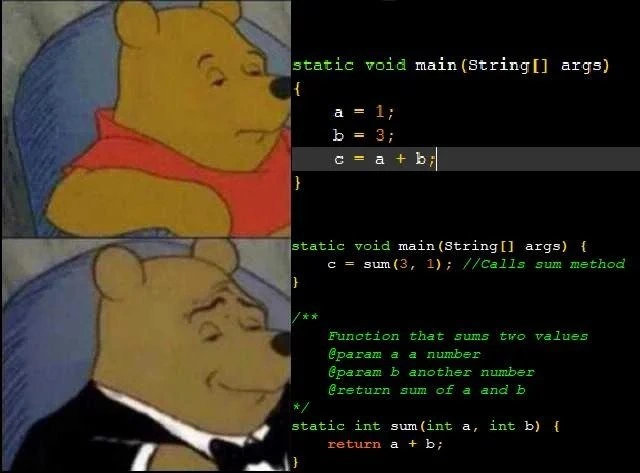
Imagine you ask someone to solve a very easy math problem, like what’s 2 + 2? The first person just thinks for a second and says, “4.” Simple! But the second person wants to be super fancy: they put on a lab coat and start writing a full instruction manual about how to add 2 and 2 together. They list out steps, definitions, and maybe even draw a diagram – all to finally arrive at the answer “4.” That’s basically what this meme is showing. The programmer did something very basic (adding two numbers) in an overly fancy way, almost like using a high-tech machine to crack a peanut. It’s funny because the extra effort is unnecessary – it’s as if they’re treating a kindergarten math problem like a rocket science project. The fancy-dressed Pooh Bear represents that over-the-top approach, looking proud as if he’s accomplished something grand, when in reality 2 + 2 was easy all along. The humor comes from seeing someone turn a super simple task into a big formal production for no good reason. It’s a reminder that sometimes the simple way is just fine – you don’t need a tuxedo and an instruction book to do basic math.
Level 2: Javadoc for 1+1
Let’s break down what’s happening in more straightforward terms. In the first panel’s code, the programmer simply adds two numbers directly. For example:
// Simple direct addition:
int a = 1;
int b = 3;
int c = a + b; // c gets the sum of a and b (which is 4)
This is a basic approach: you have two variables a and b, you add them with the + operator, and store the result in c. It’s one line doing exactly what it looks like – taking 1 and 3 and summing them to get 4. This is clear and easy to understand at a glance.
Now, the second panel shows a different approach:
// Using a separate sum function:
int c = sum(3, 1); // Calls sum method to get the result
/**
* Function that sums two values.
* @param a number
* @param b another number
* @return sum of a and b
*/
static int sum(int a, int b) {
return a + b;
}
Here, instead of doing a + b inside main, the developer created a helper function named sum. They call c = sum(3, 1) to get the result. The logic inside sum(a, b) is still just return a + b; – it does the same addition – but now it’s tucked away in its own method. Above the method, there’s a block of text starting with /** ... */. That’s a Javadoc comment, a special documentation format in Java. Javadoc comments often include tags like @param and @return to describe a method’s parameters and return value. In this case, the comment literally says the function “sums two values” and explains that it returns the sum of a and b. In other words, the comment is describing exactly what the code does.
So why do this? Typically, refactoring code into a separate function can be good for Code Readability or reusability. If you needed to sum numbers in many places, having a sum() function means you write that logic once and reuse it, following the DRY (Don’t Repeat Yourself) principle. Also, giving a meaningful name to a chunk of code can make the program easier to read. Here, sum(a, b) is pretty clear in intent (it sums a and b) – but a + b was already crystal clear, so the benefit is minimal. The added documentation (the Javadoc) is meant to make the code self-explanatory to others. In large projects or libraries, good documentation is important so that other developers understand how to use your functions. Many teams encourage writing comments for each function, and tools can even generate HTML documentation from those Javadocs.
However, in this tiny example, writing a full doc comment for a function as simple as adding two numbers is a bit like writing a formal essay to explain that 1 + 1 = 2. It’s technically correct, but it’s arguably over-engineering a simple task. The code has become more abstract – meaning you’ve introduced an extra layer (a function call) instead of doing it directly – without a clear practical need. If someone new reads this code, they might have to scroll down to see the sum function implementation to confirm it really just adds the numbers. The one-line inline version didn’t require any extra lookup. Also note the comment //Calls sum method next to the function call – that comment doesn’t tell us anything we don’t already know. It’s there because the developer is perhaps trying to be extremely clear, but to an experienced eye it feels unnecessary. This all embodies a kind of “clean code” formality taken to an extreme. The meme is a light-hearted way to say: sometimes keeping code simple is better than adding extra structure just for the sake of it. The contrast with Pooh Bear in casual clothing versus in a tuxedo helps visualize the idea: writing basic code versus dressing that code up in a fancy, formal way. It’s a fun reminder that while Refactoring and documentation are important, you should use them where they make sense – not automatically turn every single operation into a pomp and circumstance affair!
Level 3: Over-Engineering Simplicity
In this meme, Winnie-the-Pooh transforms from a bored bear in a red shirt to a smug bear in a tuxedo, mirroring a coder's progression from a simple solution to an overly formalized one. The left panel shows plain code: inside static void main(String[] args) we see a = 1; b = 3; c = a + b; – just a straightforward inline addition of two numbers. Pooh’s indifferent expression here says, "nothing special, just basic math." The right panel, however, has Pooh in full tuxedo regalia, eyes half-closed with self-satisfaction, alongside a refactored Java snippet: c = sum(3, 1); // Calls sum method, and below it a verbose Javadoc comment explaining a new sum function. This contrast humorously satirizes Clean Code zealotry: turning a trivial one-liner into a fully abstracted, documented method as if it were some grand algorithm. The meme format tuxedo Pooh is often used in developer humor to poke fun at scenarios where something ordinary is needlessly given a pretentious, "enterprise-grade" treatment. Here, Pooh’s fancy attire signifies the developer’s smug sense of elegance after refactoring a basic operation into a sum() method with all the ceremonial trappings.
For seasoned developers, the joke hits close to home. It highlights over-engineering – the tendency to add extra layers of abstraction or bureaucracy to simple tasks. Writing a separate sum(int a, int b) function (with Javadoc comments for @param a, @param b, and @return no less) to perform a + b is a textbook case of ceremonial coding. Sure, creating small functions and documenting them is a core part of many Clean Code principles and good CodeQuality. We’re taught to refactor common logic into functions, to avoid “magic numbers” and to write descriptive comments. But taken to an extreme, this well-intentioned advice can lead to absurd outcomes – like proudly implementing /** Returns sum of a and b */ return a + b; for an operation so basic it’s practically a language primitive. It’s clean-code overkill. The code has been made more “formal” and abstracted (c = sum(a, b) instead of c = a + b), but did it actually improve anything? In this case, not really. The original single line was perfectly clear to any reader. Now we have indirection (you must jump to see what sum() does), plus a comment literally explaining that the sum method "sums two values" – a redundant comment that states the obvious. Ironically, this violates the Keep It Simple, Stupid (KISS) principle and even DRY (Don’t Repeat Yourself) at the documentation level: the code and the comment both say the same thing. The humor isn’t just that someone wrote a sum function; it’s that they’re patting themselves on the back for this “elegant” solution. Pooh in a tux is essentially the developer feeling like a genius for following the book to the letter, even when it’s unnecessary. It’s a gentle jab at our tendency to sometimes write code that is technically “clean” but practically comical.
This scenario reflects real-world developer culture quirks. It’s common for enthusiastic coders (especially after reading Clean Code or getting into rigorous style guides) to apply every pattern and best practice even when it doesn’t make sense. We’ve all seen codebases where simple tasks are wrapped in needless abstraction: trivial getters and setters with extensive comments, or utility functions that do one line of math that was simpler inline. Enterprise Java projects historically encouraged lots of structure and documentation – sometimes too much. (At least here they stopped at a static function; one could imagine an even more over-engineered version with a SumManagerFactory and an interface for an Adder – the meme is funny because it’s only a slight exaggeration of things we’ve actually encountered.) The refactoring performed – essentially an “Extract Method” for a single addition – is technically correct but YAGNI (You Aren’t Gonna Need It): there’s no real need for a separate sum method if those values are used once. The comment // Calls sum method in the code is equally superfluous, reminiscent of beginner comments like // assign 1 to a that add noise rather than clarity. Seasoned developers reading this will chuckle because it reveals a truth about coding culture: sometimes our pursuit of Code Readability and reuse can slide into pedantry. It’s a nod to the internal dialogue we’ve all had – “Is this cleaner, or am I just complicating things to feel productive?” The meme playfully reminds us that good Refactoring is about finding a balance; not every summation example needs its own fully documented helper function. In short, the tuxedo-wearing Pooh embodies the absurd pride in over-engineering a simple task – a scenario every dev can recognize with a mix of embarrassment and laughter.
Description
This image uses the two-panel 'Tuxedo Winnie the Pooh' meme format to contrast two styles of coding. The top panel features a regular, unimpressed Winnie the Pooh next to a snippet of Java-like code where the sum of two numbers is calculated directly within the main method: 'a = 1; b = 3; c = a + b;'. The bottom panel shows a sophisticated Winnie the Pooh in a tuxedo, looking pleased, alongside a more professional code implementation. In this version, the main method calls a separate, well-documented function 'c = sum(3, 1);'. Below, the 'sum' function is defined with clear parameters and a return type, and is preceded by a multi-line comment block explaining its purpose, parameters ('@param'), and return value ('@return'). The meme humorously illustrates the progression from a novice to an experienced developer's mindset. The first example is functional but rigid and not reusable, typical of a beginner's approach. The second, 'sophisticated' example demonstrates core software engineering principles like abstraction, modularity, and the importance of documentation. For senior developers, it's a relatable depiction of the journey towards writing clean, maintainable, and reusable code, recognizing that how you solve a problem is often more important than just getting it to work

Comments
8Comment deleted
The top code gets the job done. The bottom code gets you promoted to architect, where you'll spend the rest of your days writing documentation for functions that add two numbers
Enterprise refactor checklist: replace “a + b” with SumServiceFacade, add Javadoc explaining commutativity, inject via Spring, and wonder why our ‘hello world’ pod now needs a 4-core node
The same developer who writes this will spend three sprints arguing that we need a AbstractSumCalculatorFactoryBuilder before we can properly scale addition across microservices
Give it two sprints and sum() will be an interface, a factory, and a SumServiceImpl - still returning a + b, but now it's 'extensible'
Ah yes, the classic senior engineer move: extracting a two-operand addition into a fully-documented, statically-typed method. Because nothing says 'enterprise-grade architecture' quite like a sum() function with parameter documentation explaining that 'a' is 'a number'. Next sprint: implement SumFactory, AbstractSumStrategy, and ISummable interface. The junior dev's inline 'c = a + b' never stood a chance against our SOLID principles and comprehensive JavaDoc. Ship it to prod - this baby's got 100% test coverage on that return statement
Enterprise Java progression: start with c = a + b; end with SumStrategy, SumServiceFactory, and a 600-word Javadoc - just in case addition needs to be feature-flagged
Compile error today, method extraction tomorrow, microservices next week
Only in enterprise Java do we wrap a+b in Sum(a,b) so we can mock arithmetic, inject it via an ArithmeticPort, and by Q3 ship an ArithmeticService with SLAs for integers