Skip to content
DevMeme
244 of 7435
The Inevitable Unmasking of Microsoft's Assistants
Microsoft Post #297, on Apr 4, 2019 in TG

The Inevitable Unmasking of Microsoft's Assistants

Why is this Microsoft meme funny?

Level 1: Old Toy, New Box

Imagine you have a toy that you used to play with years ago, and everybody thought it was a bit silly back then. Now suppose someone wraps that same toy in a shiny new box and says, “Look, it’s a brand new high-tech toy!” You get all excited, but when you open the box, you find the same old toy you remember, just wearing a little costume. You’d probably laugh, right? In this meme, that’s exactly what’s happening. The new fancy helper that talks to you (Cortana) is revealed to be the old helper (Clippy) wearing a mask. It’s like in a Scooby-Doo cartoon when the kids pull off the monster’s disguise and discover it was just someone they knew all along. The joke is that something shiny and modern turned out to be something classic and familiar in disguise. It’s funny and a bit comforting — showing that even in the tech world, sometimes new ideas are really just old favorites dressed up anew.

Level 2: Cortana vs Clippy

Clippy is the cartoon paperclip many of us met in Microsoft Office around 1997. He’d pop up in programs like Word with googly eyes, saying things like, “It looks like you're writing a letter. Need help?” Clippy was an office assistant – essentially a built-in helper designed to offer tips and shortcuts for using Office. For example, if you started typing a document with “Dear,” Clippy would assume you’re writing a letter and suggest letter-writing templates or formatting help. While this sounds useful, Clippy became infamous because he often showed up at the wrong times or gave obvious advice. Many users (especially adults at the time) found him more irritating than helpful, and by the early 2000s Microsoft disabled and eventually removed Clippy from Office. Despite that, Clippy holds a place in tech nostalgia as a memorable, quirky character from computing history.

Cortana, on the other hand, is Microsoft’s digital assistant introduced around 2014–2015, originally on Windows Phone and then Windows 10 PCs. If you’ve seen Siri on an iPhone or Alexa on an Amazon Echo, Cortana is Microsoft’s equivalent. Instead of a little cartoon popping up in your document, Cortana lives in your computer’s operating system – she can respond to voice commands or text queries. For instance, you can click the Cortana icon (a swirling blue circle logo) or say "Hey Cortana," and then ask her anything: "What's the weather today?", "Remind me to do my homework at 7 PM," or "Open Spotify." Cortana will process your request and talk back or perform the action. The name Cortana comes from a character in Microsoft’s Halo video game series – a smart AI assistant – which was a fun way for Microsoft to brand their assistant as something futuristic and cool. Unlike Clippy, Cortana doesn’t appear as a cartoon character on your screen (no friendly paperclip face); she’s mostly an icon and a voice that speaks from your device.

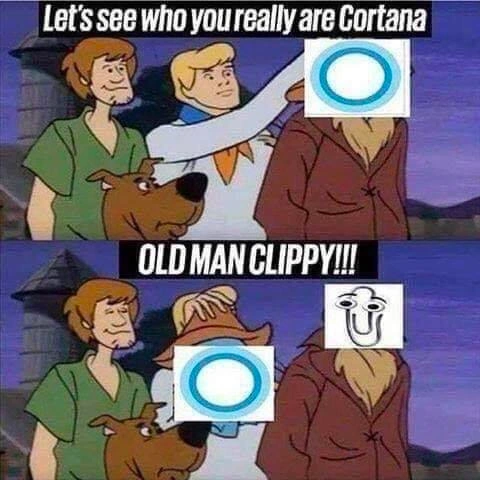
Now, the meme shows a classic Scooby-Doo scene of unmasking a villain. In the top panel, the gang has caught someone they think is Cortana (represented by the Cortana logo as a mask). The caption says, "Let’s see who you really are, Cortana." In the Scooby-Doo cartoon, this is the moment they pull off the monster’s disguise. In the bottom panel, once the mask is removed, we see the villain’s true identity: it’s Clippy – the goofy paperclip with eyes and eyebrows – underneath! Fred exclaims, "OLD MAN CLIPPY!!!" This mimics the Scooby-Doo formula where the monster is revealed to be some ordinary person, often with a line like "Old Man Jenkins!" Here, it’s a tech twist: the modern AI assistant was actually the old Office assistant all along.

What does that mean in simple terms? It’s saying that Microsoft’s new voice helper (Cortana) is basically just the old helper (Clippy) in a new form. It’s a joke about branding repackaging. Microsoft took the idea of having a helper in your computer (which they tried decades ago with Clippy) and brought it back with a new name and new technology. So Cortana and Clippy serve a similar purpose: they both try to assist users with tasks. The difference is the era and style — Clippy helped with writing documents and had a cartoon personality, while Cortana helps with web searches, apps, and uses a voice interface. The meme pokes fun at this legacy vs modern relationship. People who remember Clippy get a laugh because it’s like seeing an old friend (or prankster) resurface. Even if Cortana is far more advanced behind the scenes, to the average user it’s the same kind of experience: your computer offering you help (sometimes when you don’t ask for it). In summary, Cortana is essentially Clippy’s concept brought back to life in the age of AI. The Scooby-Doo unmasking image perfectly delivers that message in a funny, nostalgic way.

Level 3: AI Hype Unmasked

This meme hits home for seasoned tech folks because it playfully unmasks the hype behind Microsoft’s “new” AI assistant. It suggests that behind the slick Cortana marketing – all the talk of personal digital assistants and AI integration – we essentially have Old Man Clippy in disguise. In classic Scooby-Doo fashion, the supposedly futuristic villain (Cortana) turns out to be an old familiar face (Clippy) wearing a new mask. The humor comes from the industry’s habit of rebranding old concepts as new innovations. Microsoft isn’t the only culprit, but Clippy vs Cortana is a perfect example spanning 20 years: the legacy vs modern assistant.

Clippy was a 1990s icon of tech quirkiness – a helpful office assistant meant to guide you through tasks, which often ended up annoying more than helping. After widespread feedback (and plenty of jokes), Microsoft retired Clippy. Fast forward to the mid-2010s, and the trend was all about voice assistants and AI helpers (think Siri, Alexa, Google Assistant). Not to be left behind, Microsoft rolled out Cortana with great fanfare as part of Windows 10. To those of us who remember Clippy popping up in Word, it felt like deja vu. Tech nostalgia kicks in: haven’t we seen this “helpful assistant” act before? Sure, Cortana can do more – she can tell you the weather, set reminders, even crack a joke – but fundamentally, she’s fulfilling the same role Clippy did: trying to anticipate our needs and assist with our tasks.

The meme throws a wink at Microsoft’s expense: Cortana’s modern AI persona was supposed to be sleek and cool (she even has a backstory from Halo), yet users largely greeted her with the same skepticism (or apathy) they had for Clippy. Many experienced developers chuckle at this because we’ve witnessed the hype cycle firsthand. A flashy new product is announced as revolutionary, but we quickly realize it’s built on ideas we’ve had for ages (branding repackaging at its finest). There’s an implicit “we would have gotten away with it, if it weren’t for you meddling kids!” vibe – as if Microsoft tried to slip Clippy back into our lives under a new identity, and the community cried, “Aha! That’s you, Clippy!” The all-caps revelation “OLD MAN CLIPPY!!!” in the meme parodies the Scooby-Doo trope and doubles as a tongue-in-cheek jab at how old Clippy is in tech years.

From an insider perspective, this is also commentary on how big tech firms cycle through ideas. One decade’s flop becomes the next decade’s feature when technology catches up or when marketing thinks the audience is ready again. Clippy was essentially an early attempt at an A.I. assistant (albeit a rudimentary one) before we even called them that. Cortana came amid genuine advances in AI, yet to users, both can come across as unsolicited helpers living inside our computer, occasionally popping up with “Can I help you?” The meme’s comedy lies in that lightbulb moment of recognition – oh, this new AI helper is basically the same old helper with a fresh coat of paint. For veterans who survived the Clippy era, Cortana’s reveal is a mixture of amusement and exasperation: the more things change, the more they stay the same (only now with voice recognition and a Halo reference). Tech history has a habit of repeating itself, and we’re all in on the joke.

Level 4: From Bayes to Neural Nets

In the late 90s, Microsoft introduced Clippy (codename "Clippit") as an Office Assistant in Word and Excel. Clippy was an anthropomorphic paperclip that used simple AI techniques of its era to anticipate user needs. Under the hood, Clippy’s help suggestions were driven by rules and early machine learning heuristics (reportedly a Bayesian model) watching what you typed. For example, if you typed "Dear Sir," Clippy might pop up saying, “It looks like you're writing a letter.” This was essentially a primitive contextual agent: a program observing user actions and offering assistance based on predefined triggers and probabilities. It was a novel application of HCI and AI for its time, constrained by 90s technology and the limited scope of Microsoft Office documents.

Fast forward to the 2010s: Microsoft launched Cortana, a cloud-powered digital assistant for Windows 10 and Windows Phone. Technically, Cortana is a completely different beast. She (yes, Microsoft gave it a quasi-personality, named after a Halo video game AI) leverages modern AI/ML pipelines: advanced speech recognition (powered by deep neural networks analyzing your voice), natural language understanding to parse complex questions, and online knowledge graphs to fetch answers. When you say “Hey Cortana, remind me to buy milk,” your voice is converted to text via a neural acoustic model, interpreted by natural language models, sent to cloud services, and then Cortana speaks a reply using text-to-speech. It’s a far cry from Clippy’s simple pattern-matching. Cortana’s architecture is distributed across devices and cloud servers, integrating with search engines and your personal data. In academic terms, Cortana embodies an autonomous intelligent agent with access to vast data and learning algorithms, whereas Clippy was a confined expert system with a smiley face.

Despite the gulf in technology – from Clippy’s Bayesian guessing to Cortana’s deep learning – both are attempts at the same idea: an assistive user interface that proactively helps users. This concept of an anthropomorphic helper has been studied in computer science and HCI for decades. Each generation implements it with the latest tech, but the goal remains the same: make computers feel smarter and more user-friendly. Ironically, the meme hints that even with Cortana’s neural-network brains, the essence is still Clippy’s DNA. The fancy AI voice assistant is, at its core, the old paperclip idea with more processing power – proof that some ideas in computing are reborn rather than truly new.

Description

This image uses the popular two-panel 'Scooby-Doo Unmasking' meme format to make a joke about Microsoft's virtual assistants. In the top panel, the cartoon character Fred is pulling the 'mask' off a villain, whose face is covered by the circular blue logo of Microsoft's Cortana. The text above reads, 'Let's see who you really are Cortana'. In the bottom panel, the mask is off, revealing the true identity of the villain to be 'Clippy,' the infamous paperclip assistant from older versions of Microsoft Office. The text exclaims, 'OLD MAN CLIPPY!!!'. The meme humorously suggests that Cortana, despite being a more modern and seemingly advanced AI, is just a repackaged version of the notoriously annoying and unhelpful Clippy. For experienced tech professionals, this joke lands perfectly as it taps into a shared history of frustrating interactions with Clippy and a general skepticism towards new, hyped-up features from large tech corporations. It implies that at their core, both assistants suffer from the same fundamental flaws in user experience, just with a different interface
Comments

8
Anonymous ★ Top Pick The difference between Clippy and Cortana? One was an annoying COM object that interrupted your workflow, and the other is an annoying cloud service that interrupts your workflow and tracks your data
  1. Anonymous ★ Top Pick

    The difference between Clippy and Cortana? One was an annoying COM object that interrupted your workflow, and the other is an annoying cloud service that interrupts your workflow and tracks your data

  2. Anonymous

    Cortana’s all Azure Functions and LUIS until you trace the call stack and hit Clippy32.dll from ’97 still asking if you’re writing a letter

  3. Anonymous

    Microsoft's assistant strategy: spending 20 years and billions in R&D to evolve from "It looks like you're writing a letter" to "It looks like you're trying to open Calculator" with machine learning

  4. Anonymous

    Clippy, Cortana, Copilot - same intrusive assistant, three major versions, still no migration path to 'leave me alone'

  5. Anonymous

    Ah yes, the classic Microsoft strategy: take something universally despised, wait 15 years for the trauma to fade, slap a gradient and some machine learning on it, and ship it as 'innovation.' Cortana was basically Clippy with a neural network and the ability to ignore you in multiple languages. Both asked questions nobody wanted answered, both interrupted at the worst possible moments, and both were eventually deprecated after management finally read the user feedback. The real question is: what will they rebrand Cortana into next? My money's on 'Microsoft Copilot Classic' circa 2035

  6. Anonymous

    Plot twist: Cortana is just Clippy behind a REST facade - turns out the Adapter pattern survives rebrands and cloud migrations

  7. Anonymous

    Microsoft keeps refactoring the same help subsystem - Clippy to Cortana to Copilot - the Adapter pattern wrapped in an LLM with a monthly E5 line item

  8. Anonymous

    Cortana as Clippy: Microsoft's facade pattern masterpiece, hiding eternal popup meddling behind a neural net disguise

Use J and K for navigation