Skip to content
DevMeme
242 of 7435
Debugging: A Journey of Self-Discovery
Bugs Post #295, on Apr 3, 2019 in TG

Debugging: A Journey of Self-Discovery

Why is this Bugs meme funny?

Level 1: Monster Under the Bed

Imagine you think there’s a scary monster hiding under your bed because you hear strange noises at night. You call your parent to come help find it. They look all around under the bed, searching for this creature that’s causing trouble. In the end, instead of finding a monster, they take out a mirror and slide it under the bed. You look in the mirror and see your own face looking back! Suddenly you realize there was no real monster – the weird “cause” of the noises was actually something you were doing yourself (maybe you left a toy on that makes noises, or you were moving in bed and causing creaks). It’s a funny and eye-opening moment. You were blaming a mysterious monster, but it turns out you had a hand in it the whole time.

This meme is just like that. The developer was searching for a “bug” (something causing a problem) in the code, thinking it’s some hidden nasty thing. But in the end, the mirror shows that the developer themselves was responsible for it. It’s a simple joke about taking responsibility: sometimes the problem we’re looking for was coming from us all along. It makes us laugh because we’ve all been afraid of a “monster under the bed” at some point, only to discover there was nothing scary there – and maybe we were making the mistake ourselves.

Level 2: When You Are the Bug

Let’s break down the scene and its meaning in simpler terms. In software, a “bug” is any mistake or flaw in the code that causes it to behave in unexpected or incorrect ways. The term “bug” famously dates back to the 1940s when engineers found a real moth causing an error in an early computer – they taped it into the logbook and wrote “First actual case of bug found.” Ever since, we use bug to mean a glitch or error in programs (though thankfully not usually a real insect!). Debugging is the process of hunting for the cause of that error and fixing it – much like trying to find what’s causing a weird noise in your house. A bug hunt can sometimes feel like searching for a tiny monster hiding in your code.

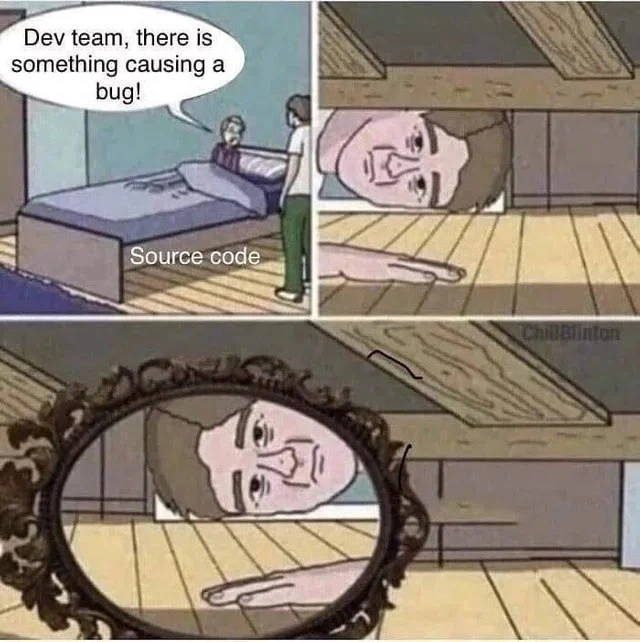
In the first panel of the cartoon, someone says, “Dev team, there is something causing a bug!” This sets the stage: something is wrong in the software (a user or tester found a problem), and they’re alerting the developer to investigate. The area under the bed is labeled “Source code,” which represents the entire codebase of the application – essentially all the programming instructions that make up the software. The developer gets down on the floor to look under the bed (through the source code) for the bug, much like one might search for a lost toy or, in scary stories, a monster under the bed.

By the second panel, the developer is fully in detective mode, peering into the depths of the code (under the bed) trying to locate this elusive bug. This is a familiar situation for any programmer: you know something’s wrong, and you’re scanning through files and functions trying to spot where things went awry. Often it involves printing out debug logs, running the program step by step, or combing through diffs of recent changes. It can be frustrating – hence the tag DebuggingFrustration – because bugs can hide in the most unexpected places, and you might start feeling a bit desperate if nothing is obvious.

Now, the punchline: in the third panel, the developer slides an ornate mirror under the bed. Instead of revealing a hidden bug creature or a broken piece of code, it reveals the developer’s own face. The text doesn’t spell it out, but the implication is crystal clear: the thing causing the bug was the developer’s own mistake. In plainer terms, the bug was introduced by the developer themself, not by some external cause. This is a form of lighthearted developer self-blame. Programmers joke about this because it happens a lot — you might spend hours suspecting complex reasons for a problem, only to find out it was a simple oversight in your own code (like using <= instead of < in a loop, or a typo in a configuration file). It’s a humbling “d’oh!” moment every programmer recognizes.

This meme basically says “After all that searching, the real bug was me.” It’s tagged with DeveloperMistakes and SelfReflection because it’s literally reflecting the developer’s image and figuratively encouraging developers to reflect on their own work. It also relates to a popular debugging technique called rubber duck debugging. That’s when you explain your code and problem out loud, even if it’s just to a rubber duck or any inanimate object on your desk. The act of explaining usually makes you realize what’s wrong. In essence, you end up debugging your own thinking. Here the mirror serves a similar purpose: it forces the dev to take a hard look at themselves (and by extension, their assumptions in code). The mirror is showing that the code under the bed didn’t magically break on its own — the bug exists because a person wrote the code that way. In real life, when we do a root cause analysis, it often comes down to human error somewhere in the chain (maybe a developer misunderstood the specs or made a copy-paste error). But rather than pointing fingers in a mean way, developers often use humor and self-deprecation to cope with these mistakes. We’ve all shipped bugs – it’s almost a rite of passage – and sometimes the only thing to do is laugh, fix it, and learn from it.

So for a newer developer, the takeaway from this meme is: don’t be too scared of monsters hiding in the tech stack. Nine times out of ten, a bug is simply a mistake that we inadvertently put there. The good news is that means we also have the power to fix it. Debugging is often an exercise in examining our own code under a microscope and, yes, occasionally having that face-palm moment when you realize the “mystery bug” was just a typo you made. It’s a universal experience in programming – frustrating at first, but a little bit funny once you see the irony.

Level 3: Bug at Layer 8

At the highest level, this meme lands a painfully familiar punchline for seasoned developers: the bug’s root cause is the developer themselves. In the cartoon, a dev is literally searching the source code (under the bed) for a lurking error. The final panel’s mirror reveals the culprit in the looking glass– it’s the developer’s own face under there. This is a nod to the classic insider joke about bugs being a PEBKAC issue (Problem Exists Between Keyboard And Chair) or a Layer 8 bug (an unofficial “user/human layer” on top of the 7-layer OSI model). In other words, after all the painstaking debugging, we discover human error planted the bug.

For experienced engineers, the humor cuts close to home. We’ve all been on those marathon bug hunts combing through logs and diffs, only to realize with a groan that we introduced the bug via a silly oversight. Perhaps an off-by-one error, a misnamed variable, or a forgotten null check – something embarrassingly basic. The meme exaggerates this detective work by showing the dev peering under the bed labeled “Source code” as if chasing a boogeyman. But the real monster under the bed is just our own bad commit or misunderstood requirement staring back at us. It’s a form of developer self-deprecation that rings true: the code was “haunted” only because we inadvertently wrote the spooky behavior into it.

This scenario is essentially a twisted root cause analysis report condensed into a joke. In real post-mortems, we often trace a bug’s lineage down to a specific commit or decision by an engineer. Here the mirror under the codebase points directly to that accountable engineer. It’s humorous because it’s a blameless blame: we’re poking fun at ourselves, acknowledging that code doesn’t write bugs by itself – people do (unintentionally, of course!). Seasoned devs will chuckle (or cringe) remembering times they swore the bug had to be in the framework, the compiler, or “someone else’s code,” only to eventually mutter “oh… that’s my bug.” The progression is almost folkloric in engineering teams:

  • We start by suspecting impossible things (a compiler bug, cosmic rays flipping bits).
  • We dig through module after module, like checking every shadow under the bed.
  • Finally, we hit a moment of truth: the only thing left to examine is our own code assumptions.

Often, explaining the code to a colleague or doing a rubber duck debugging session serves as that “mirror.” The act of walking through our logic out loud reflects our own misunderstanding back at us, much like seeing one’s face in a mirror and realizing “I’ve seen the enemy, and it is me.” The ornate mirror in the meme beautifully symbolizes this self-reflection moment – literally reflecting the developer’s face and metaphorically prompting the developer to reflect on their approach. The humor is equal parts catharsis and cautionary tale: no matter how advanced we become, bugs in software have a way of humbling us by revealing our own fallibility. In the world of debugging, the call is often coming from inside the house – and this meme captures that punchline with deadpan irony.

Description

This is a three-panel comic strip meme illustrating the frustrating reality of debugging. In the first panel, a character labeled 'Source code' is lying in bed, telling a standing developer, 'Dev team, there is something causing a bug!'. The second panel shows the developer looking under the bed, searching for this mysterious 'something'. The third and final panel provides the punchline: the developer, still under the bed, sees his own face reflected in an ornate mirror lying on the floor. A faint watermark for 'ChillBlinton' is visible. The meme serves as a powerful metaphor for the debugging process. It humorously captures the common developer experience of initially suspecting an external, complex, or hidden cause for a bug (the 'monster under the bed'), only to eventually discover that the problem was a simple mistake of their own making. For senior engineers, this is a deeply relatable and humbling moment of realization - the bug isn't in the framework, the library, or the environment; it's right in the code they wrote. It's the classic 'the call is coming from inside the house' scenario of software development
Comments

8
Anonymous ★ Top Pick The five stages of debugging: Denial, Bargaining, Anger, Depression, and finally checking the one line of code you were absolutely certain couldn't be the problem
  1. Anonymous ★ Top Pick

    The five stages of debugging: Denial, Bargaining, Anger, Depression, and finally checking the one line of code you were absolutely certain couldn't be the problem

  2. Anonymous

    After tracing the crash through six microservices, three retries, and one Kafka topic, “git blame” basically held up a mirror - turns out the outage and the post-mortem have the same author

  3. Anonymous

    The bug that only manifests in production turns out to be a race condition in code written by someone who left the company three years ago, hidden behind two layers of abstraction and a dependency injection framework that nobody fully understands anymore

  4. Anonymous

    Six hours of bisecting, blaming the library, the network, and Mercury retrograde - and git blame still returns your own name with a timestamp of 2am

  5. Anonymous

    Every senior engineer knows the hardest part of root cause analysis isn't finding the bug - it's accepting that the commit SHA points directly to your own PR from 3am last Tuesday. The real horror isn't the production incident; it's realizing you're both the detective and the perpetrator, and your git blame output is about to become exhibit A in the post-mortem

  6. Anonymous

    Classic PEBKAC: when the stack trace loops back to your last 'genius' refactor

  7. Anonymous

    After two hours blaming DNS, Kubernetes, and cosmic rays, git bisect calmly returned my username - turns out the RCA needed a mirror, not a cluster upgrade

  8. Anonymous

    RCA: after tracing 12 microservices and blaming Kubernetes, we finally used reflection - it returned the culprit: a singleton named Me

Use J and K for navigation