The Agony of the Silent Failure
Why is this Debugging Troubleshooting meme funny?
Level 1: Poke It With a Stick
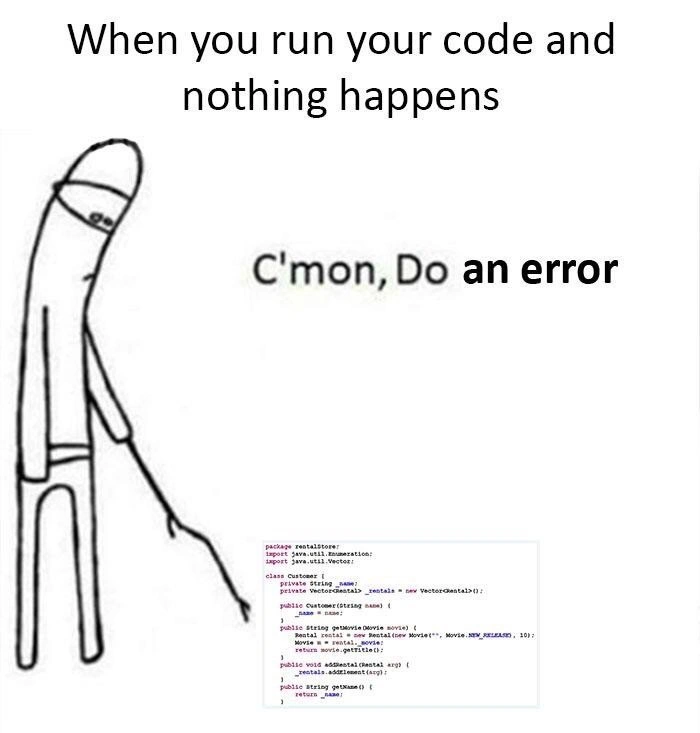
Imagine taking a broken toy to be fixed, but the toy refuses to demonstrate the problem — no weird noise, no sparks, nothing. It just sits there. So you poke it with a stick going "c'mon... do the thing... do the broken thing..." That's this entire image. The funny part is the role reversal: normally people hate when their computer shows an error message, but here the person is begging for one — because at least an error tells you where it hurts. A machine that stays completely silent is like a kid who insists "I'm fine" while clearly not being fine: now you have to guess, and guessing is so much worse.
Level 2: Why Developers Beg for Errors
Terms behind the panic:
- Error / exception: the program's way of announcing something went wrong. In Java it arrives as a stack trace — a red wall of text naming the exact line that failed and every call that led there. Scary-looking, but it's literally a map to the bug.
- Silent failure: the program finishes without complaint but also without doing what you wanted. No map. No clue. Just you and your assumptions, one of which is wrong.
Vector: an old Java list class for storing items — here, a customer's movie rentals. Seeing it in modern code is like seeing a fax machine in a startup office: functional, but a story is implied.- Print debugging: sprinkling output statements (
System.out.println("GOT HERE")) through the code to see what actually runs. Unfashionable, universal, undefeated.
Every junior hits this rite of passage: the first program that doesn't crash but doesn't work. You ran it. The cursor blinked. Nothing. You check the console — empty. You run it again, harder, as if the second click carries more authority. This meme is that exact moment, and the lesson it teaches is foundational: errors are not your enemy, invisibility is. Which is why grown-up systems invest so heavily in logging and observability — entire toolchains exist purely so production code can never pull the silent treatment depicted here.
Level 3: Exit Code 0, Confidence Also 0
When you run your code and nothing happens "C'mon, Do an error"
The stick figure prodding a screenshot of Java code with a literal stick is the most accurate depiction of late-stage debugging ever drawn, because it captures the moment a developer's relationship with errors inverts. Early in a career, a stack trace is the enemy. Later, you understand the truth this meme encodes: a crash is information; silence is a void. An exception hands you a file, a line number, a call chain — a confession with coordinates. A program that runs and produces nothing hands you an unbounded search space. The bug could be anywhere, including the spaces between your assumptions.
That's why silent failure sits at the top of the debugging difficulty hierarchy. Crash > wrong output > no output, in order of mercy. "Nothing happens" usually means one of a few dread-classics:
- The code path you're staring at never executes — the listener isn't registered, the method is never called, the
mainyou ran isn't themainyou edited. - You're running a stale build — editing one file while the JVM cheerfully executes last Tuesday's
.class. Java's compile step makes this a national pastime. - An exception is being thrown, but somewhere upstream lives the war crime
catch (Exception e) {}— the empty catch block, where errors check in and never check out. - It's working perfectly and produces no visible output because nobody wrote the
System.out.println. The most embarrassing diagnosis, arrived at after forty minutes.
The poking-with-a-stick methodology shown here is also technically accurate: deprived of an error, developers start perturbing the system — add a print, comment out half the file, change a string to "ASDFASDF" to prove the code even runs. It's cargo-cult science, but it's the correct cargo-cult science: you're trying to provoke the system into emitting any observable signal. Debugging is interrogation, and you can't interrogate a suspect who won't talk.
There's a bonus layer for the well-read: the code in the screenshot — package rentalStore, a Customer class with Vector<Rental> _rentals, getMovie, addRental — is recognizably the video-rental-store example from the refactoring literature, the canonical "code that works but needs help" specimen. And it's written in gloriously dated style: java.util.Vector (the synchronized dinosaur everyone was told to replace with ArrayList two decades ago), Enumeration instead of iterators, underscore-prefixed fields. Code like that doesn't do errors. It predates them. It will outlive us all, silently.
Description
A popular meme format featuring a simple, white, crudely drawn character with a blindfold, poking at a small snippet of Java code with a long stick. The top text reads, 'When you run your code and nothing happens'. The character is pleading with the code, with the text 'C'mon, Do an error' next to it. This meme perfectly encapsulates one of the most maddening scenarios in programming: silent failure. An error or a crash provides a stack trace, a line number - a starting point for debugging. But when code executes and produces no output, no errors, and no effect, it's a black box. The developer is left questioning everything from the execution environment to whether the correct file is even being run. This state of uncertainty is often more difficult and time-consuming to resolve than a straightforward bug with a clear error message, making the plea for an error a relatable cry of desperation for any developer
Comments
8Comment deleted
I'd take a segfault over a silent failure any day. A segfault tells you where the body is; a silent failure makes you wonder if there was ever a crime at all
Nothing reminds you that observability is a feature - not an afterthought - like praying for a NullPointerException just so your span finally shows up in Jaeger
After 20 years, you realize the most reliable monitoring system is still adding System.out.println() every three lines and watching for the one that doesn't print
A stack trace is a conversation; silence is a hostage situation. Twenty years in, you learn the scariest exit code is 0
Ah yes, the Schrödinger's bug - your code is simultaneously working and broken until you add a print statement to observe it. At least with a NullPointerException, you know which line to blame. But silent failure? That's the universe's way of saying 'figure it out yourself' while your logs remain pristinely empty and your sanity slowly evaporates. Senior engineers know the real horror isn't the stack trace - it's the absence of one
The scariest incident is the one with zero telemetry - throw me an exception; a silent no‑op is just failure with better marketing
Silent failures: because a stack trace is honest feedback, blank stdout just gaslights you
Nothing scares me more than exit code 0 with empty logs - that’s not success, that’s a decade-old catch(Exception e) {} accruing compound interest