The Vicious Cycle of Bug Fixing
Why is this Bugs meme funny?
Level 1: The Leaky Boat
It's like plugging a hole in a leaky boat, hearing a triumphant pop, and watching two new holes open where the wood flexed — and while you're staring at those, a third one starts dripping behind you. The man in the pictures goes from proud teacher pointing at his brilliant plan to slumped and defeated in just four steps, and that emotional collapse is the whole joke. Everyone has had a chore like this: tidy one shelf and the closet avalanches, fix one squeaky door and the handle comes off in your hand. Computer programs are that closet — and the people who fix them know that face in the last panel very, very well.
Level 2: Vocabulary for Panel Three
- Bug: a flaw making software behave incorrectly. Finding one is genuinely a victory — you can't fix what you can't reproduce.
- Bug fix: a code change meant to remove the flaw. Crucially, it's still a change, with all the risk any change carries.
- Regression: when something that used to work breaks because of a new change. The word every junior learns within their first month, usually in the sentence "your fix caused a regression."
- Side effects: consequences of code beyond its obvious purpose. The function you fixed also, unbeknownst to you, formatted the dates for an entirely different screen. Now that screen shows
NaN/NaN/NaN. - Regression tests: automated checks that re-verify old behavior after every change — the industry's vaccine against exactly this meme.
The rite of passage encoded here happens to every developer: your first confident fix, the triumphant commit message (fix: resolve login issue, for real this time), and then the bug tracker pinging twice before lunch. The lesson isn't "don't fix bugs." It's that code is a web, not a list — pull one thread and distant parts move. That's why seniors ask the eternally annoying, eternally correct question before approving your one-line change: "what else calls this?"
Level 3: Conservation of Bugs
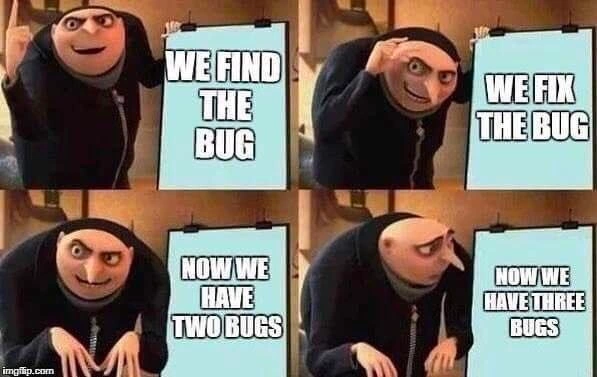
WE FIND THE BUG → WE FIX THE BUG → NOW WE HAVE TWO BUGS → NOW WE HAVE THREE BUGS
Note what the meme adds to the standard Gru's Plan format: usually panel four is just Gru staring again at the same unwelcome slide. Here the slide changes — three bugs, not two. The defect count is increasing while he reads the chart. That escalation is the most honest thing about it, because regression bugs don't arrive as a one-time penalty; they compound. Every fix is also a change, every change is a roll of the dice, and in the wrong codebase the dice are loaded.
Why does fixing one bug produce two? The mechanisms are depressingly well-catalogued:
- Tight coupling: in a system where module A quietly depends on module B's internals, correcting B's behavior breaks A — which had been compensating for the bug for three years. The bug wasn't a defect anymore; it was a load-bearing wall.
- Bugs masking bugs: defects interact. The off-by-one in the pagination hid the duplicate-row bug in the query. Fix the first, and the second walks on stage to take its bow. You didn't create two bugs — you revealed one and introduced one, which from the on-call rotation's perspective is a distinction without a difference.
- Fixing the symptom, not the cause: patch where the crash happens instead of where the bad state originates, and the bad state simply finds two new exits. This is the entire genre of the
if (value == null) return;fix. - No regression safety net: the deeper satire is that this multiplication is only visible in codebases without meaningful test coverage. With tests, panel three happens privately in CI. Without them, it happens in production, with Gru's exact face, during the demo.
The folk wisdom is older than the template — the "99 little bugs in the code" song ends with "take one down, patch it around, 127 little bugs in the code" — and the industry data has long backed the folklore: a meaningful fraction of bug fixes introduce new defects, and that fraction climbs with code age, coupling, and time pressure. Which points at the organizational layer Gru is really presenting to: when management measures tickets closed rather than defects prevented, the rational move is the fast shallow patch, and the meme becomes a roadmap. The plan was fine. The codebase voted against it.
Description
A four-panel meme using the 'Gru's Plan' format from the movie 'Despicable Me.' Gru is presenting a plan on a flip chart. In the first panel, he enthusiastically points to the first step: 'WE FIND THE BUG.' In the second panel, he looks at the next step with a confident, scheming expression: 'WE FIX THE BUG.' The third panel shows him looking back at the chart with a puzzled expression, revealing the third step: 'NOW WE HAVE TWO BUGS.' The final panel shows him with a look of defeated realization, as the chart now reads, 'NOW WE HAVE THREE BUGS.' This meme humorously illustrates the concept of software regression, where a seemingly simple bug fix inadvertently introduces new, often more numerous or complex, bugs. It's a painfully relatable experience for any developer, especially those working in large, tightly-coupled legacy codebases where the ripple effects of a small change can be unpredictable and catastrophic
Comments
8Comment deleted
Fixing a bug in a legacy system is like trying to change a single lightbulb in a house where all the wiring is a single, tangled Christmas light string
Looks like our defect backlog finally achieved eventual consistency - the bug count only moves monotonically upward
The senior engineer who confidently said "it's just a null pointer, I'll have it fixed in 5 minutes" is now explaining to the CTO why half the microservices are down and the database is somehow returning customer data in Mandarin
Bug-fixing in a legacy monolith is just mitosis with extra steps - the only fix that never causes a regression is the one still sitting in the backlog
This meme perfectly captures the Hydra principle of legacy systems: fix one bug in a tightly-coupled codebase without comprehensive integration tests, and two more emerge from the shadows of your inadequate test coverage. Senior engineers know this isn't just Murphy's Law - it's the inevitable consequence of high cyclomatic complexity, implicit dependencies, and that one 'quick fix' that seemed safe because it only touched three files... which turned out to be imported by seventeen others
Gru's Law: Fix one bug, spawn two more - the CAP theorem of debugging, where consistency is always partitioned
When your “quick fix” touches a shared util in the monorepo, you don’t close a bug - you trigger a distributed regression; turns out our contract tests are just optimism in YAML
Welcome to RDD - Regression-Driven Development - where a hotfix breaks an implicit contract, mocks keep CI green, and production discovers the real integration tests