Skip to content
DevMeme
1578 of 7435
Shower Temperature: Integer vs. Boolean Reality
Languages Post #1761, on Jul 8, 2020 in TG

Shower Temperature: Integer vs. Boolean Reality

Why is this Languages meme funny?

Level 1: Too Hot or Too Cold

This meme is saying that using some shower knobs is like having only two choices: really cold or really hot, with no comfortable middle. Imagine if the shower knob was like a simple light switch instead of a dimmer. You flip it one way and the water is freezing, flip it a little the other way and suddenly the water is scalding. There’s no gradual warm setting where it’s “just right.” We expect to be able to carefully adjust the temperature, but in reality those showers feel like they only have two settings. That’s why it’s funny – it points out in a silly way that something meant to be adjustable is acting like it’s only on or off. Anyone who’s jumped back from an unexpected burst of cold or hot water can relate to the joke: it’s the struggle to find that perfect in-between temperature, when the shower basically says “nope, it’s either Arctic cold or boiling hot!”

Level 2: Binary Bathing

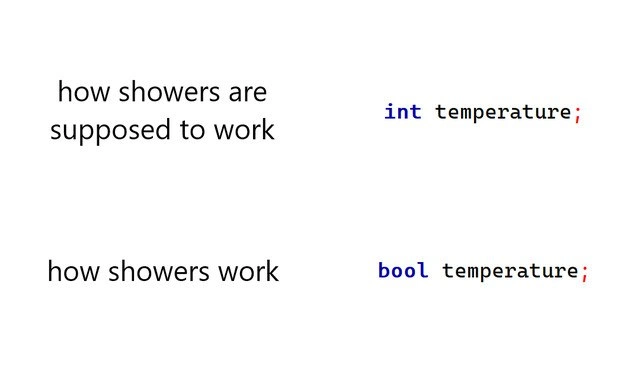
The meme compares an ideal shower control to the actual shower experience using programming terms. The top text says "how showers are supposed to work" and shows int temperature;. The bottom text says "how showers work" and shows bool temperature;. In code:

  • int (short for integer) is a data type that can hold many possible values (whole numbers). For example, an int temperature could represent 0, 1, 2, ... up to 100 or beyond – meaning you could set the water to 30°C, 31°C, 32°C, etc., covering a wide range of temperatures.
  • bool (Boolean) is a data type that only has two possible values: typically true or false. It’s like a simple on/off switch (one bit of information).

So, if a shower’s temperature were stored in an int, you could adjust it to a lot of different levels (a whole range from cool to warm to hot). But if it were a bool, you'd only have two options: say, false for cold and true for hot, with nothing in between. This highlights the difference between a continuous versus a discrete input: an int allows a graduated range of settings, while a bool is like a hard switch with only two fixed positions. The joke is pointing out that while we expect a nice smooth control (like an integer dial with many settings), what we get in reality feels more like a binary choice (a Boolean that flips between two extremes).

This ties into UX design (User Experience design). Showers should allow you to fine-tune the water temperature to your liking. That’s the intended user experience – gradually turning the knob should gradually change the temperature. But a badly designed shower fails at this, because small adjustments don't do what you expect. Instead, you often end up with either freezing cold or scalding hot water. In other words, the user interface behaves like it only understands two states. That’s a classic UX design failure: the interface promises something (fine control) that it doesn’t deliver.

The meme uses actual code syntax to get this point across. The phrases int temperature; and bool temperature; are written just as they would appear in a programming language like C++ or Java, complete with syntax highlighting. The type keywords are colored (blue for int and bool in the image, with a red semicolon), just like in a code editor, to make it clear to developers. This makes the comparison easy to spot:

  • Supposed to work: int temperature; suggests a full spectrum of temperature values (you could set any number, like any degree you want).
  • How it works: bool temperature; means only a binary hot/cold outcome (basically a True/False flag for "cold" vs "hot").

For a newer developer or someone learning about data types, this meme is a fun illustration. It essentially says: "We intended to give the shower a variable with lots of possible values, but instead it acts like a yes/no flag." In programming, using the wrong data type can cause real issues – imagine if you accidentally used a boolean when you needed a range of numbers! It even hints at a type safety lesson: using the wrong type for the job can lead to poor results, whether in code or in a shower. Here that idea is applied to a real-world scenario. The result is both funny and relatable. Anyone who’s fiddled with a tricky shower knob instantly understands the feeling of boolean-style temperature control: either too cold or too hot, with no comfortable middle ground.

Level 3: Quantized Comfort

In theory, a shower temperature control should be a smoothly adjustable parameter – like a continuous dial representing a full range of values. The meme humorously casts this ideal as an int temperature variable. In code, an int (integer) can represent a broad range of numeric values, offering fine-grained control (think of specifying any exact water temperature in degrees). This is how showers are supposed to work: you turn the knob and get a precise level of warmth, not unlike choosing any number within an expected range.

However, in reality many showers feel like they have only two states – basically cold or hot, nothing in between. The bottom half illustrates this by declaring bool temperature. A bool (Boolean) in programming is a one-bit value that can be either true or false (often used for yes/no or on/off). Here it’s effectively mapping to "cold" vs "hot". The joke is that the fancy continuous control has been reduced to a binary choice. It's as if the shower’s design uses a single bit of precision for temperature. If we wrote pseudo-code for such a shower, it might look like:

bool temperature = (knobPosition > 0.5);
if (temperature) {
    waterTemperature = "SCALDING";  // true means too hot
} else {
    waterTemperature = "FREEZING";  // false means too cold
}

This snippet exaggerates the feeling that a slight turn past the midpoint flips the water from icy cold to lava hot. For an experienced developer, the humor cuts deep: it's highlighting a UX failure where a design promises a continuum of options but delivers a binary outcome, essentially a one-bit bathing experience.

This comedic contrast is rooted in CS Fundamentals: choosing the right data representation matters. Representing temperature as an int suggests many possible values (imagine setting temperature = 38 for a nice 38°C shower). Representing it as a bool lumps everything into just two buckets. In a strongly typed system, treating a multi-valued concept as a boolean would be a type mismatch – a serious design flaw. Here the real-world UI irony is that a physical interface – the shower knob – behaves like it’s using the wrong data type internally. It's as if the plumbing "code" has a bug: they implemented the knob with a boolean where an integer was expected.

Seasoned developers have seen analogous scenarios in software and system design. We spec out features with plenty of nuance, but the real implementation gets dumbed down to an on/off flag. It’s like giving users a volume dial that actually only toggles between mute and max volume – a betrayal of the interface’s promise. The meme nails this concept in a few words and a code snippet. The colorful syntax-highlighted code snippet (blue for types, red semicolon) immediately signals Developer Humor. By framing an everyday frustration in terms of data types and Boolean logic, it resonates with the engineer’s mindset. You can almost hear a dev chuckle, “They essentially coded the shower as bool tooHot; – no wonder I can’t get a comfortable temperature!” It’s a playful jab at both poor UX design and the importance of proper type safety: get the design’s “data type” wrong, and your users (or your morning shower routine) will suffer.

Description

A minimalist two-panel meme on a plain white background that uses code to describe a common frustration. The top panel has the text 'how showers are supposed to work', followed by a line of code with syntax highlighting: 'int temperature;'. This suggests that the temperature should be an integer, a value with a wide range of granular control. The bottom panel presents the reality with the text 'how showers work', followed by the code 'bool temperature;'. This humorously implies that in practice, showers only have two settings - scalding hot and freezing cold - with no comfortable in-between, much like a boolean variable which can only be true or false. The joke serves as a perfect analogy for any system that promises fine-tuned control but delivers a frustratingly binary user experience

Comments

7
Anonymous ★ Top Pick I tried to fix my shower by changing the variable to a float, but it just introduced a whole new set of rounding errors and now it oscillates between hot and cold with double precision
  1. Anonymous ★ Top Pick

    I tried to fix my shower by changing the variable to a float, but it just introduced a whole new set of rounding errors and now it oscillates between hot and cold with double precision

  2. Anonymous

    Shower controls: the daily reminder that hardware shipped a 1-bit DAC behind a UI spec’d for float32

  3. Anonymous

    This is exactly how we modeled the thermostat in production until someone flushed a toilet and the entire system threw an uncaught NullPointerException

  4. Anonymous

    This is a classic case of lossy type conversion in the physical world - someone clearly cast a float to a bool without considering the precision requirements. The shower's control system suffers from a 1-bit resolution problem where the entire temperature range gets quantized into exactly two states: Arctic and Magma. It's like using a boolean flag for a feature that desperately needs an enum, or better yet, a properly calibrated analog value. No wonder the standup meetings always include someone complaining about the office bathroom's binary temperature API

  5. Anonymous

    The shower’s temperature controller is an MVP that downgraded int to bool and outsources the PID loop to your forearm

  6. Anonymous

    Shower firmware: bool temperature to sidestep floating-point woes in the thermostat microservice

  7. Anonymous

    Spec said int temperature; prod shipped bool - PID swapped for bang-bang, QA checked “cold” and “second-degree burns.”

Use J and K for navigation