The Inevitable Rake of Launch Day: Ship Fast vs. Ship Perfect
Why is this Deployment meme funny?
Level 1: Trip at the Finish Line
Imagine you have two kids trying to clean up a messy room with toys everywhere. The first kid is impatient and wants to go play, so he runs around stuffing toys under the bed and in the closet as fast as he can. He says “I’m done!” really quickly. But because he rushed, he didn’t see a toy firetruck still lying on the floor. The moment he starts to leave the room – ouch! – he steps right on that toy and hurts his foot. Now, the second kid takes a very long time to clean. He carefully picks up each Lego, each action figure, and puts them all in the right bins. He wants the room to be absolutely perfect, so he even color-codes the blocks and makes everything super neat. Hours later, the room looks spotless and he’s very proud. But guess what? He accidentally missed one tiny Lego piece that slid under the rug. So when he finally walks across the room… ouch! – he steps on that lone Lego and it hurts just the same. In both cases, the kids end up jumping in pain because of a toy they didn’t catch. It’s a bit funny and a bit frustrating: whether they hurried through or tried to be extra careful, something small still went wrong at the end. That’s exactly the point of the meme – in software, whether you rush a project or take forever to perfect it, there can still be a surprise mistake waiting when you finally “launch” it, just like that hidden toy causing a stubbed toe at the finish line.
Level 2: Speed vs Quality
At its core, this meme contrasts two opposite strategies for shipping software – “ship it fast” versus “ship it perfect” – and jokes that launch day bugs are unavoidable with either approach. Let’s break down what’s happening in each panel and the terms involved, in case you’re a newer developer or haven’t experienced the pain of a problematic deployment yet.
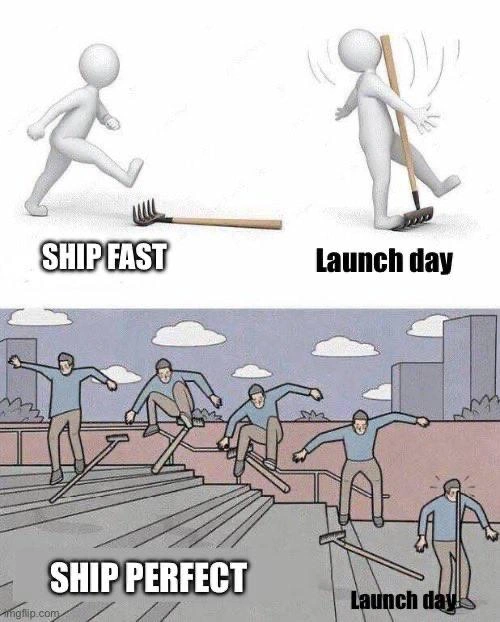
In the first panel, we have a simple white 3D-figure sprinting forward, labeled “SHIP FAST,” heading straight towards a rake on the ground. The moment after, the rake handle springs up and smacks the figure’s face, with the caption “Launch day.” This scene is a metaphor. Shipping fast means deploying new code or features quickly, prioritizing speed (high development velocity) over thoroughness. The poor stick figure represents a development team that’s rushing to release. The rake hitting their face symbolizes an immediate bug or failure they run into in production (the live environment) on the day of the launch. It’s like saying: “We pushed it out super quick… and immediately hit a big problem.”
In the second panel (drawn in a more detailed cartoon style), we see six engineers with pole vault poles attempting a much more elaborate obstacle course. The path is a staircase scattered with many rakes at various steps. These folks are labeled “SHIP PERFECT.” They are vaulting gracefully over each rake and cleared almost all obstacles. This represents a team that is trying to anticipate every problem and build the product perfectly before releasing. They likely went through extensive testing and quality assurance – each rake on the stairs is like a bug or issue that could happen, and these engineers have skillfully avoided them during the development and testing phases. However, at the very bottom, the last engineer is coming down from the final vault and about to land on one last rake that was beyond all the others. And wouldn’t you know, that rake is going to smack them on launch day (as noted by the caption near the impact). In other words: this team did everything to avoid mistakes (they shipped as perfectly as possible), yet on release day one unexpected bug still slipped through and “whacks” them. The joke is that even with an extremely careful approach, you can’t catch absolutely everything.
So, what do we call these approaches in software development, and what are the trade-offs?
Ship Fast (High Velocity) – This strategy is all about speed and rapid deployment. Teams focused on speed often release new features in quick iterations (think daily or weekly deploys). The advantage is getting features to users faster and early; you gather feedback sooner and can outpace competitors. However, the trade-off is usually technical debt and higher risk of bugs. Technical debt is a term for the “IOUs” you accumulate when you choose quick-and-dirty solutions that you plan to fix later. For example, you might hardcode a value or skip writing unit tests to save time – that’s adding technical debt. It’s like borrowing time now and paying interest in the form of bug fixes or refactoring later. In the meme’s first panel, the rake is essentially the debt coming due: an obvious bug pops up because of a corner that was cut or an assumption that wasn’t thoroughly checked. Deployment day under this approach can be chaotic – it’s common to patch issues on the fly in prod (hotfixes) because you discover problems late. This is a very reactive way of working: move fast, and if something breaks, we’ll fix it live. Many startups or agile teams lean this way, embracing mistakes as learning opportunities. But as the meme shows, it often leads to a facepalm moment on launch: “Oops, we shipped a bug!”
Ship Perfect (High Quality) – This approach emphasizes releasing software that is as bug-free and polished as possible, even if it takes more time. Teams aiming for perfection will have longer development cycles, exhaustive testing (unit tests, integration tests, manual QA, you name it), code reviews for every change, and maybe multiple staging environments to simulate production. They try to pay off or avoid any TechnicalDebt upfront and even tackle things that might not be strictly necessary right now (this is where premature optimization can come in – e.g., spending a week refactoring code for an imagined scaling issue that might never happen, just in case). The upside: when they finally deploy, they expect fewer things to go wrong. It’s a proactive strategy: prevent issues before users ever see the product. However, the trade-off here is time and sometimes overconfidence. Big “perfect” releases are usually slower to deliver value and can suffer from release delays as teams try to chase an unattainable zero-bug target. And crucially, no matter how perfect you try to be, complex software systems can still have hidden issues. The meme’s second panel highlights that irony – even after vaulting over a gauntlet of anticipated problems (the rakes on the stairs), one pesky rake still gets you. Maybe it’s a scenario no one thought of, or a bug in a part of the system that was considered “safe.” It might even be an external problem: for instance, you finally launch and then a third-party service or API your application relies on behaves unexpectedly, or a last-minute change in data (like a customer with a name containing an emoji crashes your perfectly tested form because no one tried an emoji 🙂). This approach might avoid the obvious mistakes, but launch day can still bring a surprise that sends everyone scrambling.
The irony captured by the meme is a huge source of release anxiety for developers: even with the best preparation, you never feel 100% safe on deployment day. Newer developers (and students learning programming) often imagine there’s a way to write perfect code given enough effort – but experienced devs know there will always be something you didn’t account for. Real production environments have a way of exposing issues that never showed up in testing. Maybe the production server configuration is slightly different. Maybe real users do something with your app you never tried. Or maybe it’s just Murphy’s Law. This is why teams often plan for a “post-release monitoring period” or keep engineers on-call during a big launch. We anticipate that the first contact with real users will reveal at least one bug or hiccup, no matter how much we polished beforehand.
It’s worth noting that these two extremes – “ship fast” vs “ship perfect” – are like two ends of a spectrum. In practice, most teams try to find a balance. You want to deliver features at a good pace (speed), but you also want solid quality and fewer fires to fight in production. Finding that balance is essentially managing engineering trade-offs. There’s even a common saying: “Good, Fast, Cheap – pick two.” In software terms, if you prioritize being fast and cheap (low effort), quality often suffers; if you want high quality and speed, it will require a lot of resources (not cheap); and if you want high quality on a cheap budget, it’s going to be slow. The meme specifically jokes about Speed vs Quality: even if you pick one or the other, the outcome (some pain on launch day) can feel similar. It’s a bit of a dark humor that keeps engineers humble.
Some key terms for clarity:
- Prod (Production): This is shorthand for the live production environment – where your application runs for real users. Bugs in “prod” are the ones that affect real customers or systems in real-time (as opposed to a test environment where only internal folks see it).
- Launch day: the day (or moment) you deploy/release your software to production. Often a source of both excitement and stress. Teams usually circle this on the calendar and may do special preparations (freezing other changes, having extra staff on hand, etc.).
- Deployment: the act of releasing new code to an environment (like pushing the latest version of your app onto the production servers). A deployment can be small (a minor update) or large (a major new version), and they can be automated or manual. Regardless, every deployment carries a bit of risk – hence those rakes.
- Technical debt: as mentioned, a metaphor comparing quick, sub-optimal solutions in code to financial debt. Just like financial debt, technical debt can accumulate “interest” – the interest here is the extra effort and risk you’ll deal with later because of a hasty solution now. Lots of tech debt means launch day might bring more rakes because the codebase has more hidden problems.
- Premature optimization: a famous concept where optimizing or perfecting something too early is considered a bad practice. If you try to make code super optimal or handle every edge case before you actually know you need to, you might waste time or even introduce complexity. The “Ship Perfect” team in the meme could be guilty of this – spending time on things that maybe weren’t the real cause of the eventual prod bug. There’s a saying: “premature optimization is the root of all evil” meaning don’t optimize too early. Focus on correctness and needed features first, because you might optimize something that isn't a bottleneck at all, while missing a basic issue.
- Reactive vs Proactive: A reactive approach means you react to problems as they occur (the “ship fast” mentality – deal with bugs after shipping). A proactive approach means you try to foresee and prevent problems before they happen (the “ship perfect” mentality – test and fix everything in advance). Neither is absolute; most teams use a mix (proactively prevent as much as possible, but also have a reactive plan like incident response for the unexpected). The meme humorously shows that even a highly proactive stance can’t catch everything.
- Quality vs Speed: This is the fundamental tension here. “Quality” means fewer bugs, more polish; “Speed” means delivering sooner, iterating quickly. The meme’s message is that optimizing for either axis has its pitfalls. High speed can reduce quality leading to obvious bugs (the rake you didn’t bother to remove). High quality focus can slow you down and yet you might get a surprise bug anyway (the one rake you didn’t see).
In real-world terms, think about a scenario from a junior developer’s perspective: You might have experienced a rushed college assignment or coding hackathon where you just cobble something together quickly (“ship fast”). It probably worked for the demo, but later you found a bunch of errors or edge cases you hadn’t considered. That’s like stepping on the rake immediately – you see the issues right away. Alternatively, perhaps you’ve worked on a project where you tried to be super thorough – you double-checked everything, wrote tests, maybe over-engineered the solution to be really robust (“ship perfect”). It felt solid in the controlled environment. But when you finally ran it in a real situation (maybe a different computer or with real user input), something completely unexpected happened – the program crashed or gave the wrong result because of a scenario you never anticipated. That’s like after all that careful work, a sneaky bug still jumped out. It’s frustrating and a bit humbling.
The takeaway for a newcomer is: bugs happen to everyone. You absolutely should try to write quality code and test it – that’s important – but don’t be surprised or think you’re a terrible developer if something goes wrong when you deploy. Even the most veteran engineers have stories of a launch day bug that embarrassed them. The meme is essentially the developer community laughing at this shared experience. We laugh because it’s better than crying, and we’ve all been there. It encourages a healthy respect for Murphy’s Law: plan for the unexpected. That’s why practices like monitoring, feature flagging (so you can turn off a feature if it misbehaves), canary releases (releasing to a small percentage of users first), and having rollback plans exist – they acknowledge that a rake might still be out there.
In summary, “No matter your velocity, the rake in prod still finds you” means no matter how fast or slow/careful you go, you can’t eliminate all risk. The best approach is often somewhere in the middle: ship in iterations (so you find rakes in smaller batches) and invest in quality where it counts (tests for critical functionality), but always be ready to catch that last rogue rake. After all, even rocket scientists have had rockets fail despite exhaustive pre-launch checks – software development is no different. This meme is a lighthearted reminder to every engineer: stay humble, because production has a way of surprising you.
Level 3: No Plan Survives Prod
This meme comically illustrates the inevitability of ProductionIssues on launch day no matter your software delivery style. In the first panel, a solo stick figure labeled “SHIP FAST” sprints right into a rake and gets bonked on the head – captioned “Launch day.” In the second panel, a whole squad of engineers with pole vaults labeled “SHIP PERFECT” acrobatically clears an obstacle course of rakes, only for the last vaulter to land on a lone rake at the bottom (again, Launch day strikes). The humor hits senior engineers immediately: whether you move fast and break things or polish every detail for months, something in production whacks you in the face. It’s a wry embodiment of Murphy’s Law in software deployment: anything that can go wrong in prod will go wrong.
From a seasoned perspective, this is poking fun at two extreme release strategies in the SDLC (Software Development Life Cycle). The “Ship Fast” approach is all about high velocity – pushing out features quickly, often accepting technical debt and minimal testing for the sake of speed. It’s the classic startup mantra “deploy on Friday, fix on Monday (or at 3 AM Saturday).” Everyone on the team knows they’re sprinting through a minefield of rakes: skipping some code reviews, leaving // TODO: fix this hack later comments all over, maybe deferring unit tests. The predictable outcome? On launch day, an obvious bug that was lurking (the rake) springs up and smacks the team in the face. Perhaps the app crashes because of an uncaught error, or an overlooked config causes a meltdown. It’s fast, and it’s messy – the rake handle imprint on your forehead is basically the company logo at that point.
On the other hand, “Ship Perfect” is the meticulous approach: dot every i, cross every t, annihilate every known bug before release. This is the team that has exhaustive checklists, a testing pipeline longer than the Nile, multiple QA phases, performance tuning, and maybe even formal verification step for critical pieces. They’re trying to pole-vault over every possible rake by being proactive – eliminating TechnicalDebt, refactoring for clarity, addressing corner cases, perhaps even indulging in a bit of premature optimization in the name of perfection. In theory, this team does everything right. The meme shows them clearing an increasingly complex staircase of rakes, which represent all those potential failures and edge cases they’ve handled. But the punchline? Launch day comes and still some unforeseen bug cracks them in the face. Despite all that effort, an unknown unknown was lying in wait – the lone rake nobody anticipated.
Why is this so relatable (and darkly funny) to experienced engineers? Because we’ve lived it. We’ve seen the ReleaseAnxiety play out in real life. Maybe you’ve been that developer racing to hit a deadline, merging code at 4:59 PM Friday, thinking “we’ll QA in prod” (the YOLO deploy strategy) – and sure enough, the application falls flat on its face on launch, triggering a midnight hotfix scramble. Conversely, perhaps you’ve worked on a project that spent six extra months in “gold-plating” mode (polishing the product to perfection) with endless test cycles and stakeholder sign-offs. Confidence was sky-high that this would be a flawless launch (“What could possibly still be wrong? We literally tested everything!”). Then reality hits: an integration point wasn’t configured correctly, or a last-minute one-line config change (ENABLE_NEW_FEATURE=true in prod) was missed, and suddenly things blow up anyway. Cue the collective facepalm 🤦♂️.
Ultimately, the meme is poking at the engineering trade-offs between speed and quality. In theory, you’d hope if you invest in quality, you avoid chaos – but complex systems have a way of surprising you. That last rake might be a weird concurrency bug that only appears under production load, or a difference between your staging environment (supposedly identical to not at all like production) and the real thing. It might be an expired certificate, a misconfigured DNS entry (it’s always DNS!), or some innocuous library update that decides to throw a tantrum only in prod. As a veteran dev, you develop a kind of morbid expectation: there will be bugs, no matter what. Even with 100% unit test coverage, robust integration tests, and all the code quality practices, testing can show the presence of bugs but never prove their absence. There’s a famous adage in software: “No amount of testing can guarantee a bug-free program” – you can mitigate risk, but you can’t eliminate it entirely in any non-trivial system.
This shared inevitability is why the meme resonates. Whether you choose a reactive strategy (“move fast, break things, then scramble to fix”) or a proactive strategy (“anticipate and prevent every failure before release”), the outcome on launch day feels eerily similar at times. It’s two paths converging to the same faceplant. Seasoned engineers have sat through the 2 AM war-room calls on Launch day, eyes on dashboards, waiting for the first alert to go off. Deployments, especially big ones, carry that suspense: you’ve done all you can, but you’re never truly safe from the rake. Continuous deployment advocates actually embrace this – they say “accept the rakes and step on them often” (release very frequently) so each impact is minor and you learn quickly. In contrast, heavyweight process teams try to remove every rake from the path – but they might only get one giant surprise if one rake remains. The meme’s joke is that either way, the rake in prod still finds you. Or as Dr. Ian Malcolm from Jurassic Park might adapt it: “Bugs, uh, find a way.” In the end, there’s no silver bullet and no escaping a prod surprise now and then – the best you can do is pick your strategy and keep a sense of humor (and maybe an ice pack for that forehead).
Team: “We’ve covered every scenario. Nothing can go wrong.”
Prod: “Hold my rake.”
Description
A two-panel meme contrasting two software development philosophies, both leading to the same disastrous outcome. The top panel, labeled 'SHIP FAST', shows a 3D stick figure running towards a rake on the ground. The next frame, labeled 'Launch day', shows the figure having stepped on the rake, which then swings up and hits them in the face. The bottom panel, titled 'SHIP PERFECT', depicts a more elaborate scenario: several cartoon figures are skillfully grinding down a flight of stairs on rakes as if they were skateboards. However, at the bottom, under the label 'Launch day', one of the figures finishes the stunt only to step on the rake in the exact same way, getting hit in the face. The meme satirizes the endless debate between rapid, agile-style development and slower, perfectionist approaches. It humorously suggests that regardless of the methodology, the project is doomed to fail on launch day due to some simple, unforeseen oversight, symbolized by the classic rake gag

Comments
10Comment deleted
The 'Ship Fast' team hits the rake they knew was there but added a ticket to fix it later. The 'Ship Perfect' team spends six months building a diamond-encrusted, perfectly balanced rake, and then hits themselves in the face with it on launch day
Whether you push straight to main or run a 37-step gated pipeline, prod is still the world’s most enthusiastic QA engineer with a rake
After 20 years in tech, I've learned that 'Ship Fast' means you'll step on the same architectural rake quarterly in different microservices, while 'Ship Perfect' means you'll still be refactoring that monolith when JavaScript framework #47 becomes obsolete and your competitors have pivoted twice
The eternal dilemma: ship fast and spend your launch day firefighting production incidents with a rake-shaped bruise on your face, or architect the perfect system with comprehensive test coverage, feature flags, and graceful degradation - only to realize your competitor shipped six months ago and your stakeholders are now doing parkour over your beautifully engineered but never-deployed codebase. The real senior move? Ship fast enough to validate the market, but with enough observability and rollback mechanisms that when you step on that rake, you've got a runbook, feature flags, and a blameless postmortem template ready to go
Ship fast and you hit one rake; ship “perfect” and you’ve built rake orchestration - your error budget just bought more handles
Ship fast: one rake to sweep. Ship perfect: distributed rake avalanches proving CAP's 'no partition tolerance on launch day'
“Ship perfect” is just how you amortize nine months of uncertainty into one 40k‑line diff - congrats, the only DORA metric you optimized was blast radius
Bro... Comment deleted
Bruuuh Comment deleted
Grub is too complicated Comment deleted