Share Our Knowledge We Must
Why is this Documentation meme funny?
Level 1: Do Not Keep the Map Secret
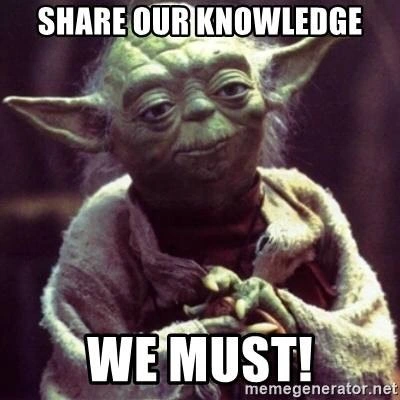
This is like a group of friends exploring a maze. If only one friend knows the way out and never tells anyone, everyone gets stuck when that friend leaves. The funny Yoda picture says the obvious lesson in a serious voice: people should share what they know so the whole group can keep going.
Level 2: Docs Save Teams
Documentation is written information that helps people understand a system. It can explain how to run a service, why an architecture decision was made, how to debug an alert, or what a feature is supposed to do.
Knowledge transfer means moving information from one person's head into a form other people can use. That can happen through:
- Pair programming
- Design reviews
- Runbooks
- Architecture decision records
- Onboarding guides
- Internal demos
- Clear code comments where the reason is not obvious
For junior developers, this matters because early confusion is normal. Good mentorship and documentation turn "I have no idea where to start" into "I know which file, command, person, or doc to check first." It also makes teams kinder: fewer repeated explanations, fewer hidden traps, and fewer moments where someone feels foolish for not knowing secret history.
The Yoda meme is basically saying that sharing knowledge is not optional decoration. It is part of building maintainable software.
Level 3: Bus Factor Jedi
The meme shows Yoda with the caption:
SHARE OUR KNOWLEDGE
and:
WE MUST!
The joke is gentle, but the engineering problem underneath is not. Knowledge sharing sounds like wholesome team advice until the deployment pipeline is broken, the only person who understands it is on vacation, and the runbook says "ask Alex." At that point, undocumented knowledge stops being culture and starts being an outage dependency.
The Yoda phrasing makes basic team hygiene sound like ancient wisdom, which is funny because software teams routinely need a mystical intervention to do obvious things: write documentation, record architecture decisions, explain trade-offs, mentor newer engineers, and stop hiding critical production behavior in one senior person's memory. The industry has invented wikis, ADRs, onboarding docs, internal talks, code comments, design reviews, incident postmortems, and still somehow the most reliable knowledge base is often "that one Slack thread from March."
Experienced developers read this as a bus factor joke. If one person being unavailable can paralyze a system, the team has a resilience problem. This applies to code, infrastructure, product decisions, release rituals, security exceptions, and customer-specific weirdness. The fix is not dumping every thought into a wiki graveyard. The fix is making knowledge usable: current, discoverable, reviewed, and connected to the work people actually do.
The humor works because Yoda's dramatic seriousness is being applied to something mundane but essential. Share our knowledge, we must, because production will not care that the only person who knows the cron job's true purpose has achieved work-life balance.
Description
The image is a classic Yoda reaction meme with Yoda centered against a dark background, hands clasped, and white Impact-style text with black outline. The top caption reads "SHARE OUR KNOWLEDGE" and the bottom caption reads "WE MUST!", with a small "memegenerator.net" watermark near the lower right. In a software-engineering setting, it argues for knowledge sharing, documentation, mentoring, and reducing single points of failure caused by tribal knowledge. The humor comes from treating basic team hygiene as Jedi-level wisdom.
Comments
5Comment deleted
The strongest architecture decision record is still a Jedi waving at the one engineer who knows why prod needs that cron job.
So, guys, have you checked that rare ads? Comment deleted
нет Comment deleted
But it was yes Comment deleted
Link expired,... Comment deleted