A Mathematician's Bedside Manner
Why is this Mathematics meme funny?
Level 1: Not That Kind of Doctor
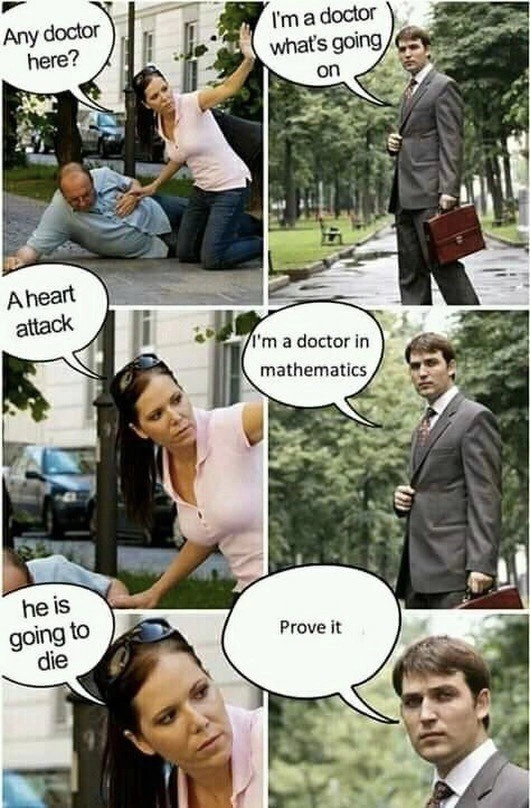
Imagine you’re at the playground and your friend falls off the swings and gets hurt. You yell, “We need a doctor!” You expect someone to come and help bandage the wound. Instead, a math teacher walks over and says, “I have a doctorate in math, what’s the problem?” You tell them your friend is really hurt and might be in big trouble. Then the math doctor calmly says, “Hmm, prove it.” 😐 See how silly that is? He’s the wrong kind of doctor for this situation. He’s treating a very obvious emergency like it’s a math puzzle. Instead of helping your friend, he wants to see evidence and logic that the situation is truly as bad as you say. Of course, by the time you prove it, it might be too late! The reason it’s funny is because the math doctor is behaving in a completely inappropriate way for the situation – he’s using math logic when we just need quick action. It’s like if your kitchen is on fire and someone wants to write an essay about the chemistry of fire instead of grabbing water. We laugh because we know real doctors don’t do that: a real medical doctor would start helping immediately. The joke shows a goofy mismatch: book-smart in the wrong moment. The poor lady wanted a life-saver, but got a math nerd who answers with a stiff “Prove it,” which is definitely not the help she was looking for.
Level 2: Proof Culture 101
Let’s break down the nerdy elements for a junior developer or someone new to this academic humor. First, the word “doctor” can mean different things: usually a doctor means a medical doctor (an MD) who treats sick people, especially in emergencies like a heart attack. But a person with a Ph.D. in mathematics is also called a “Doctor” (as in Doctor of Philosophy)—just not the life-saving kind! This meme hinges on that double meaning. A PhD in math spends years studying abstract problems and writing new proofs for mathematical theorems. So when the woman shouts “Any doctor here?” expecting a physician, the man with a math doctorate answers earnestly, “I’m a doctor, what’s going on?” – technically correct, but not what she needs.
Now, why does he say “Prove it”? In mathematics and theoretical computer science, proof is everything. A mathematician won’t accept a statement as true without a valid proof. For example, if someone states an important claim in an algorithms class – say, “This sorting algorithm always finishes in $O(n \log n)$ time” – the professor or PhD student might respond with “prove it,” meaning show me the logical evidence. This is the rigorous_proof_culture academics joke about. In the meme, the poor woman is saying “He is going to die” as a frantic warning. But the mathematician treats that like a hypothesis in a math problem. Instead of reacting with empathy or urgency, he coldly asks for a formal demonstration that the statement “he will die” is true. It’s a wild misapplication of classroom logic to a heart attack scenario. Essentially, he’s acting like the situation is a math debate: “You claim this outcome (death) will occur – can you back that up with axioms and lemmas?”
This contrast highlights theoretical_vs_practical in simple terms. Theoretical people (like math PhDs or CS theory experts) care about why something is true and proving it step-by-step. Practical people (like medical doctors, or software engineers in crunch time) care about fixing the problem right now. The meme is a math_doctor_joke illustrating that just because someone is called “doctor” doesn’t mean they’re useful in every scenario. It’s poking fun at the academic mindset: in a life-threatening emergency, asking for a proof is not just useless – it’s darkly comedic. The visual panels amplify this: the woman’s face is pure urgency and panic, while the mathematician looks serious and detached, as if he’s in a lecture hall. The humor is clear even for a newcomer: the academic humor lies in how misplaced the mathematician’s response is. If you’ve ever had a professor who answered a simple question with “Let’s prove it formally,” you’ll recognize the joke. This meme is basically saying, “Sometimes highly educated nerds can miss the point completely when they stick to their training!”
Level 3: Rigorous to a Fault
For seasoned developers and academics, this meme hilariously captures the gap between pedantic theoretical mindset and real-world problem-solving. The suited man proudly announces, “I’m a doctor in mathematics,” bringing the rigorous proof culture of academia onto a chaotic street scene. When he deadpans > “Prove it.” in response to “He is going to die,” it satirizes the habit of demanding definitive evidence for every claim – a hallmark of math and algorithm theory – even when the situation is blatantly clear. This is a classic doctor_vs_doctor joke: someone asks for a medical doctor and gets a PhD (not that kind of doctor). In software terms, it’s like a critical bug is bringing production down and an engineer with a research background responds, “Can you formally prove the system is actually crashing?” instead of rushing to restart services. We’ve all met that ultra-analytical teammate who won’t accept “it’s broken” without a stack trace and a whiteboard proof. The meme plays on theoretical vs. practical tensions: in academia and CS fundamentals, you learn to prove every algorithm’s correctness and every theorem’s conditions. But in an emergency (whether it’s a server on fire or a man on the ground), insisting on a formal proof is ridiculously out of place. The experienced reader laughs in recognition – it’s an inside joke about how brilliant logic-oriented minds can become ironically useless when they cling to theory at the wrong moment. The mathematician’s calm detachment (suit, briefcase, unbothered posture) amid the panic is the punchline: he’s rigorous to a fault, exemplifying that beloved nerd humor trope where intellect meets absurdity. We find it funny (and a bit painful) because it reminds us that a solution that’s logically correct on paper might be totally inadequate when real life is at stake.
Level 4: No Time for Q.E.D.
At the most abstract level, this meme spotlights a collision between formal logic and real-time urgency. In mathematics (and theoretical computer science), nothing is accepted as true until it's rigorously proven from axioms – a mindset formalized with the Latin stamp Q.E.D. at the end of a proof. Here the mathematician treats “He is going to die” as if it were a theorem requiring proof, which is absurd under an immediate deadline like a heart attack. Proving a statement in a formal system can be time-consuming or even intractable (some proofs take months or years!), analogous to an algorithm with exponential time complexity – totally impractical during an emergency. This is like trying to run a thorough formal verification of a program while the system is on fire. In computing terms, it’s akin to pausing a production outage to write a formal proof of what’s wrong, instead of swiftly rebooting the server or applying a fix. The humor emerges from this extreme theoretical vs. practical mismatch: the mathematician demands a perfectly sound logical derivation (require_proof(patient.willDie) 📜) in a scenario that calls for immediate action (perform_CPR(patient) 🚑). It’s a playful jab at how academic rigor, which is crucial in math and CS fundamentals, can become comically misapplied in a life-or-death context where there’s literally no time for Q.E.D..
Description
This is a six-panel comic strip that plays on the ambiguity of the title 'doctor'. In the first panel, a woman is tending to a man who has collapsed on the sidewalk, calling out, 'Any doctor here?'. He says he's having 'A heart attack'. A man in a business suit approaches, stating, 'I'm a doctor, what's going on'. In the following panels, he clarifies, 'I'm a doctor in mathematics'. The woman, distressed, tells him, 'he is going to die'. In the final panel, the mathematician, with a deadpan expression, responds, 'Prove it'. The humor stems from the collision of two worlds: the urgent, practical world of medicine and the abstract, proof-based world of mathematics. The joke satirizes the stereotype of the academic who is so detached from reality that they would demand a formal proof for an observable, life-or-death event. It resonates with anyone in tech or academia who has a Ph.D. and isn't a medical doctor
Comments
16Comment deleted
This is what happens when the formal verification team is asked to join a production incident bridge. They don't offer a fix, they just ask you to prove the system is actually down
PagerDuty: “Checkout service is in cardiac arrest!” Formal-methods PhD on call: “Hold the defibrillator - I won’t touch prod until someone produces a Coq proof that CPR preserves liveness.”
This is every code review where the senior architect asks you to formally prove your O(n) solution won't cause heap exhaustion in production while the servers are literally on fire and customers are screaming - sometimes you just need to ship the defibrillator patch, not derive its correctness from first principles
When your PhD in Computer Science makes you technically a 'doctor' but the only thing you can debug is code, not cardiac arrest. At least in mathematics, every problem has a proof - in production, we just have post-mortems and hope the logs tell us what killed the system
Mathematician on the incident bridge: “Prove it.” SRE: “Around here, QED means quick emergency deploy - Grafana provides the axioms.”
Prod heart attack? Mathematician on-call: 'First, prove liveness property holds.'
Sev0 with the team’s math PhD: “Prod is dying!” “Prove it.” Two hours later we had a TLA+ spec, a neat QED, and a dead cluster
Oh no Comment deleted
cringe Comment deleted
That girl: Thats obvious (это очевидно!) Comment deleted
Sherlock Holmes and Dr. Watson, being drifted away in a hot air balloon, finally spot a man below and ask him where they are. "You are in a hot air balloon." "Watson, that man below is a mathematician." "But Holmes, how can you know that?" "His answer is both correct and totally useless." Comment deleted
legit Comment deleted
Brilliant Comment deleted
I heard some people have same impression about Japanese. "Does this train go to station X?" "Yes" ... "Does this train stop at station X?" "No" Comment deleted
🤷♂️ Comment deleted
Minus 1 Comment deleted