A Developer's Ego vs. Browser History
Why is this Learning meme funny?
Level 1: We All Forget Stuff
Imagine you’re learning to tie your shoes, and even after doing it a bunch of times, you still forget one of the steps and have to ask for help every single day. Kinda funny, right? You’d think, “Shouldn’t I know this by now?” That’s exactly what’s happening in this meme, but with a programmer and their code. The picture shows a confident guy calling someone else dumb, but then it turns out he’s been forgetting a super basic thing over and over: how to do a simple action in his computer code. It’s like if every day he had to google “how to open a door” because he keeps forgetting, even though he’s opened plenty of doors before! In the last part of the meme, that confident guy turns all sad and hollow-eyed when he realizes he’s the one being silly. The feeling behind it is familiar to everyone: sometimes we keep forgetting something we thought we knew, and it makes us feel a bit dumb. But it’s also funny because we can all relate – everyone’s brain leaves them hanging once in a while. The meme is basically saying: “Hey, it happens to the best of us. Don’t beat yourself up!” We laugh at the picture because we’ve been that person, secretly googling something super simple, and then looking around hoping no one noticed. In the end, it’s okay – just like eventually you’ll remember how to tie your shoes without looking it up, a programmer will remember the easy stuff... until they forget and have to look it up again, and we all have a good laugh about it.
Level 2: Basic File I/O (Again)
Let’s break down the meme’s scenario in simpler terms. The joke here is about a programmer who keeps forgetting how to do file I/O in Python, so they keep searching online for the answer. File I/O stands for File Input/Output, and it basically means reading from or writing to a file on your computer. In Python, this is a common task – for example, you might need to read a configuration file or save program output to a text file. The “74 times this week” is almost certainly an exaggeration, but it emphasizes that feeling of “Wait, how do I do that again?” that even developers have repeatedly.
What exactly are they googling? Probably something like “how to open a file in Python” or “Python write to file example.” The core steps for file operations in Python usually look like this: you use the built-in open() function to open a file, then call methods like .read() or .write() on the file, and finally close it. There’s even a handy shortcut in Python – the with open(...) as ...: syntax – that opens the file and automatically closes it for you. Here’s a quick refresher on the two common ways to handle a file in Python:
# Method 1: Manual open and close
file = open("example.txt", "r") # 'r' means read mode
content = file.read() # read the entire file content into a string
file.close() # always remember to close the file!
# Method 2: Using a context manager (with open)
with open("example.txt", "r") as f: # 'with' handles closing the file automatically
content = f.read()
# file is only open inside this indented block
# once we exit the block, the file is closed automatically
In the code above, "example.txt" is just a filename. The "r" means we’re opening the file for reading. If we used "w" instead, that would open the file for writing (and create it if it doesn’t exist). These are the kind of details the developer in the meme keeps forgetting – like “do I use open or some library? Do I need to close it? What was that with keyword about?” It’s basic stuff, taught early in learning Python, but it’s easy to forget the exact syntax or best practice if you haven’t done it in a while.
Now, why is this so relatable and funny to other developers? Because googling code snippets is practically a part of the job. Beginners might feel bad about it, thinking “I’m supposed to memorize this”, but in reality even experienced programmers do it all the time. The meme calls out a common case: file I/O is taught in every intro course, yet here we have someone (presumably a professional developer) who looked it up dozens of times. It’s highlighting a learning curve phenomenon – repetition is usually how we learn, but sometimes we repeat not to learn, just to get through the task. When you’re jumping between many tasks or languages, your brain might not hold onto every detail. One day you’re writing SQL queries, the next day you’re writing a Python script, and poof – the exact file-handling syntax slips out of your mind. Memory lapses like this happen to everyone.
Let’s also talk about that “74 times” number. It’s obviously a comedic exaggeration (most people wouldn’t literally search the same thing 74 times in one week), but it serves to stress the dependence this developer has on search engines or Stack Overflow. Stack Overflow is a popular Q&A website where developers post questions and answers; it’s so famous in programming culture that many code-related Google searches lead there. When the meme says the person has looked up file operations dozens of times, it implies they might be copying the same snippet from a Stack Overflow answer or documentation again and again. This pokes fun at a kind of copy-paste coding. But truthfully, using examples from the internet is an essential skill. It doesn’t mean you’re a bad coder; it means you know how to find solutions quickly. We often say that a good programmer isn’t someone who remembers everything, but someone who knows how to search effectively and solve problems.
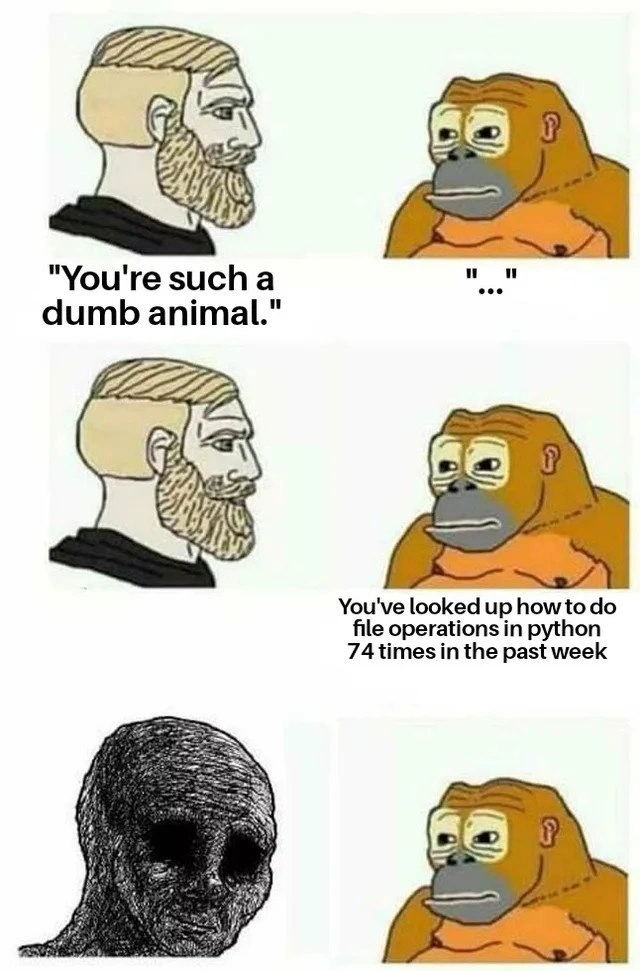
The characters in the meme help convey this joke. The orange Wojak gorilla (a meme character) is silently being insulted as “dumb” by the blonde Chad (who represents a cocky attitude). The twist is that the Chad figure is basically us, the developers, when we feel smug but then get knocked down a peg by a simple task we haven’t memorized. In panel 3, a caption exposes the truth: the supposedly smart person has had to ask the same question over and over. In panel 4, Chad’s pride is gone – he’s depicted as a dark, hollow-faced figure symbolizing embarrassment or internal despair. This is a dramatization of developer self-doubt or feeling like “I’m such an idiot for not remembering.” The meme exaggerates it to make us laugh, but it resonates because every developer has had that facepalm moment of forgetting something “obvious.”
In a learning context, the meme actually carries a reassuring message: no one remembers everything, and that’s okay. Need to recall how to do something? That’s what documentation and search engines are for. Programming languages like Python have concise syntax, but when you juggle multiple tasks, it’s normal to need a refresher. The more you use file I/O, the more it’ll stick – but if you step away from it, don’t be surprised if you have to look it up again. The difference between a newbie and an experienced dev is often just how calmly they handle looking things up. A seasoned dev might chuckle and say “ha, there I go again,” whereas a newer dev might panic and feel like they’re not cut out for coding. This meme is a lighthearted reminder that having to Google something repeatedly doesn’t mean you’re not learning; sometimes it’s just a quirk of how our memory works in a busy developer life. Remember, the code you write works whether you recalled it from memory or copied it from Stack Overflow – what matters is understanding it in the end. And if you have to search 74 times, so be it – eventually, it’ll be 75, and still no shame in that!
Level 3: Context Switch Amnesia
Even seasoned developers chuckle (and cringe) at this meme because it nails a painfully common reality: relying on Google for Python file I/O reminders over and over again. The blonde bearded "Chad" character confidently calling someone a "dumb animal" sets up a classic irony. In the programming world, that overconfidence is often humbled by something as simple as file operations. The punchline reveals Chad’s hypocrisy: he’s had to look up basic file handling 74 times in one week! This absurd number is an exaggerated wink to how frequently we search the same coding snippets. It’s funny because it’s relatable – many of us have felt like that “dumb” gorilla, stoically googling the same thing repeatedly.
On a deeper level, the meme highlights an open secret in software development: even senior engineers constantly reference documentation or Q&A sites like Stack Overflow for “simple” tasks. It’s a shared industry joke that modern development is “90% googling, 10% coding.” We talk about being 10x developers, but often that just means we’ve gotten really quick at finding answers online. Here, Python’s file operations are the culprit. Why file I/O? Because it’s a fundamental task (reading from or writing to a file) that you’d expect yourself to memorize. Python makes file handling pretty straightforward (open(), read, write, close or the with open(...) as f: pattern), yet the exact syntax or best practice can slip your mind if you haven’t used it recently. The humor is a mix of self-deprecation and truth: the very thing that makes us feel like programming “pros” – managing complex logic, algorithms, systems – coexists with moments where we blank on a one-liner to open a file.
This scenario is a case of context-switching induced amnesia. One hour you’re debugging an API response, the next you’re writing a quick script to parse a file in Python. Your brain’s cache of knowledge gets thrashed by the switch. The information isn’t gone forever, but it’s swapped out, just like an LRU cache evicting something that hasn’t been used lately. When you reach for that memory of Python’s file syntax, you get a cache miss – brain returns a 404: Function Not Found. So you alt-tab to Google for the nth time. It’s practically muscle memory to hit the search bar and type “Python open file”. In real developer life, this pattern is often jokingly called “Stack Overflow–Driven Development.” The meme’s third panel text (“You’ve looked up how to do file operations in Python 74 times...”) is basically StackOverflow calling out our dependence on it. It’s the computer-age equivalent of a teacher saying, “I’ve told you this 74 times, why don’t you remember?” except the teacher is Google and it never actually judges you – but you judge yourself.
Notice in the final panel, Chad’s face has morphed into that hollow-eyed, black despair Wojak. That visual is meme-speak for an existential crisis or developer self-doubt setting in. It represents the "oh no... that’s me" realization. The confident facade crumbles; our arrogant inner Chad is confronted by the orangutan of truth. In developer terms, it’s a flash of imposter syndrome – “How can I call myself a programmer if I can’t remember a simple file open command?” We’ve all had that late-night humiliation feeling, when a trivial bug or forgotten detail makes us question our competence. This meme cleverly portrays that internal drama: one moment you’re smugly thinking you’ve mastered your code, next moment you’re the skull-faced doomer, humbled by a Google search history.
Importantly, the humor also serves as camaraderie. It’s DeveloperHumor that unites newbies and veterans alike. By laughing at this, experienced devs signal to juniors: “Hey, we all rely on Google and docs. Forgetting stuff – even simple stuff – doesn’t make you dumb, it makes you human.” In fact, knowing that you can quickly lookup and confirm the correct file_operations syntax is part of good DeveloperExperience (DX). It’s more efficient than stubbornly hacking away from memory and possibly introducing a bug (like forgetting to close a file). The industry has tacitly accepted that our brains have limited memory (RAM) and we outsource certain facts to the internet. This meme playfully reminds us that no one’s mind is a perfect database. Even the Chad developers have memory lapses and use the cloud brain (Google) as a crutch. It’s a lighthearted poke at our profession’s constant learning curve – in tech, you’re always re-learning and looking things up, 74 times or more, and that’s okay. In short, the meme is funny-not-funny because it brutally calls out a cycle every developer knows too well, turning our frustration and secret shame into a shared laugh.
Description
This is a three-panel meme featuring a confident, bearded 'Chad' Wojak on the left and a calm orangutan on the right. In the first panel, the Chad character condescendingly says to the orangutan, 'You're such a dumb animal.' The orangutan remains silent. In the second panel, a caption appears under the orangutan, which reads, 'You've looked up how to do file operations in python 74 times in the past week'. In the final panel, the Chad character has transformed into a dark, hollow-eyed 'Doomer' Wojak, utterly crushed, while the orangutan looks on with the same placid expression. The meme hilariously captures the feeling of imposter syndrome among developers. It points out the humbling reality that even experienced programmers frequently forget and must re-lookup fundamental syntax for common tasks, like file I/O in Python. The developer's initial arrogance is shattered by the simple, data-driven truth of their own search history, serving as a relatable commentary on the gap between how smart a developer feels and their daily reliance on documentation and search engines

Comments
12Comment deleted
It's not that I forget the syntax for file operations; I'm just diligently checking for breaking changes in the POSIX standard every time I write `with open()`
Built a lock-free queue in C at 3 a.m., yet `with open(path, 'r') as f:` still causes an L3 cache miss in my brain - 74 Stack Overflow reads, zero writes to long-term memory
I've architected distributed systems handling petabytes of data, but I still can't remember if it's 'rb' or 'br' for binary mode without checking - turns out the real cache invalidation problem is my brain's L1 for Python's context manager syntax
After 15 years, I've accepted that my brain has implemented a lazy-loading pattern for Python's file I/O syntax - why keep `open()` modes in memory when Stack Overflow has better uptime than my recall? The real senior move is knowing *what* to search for in under 3 seconds
Staff+ tip: outsource stdlib minutiae - let your brain GC it nightly and accept the cold-start latency while Google serves as your distributed cognition
My brain runs LRU: Raft and backpressure are pinned; 'with open(path, mode, encoding=...)' cold-starts 74 times a week
We've orchestrated Kubernetes clusters at petabyte scale, yet `f.seek(0)` requires a SO pilgrimage every sprint
😂😂😂😂😂😂 gold meme Comment deleted
Anyone explain? I am not a pythone devs Comment deleted
it's when you forget how simple stuff work in programming, like working with files, so you google it up again only to use it once and forget about it again Comment deleted
I see.... Comment deleted
Well, yes, but when it stops you from imposter syndrome? :D Comment deleted