Serverless, Now Featuring the Same Server
Why is this Cloud meme funny?
Level 1: The Hidden Kitchen
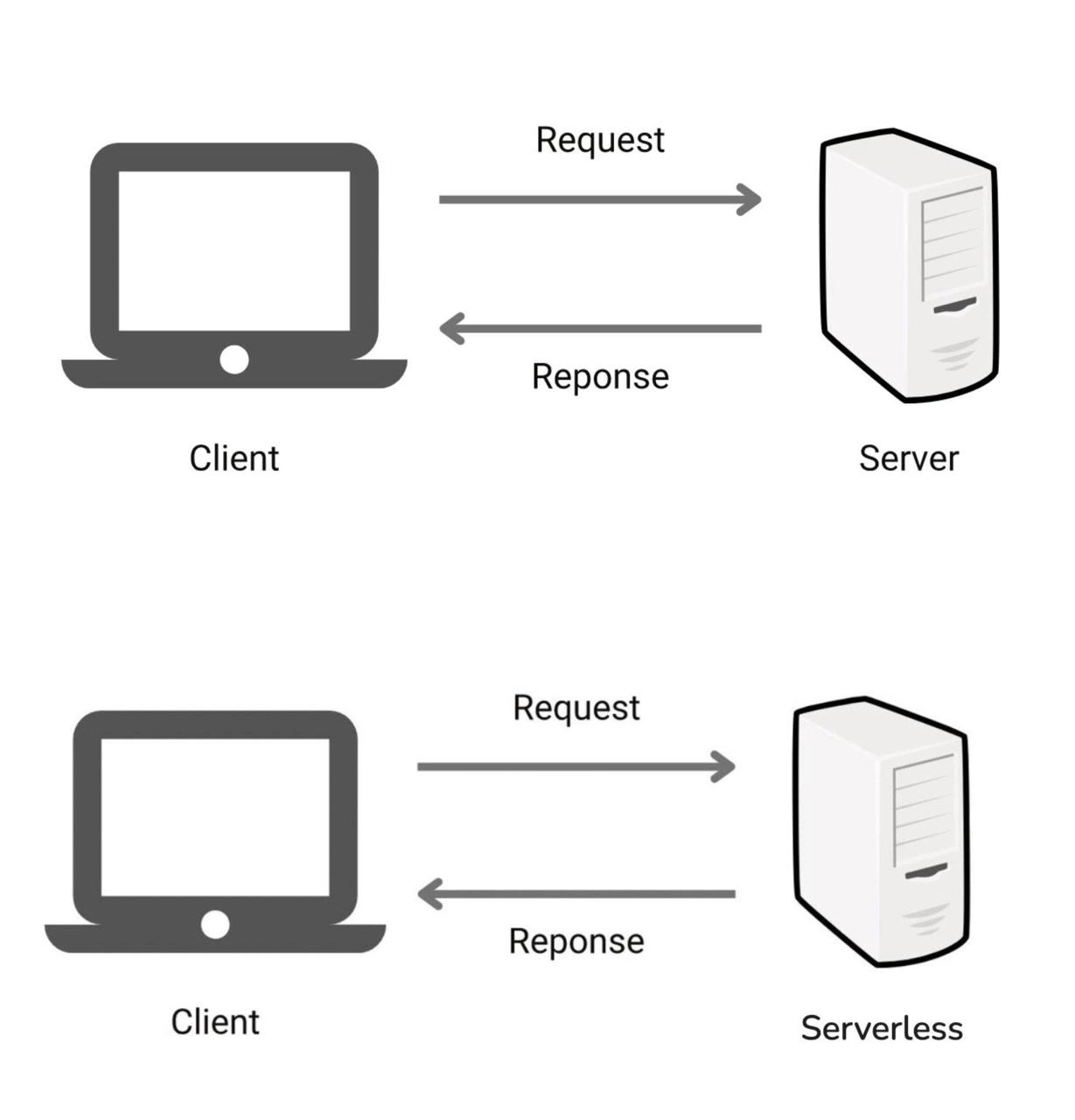
It is like a restaurant advertising “kitchenless dining.” You still order food and someone still cooks it; you simply do not own, clean, or manage the kitchen. The picture is funny because it shows the same kitchen twice and changes only the sign, revealing that “serverless” really means “the server is somebody else's problem.”
Level 2: Somebody Else's Computer
A client is the laptop, browser, or app asking for work. A server is a computer or program that accepts that request and sends information back. The arrows labeled Request and Reponse show this familiar exchange in both rows, although the picture consistently drops the “s” from “Response.” Nothing about that basic conversation changes when the lower tower is labeled Serverless.
What changes is the developer's workflow. With a conventional server, a team may choose a machine size, deploy a long-running application, install updates, and decide how many copies should run. With a serverless service, the team commonly uploads a small handler such as:
export async function handler(request) {
return { statusCode: 200, body: "Hello" };
}
The cloud platform decides where and when that handler runs and can create more instances when traffic increases. This is why cloud infrastructure remains present even though it is hidden from the application developer. A junior engineer's first surprise is often discovering that “managed” means fewer knobs, not fewer failure modes: permissions can still be wrong, downstream databases can still be overloaded, and logs can still be scattered across several services.
Level 3: Abstraction Has Servers
The two halves are deliberately almost identical: a gray Client sends a Request to the same beige tower, then receives a misspelled Reponse. Only the tower's label changes from Server to Serverless. That unchanged hardware icon is the whole technical punchline. Serverless architecture does not abolish servers; it moves their provisioning, patching, capacity planning, and much of their failure handling behind a cloud provider's control plane. The server has not vanished. It has acquired an API, a billing meter, and plausible deniability.
In a typical Function-as-a-Service system, an API gateway or event source accepts the request, a scheduler selects capacity, and the platform starts or reuses an isolated runtime to execute the developer's function. Physical machines, virtual machines, containers, networks, and storage still carry out every step. What becomes “less” is the customer's direct responsibility for named hosts. That is code abstraction applied to infrastructure ownership, not a violation of thermodynamics.
The mirrored request-response arrows also expose why serverless can look unremarkable from outside. A client still speaks to a web service and waits for a result; the architectural change is behind the endpoint. The trade-offs appear in operations: automatic scaling and usage-based billing can be excellent for bursty workloads, while cold-start latency, execution limits, opaque platform behavior, distributed observability, and vendor-specific integrations can make debugging feel like questioning a witness behind frosted glass. At steady high utilization, renting execution in tiny metered slices may also cost more than operating predictable capacity.
The accompanying “Clientless SaaS” jab applies the name literally in the opposite direction. Calling the backend serverless makes about as much literal sense as calling software clientless because customers do not maintain the browser. The industry term describes who manages a layer, while the joke pretends it describes which layer physically exists. Marketing supplied the ambiguity; the diagram merely filed the incident report.
Description
A white-background diagram stacks two nearly identical client-server exchanges vertically. In the top diagram, a gray laptop labeled “Client” sends a right-pointing arrow labeled “Request” to a tower labeled “Server,” which sends a left-pointing arrow labeled with the misspelled word “Reponse” back to the client. The lower diagram repeats the same laptop, tower, “Request,” and “Reponse” arrows, but the tower is labeled “Serverless.” The visual joke exposes the literal misreading behind the cloud term: serverless computing removes server provisioning and ownership from the application developer’s view, not servers from the physical execution path.
Comments
1Comment deleted
Serverless is just server ownership behind an opaque pointer.