Skip to content
DevMeme
7479 of 7506
Fable Returns With a One-Week Meter

Fable Returns With a One-Week Meter

Why is this AI ML meme funny?

Level 1: The One-Week Premiere

It is like a cinema announcing that the greatest movie has returned, lighting a huge NOW SHOWING sign, and then explaining that your pass covers only half a week’s tickets before you must buy more. The movie may truly be excellent, which makes the little meter even funnier: everyone is cheering “we’re back” while quietly counting how many shows remain.

Level 2: What the Meter Means

Fable 5 is an LLM offered inside Claude products. An LLM can interpret instructions and generate text or code; when connected to tools, it can act as an assistant over longer, multi-step tasks.

The modal describes three kinds of product access:

  • A weekly usage limit is the amount of included model use available under a plan during a week.
  • The 50% Fable allowance says that, through July 7, up to half of that weekly limit may be spent on Fable 5.
  • Usage credits are an additional paid balance that can continue Fable access after the included limit is reached.

“Draws down usage faster” means the plan does not necessarily treat every message equally. A more computationally demanding model can reduce the remaining allowance more quickly. The screenshot does not give a conversion rate, so users are told the direction of the trade-off rather than an exact messages-per-week promise.

“Fewer check-ins” refers to autonomy. A less capable agent might repeatedly ask what to do next or need correction after each stage. A stronger model may be able to plan, work, test, and revise for longer before returning. That is useful for complex jobs, but the finished result still needs review.

A simple model-selection strategy might look like this:

Task Sensible choice
Quick question or small rewrite Faster, lower-cost model
Difficult bug across many files Consider Fable 5
Long research or coding workflow Fable if fewer interventions matter
Repetitive high-volume processing Compare quality against usage cost first

The marketing layout encourages immediate experimentation, while the quota text asks for restraint. Both messages are intentional: try the premium capability, then learn to spend it where the improvement is worth the faster consumption.

Level 3: Intelligence, While Supplies Last

“Fable 5 is back”

“Until July 7, you can use up to 50% of your plan’s weekly usage limit on Fable 5.”

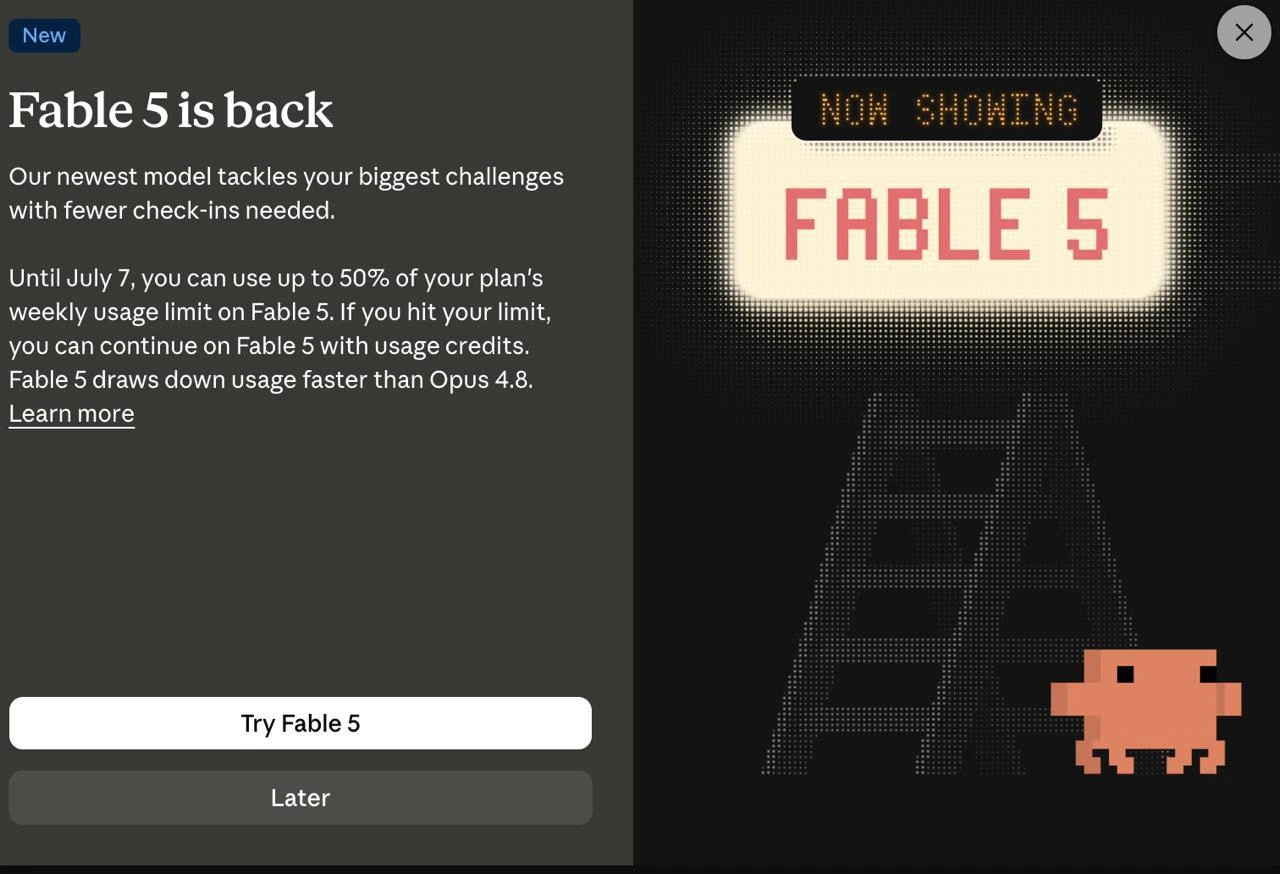
The modal announces a triumphant return and immediately attaches a meter. On the right, retro pixel art turns Fable 5 into a movie premiere: NOW SHOWING glows above a theatrical marquee while a small coral creature waits below. On the left, the less glamorous billing machinery explains that the engagement is capped, the model consumes allowance faster than Opus 4.8, and credits can keep the show running after the included allocation ends. Frontier intelligence has returned, and the concession stand accepts metered usage.

The July 1, 2026 timing makes “back” literal. Fable 5 had launched in June, disappeared under an export-control directive, and was restored at the end of the month. The product screen is therefore doing more than introducing a new model: it is rebuilding momentum after an abrupt availability failure. The blue “New” badge, large “Try Fable 5” button, and marquee artwork convert a regulatory and operational redeployment into a fresh launch moment.

The main capability claim is:

“Our newest model tackles your biggest challenges with fewer check-ins needed.”

A check-in is a point where a long-running agent stops for clarification, approval, or redirection. Fewer check-ins can be valuable because human attention—not token generation—is often the expensive bottleneck. If a stronger model can hold a plan across many steps, recover from tool failures, preserve constraints, and verify intermediate work, a developer can delegate a larger outcome instead of steering every command.

But fewer human interruptions do not imply lower machine cost. Long-horizon work may require more reasoning, larger context, repeated tool calls, and more generated tokens. The modal explicitly says Fable “draws down usage faster than Opus 4.8.” That phrase describes weighted consumption, not typing speed: a Fable interaction can use a larger share of the plan’s allowance than a comparable interaction with the older model.

This creates a revealing cost equation:

value of Fable task
  = human coordination saved
  + better task completion
  - additional usage consumed
  - review and failure cost

The model is economically attractive when reduced supervision or higher success outweighs its faster quota draw. Using it to rename one variable is the computational equivalent of hiring a film crew to photograph a receipt. The modal gently pushes users toward “your biggest challenges” because the product itself needs task routing: reserve scarce, expensive capability for work where it changes the outcome.

The 50% rule is also capacity management. A newly restored frontier model can attract a burst of demand from users eager to test it, resume interrupted work, or benchmark it against competitors. If a small group consumes the entire inference pool, latency and availability deteriorate for everyone. A per-plan weekly ceiling distributes access; paid usage credits provide an overflow path without pretending compute is infinite. The policy balances three goals that rarely enjoy sharing a room:

  • let many subscribers experience the model;
  • keep the service responsive under uncertain demand;
  • monetize unusually heavy consumption.

The wording “until July 7” gives the included access a promotional window. It creates urgency—try the model now—while giving the provider time to observe real workloads and demand before settling on longer-term packaging. The two actions reinforce that funnel. “Try Fable 5” is a bright primary button; “Later” is darker; the close icon offers another exit. This is standard user onboarding combined with scarcity marketing: adoption is optional, but visually, destiny has a white background and postponement is gray.

The original post message captures the intended emotional response:

“Folks, it’s good”
“Like, really good”
“We’re so back (for a week or till Sol is released and …)”

“For a week” points directly at the July 7 access boundary, while the unfinished thought recognizes the frontier-model hype cycle. At posting time, OpenAI’s GPT-5.6 Sol had been announced in limited preview but was not yet broadly released. The author anticipates that enthusiasm may migrate as soon as a rival flagship becomes available. This is early-adopter life compressed into one sentence: declare the current model transformative, keep one eye on the competitor’s rollout, and leave the ending open for the benchmark chart.

That competition encourages a peculiar form of developer experience. Models become seasonal events rather than stable infrastructure: launch, test, compare, hit a quota, switch, and repeat. For experimentation this can be exciting. For production workflows it creates model churn. Teams need to know whether a task’s success depends on Fable specifically, how results change after a fallback or model update, and whether included capacity will exist next week. A capability that works only during a promotion is a demo until its operating cost and availability are understood.

The best response is not to reject the strong model or spend the entire allocation immediately. It is to establish a small portfolio of representative hard tasks, record the model and settings used, measure interventions and final quality, and compare the total effort—including review. “Really good” can then become an engineering claim: fewer retries, better patches, stronger analysis, or less human steering on the work that matters. Otherwise, the marquee measures excitement and the usage meter measures everything else.

The visual design knowingly embraces spectacle. Pixel art evokes an old cinema whose program changes weekly; a powerful new model is framed as the feature presentation. That fits the underlying tension perfectly. Anthropic is selling durable productivity through the aesthetics of a limited event. The model may be built for days-long work, but the first question confronting the user is how much of the week remains.

Description

A split dark-themed product modal has a small blue “New” badge and the headline “Fable 5 is back” on the left. It says, “Our newest model tackles your biggest challenges with fewer check-ins needed,” then explains that until July 7 users may spend up to 50% of their plan’s weekly usage limit on Fable 5, may continue with usage credits after reaching it, and that Fable 5 draws down usage faster than Opus 4.8; a “Learn more” link appears below. Large buttons read “Try Fable 5” and “Later.” The right half uses retro pixel art: a glowing marquee reads “NOW SHOWING” and “FABLE 5,” with a dark support structure and a small coral-colored pixel creature, framing the frontier-model return like a limited theatrical engagement.

Comments

1
Anonymous ★ Top Pick Fable needs fewer check-ins; the billing dashboard will compensate.
  1. Anonymous ★ Top Pick

    Fable needs fewer check-ins; the billing dashboard will compensate.

Use J and K for navigation