Skip to content
DevMeme
270 of 7435
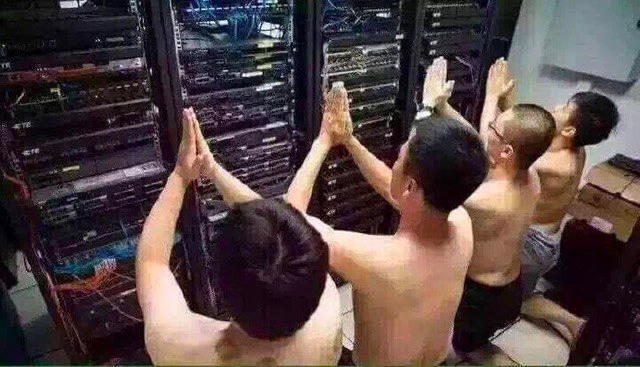
When production servers fail and desperate sysadmins resort to data-center rituals
SystemsAdministration Post #326, on Apr 19, 2019 in TG

When production servers fail and desperate sysadmins resort to data-center rituals

Why is this SystemsAdministration meme funny?

Level 1: Please Work, Please!

Imagine your computer or toy stops working, and you’ve tried everything to fix it – pressing the power button, plugging it in and out – but it just won’t turn on. You feel totally helpless. Finally, you put your hands together, look at the device and say, “Please, please work again!” as if your toy might magically hear you. We know that’s not how machines really work, but when you’re super desperate, you’ll try anything, even a little prayer.

This picture is doing the same thing, but with big important computers in a server room. The people in the image are the ones who need those computers (servers) to run a company’s website or app. The servers broke at the worst time, and nothing they did fixed the problem. They’re so desperate that they’re kneeling and praying to the machines to start working again. It’s funny because normally people fix computers with tools and technical know-how, not by praying. Seeing grown adults bowing to computer racks like they’re sacred statues is a silly, exaggerated way to show how panicked and hopeless they feel. It’s like when you really, really need something to work and you cross your fingers or talk to it: “Come on, please work!” The humor is that everyone can relate to hoping for a miracle when you feel out of control – even these tech experts are reduced to hoping and praying when things go horribly wrong.

Level 2: Friday Deploy Fiasco

This meme is highlighting a classic DevOpsHumor scenario: a production server outage so bad that the techs are jokingly “praying” to the servers for a fix. In the image, a team of system administrators (sysadmins) or operations engineers is on their knees in front of tall black server racks filled with actual physical servers and network equipment (you can see all the blinking LEDs and colorful Ethernet cables). They’re pressing their hands together in a prayer pose toward the machines. It’s obviously a staged exaggeration, but it represents how desperate ops teams feel during severe ProductionIncidents.

Why are they shirtless? That detail is part comedy and part plausible reality of a server room: big data-center rooms can get extremely hot, especially if the cooling (air conditioning) fails or if you’ve been rushing around swapping hardware. The tag server_room_heat hints that maybe the AC is down, turning the room into a sauna. So the admins strip off their shirts, both as a joke and because they’re literally sweating while working on the problem. It adds to the absurdity: it almost looks like a weird ritual or downtime_ceremony.

The caption gives context: “After deploying to production before long weekend.” In the tech world, deploying new code or changes to production right before a weekend (especially a long holiday weekend) is notoriously risky. There’s even an unwritten rule: never deploy on a Friday. The reason is exactly what we see here – if the deployment goes wrong, you might crash the system and have an outage at the worst possible time, when most of the team is offline or trying to relax. Here, apparently someone pushed an update before the long weekend, and Murphy’s Law struck: the servers failed hard. The people on OnCallDuty (the ones responsible for handling after-hours emergencies) had to rush into the data center to fix this ProductionIncident instead of enjoying their holiday. That’s why we see “desperate sysadmins” – they are the poor souls stuck dealing with the fallout.

In a real situation, what would they do to fix a failure? Typically:

  • Troubleshoot: check monitoring dashboards, see error alerts, open logs (/var/log/...) to find clues.
  • Diagnose hardware/software: Is a server down? Is it the network, the database, or maybe the dreaded DNS? (Tech joke: “It’s always DNS” is a common blame when things break.)
  • Attempt fixes: restart services (sudo systemctl restart some_service), reboot servers (sudo reboot), fail over to backup systems if possible, or rollback the new deployment to the previous stable version.

If all those normal steps don’t work, frustration sets in. The meme shows them at that stage: nothing is working, the site is still down, and they’re basically out of ideas. So they resort to humor and “prayer”. Of course, praying to servers isn’t in any admin manual – it’s poking fun at the feeling of helplessness. We joke that these servers have minds of their own or that there are server gods controlling uptime. “Hardware_worship” and “praying_to_servers” in the tags perfectly describe this joke: it’s like they formed a little cult worship session hoping the almighty Server Deities bring their systems back online.

This resonates with many in SysadminLife or DevOps roles. Being on-call at 3 AM during a production outage can feel like an emergency room situation. You’re under pressure, adrenaline pumping, and sometimes you do silly things to keep morale or make light of a nightmare scenario. One common ServerRoomStories anecdote is an admin jokingly whispering to a server, “Be a good girl and work for me, please,” as they flip the power switch, almost like coaxing a stubborn machine. Another is doing a sarcastic “rain dance” or putting a lucky charm on the server chassis. These are obviously jokes – the real fixes are technical, but when those fail, humor is the last resort to stay sane. The meme’s humor comes from recognizing that crazy, almost superstitious feeling that tech folks get when an outage is so bad, you half-jokingly act like the machines respond to prayer.

In short, this meme uses exaggeration to capture a real truth of Infrastructure and operations work: things can and will go wrong (especially if you break the “no Friday deploy” rule), and when they do, sysadmins sometimes jokingly behave as if the servers are capricious gods. It’s a light-hearted take on the stress and absurdity that come with keeping large systems running.

Level 3: Site Reliability Seance

Under the dim data center fluorescents, this scene is a midnight mass for malfunctioning servers. Those four shirtless sysadmins kneeling before the rack might look absurd, but any battle-scarred DevOps engineer recognizes the dark humor: when a production outage defies all logic, even the best SRE practices can devolve into quasi-religious desperation. In a high-stakes ProductionIncident (of course it’s a Friday deploy before a long weekend, the classic “what could go wrong?” gamble), every OnCallDuty veteran has felt this level of panic. They’ve tried everything — redundant failovers, rolling back the deployment, sudo systemctl restart on every service, jiggling network cables like a techie’s version of an incantation. The monitoring dashboards are lit up like a Christmas tree of red alerts, error logs spew gibberish at 2 AM, and still the system is down. When infrastructure that’s supposed to be resilient refuses to recover, even the rational start eyeing the server rack like an angry deity that needs appeasing.

It’s a scene that blends gallows humor with truth: modern systems can be chaotic and failures sometimes feel mystical. The ServerRoomStories practically write themselves — perhaps a hidden hardware fault or a config gone awry has brought the whole cluster to its knees. The ops team has been in the trenches for hours, shirts off because the server_room_heat is spiking (maybe the cooling failed too, just to rub it in). Sweat drips, nerves fray. By this point they’ve paged half the team, and the downtime_ceremony of prayer is all that’s left after the runbook of real fixes is exhausted. It’s a tongue-in-cheek portrayal of SysadminLife: blinkenlights on the rack casting shadows on kneeling admins who have entered the realm of tech superstition. You won’t find “ritual chanting” in any official post-mortem, but every old-timer knows the joke that at 3 AM, after the tenth failed fix, you start considering sacrificing a goat trying anything to coax the servers back. The meme exaggerates it to literal praying_to_servers, complete with a tableau that resembles a cult worship session. It’s funny because it’s painfully relatable – when you’ve done all you can, sometimes all that’s left is to plead to the silicon gods for mercy.

Beyond the humor, there’s an underlying commentary on Infrastructure fragility. We strive for five nines (99.999% uptime) with redundant hardware and automated failovers, yet here we are at downtime zero hour, essentially resorting to a hardware_worship ritual. It pokes fun at the unpredictability of complex systems: even with Kubernetes, auto-scaling, and fancy DevOps pipelines, occasionally things fail so mysteriously that ops might as well perform a production_outage_panic dance. Seasoned engineers smirk at this image because they’ve lived some version of it – not literally praying shirtless on the floor (one hopes), but definitely experiencing that “nothing is working, please, I’ll do anything” moment. It’s the unspoken truth in SysadminHumor: after you’ve checked the last log and pressed the last button, sometimes you half-jokingly appeal to any power that will listen. And wouldn’t you know, sometimes the system does spring back to life right after – pure coincidence, of course, but in the dead of night you might just nod and whisper “thank you, server gods”.

Description

The image shows four shirtless men kneeling side-by-side on a tiled floor in front of tall black server racks packed with blinking network gear and multicolored Ethernet cables. Each person presses their palms together in a prayer pose, holding their hands up toward the servers as if worshipping or pleading for mercy. The perspective is slightly elevated, emphasizing the rows of densely stacked hardware while the dim, fluorescent lighting casts a data-center ambiance. No text appears in the image, but the scene humorously captures the frantic, almost religious devotion operations teams sometimes feel during critical outages. For seasoned engineers, it evokes the all-too-familiar mix of on-call panic, production firefighting, and the superstition that maybe - just maybe - praying to the racks will coax mission-critical systems back online

Comments

7
Anonymous ★ Top Pick We shipped on the Friday before a three-day weekend, so ops auto-scaled the on-call rotation into a four-node prayer cluster - eventual consistency now includes divine ack
  1. Anonymous ★ Top Pick

    We shipped on the Friday before a three-day weekend, so ops auto-scaled the on-call rotation into a four-node prayer cluster - eventual consistency now includes divine ack

  2. Anonymous

    The only difference between this and our actual incident response playbook is that we usually keep our shirts on during the ritual sacrifices to the load balancer gods

  3. Anonymous

    Five nines architecture: four nines from redundancy, the last one from kneeling

  4. Anonymous

    When your monitoring dashboard turns red at 3 AM and you've exhausted all runbook procedures, sometimes the only option left is to appeal directly to the server gods. This is what 'defense in depth' really means - multiple layers of protection, culminating in ritualistic supplication. Note the proper form: hands flat against the rack for maximum surface area contact, ensuring optimal prayer propagation through the backplane. Senior SREs know that while Kubernetes promises self-healing, nothing beats a well-executed production prayer circle when your error budget is depleted and the CTO is asking for an ETA

  5. Anonymous

    Failover failed, IPMI unresponsive; invoking the last-resort runbook step: human quorum - Paxos in the hot aisle - to keep the SLO and our error budget barely consistent

  6. Anonymous

    On-prem HA = Human Assistance: when quorum fails, the hot aisle becomes a chapel and everyone remembers the “cattle” actually have names

  7. Anonymous

    When etcd quorum fails and alerting's dark, the SREs invoke the ancient shirtless ritual before 'kubectl drain --all'

Use J and K for navigation