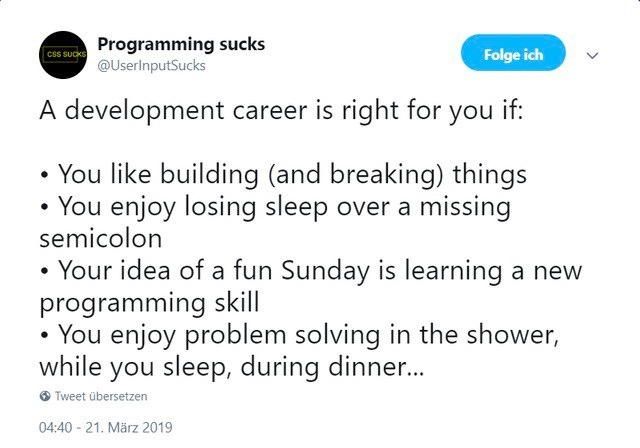
Checklist tweet humorously describing true signs you’re meant to be a developer
Why is this DevCommunities meme funny?
Level 1: Always Solving Puzzles
Imagine you have a big jigsaw puzzle that you absolutely love working on. You spend all day building it, and sometimes you even break apart a section just to see if you can make it better. If one tiny piece is missing, it bothers you so much you might stay up past bedtime looking for it under the couch. Even on Sunday, when other people want to just watch TV, you feel excited to pull out a brand new puzzle (maybe an even harder one) to solve for fun. And then, even when you’re not actively doing the puzzle – say you’re taking a shower or eating dinner – you’re still thinking about it, like “Hmm, maybe that blue piece goes in the sky part...”. You might even dream about finishing that puzzle!
This meme is saying that being a developer is a lot like that. Coding is the puzzle developers love. It’s funny because it describes people who are so passionate about solving their coding puzzles that they do all these things. Most folks would think “wow, you’re obsessed!” – and that’s exactly the joke. If you really enjoy and do all those things (staying up late for a missing piece, learning new stuff on your day off, and daydreaming solutions), then a career in development might be perfect for you. In other words, it’s saying: if what sounds like hard work to others feels like fun to you, you just might be a natural developer! We laugh at this list because we recognize ourselves in it – we know it’s a little silly to be thinking about code while in the shower or at the dinner table, but we just can’t help it when we love what we do.
Level 2: Semicolons & Shower Thoughts
For those newer to coding or considering a developer path, each item in this tweet highlights a real aspect of the programmer’s life in simpler terms:
Building (and breaking) things: Developers write programs to create new tools and features – that’s the "building" part. But when you build software, things don’t always work perfectly the first time. “Breaking things” refers to how code often fails or causes errors initially. Beginner programmers quickly learn that you have to test your code and sometimes intentionally push it to see where it breaks. For example, you might make a small web app and then try weird inputs to see if it crashes. Liking to break things might sound odd, but it really means enjoying the process of finding a program’s weaknesses and fixing them. If you get a kick out of tinkering with a project until it works (and maybe taking it apart when it doesn’t), that’s a sign you have the developer mindset.
Losing sleep over a missing semicolon: A semicolon (
;) in many languages is just a punctuation mark that ends a statement (like a period in a sentence, but for code). Forgetting one can make your whole program stop working. “Missing semicolon anxiety” is a tongue-in-cheek way to describe the stress of hunting for such a tiny mistake. Imagine writing a whole essay and it won’t print because you forgot one period at the end of a sentence – it’s that frustrating! New coders often experience this: the code refuses to run, and after an hour of checking, they find a single;was missing. The tweet jokes that you “enjoy losing sleep” over this, exaggerating that a true coder will stay up late until they find that pesky error. Of course no one actually enjoys the frustration, but there’s a strange satisfaction in finally spotting the problem at 1 AM. If you’re the type of person who can’t go to bed with an error in your program and will debug into the night, that’s a pretty strong indication that coding might be your thing!Fun Sunday = learning a new programming skill: Developers have to keep learning new technologies continuously. The tweet says your idea of a fun Sunday is picking up a new programming skill – meaning you might spend your weekend reading about a new programming language, framework, or technique. For a lot of people, Sunday is a day off to relax. But aspiring devs and junior developers often find themselves watching coding tutorials on YouTube, following an online course, or building a side project for fun. This highlights the passion (and necessity) for lifelong learning in tech. There’s even a term “learning curve” which describes how much you have to learn to get good at something; in programming, you’ll tackle many learning curves over your career. So if instead of feeling like homework, learning a new code library feels like an exciting challenge to you, you’re fitting right in with developer culture. (Just remember, balance is important – even if it’s fun, everyone needs a break sometimes, which is why folks jokingly bring up WorkLifeBalanceTips. But many devs admittedly spend downtime on tech stuff anyway!)
Problem solving in the shower, in your sleep, during dinner: Writing code is a bit like solving puzzles, and those puzzles don’t always get solved while you’re sitting at your computer. “Shower thought” is a common phrase for when a great idea pops into your head while you’re doing something unrelated – like showering. For programmers, it often happens that when you step away from the keyboard to relax, your brain is still quietly working on that bug or algorithm. Suddenly, mid-shower or while you’re falling asleep, boom – the solution appears in your mind. This meme line lists shower, sleep, and dinner as times when you continue problem-solving. It’s poking fun at the fact that coding can follow you out of the office. Even as a new coder, you might experience this: maybe you’re out with friends but part of you is still thinking about why your code wasn’t working. Or you dream about a project you were stuck on. “Shower thought debugging” is just a fun way to say you’re fixing errors in your head when you’re technically on a break. If you find that working through a tough coding problem is something you do unconsciously while brushing your teeth or waiting for the bus – and you kind of enjoy that eureka moment when the answer hits – it’s a sign that you think like a programmer. Just be careful not to spill the soup if a solution strikes you during dinner!
This tweet is formatted as a bullet-point list, which is actually a bit unusual for Twitter (people often just use dashes or numbers manually, like the dots here, to mimic bullet points). The list format makes it easy to read each sign one by one. This style is common in online developer communities where people share “You know you’re a programmer when…” checklists. Each bullet here is an example of a habit or quirk many developers have. For someone starting their career, it’s both a humorous peek at what may lie ahead and a self-check: “Do these things excite me more than they scare me?” It’s okay if not every point resonates with you yet – these tend to become more true as you dive deeper into coding. Over time, you’ll likely catch yourself saying “Oh wow, I’ve actually done that – the meme was right!” When you do, you’ll know you’re becoming part of the dev community that finds this humor so relatable.
Level 3: No Rest for the Debugger
A development career is jokingly framed here as something you’re "meant for" only if you embrace a set of borderline obsessive traits. This bullet-point tweet uses exaggeration and irony that experienced developers immediately recognize from their own lives. It's essentially a piece of CodingHumor presented as a checklist: each bullet reveals a truth about developer habits, and in classic DeveloperMemes style, it’s both funny and uncomfortably accurate. The format (“A development career is right for you if…”) reads like a tongue-in-cheek job ad from the programming trenches. It implies that being a programmer isn’t just a day job – it’s practically a 24/7 mindset. In essence, it says “you might be a developer if you find joy in these crazy behaviors”. The comedic twist is that these “joys” are usually considered downsides by normal people. But in developer culture, suffering persistence is worn like a badge of honor.
Let’s parse the checklist:
“You like building (and breaking) things” – Software engineers are makers at heart. We get a thrill from creating something out of code—from a simple script automating a task to a complex app. But here’s the catch: in tech, you can’t build without breaking. Seasoned devs know that the path to a stable app is littered with broken builds and crashed servers. In fact, breaking things on purpose is a common testing strategy: you push your code to its limits to see where it fails. It’s reminiscent of Facebook’s old motto “Move fast and break things.” This bullet acknowledges that developers are a curious mix of construction worker and demolition expert. A senior engineer reading this will smirk because they’ve spent countless hours both making new features and resolving the mess when those fresh features unexpectedly break other parts of the system. They enjoy that cycle of creation followed by debugging. It’s even arguable that you’re not a real developer until you’ve broken your own code a few times (or a few hundred times) and learned from it. The best devs have a bit of a mad scientist streak—they’re not afraid of experiments blowing up in their face, because that’s how you discover the limits and learn. This first bullet essentially says: if you get a kick out of tinkering, and you’re okay with things occasionally going kaput because you know you can fix them, then programming might be your calling.
“You enjoy losing sleep over a missing semicolon” – Here the meme dives into a classic programmer pain point: tiny syntax errors causing big headaches. A semicolon (;) in many programming languages (like C++, Java, JavaScript) is used to end statements. Omit one semicolon and the compiler or interpreter often throws an error or misbehaves. The tweet exaggerates that you lose sleep over it – implying the issue kept you up all night. For veteran developers, this conjures vivid memories of late-night debugging sessions, eyes red from LateNightCoding and SleepDeprivation, chasing down an elusive bug only to find out it was literally a one-character mistake. It’s a rite of passage in coding: you spend hours thinking your program logic is broken, scanning hundreds of lines, only to find a stray ; or a missing one was to blame. The phrasing “enjoy losing sleep” is ironic; nobody enjoys being bleary-eyed at 3 AM. But if you’re truly meant for this field, you might feel a weird satisfaction when you finally fix that semicolon-induced error at sunrise. The meme pokes at that masochistic pride developers have: you hate the bug while it’s unsolved, but the chase and the eventual “Aha!” moment is thrilling. Experienced devs might also chuckle here because a missing semicolon is such a small error compared to the monstrous bugs they’ve seen. It’s as if saying: if even a tiny missing ; is enough to keep you up, determined to fix it, you definitely have the developer mindset. Many can relate to “missing semicolon anxiety” – that subtle panic when code won’t run due to a trivial syntax issue. In some languages like Python, there's no semicolon to worry about, but then you’ll lose sleep over mis-indentation or a missing colon (:) instead. It’s always something. The senior perspective acknowledges this as a universal programmer experience. It’s funny because we’ve all been there, and we’ve all learned that one little character can humble even the best of us. (Side note: The screenshot shows this tweet was posted at 04:40 in the morning. How fitting is that? The author might have actually been up at an ungodly hour—perhaps because of a pesky bug or just the usual developer sleep schedule. It’s a wink to the fact that devs often keep odd hours.)
“Your idea of a fun Sunday is learning a new programming skill” – Ah, the LearningCurve never ends in tech. This bullet highlights how passionate developers treat their craft not just as a weekday job but as a hobby or even an obsession. Instead of Sunday being purely a day of rest or a break from work, many coders find themselves watching programming tutorials, reading docs for a new framework, or hacking on a side project “for fun.” A senior engineer knows this feeling well: the industry evolves so rapidly that if you stop learning, you fall behind. There’s always a new language (Rust, anyone?), a new JavaScript library of the week, or some devops tool everyone’s talking about. What starts as curiosity (“I’ll just try out this new framework for an hour”) often becomes a whole Sunday rabbit-hole of coding, because it’s both enjoyable and professionally beneficial. It’s funny because it’s true—developers often blur the line between work and play. This isn’t the typical 9-to-5 career, it’s one where continuously learning is part of the lifestyle. A senior dev might chuckle remembering their “free time” spent setting up a home Kubernetes cluster or finally reading that book on algorithms. While friends might be out brunching, the dev is happily indoors wrestling with code by choice. The tweet implies: if that scenario sounds appealing rather than dreadful, you definitely have the developer DNA. There’s an undercurrent of truth about WorkLifeBalanceTips here too: in tech, “fun” side projects can easily bleed into personal time. Many experienced devs have been gently scolded by family or partners for “working” on the weekend, when in their mind they’re just playing around with code. This line resonates because it celebrates the self-driven learning ethos of developers, while humorously acknowledging that what we call “fun” might look like work to everyone else.
“You enjoy problem solving in the shower, while you sleep, during dinner…” – This one nails a key part of DeveloperCulture: the constant mental churn over problems. Seasoned programmers know that coding isn’t just done at the keyboard – your brain keeps iterating on challenges in the background, often at the most inconvenient times. The shower thought is almost a cliché in programming: you stare at a bug for 5 hours at your desk with no luck, then while shampooing your hair it suddenly clicks and you shout “Eureka!” like Archimedes. Why the shower? Because it’s one of the few times your mind relaxes, wanders, and then suddenly pieces together a solution. Similarly, many devs have experienced dreaming about code or waking up with an idea at 3 AM. (It’s like your brain has a background thread dedicated to debugging.) And of course, thinking about a coding issue during dinner – your body might be at the table, but your mind is back at the code editor. This line humorously exaggerates that intrusive thought pattern: a developer’s brain is always half at work, solving puzzles even off the clock. It’s simultaneously a point of pride and a bit of a nuisance. A veteran developer reading this might grin and recall times they’ve half-jokingly told their brain “shut off already!” at midnight, only to dream about a segfault anyway. The phrase “enjoy problem solving” in those scenarios is intentionally absurd – nobody enjoys being unable to turn off their brain. But the truth is, if you’re the kind of person who can’t let a puzzle go and actually feels a tiny thrill each time you mentally chip away at it, then you have the classic programmer mindset. It’s a nod to how problem-solving for developers isn’t just a work task, it’s a persistent state of mind. And yes, some devs actually keep waterproof notepads in the shower or grab their phone at 2 AM to jot down a sudden solution before it slips away. That’s how real shower_thought_debugging can get! It’s funny and a bit crazy – and that craziness is exactly what the tweet celebrates.
In summary, this meme resonates with experienced engineers because it’s built on shared experiences. It cleverly packages aspects of the programmer’s life — creative construction and destruction, obsessive debugging, perpetual learning, and inability to mentally unplug — into a cheeky “checklist.” It basically says: if you find joy in what others would call madness, congratulations, you’re one of us! The humor lands so well in dev communities because it validates that the quirks and struggles we face are not just personal but universal in the coding world. It’s simultaneously a lighthearted Career_HR guide (the kind of unofficial job requirements recruiters don’t mention) and a wink of solidarity among programmers. Seasoned devs laugh because it’s true: we’ve all lost that sleep, spent that Sunday, and solved that shower puzzle. And despite it all (or because of it all), we still love programming enough to keep doing it. A development career really is right for you if these things sound oddly appealing — it means you’ve got the passion (or the insanity) for the job!
Description
Image is a screenshot of a tweet from the account “Programming sucks” (@UserInputSucks). The avatar is a black circle with small yellow text reading “CSS sucks.” In the top-right corner sits a bright-blue rectangular button that says “Folge ich” (German Twitter UI for “Following”). The tweet text reads: “A development career is right for you if:” followed by four bullet points: 1) “You like building (and breaking) things” 2) “You enjoy losing sleep over a missing semicolon” 3) “Your idea of a fun Sunday is learning a new programming skill” 4) “You enjoy problem solving in the shower, while you sleep, during dinner…” A small grey link “Tweet übersetzen” appears under the text, and the timestamp shows “04:40 · 21. März 2019.” The humor centers on familiar developer behaviors - debugging insomnia, perpetual learning, and intrusive problem-solving thoughts - that resonate with experienced engineers juggling work-life balance and constant skill growth
Comments
7Comment deleted
You know you’re a senior dev when you refactor half the monolith into microservices to find a missing semicolon - then present it on Monday as “strategic domain decomposition.”
Twenty years in and I've graduated from losing sleep over missing semicolons to losing sleep over missing distributed transaction guarantees across seventeen microservices that someone decided didn't need a saga pattern because "it's just a simple checkout flow."
The checklist omits the final qualifier: the bug you solve in the shower belongs to code you deleted two jobs ago
This reads like a job posting written by someone who's been on-call for 72 hours straight. The missing semicolon bit hits different when you've spent 4 hours debugging only to discover it was a typo in a config file that your IDE's linter somehow missed. The real test isn't whether you enjoy problem-solving in the shower - it's whether you've ever woken up at 3 AM with the solution to a race condition you've been chasing for a week, then couldn't fall back asleep because you had to implement it immediately. Welcome to the profession where 'work-life balance' means your debugger is open on both your work laptop and personal machine
Senior dev edition: semicolons don’t cost sleep anymore; choosing between exactly-once and at-least-once across nine microservices does - welcome to shower-driven architecture
Juniors lose sleep over semicolons; architects ponder if that monolith needs event sourcing - mid-brunch
Career litmus test: when a missing semicolon causes a priority inversion that starves your melatonin thread, you’re already running production in your head