Senior vs. Junior Developers Reacting to AI Job Replacement Threats
Why is this AI ML meme funny?
Level 1: Scary Story vs. Old Joke
Imagine two teachers at a school hearing a rumor that robots will start teaching classes next year. The first teacher is very new on the job – she’s just started teaching this year. When she hears this, her eyes get wide and she feels like crying, thinking, “Oh no, I might lose my job to a robot!” Now, the second teacher has been teaching for 30 years. When he hears the same rumor, he just laughs. He even takes a bite of his sandwich, smiles, and says, “I’ve heard this kind of talk many times before. I’m not worried at all.” Why are their reactions so different? The new teacher is like a kid who hears a scary story for the first time and totally believes it, getting frightened. The experienced teacher is like a grandparent who’s heard that same silly story told over and over – he knows it’s mostly just talk, so it doesn’t scare him anymore.
This is exactly what’s happening in the meme. The “scary story” here is the boss saying “AI will replace programmers.” For the junior (new) programmer, it’s terrifying – like a monster-under-the-bed story that feels real, because they’ve never been through it. For the senior (older) programmer, it’s an old joke – they’ve seen many “monsters” announced, and none have actually eaten their job yet! The senior is confidently laughing, basically saying, “Been there, heard that, not buying it.” The junior is upset and worried, basically saying, “Oh no, is the scary thing true?”
We find it funny because of this clear contrast: two people hear the same thing, one laughs and one cries. It’s like if someone said, “There’s a machine that will do all your homework for you.” An older student might roll their eyes and say, “Yeah right, I’ll believe it when I see it,” while a younger student might gasp, “Really? Oh no, what if I don’t get to do anything myself or I get in trouble?!” The older student’s calm makes the younger student’s panic seem a bit silly – not to be mean, but in a way that we can all chuckle at, since we understand why each one feels that way.
In simple terms, the meme jokes about fear of new technology. The moral is kind of warm: usually things aren’t as dire as they sound, and with experience, you learn to take scary tech predictions with a grain of salt. So the senior keeps on driving happily, and hopefully the junior will realize later that the “big bad AI” isn’t actually coming to steal their keyboard overnight! It’s a funny reminder not to panic just because someone says something dramatic – especially if that someone is your boss with the latest crazy idea. Sometimes, a laugh is the wiser reaction.
Level 2: Keep Calm, Code On
Let’s break down what’s happening here in simpler terms. The meme is about artificial intelligence (AI) and the fear of it taking over programmers’ jobs. Specifically, it contrasts a senior programmer and a junior programmer reacting to their boss’s claim: “AI will replace them.” In tech lingo, a senior developer means an experienced coder who’s been in the industry for many years, and a junior developer means someone who’s just starting out or has only a couple of years of experience. Think of seniors as the mentors or veterans on a software team, and juniors as the newer folks still learning a lot on the job. Naturally, their perspective on job threats can be very different.
AI, in this context, refers to smart software (often powered by machine learning) that can do tasks which normally require human intelligence. Lately, a big trend in programming is AI tools that can generate code. For example, GitHub Copilot or ChatGPT can assist by suggesting lines of code or even writing simple functions when you describe what you need. It feels a bit like having an autocomplete on steroids – you start typing a function, and the AI tries to finish the whole thing for you. This has led to buzz in the industry (and sensational news headlines) that maybe one day AI could handle all programming tasks. That’s where the fear of “AI replacing developers” comes from. The boss in the meme is basically voicing that hype: telling his team that an AI might do their work in the future. A pink slip is an old term for a layoff notice (from when termination letters were printed on pink paper), so saying “AI pink-slip emails” is a jokey way of saying “emails that fire people because AI is taking over their job.” 😅 (No, there aren’t really pink emails – it’s humor.)
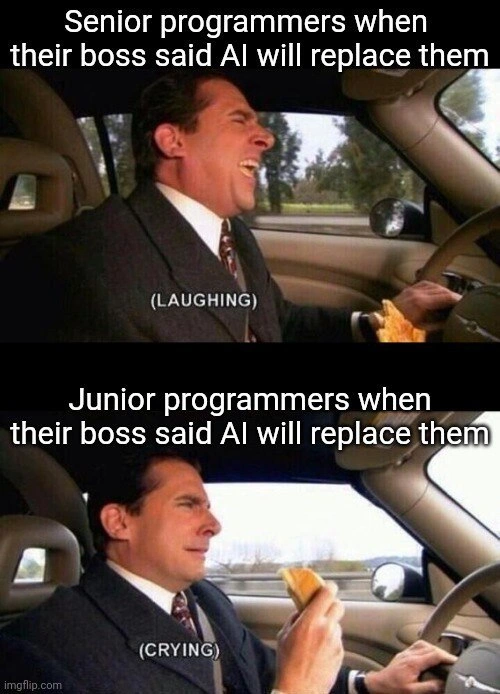
Now, why does this land so differently for seniors vs juniors? It comes down to experience and what each has been exposed to in their career. The senior programmer in the top panel is shown literally laughing at the news. He’s driving a car, munching on a sandwich, and chuckling – meaning he’s totally relaxed and not taking the boss’s warning seriously at all. This reflects how many experienced devs react to hype. They’ve probably lived through previous tech fads. Maybe when they started out, someone said “learn XYZ tool or you’ll be obsolete,” and then XYZ turned out to be just one more tool in the toolbox, not a job-stealer. By now, a senior dev has learned that new technology often gets over-hyped. They tend to respond with skepticism or dark humor. They might joke, “Sure, let the AI also handle my on-call pager at 2 AM, please!” – implying they’d love to hand off the boring or tough parts but don’t actually believe the AI can truly replace them. In short, the senior isn’t afraid of losing his job to a bot; if anything, he might be a bit amused by the exaggeration.
Contrast that with the junior programmer in the bottom panel. He’s the same guy in the car, but now he’s crying, even though he’s still holding that sandwich (poor guy can’t even finish his lunch). This dramatizes the worry and stress a newer developer might feel. If you’re just a year into your first programming job, and you hear your boss say something like “AI will replace programmers,” you might really take it to heart. Juniors often struggle with confidence – they know they have a lot to learn, and it’s easy for them to think “oh no, maybe a machine can do what I do, faster and cheaper.” They may not yet have the perspective to think about what an AI can’t do. Instead, they focus on what it apparently can do (you see all these impressive demos of AI solving coding interview questions or generating entire websites). So, a junior might fear that their role will vanish or that they’ll get that dreaded layoff email soon. It’s basically job security anxiety early in a career. It doesn’t help that bosses or media sometimes hype these AI tools without explaining the limitations, so the threat can sound very real if you haven’t seen otherwise.
The humor comes from putting these two opposite reactions side by side. It’s like the workplace version of “one person’s trash is another person’s treasure,” but here it’s “one hears doom, the other hears a joke.” And both are looking at the same situation! This contrast highlights a common office dynamic: veteran employees are jaded (or confident, choose your word) about big change announcements, whereas newer employees might panic or overthink. In tech specifically, this has played out with trends like cloud computing, outsourcing, or new programming languages – seniors shrug, juniors freak out. AI in programming is just the latest instance.
To ground it in a concrete scenario: imagine a team meeting where the boss excitedly says, “We’re going to incorporate this new AI tool to handle coding. It might mean we need fewer developers in the future.” After the meeting, the junior dev is googling “jobs safe from AI” and worrying if they should update their resume. Meanwhile, the senior dev is back at their desk, perhaps checking out the AI tool out of curiosity but mostly carrying on with work, maybe even making a quip in the team chat like, “If AI takes over, I’ll finally take that long vacation 😏.” They’ve heard grand claims before and know not to hit the panic button.
We also have a bit of implicit office politics/hierarchy here: the boss is the one stirring this up. Sometimes higher-ups get excited about cutting-edge ideas (it sounds cost-saving or future-proof), but they may not grasp the technical reality. Seniors often have the confidence to quietly think “I’ll believe it when I see it,” whereas juniors might feel they have to take the boss’s words at face value. Part of becoming seasoned in any industry is learning to read between the lines and not let every bold statement shake you. The meme captures that learning gap in a funny way.
Just to clarify a few terms from the meme and tags:
- AIHypeVsReality: The difference between what people hope AI can do (hype) versus what it actually can do (reality). The senior vs junior reactions literally show hype vs reality: the junior is buying the hype (hence fear), the senior is grounded in reality (hence calm).
- JobSecurityInTech: This refers to how secure one feels about keeping their tech job. It’s a common discussion these days, with AI and automation on the rise. The meme jokes about this issue – the junior fears for job security, the senior apparently feels secure enough to laugh.
- AIHumor / DeveloperHumor: This means the joke is one that developers, especially those in the AI or software field, would relate to. It pokes fun at their workplace situation. If you’re in this field, you might have even heard colleagues literally laughing or groaning about similar “AI will take our jobs” statements.
- SeniorVsJunior: This tag just reinforces the core contrast: experienced vs inexperienced employees. Many memes play on this because it’s a relatable office theme – the new hire’s wide-eyed reaction vs the old-timer’s been-there-done-that attitude.
To illustrate programmatically what the meme is showing, here’s a tiny bit of pseudocode:
# Boss announces: "AI will replace programmers."
for dev in team:
if dev.level == "Junior":
dev.react(emotion="😭 panic")
elif dev.level == "Senior":
dev.react(emotion="😅 laughter")
In reality, of course, not every junior will cry and not every senior will laugh, but the meme boils it down to that for comedic effect. The senior’s confidence (some might say over-confidence) comes from having survived previous “the robots are coming” alarms. The junior’s worry comes from facing this alarm for the first time. The takeaway for a real junior developer might be: don’t panic! Often these bold claims mean something will change, yes, but it usually changes how we work, not whether we have work. The experienced folks are laughing because they know programming has always evolved with new tools (from code editors, to frameworks, to now AI assistants) and each time, good developers are still needed – sometimes even more so – just in different ways.
So the meme is a lighthearted way to say, “We’ve heard this story before.” It resonates in the tech world: seniors comfortingly mock the hype, juniors nervously wonder about it. And the image of the guy laughing vs crying in the car makes it super clear and cartoonish, which helps us laugh at our own workplace fears. It’s a form of career humor that both pokes fun at the situation and provides a little reassurance hidden behind the laughs.
Level 3: Hype Cycle Déjà Vu
Zooming out to an industry view, this meme highlights the classic AI hype vs. reality gap in a developer’s career context. Senior engineers are old hands at weathering the storm of buzzwords and grandiose predictions. They’ve seen bosses and tech pundits declare “This new thing will replace all you programmers!” during every hype cycle. Remember when code generation tools from the early 2000s were supposed to let managers draw some UML diagrams and poof, working applications? Many veteran devs do – and they also remember being called in late to untangle the monstrous spaghetti those “miracle” tools produced. Or take outsourcing in the 2010s: management buzz was “We’ll replace expensive seniors with offshore juniors” – until communication gaps and quality issues brought some of those jobs right back. IndustryTrends_Hype like these come in waves. Today’s wave is AI/ML with fancy copilots and chatbots that can write code. And guess what? The seniors are largely unfazed, even amused, which is exactly what the meme’s top panel shows.
Why the smirk? Because seasoned developers have a healthy sense of déjà vu about “the next big thing” supposedly booting them out of a job. They’ve survived enough buzzword blitzes to earn a bit of confidence (and cynicism). Every few years there’s a new silver bullet technology promising to make coding so simple that “anyone can do it” or that the code will write itself. No-code platforms, 4GLs (fourth-generation languages), even the rise of open-source libraries – all were hyped to reduce the need for professional developers. Yet here we are, and experienced coders are still in demand to clean up the messes, integrate the pieces, and build the parts the tools can’t. This shared history is why the senior dev in the meme is depicted literally laughing while driving, sandwich in hand, not even bothering to put down his lunch. It’s the ultimate nonchalant response: “AI replace me? Sure, just like all those other things did (not).” There’s a dark little joke in the software world that whenever management proclaims some new tech will let them fire engineers, those same engineers end up working overtime implementing or fixing that very tech. The senior in the meme likely remembers that joke – it’s practically WorkplaceReality in our field.
On the flip side, the junior developer’s reaction (the bottom panel with (CRYING)) captures genuine anxiety that many newer entrants to the industry feel. If you started your career in the last year or two, you’ve probably heard all the doomsaying: “Why pursue coding? AI will do it by the time you’re experienced.” It’s intimidating! Junior devs often lack the context to know that similar predictions have crashed and burned before. They’re more vulnerable to imposter syndrome and job security fears. When the boss – who holds power over their paycheck – says “AI will replace you,” a junior might take it literally and think, “Oh no, I just began this career and it’s already ending?!” They haven’t yet lived through a hype cycle’s rollercoaster: the inflated expectations, the inevitable disappointments, and the eventual balanced view where the tech finds a realistic use. Seniors have that scar tissue; juniors are seeing the scary loop for the first time.
The meme brilliantly exaggerates this divide using the same image of a driver reacting in two opposite ways. Both panels show a man gripping the wheel and holding a half-eaten sandwich. In the top, he’s chuckling confidently – that’s the senior dev vibe when hearing about AI taking his job. It screams, “I’ve got cruise control on this career, kid.” In the bottom, he’s looking down crying, sandwich forgotten – the junior’s “end of the road” panic moment. The humor lands because in many tech offices you really do see this generational reaction gap. A meeting announcement about integrating ChatGPT or layoffs “because AI automation will improve efficiency” might literally have seniors cracking jokes in the back (“Can it also fix legacy bugs for us? haha”) while new hires quietly worry if they should start applying elsewhere. It’s a satirical snapshot of how experienced_dev_confidence and entry_level_anxiety play out when AI_hype hits the fan.
Importantly, the meme also hides a nugget of wisdom: the seniors aren’t just laughing to be cocky; they’re implicitly saying “Don’t panic. We’ve seen that AI and fancy algorithms actually create new kinds of work for programmers.” Often, an AI tool that was supposed to replace developers ends up augmenting them – it takes over the boring parts of coding (like boilerplate generation or reminding you of syntax), which can increase productivity, but it also introduces new complexities (like needing people to review AI suggestions, handle exceptions, and maintain those AI models themselves!). So ironically, far from receiving “pink slips” en masse, developers (including juniors) often end up with new tasks: integrating AI into workflows, checking its output, and focusing on higher-level problems. The senior who’s been through it knows there’s a good chance the junior will still have a job – albeit a job that might involve wrangling AI outputs rather than writing every line from scratch. Hence the confident laughter: it’s part self-assurance and part inside joke about how these things usually go.
Bottom line at this level: The meme speaks to a shared understanding in developer culture (DeveloperHumor) that AI is just the latest in a long line of “magic” technologies touted to replace us. The younger folks are understandably spooked (hype is scary when you haven’t seen it fizzle before), while the old guard has a sort of “bring it on” swagger. It’s a mix of CareerHumor and WorkplaceReality: knowing that those apocalyptic tech headlines often translate to minor workflow changes, not mass unemployment. The laugh vs. cry contrast exaggerates it perfectly, making the meme funny, relatable, and even a bit comforting – we’re collectively giggling at the absurdity of the “replace all devs” trope, while patting the juniors on the back saying, “It’ll be okay, we’ve been through this.”
Level 4: NP-hard to Replace
At the far end of complexity, this meme taps into some deep computer science truths: programming isn't a trivial task that you can fully automate with a push-button AI. In theoretical terms, writing correct, production-ready software involves solving problems that range from undecidable questions (like the infamous Halting Problem) to downright NP-hard optimizations. In plain English: there's a mathematical limit to how much any algorithm (or AI) can guarantee when generating code. A seasoned engineer might chuckle because they intuitively know that if an AI claims it can handle all coding, it’s implicitly claiming to solve some provably unsolvable or intractable problems.
Consider what a modern code-generating AI (usually a large language model, or LLM) actually does under the hood. It's an advanced pattern-matching engine, digesting billions of lines of code and spitballing what “looks like” a plausible solution. But it doesn’t truly understand the code the way a human does; it doesn’t know why a piece of software is written or whether it meets the nuanced requirements. It can’t perform formal reasoning about the code’s intent or guarantee it handles every edge case (unless those edge cases were explicitly in its training data). In formal methods terms, current AI lacks semantic understanding and rigorous proof of correctness. It’s like an extremely powerful auto-complete – brilliant at continuing patterns, but oblivious to the broader context or any hidden gotchas.
Senior developers often have a mental library of those hidden gotchas. They know real-world systems are messy and complex. For example, something as “simple” as calculating an average can blow up when you hit integer overflow or weird data – scenarios a pattern-based AI might not anticipate without explicit hints. Experienced devs know that a lot of programming involves creative problem decomposition, domain-specific knowledge, and clairvoyant debugging of things that no training set can cover completely. They’ve seen AI and automation attempts come and go because of these fundamental challenges. From early expert systems to code-generating wizards, every wave hit a wall: the combinatorial explosion of real-world variability. Sure, an AI might churn out a routine CRUD app or a boilerplate function, but will it architect a whole complex system correctly? Will it anticipate the edge cases that cause a 3 AM outage? Not likely, not without a human (probably that senior) double-checking.
In summary, at the most theoretical level, the meme is funny because it pokes at the impossibility (or at least extreme difficulty) of fully automating the programmer’s job. The senior’s confident (LAUGHING) face embodies the idea that he’s not worried – essentially, “I’ll believe an AI can truly replace me when it successfully proves $P = NP$ and fixes all my production bugs without supervision.” Until then, there will always be those unsolvable puzzles and hard problems keeping real developers in the driver’s seat. The junior, lacking this perspective, hears “AI” and imagines something far more omnipotent than it really is. The stark difference in reactions comes from understanding these deep limitations versus being awe-struck by the tech’s surface capabilities. It’s a wink to those who know that under the hype, AI still can’t magically sidestep the fundamental complexities of coding.
Description
A two-panel meme format featuring character Michael Scott from the TV show 'The Office' driving his car. The top panel has the caption 'Senior programmers when their boss said AI will replace them' and shows Michael Scott laughing hysterically, with the subtitle '(LAUGHING)'. The bottom panel is captioned 'Junior programmers when their boss said AI will replace them' and shows Michael looking dejected and crying while eating a sandwich, with the subtitle '(CRYING)'. The meme humorously contrasts the confidence of experienced senior developers with the anxiety of junior developers regarding the threat of AI in the software industry. It suggests that seniors feel their complex problem-solving, architectural skills, and deep contextual knowledge are irreplaceable by current AI, while juniors, who often handle more automatable tasks, feel vulnerable
Comments
12Comment deleted
AI can write a perfect sorting algorithm, but it can't yet join a 3-hour Zoom call to passionately argue with the product team about why the requirements make no sense. The senior's job is safe
Sure, let the LLM take my seat - just make sure it’s the one answering PagerDuty at 03:00 while refactoring the COBOL that bills our customers
Senior devs laughing because they remember when XML was going to replace programmers, then NoSQL, then microservices, then blockchain... Meanwhile, they're still debugging the same null pointer exception from 2003 that AI confidently claims doesn't exist in the codebase
Senior engineers laugh at AI replacement threats because they've already survived the outsourcing wave, the 'everyone should learn to code' movement, and three separate predictions that their primary language would be dead within five years. They know the real job security comes from understanding the 15-year-old monolithic codebase with zero documentation that somehow processes $10M in transactions daily - good luck training an LLM on that tribal knowledge when the only person who understood the original architecture retired in 2019
Call me when a GPT volunteers for 3 a.m. pager duty, ships a rollback-safe multi-tenant migration, reverse-engineers 2007 PowerPoint business rules, and negotiates scope creep with the PM in the same meeting
AI crushes hello-world tutorials; seniors debug the production fires it ignites
Sure, AI will replace me right after it untangles our monorepo, passes the SOX audit, survives a 3am PagerDuty, and explains to Finance why throughput != velocity
Eventually it will. But not today. Comment deleted
If you get replaced by AI, then what is the purpose of your "boss". In other words, 1000 devs implies 100 middle-managers and 10 department managers employed. Keep this in mind Comment deleted
My boss is the biz owner His purpose is to sell a product without paying me a paycheck Who knows maybe if AI programming goes mainstream many more people will be able to afford starting a business making some shitty SaaS app Comment deleted
Does "them" relate to the boss, and the boss is saying farewells 🤔 Comment deleted
So, soon in will be like, either you was born as senior developer already or you just useless and land straight into the recycle bin. Comment deleted