The Final Boss of DevOps Buzzwords
Why is this IndustryTrends Hype meme funny?
Level 1: All the Toppings
Imagine you’re making a pizza and you keep hearing about new favorite toppings that everyone loves. First you add cheese and tomato (that’s the basic pizza, like DevOps). Then someone says, “Pepperoni is great!” so you add pepperoni (that could be like adding Security – now it’s DevSecOps). Then another friend insists on mushrooms (maybe FinOps), and someone else loves pineapple (MLOps), and another wants olives (GitOps). Finally, you even sprinkle chocolate chips on top because why not add dessert too (that’s “+Docs” in our crazy analogy). Now you have a pizza with every topping in the world. Does it taste good? Probably not – it’s a weird mix of everything. This meme is funny for the same reason: it’s as if the tech world kept piling every trendy idea onto one plate, creating a giant nonsense combo. Just like too many pizza toppings can ruin a pizza, too many buzzwords stuck together become kind of silly. The joke reminds everyone that sometimes, adding more and more things just because they’re popular doesn’t actually make the end result better – it just makes it ridiculous (and pretty hard to chew!).
Level 2: Acronym Soup 101
If you’re a newer developer or someone outside this DevOps culture, that multicolored word DevSecFinMLGitOps+Docs probably looks like gibberish. Let’s break down the ingredients of this acronym soup one by one, and it will start to make sense (and you’ll see why it’s funny):
DevOps: This is the foundation. It’s a blend of “Development” and “Operations.” Instead of developers just writing code and throwing it over a wall for ops people to deploy and maintain, DevOps culture says: let’s work together. DevOps is all about collaboration, automation (using scripts and tools to do repetitive tasks), continuous integration/continuous deployment (so code updates go live faster), and monitoring in production. Imagine a developer and a system admin teaming up like a buddy-cop duo to deliver software swiftly and reliably—that’s DevOps culture in a nutshell.
DevSecOps: Now take DevOps and add Security to it (that’s the “Sec” in the middle). This reminds everyone that security isn’t an afterthought. In DevSecOps, you build security practices into the pipeline from the start: things like code analysis for vulnerabilities, automated security tests, and managing access keys properly. The idea is to avoid the old scenario of “DevOps moved fast and broke things, now security has to clean up the mess.” By saying DevSecOps, we explicitly include the security team in that buddy-cop team—now it’s a trio, ensuring the product is secure and delivered fast.
FinOps: Add Finance into the mix. “FinOps” (short for Financial Operations) is about managing cloud costs and budgeting as part of your operational concerns. As companies moved to cloud infrastructure, they found it’s easy to spin up servers and also easy to accidentally run up huge bills. FinOps practitioners track spending, set up alerts or policies for cost, and work with devs to write efficient code that doesn’t waste resources. Think of it as making sure your awesome app doesn’t accidentally burn through the company credit card on cloud servers. FinOps makes cost an ongoing consideration, not just something the finance department frets over after the fact.
MLOps: Now we throw in Machine Learning (ML). MLOps means applying DevOps practices to machine learning projects. Building and updating ML models (like ones for recommendation engines or image recognition) is a special process: you need to handle data, retrain models, and deploy those models into production. MLOps tries to streamline that. It covers versioning datasets, automating model training, continuous integration for model code, and monitoring models in production (to see if accuracy drifts). Essentially, it’s DevOps for data scientists and ML engineers – ensuring that cool AI prototype in the lab can reliably become a product feature that keeps working after launch. It became a hot term as every company rushed to add AI/ML to their products and needed a way to manage that pipeline.
GitOps: Now comes Git. GitOps is a style of operations where the Git repository is the single source of truth for infrastructure and deployments. In practice, you store your configuration files (for cloud resources, Kubernetes, etc.) in Git, and any change to those files triggers an automated deploy. If DevOps is about automating and collaborating, GitOps gives a specific mechanism: “everything as code” and tracked in Git version control. This way, rollbacks are easy (just revert a commit), and you have a clear history of who changed what in your infrastructure. It’s kind of like treating your servers and configs just like code, with the same review process. GitOps became popular with the rise of cloud-native tech because tools could watch the repo and apply changes continuously.
Docs: Finally, “+Docs” means Documentation. It’s not an acronym by itself, just a nod that even documentation is being included in this long list. In software teams, Docs are the user guides, developer docs, runbooks, etc. There’s a mindset now that documentation should be kept up-to-date alongside the code (sometimes using similar workflows – you might hear terms like “Docs as Code”). By adding “Docs” to the mega-acronym, the slide humorously suggests, “Hey, let’s not forget documentation operations!” Even though “DocsOps” isn’t a widely-used term, it’s true that modern teams try to automate and streamline docs, too (for example, auto-generating docs from code comments, or having a documentation review in the deployment pipeline).
When you mash all those together, you get DevSecFinMLGitOps+Docs. That’s clearly not a real methodology name; it’s an exaggeration for comedy. Each piece – DevOps, SecOps, FinOps, MLOps, GitOps, Docs – represents a serious concept on its own, but concatenating them highlights how absurd it would be to try to chase every trend at once. It’s poking fun at the industry’s love for buzzwords.
In tech, new buzzwords emerge so often that there’s a joke game called “Buzzword Bingo.” People literally make bingo cards with trendy terms instead of numbers. When they attend a meeting or talk and hear words like “synergy,” “blockchain,” “web3,” or “DevSecOps,” they tick them off. If you get a whole row, you whisper “Bingo!” (hopefully on mute in a Zoom call). This meme’s giant acronym could probably fill a bingo card all by itself. It’s satire: nobody expects a serious initiative named exactly that. But it highlights something real – sometimes tech leaders keep adding on fashionable concepts to their strategy, almost like a shopping list, hoping it will cover all bases or make them look progressive.
There’s also a term “hype-driven development.” This is not a compliment – it’s when teams pick technologies or approaches because they are hyped, not necessarily because they fit the problem at hand. A junior dev might encounter this when a boss says “We need to implement [Hot New Tech] because I saw a fancy presentation,” even if the current solution works fine. The slide title referencing cognitive biases hints that the speaker is cautioning against blindly following the hype. One common bias here is the Bandwagon Effect: “Everyone else is doing DevSecOps and MLOps, so we should too!” Another is FOMO (fear of missing out) – not exactly an academic term, but it captures how teams sometimes adopt trends just because they don’t want to be left behind.
From a newcomer’s perspective, it can be overwhelming to hear all these terms thrown around. You might think, “Do I need to learn an entirely new thing called DevSecFinMLGitOps+Docs now?!” Rest assured, you don’t – because it doesn’t actually exist! The meme is making an in-joke. In reality, each “Ops” term grew out of the DevOps movement to emphasize a particular focus area. But no one expects you to become an expert in a combined uber-acronym like that. The message (in a jokey way) is: be careful of scope creep in methodologies. Each addition (Sec, Fin, ML, etc.) is meaningful on its own, but if you just pile them on top of each other without thought, you could lose sight of what you’re actually trying to achieve.
So if you’re a junior dev, take this meme as a lighthearted lesson. It’s telling us that tech loves its jargon—and it loves to keep reinventing jargon by chaining words together. Part of growing in this field is learning to see through the hype: understand what each fancy term actually means (as we did above), but also realize when people are just name-dropping acronyms versus doing the real work those acronyms stand for. And when in doubt, remember that an engineer with a solid grasp of fundamentals will always see beyond the buzzwords. (They’ll also be the one chuckling the hardest when a term like “DevSecFinMLGitOps+Docs” comes up on a conference slide.)
Level 3: Buzzword Bingo Overload
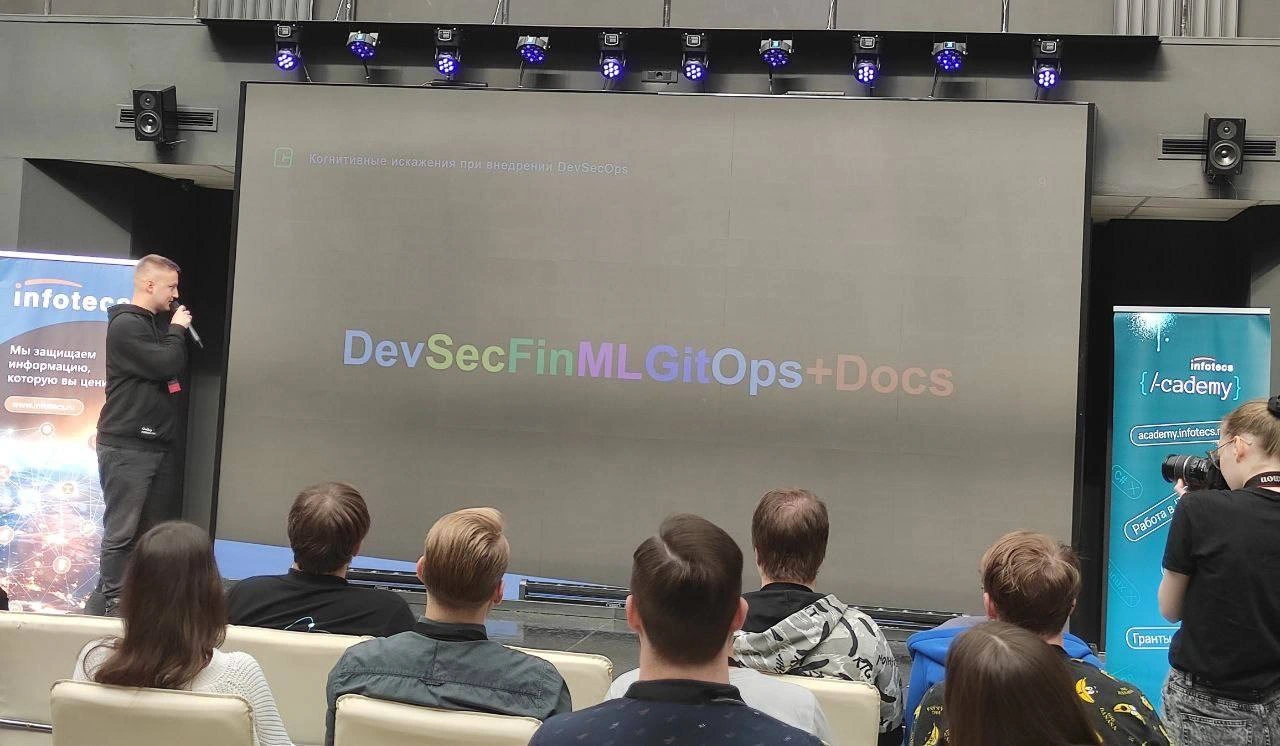
At first glance, the slide’s giant rainbow word DevSecFinMLGitOps+Docs looks like someone hit the buzzword jackpot. It’s a Frankenstein string of every hot tech trend glued back-to-back. This is a conference talk on DevSecOps cognitive biases, and the speaker is cheekily demonstrating one right on the screen: the belief that if DevOps was good, then more acronyms must be better. Seasoned engineers in the audience are likely smirking (or cringing) because they’ve seen this pattern before—today’s “must-have” DevOps spinoff becomes tomorrow’s punchline. The meme lampoons our industry’s habit of taking a basic concept and continuously inflating it with trendy additions until it’s a bloated rainbow of jargon. It’s the ultimate game of Buzzword Bingo, and this slide just scored a full card.
Let’s unpack that acronym monster. DevOps (Development + Operations) started as a genuine movement to tear down silos between coding and IT operations teams. It emphasized collaboration, automation, and monitoring to achieve continuous delivery. Then someone realized “Ops” should also include security from the start—enter DevSecOps. (Because why fix security later when you can sprinkle it in from the beginning?) But the hype train didn’t stop there. Cloud bills were skyrocketing, so FinOps (Financial Operations) emerged to bring cost management into the mix. Next, with the rise of AI hype, MLOps showed up, promising to apply DevOps principles to machine learning model training and deployment (gotta have some ML in there for investor appeal, right?). And of course, GitOps became a thing: treating Git as the single source of truth for deployments and infrastructure, because if it isn’t in version control, does it even exist? Finally “+Docs” tacked on the end reminds us not to forget documentation—some folks call this DocOps or similar, pushing the idea that docs should be treated as code too. Each of these terms individually addresses a real need, sure. But concatenating them into one mega-buzzword? That’s pure satire of our tendency to think complex problems can be solved just by adopting a new acronym.
The humor here cuts deep for senior engineers because it rings true. We’ve lived through the TechHypeCycle repeatedly: a new practice emerges (often a genuinely good idea), but then the hype-driven development kicks in. Everyone and their dog starts slapping the new label on their project to sound cutting-edge. Managers insist “We need to implement XOps NOW” without fully understanding it. It becomes buzzword chaining, where adopting one trendy concept isn’t enough—better chain together a dozen to cover all bases. This slide exaggerates that to absurdity: why stop at DevSecOps when you can add Fin, ML, Git, and Docs? It’s making fun of our cognitive biases: the bandwagon effect (“everyone’s talking about ML Ops, we should do it too!”) and maybe a dash of the halo effect (assuming a methodology with more fancy components is inherently superior). The title in Russian, “Cognitive biases in implementing DevSecOps,” suggests the speaker is warning against exactly this kind of thinking—pointing out how easily we get seduced by shiny terms. An experienced dev knows that piling on trends is no silver bullet. As the cynical joke goes, if your DevOps pipeline is a mess, calling it DevSecFinMLGitOps+Docs won’t magically fix your outages (it might just give you a longer title to curse at 3 AM).
There’s also a whiff of resume-driven development being mocked here. Ever notice how job postings and LinkedIn profiles start to read like alphabet soup? “Seeking a DevSecOps engineer with FinOps and MLOps experience (GitOps a plus).” It’s as if accumulating these terms makes you more qualified—when in reality, they overlap a lot on the fundamentals. A veteran engineer might chuckle because they’ve seen core principles repackaged again and again under new names. Today it’s GitOps; yesteryear it was simply known as Infrastructure as Code and good CI/CD practices. We’re witnessing the devolution of a straightforward idea into a verbose parody of itself. It’s funny in the same way as watching enterprise software names get longer with each acquisition and feature (“Ultra Mega Cloud Suite Extreme Edition™”). Eventually, the name collapses under its own weight.
In real life, this tendency can lead to confusion and misplaced priorities. Teams might spend more time debating terminology (“Are we doing DevSecOps or DevSecFinOps now? Do we need a new department for that?”) than actually improving deployment pipelines or security testing. The meme nails the absurdity: instead of solving actual problems or simplifying processes, organizations sometimes think they need to adopt “the next buzzword” to be modern. A grizzled SRE (Site Reliability Engineer) or DevOps old-timer will tell you: calling your process DevSecOps means nothing if you’re still manually deploying on Fridays and forgetting to rotate keys. It’s reminiscent of the old joke “What’s after DevOps? DevOops.” Here, by tacking on every imaginable suffix, we’ve reached “DevOops++”. The slide’s rainbow colors even feel like a nod to Rainbow Books or multi-colored tech stack diagrams—each color a different domain vying for attention. But jam them all together, and you get a muddy brown of hype overload.
Ultimately, the senior perspective sees this meme as a self-inflicted roast of the tech industry. It highlights how we sometimes handling serious practices (development, security, ops, etc.) with the fashion of trend-chasing rather than focusing on core principles. It’s both a laugh and a facepalm. We laugh because it’s true: we have been in meetings where someone suggests adopting the latest “Ops” buzzword as a cure-all. And we facepalm because deep down we know successful engineering culture isn’t about how many acronyms you can chain together. As the saying goes, there’s no silver bullet—and certainly not a rainbow-colored one conjured by concatenating every hot tech term. This meme is a witty reminder to get back to basics, even as the industry brainlessly jogs on the buzzword treadmill.
Description
This is a photograph taken at what appears to be a tech conference or meetup. A male speaker in a black hoodie stands on a stage, holding a microphone and addressing an audience whose backs are to the camera. The main focus is the large presentation screen behind him, which displays the absurdly long, multi-colored portmanteau: 'DevSecFinMLGitOps+Docs'. Above this, in smaller, non-colored Russian text, is the phrase 'Когнитивные искажения при внедрении DevSecOps', which translates to 'Cognitive biases in the implementation of DevSecOps'. The meme satirizes the tech industry's rampant trend of creating increasingly complex and often meaningless buzzwords by combining various methodologies. It takes well-known concepts like DevOps, DevSecOps, FinOps, MLOps, and GitOps and mashes them into a single, ridiculous acronym, highlighting the absurdity of 'buzzword-driven development' and the hype cycle that often plagues industry conferences

Comments
31Comment deleted
Our new methodology, DevSecFinMLGitOps+Docs, is so advanced that by the time you finish saying its name, your funding has been diluted and the technology is already legacy
Give it another sprint and the roadmap will call for DevSecFinMLGitOps+Docs+NFT+Metaverse - because clearly the real blocker is an insufficient acronym budget
When your architect insists on 'synergies' so hard that even the methodologies start merging into a single, incomprehensible entity - next up: DevSecFinMLGitOpsBlockchainQuantumServerlessEdgeCloudNativeMicroservicesAsCode+Docs (documentation sold separately, naturally)
When your DevSecOps implementation roadmap becomes so comprehensive it accidentally achieves sentience and starts filing its own Jira tickets for 'FinMLGitOps+Docs alignment sprints.' The cognitive distortion here isn't in the implementation - it's believing you can actually explain this acronym to your CFO without them questioning your sanity. By the time you've convinced leadership that DevSecOps is essential, the industry has already moved on to DevSecFinMLAIOpsObservabilityPlatformEngineeringMesh. The real security vulnerability? Your resume's character limit
DevSecFinMLGitOps+Docs: the only pipeline where scope creep is branch‑protected but the acronym keeps merging to main
The full-stack Ops monolith: because distributed systems needed more silos to coordinate
We solved Conway’s Law by string‑joining the org chart - Dev+Sec+Fin+ML+GitOps+Docs; accountability now hashes to null
what is this Comment deleted
russia Comment deleted
Are they try to stole something? Comment deleted
Who knows them?🤷♂ Comment deleted
No, they are pretending that this set of letters makes any sense, in order to make money. Comment deleted
From my experience, russian devs are on same level as indian devs. The only different indian devs are cheaper and not lazy like russian. Comment deleted
Video tutorials in YouTube from Indians are generally top.😁 Comment deleted
Actually yes, I like them. But somethimes when request something to develop, I get middle level instead of senior. Comment deleted
Here it depends on experience. Comment deleted
Lazy? Try developers from Israel, they will redefine everything you know about laziness. Comment deleted
I tried once, bad experience. Btw, they was jews escaped from Russia 😄 Comment deleted
It's all about the Mediterranean climate - there is no rush, just relax and do some coding. If it works, it works; if it doesn't, there will be another day tomorrow. Comment deleted
omg me(i am a clown) Comment deleted
omg mental illness Comment deleted
Infotecs🤩🤩🤩 Comment deleted
🤬 Comment deleted
Dev....Oops Comment deleted
LGBTQ+++ in dev Comment deleted
2SLGBTQIA++IDDQDIDKFA 😁 Comment deleted
Console.Write(“LGBTQ”); for (int i = 0; i < 256; i++) { Console.Write((char)i); } Console.WriteLine(“+”); Comment deleted
Combined with the following JS meme, that becomes: class Queer { int q; Queer(void) : q(255) { } operator bool() const { return q; } operator int() const { return --q; } operator const char*() const { return "LGBTQ+"; } }; void parade() { LGBT a; printf("%s", a); while(a) { printf("%c", a); } } Comment deleted
This ain’t JS or am I tripping? Comment deleted
Ohh this is C# if you meant that Comment deleted
The hint of the meme also lies at the top left corner of the screen 😆 It says "Cognitive distortions in DevOps implementation" Comment deleted