Skip to content
DevMeme
2878 of 7435
The Heisenberg Uncertainty Principle of Live Demos
Bugs Post #3182, on Jun 2, 2021 in TG

The Heisenberg Uncertainty Principle of Live Demos

Why is this Bugs meme funny?

Level 1: Stage Fright

Imagine you’ve been practicing a magic trick at home all week. Every time you do it alone, it works perfectly – the coin disappears, the cards fly just right. You’re so proud and excited to show your friends. But when you finally get on stage in front of the class, suddenly everything goes wrong at once. The coin slips and drops on the floor, the cards scatter everywhere, and even your magic wand breaks in half! Every possible “uh-oh” light is blinking in your head. It’s embarrassing and frustrating because you did it flawlessly before. That’s exactly what’s happening in this meme. The code is like that shy performer: it had stage fright. It worked fine in practice, but the moment it had an audience, it panicked and all its hidden problems popped out, which is funny in that “of course it happens now!” kind of way. Just like you might laugh later about the chaotic magic show, developers laugh at this meme because we’ve all had our “perfect” project hilariously fall apart at the worst time.

Level 2: Works on My Machine

For newer developers, let’s break down what’s happening here. The phrase “works on my machine” is a tongue-in-cheek excuse in programming. It means “I ran the code on my computer, and it ran fine, so if it’s broken elsewhere, not my fault!” Of course, in reality, if it only works on your machine and nowhere else, there’s a bug or environment problem. In this meme, the code was running without errors on the developer’s own PC. All tests were green, no warnings — everything seemed flawless. But the first time they run it on a different computer (or in front of someone), BAM! Every error light comes on. This is exactly what we call the demo effect: the act of demonstrating your software somehow introduces new problems out of nowhere.

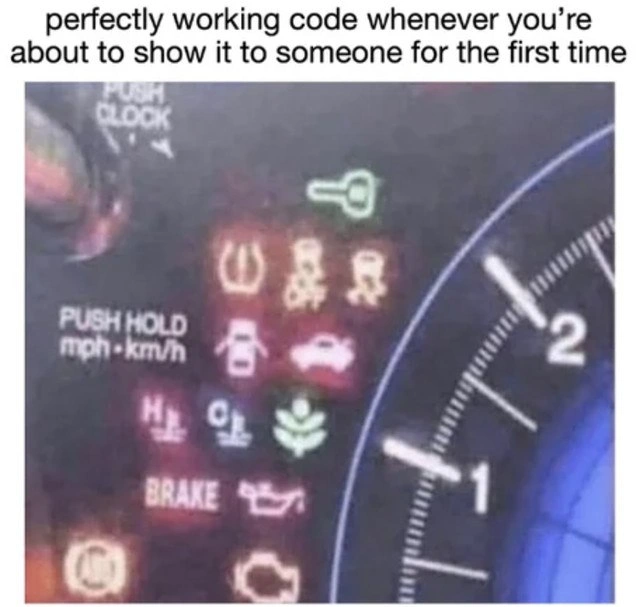
Think of each glowing icon on that car dashboard as an error message from different parts of the app. For example: the little battery light on the dash could be like an error saying “Failed to connect to power supply” – in software, maybe “Failed to connect to database”. The tire-pressure warning might be analogous to a “Low memory” warning or some resource not being found. Basically, the program’s error logs suddenly fill up with red and yellow messages. Developers often refer to a screen full of errors as “lit up like a Christmas tree,” exactly like the image. It’s a funny visualization of debugging frustration: you expected a smooth ride, but you got a dashboard full of trouble.

Why would code break only during the demo? A few common reasons that junior devs quickly learn:

  • Environment Differences: The setup on the demo computer might lack something your dev computer had. Maybe you forgot to install a library or the demo machine has a different version of Python/Node/Java. This mismatch can cause crashes. (Example: It worked on your laptop because you have a font file locally, but on the projector PC that font isn’t there, so the app throws an error and logs complaints – surprise!).
  • Missing Configuration: Perhaps an API key or a config file wasn’t set up on the demo environment. Suddenly the app can’t access a service and every feature that relies on it fails. It’s like forgetting to put oil in a car – multiple systems start failing at once.
  • Timing or State Issues: Your code might rely on something that was true earlier (like cached data or a certain server being up). In a fresh demo run, the timing is different. The database might take longer to respond or a race condition appears. Boom, error city.
  • Pressure and Changes: Let’s be honest, sometimes in the rush of prepping for a presentation, a newbie might tweak one last thing (“I’ll just quickly refactor this… what could go wrong?”). Unfortunately, that untested last-minute change can introduce a bug that only shows up during the demo. Oops.

All of this contributes to DeveloperFrustration during a demo. You’re clicking the button you’ve clicked a hundred times before, but now nothing happens or error dialogs pop up. Your heart rate shoots up (just like that tachometer near 2k RPM in the image). You start sweating, entering panic_mode, thinking “Why now?!” as everyone watches. Debugging under pressure is a tough learning experience. You scramble to troubleshoot: reading error messages (those “lights”), maybe opening the code or checking the server, all while trying to maintain your composure. It’s a crash course (sometimes literally) in Debugging & Troubleshooting when stakes are high.

The meme is relatable developer experience wrapped in humor. It reminds new devs that this happens to everyone. The first time it happens to you, you might feel horribly unlucky or embarrassed. But know that even senior engineers have had their share of live demo fails. It’s why many carry that scarred, sarcastic attitude and double-check everything. In fact, one informal rule in software teams is to never deploy or demo untested code on Friday (because Murphy’s Law loves Fridays and demos!). The best takeaway for a junior dev: always test your code in an environment similar to where you’ll show it. And if possible, test in front of a colleague before the big moment – it might trigger those warnings early when you have time to fix them. Then you can laugh about it later, just like we’re laughing (through our tears) at this meme.

Level 3: Full Stacktrace Dashboard

When a flawless app suddenly goes haywire in a demo, every developer in the room just nods knowingly. This meme shows a car dashboard lit up with every warning light imaginable. In coding terms, that's like your program dumping a full stack trace and every possible error message at once. It's the classic works on my machine scenario colliding with Murphy’s Law in real time. Seasoned devs have seen this movie before: the code ran perfectly during all your private tests, but the minute you hit present in front of an audience, it’s like an entire Christmas tree of exceptions, logs, and alerts appears.

Why is this so humorous (and painful)? Because it satirizes a universal DeveloperExperience nightmare: the dreaded demo_effect. We even joke about the “demo gods” needing appeasement. The meme’s instrument cluster — tire pressure, airbag, ABS, oil, battery lights all blazing — represents a cascade of failures across your software’s modules. One minute everything’s green, the next minute:

  • Database connection lost: Red light: “Cannot connect to DB”
  • API key missing: Amber light: “Unauthorized access”
  • Null pointer exception: Red light: “NullReferenceError at module X”
  • Out-of-memory warning: Blinking: “High memory usage detected”

It’s a domino effect. Often one small glitch (like a missing config file or a mis-set environment variable) triggers multiple subsystems to freak out. In a car, a dying alternator might light up battery, engine, and oil lamps all at once. In a program, forgetting to set CONFIG_MODE=production could spawn a dozen errors as every component from logging to security throws a fit. The humor comes from how absurdly timed these blow-ups are. The code behaved for weeks, and now it decides to act up? Of course it does — it’s practically a rite of passage in Debugging_Troubleshooting.

Experienced developers have a dark chuckle at this because it's too real. We’ve learned that anything that can go wrong will go wrong — usually right when you’re showing it off. There’s even a corollary of Murphy’s Law in software: the likelihood of a bug appearing is directly proportional to the importance of the demo. That’s why veteran engineers double-check everything and have backup plans (or at least a strong cup of coffee) before live demos. We’ve been burned by the live_demo_fail before. The meme nails the feeling: your program is basically in panic_mode, flashing urgent signals, and you're up there trying to keep a poker face while internally screaming “it never did this before!”

This scenario is so common in Developer Humor that everybody instantly gets it. The RelatableDeveloperExperience here is equal parts tragic and comic. It’s tragic for the poor dev on stage, but comic in hindsight because we've all been that dev. (Yes, even that grizzled principal engineer who claims everything is under control has had their app fall apart the moment the CTO steps into the room.) The meme exaggerates reality — a car’s dash lit up like Las Vegas, or an app throwing every exception known to man — to highlight that gut-sinking moment. The next time you see a presenter nervously muttering “One second, it was just working...”, you’ll remember this dashboard-of-doom meme and think, uh-huh, been there, buddy.

Description

A popular tech meme featuring a close-up photograph of a car's dashboard where nearly every possible warning light is illuminated in a chaotic display of red, orange, and green symbols. Above the image, white text provides the context: 'perfectly working code whenever you're about to show it to someone for the first time'. This meme perfectly captures the 'demo effect' or 'presentation effect', a painfully relatable phenomenon for developers where software that functioned flawlessly in a development environment suddenly fails spectacularly the moment it's demonstrated to a manager, client, or colleague. The dashboard of a car having a catastrophic failure is a universal symbol for 'everything is wrong,' mirroring the developer's internal panic when their code implodes under observation

Comments

7
Anonymous ★ Top Pick The Heisenberg Uncertainty Principle of software: The act of observing an application's success fundamentally changes its outcome to failure
  1. Anonymous ★ Top Pick

    The Heisenberg Uncertainty Principle of software: The act of observing an application's success fundamentally changes its outcome to failure

  2. Anonymous

    Demo day law: the moment you screen-share, your “stateless” microservices collectively remember they all depend on the same Redis and light up Grafana like that over-caffeinated car dashboard

  3. Anonymous

    After 20 years in tech, I've learned the demo gods demand a sacrifice: either your staging environment mysteriously goes down, your perfectly tested feature develops a race condition, or your laptop decides it's time for a mandatory update. The only reliable demo is showing yesterday's git commit on someone else's machine while Mercury is in retrograde

  4. Anonymous

    Ah yes, the infamous 'demo effect' - that quantum phenomenon where code exists in a superposition of working and broken states until observed by a stakeholder, at which point the wave function collapses directly into production-breaking chaos. It's like every warning light on your dashboard knows you're about to sell the car. Senior engineers have learned to combat this with the ancient ritual of 'pre-demo dry runs,' though the demo gods remain capricious. The real pro move? Always blame DNS, even if you're demoing a desktop calculator

  5. Anonymous

    Add a stakeholder as an observer and the system collapses into its Heisenbug state - every SLO light red and that “non‑critical” feature flag defaults to off

  6. Anonymous

    Schrödinger's bug in reverse: broken until demo observation collapses it into flawless execution - for exactly one run

  7. Anonymous

    Schrödinger’s demo: green in CI, but the moment a VP joins the call the cluster lights up like a car dashboard - turns out our primary incident trigger is being observed

Use J and K for navigation