Skip to content
DevMeme
4089 of 7435
Senior dev leverages ancient commit memory to locate bug in record time
Bugs Post #4460, on Jun 15, 2022 in TG

Senior dev leverages ancient commit memory to locate bug in record time

Why is this Bugs meme funny?

Level 1: Built-It Knows-It

Think of it like building a sandcastle or a LEGO tower. Say you helped build a big LEGO tower last week, and you remember that you put a wobbly block somewhere in the middle. Today the tower is shaking, and a younger friend is worried it might fall. They’re not sure why it’s unstable. But you immediately know it’s because of that one wobbly block – you remember placing it imperfectly. So you pull out that block and fix the tower quickly. Your friend is amazed and asks, “How did you know what was wrong so fast?!” You just smile like a wise old lion and say, “Because I was the one who built it.” In the same way, the meme is funny because the experienced developer finds the software bug fast simply by remembering that they’re the one who wrote that part of the code (and probably made the mistake in the first place!). It’s like having the answer to a puzzle because you were the person who created the puzzle.

Level 2: Legacy Code Bug Hunt

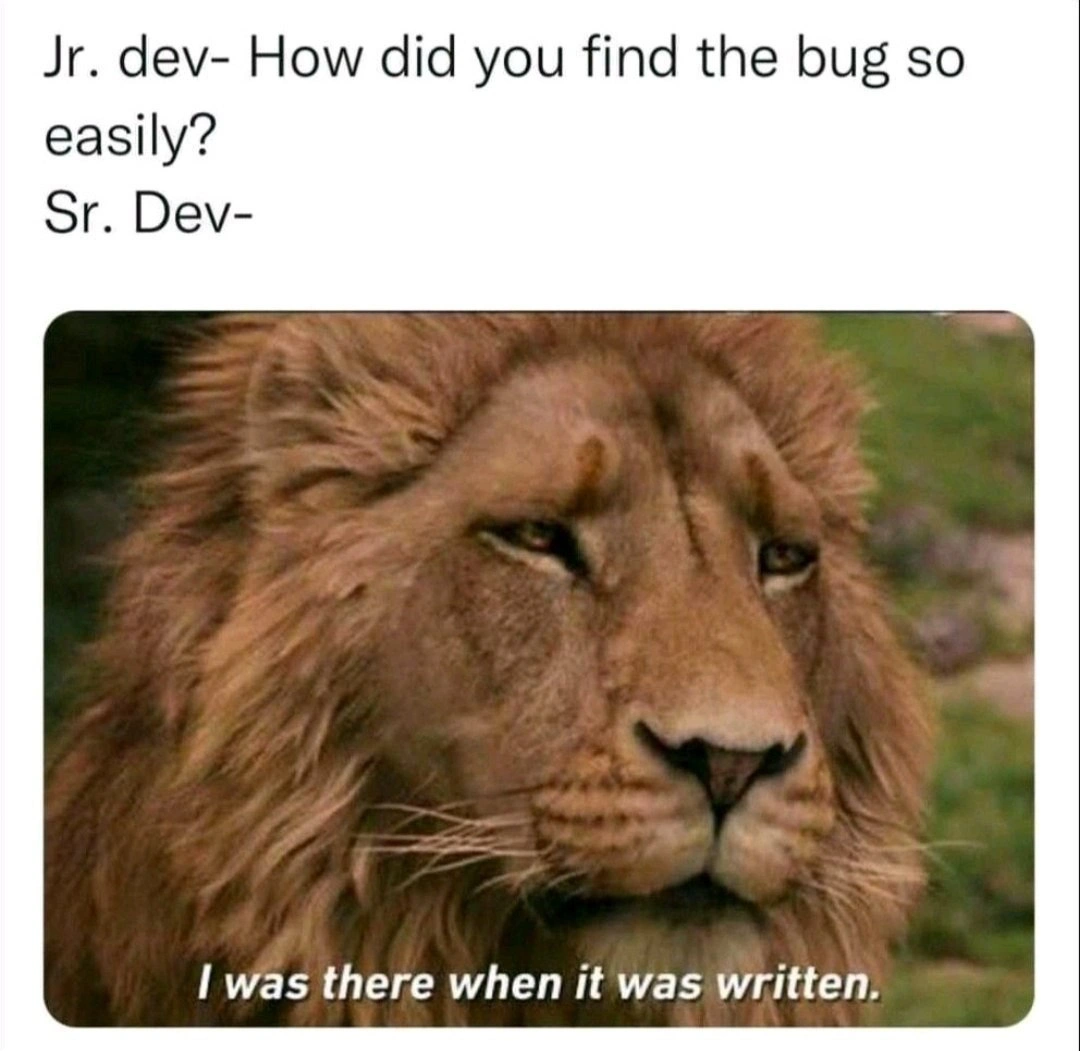
Let’s break this down in simpler terms. The meme shows a conversation:

Junior dev: “How did you find the bug so easily?”
Senior dev: “I was there when it was written.”

In a normal workplace, a bug is an error or flaw in the software that causes it to behave in unexpected or wrong ways. Debugging – the act of finding and fixing bugs – can be hard, especially if you’re new to a legacy codebase. Legacy code basically means old code that has been around for a long time. It’s often code written years ago, possibly by developers who have since left, using older techniques or quick fixes. Newcomers (like a junior dev just joining the team) might find this code confusing or antiquated. They weren’t around when design decisions were made or when weird fixes were added, so finding a bug in that tangle of old code can feel like digging through ancient ruins. We sometimes call it codebase archaeology – exploring old code is like an archaeologist examining artifacts, trying to understand what the original creators were thinking.

Now, the senior developer in the meme is depicted as a wise old lion with a knowing look. This lion image is a metaphor: lions often symbolize experience and authority (and fun fact, it also references Aslan from Narnia, who literally says a similar line about being there when magical laws were written). The senior dev essentially says, “I found the bug easily because I wrote this code in the first place.” This points to something known as tribal knowledge or institutional memory. Tribal knowledge is information that is known within a group (or “tribe”) but not formally documented. In a software team, tribal knowledge might include understanding of old design quirks, knowing that “Module X always acts weird if input Y is zero,” or remembering that there’s a temporary workaround in place since 2015. A junior who joined last year wouldn’t know any of this unwritten history – they only see the code as it is today, not the story behind it. But the senior who’s been at the company for ages has all that context in their head. They remember that one desperate late-night deployment, or that time they had to patch a function to avoid a crash and promised to fix it properly later (but “later” never came). That memory is the key to finding the bug quickly now.

The phrase “I was there when it was written” is almost literal in a coding sense. Modern developers use tools like version control (for example, Git) to keep track of every change to the code. Each saved change is a commit, and each commit usually has an author and date. There’s even a command git blame that lets you see who last modified each line of a file (so you can figuratively “blame” them for what that line does). If the junior ran git blame on the buggy code line, they might see the senior dev’s name from many years ago. The senior doesn’t even need to run this tool – they vividly recall writing that code. Maybe the commit message from that time was “Quick fix for issue #123, will refactor later.” They never did refactor, and here we are. This is what we call technical debt: when you take shortcuts in code or postpone improvements, you incur a “debt” that will eventually come due, often as a bug or performance issue down the line. Just like financial debt accrues interest, technical debt can make future changes harder or buggier. In our scenario, the senior dev likely knows this bug is the “interest” being paid on a long-ago quick fix. They can zero in on it because they remember the exact context and the corner that was cut.

Let’s illustrate with a tiny example of what such a quick fix might look like in code:

def process_user(user):
    # HACK: Temporary workaround added 2014 by SeniorDev 
    # TODO: Remove this once the validation system is improved
    if user.id == 0:  # special case for admin user
        return allow_access(user)  # bypass normal checks for admin
    
    # ... normal processing for regular users ...
    validate_user(user)
    ...

Imagine the code above is part of an old system. There’s a comment # HACK: indicating this was meant as a quick-and-dirty solution, and a # TODO: promising it would be removed later. But years pass, that temporary hack stays in production. Now suppose a bug appears related to admin users having weird behavior. A new developer might be scratching their head looking through the code, not immediately noticing this obscure condition. But the senior dev who originally wrote this workaround in 2014 remembers it instantly: “Ah, I bet it’s that hack I put in for admin user logic.” They jump straight to this spot and indeed find the bug (maybe the admin bypass has unintended side effects). The junior is amazed: it’s like the senior has a sixth sense! But really, it’s a memory of their own past work.

This kind of scenario is common in legacy systems. Many large companies have important software running that was written 5, 10, or even 20+ years ago. Often, the people who wrote the most critical pieces have either moved up the ranks or moved on, and new folks inherit a mysterious codebase. The new folks rely on whatever documentation exists (sometimes not much) and on veterans’ knowledge. If you’re a junior dev, you might one day encounter an area of code where everyone says “Oh, only Alice understands that part.” Alice, in this case, is like the lion in the meme – the wise senior who was “there when it was written.” It feels reassuring that Alice can save the day when that code breaks, but it also highlights a problem: knowledge should ideally be shared, not siloed. If Alice is sick or leaves the company, that code could become a real headache for everyone. That’s why teams try to increase the bus factor (spreading knowledge so no single person is the only one who can fix a system). Until then, juniors often have to lean on seniors’ memories for debugging tough problems. The meme gets a laugh because it’s a situation many of us have seen: sometimes the fastest debugger is not a cutting-edge tool, but an old engineer with a long memory and perhaps a guilty conscience for the bug they planted long ago.

Level 3: Deep Magic of Legacy Code

At the highest level, this meme evokes the tribal knowledge and war-weary wisdom that long-time developers carry. It parodies a scenario where a junior developer is baffled by how a senior found a tricky bug almost instantaneously. The punchline is the senior’s mythical reply: “I was there when it was written.” This is a direct nod to Aslan’s famous line in The Chronicles of Narnia – “Do not cite the Deep Magic to me… I was there when it was written.” Here our seasoned engineer is essentially cast as the majestic, battle-scarred lion who possesses nearly magical insight into the codebase’s deepest secrets, because, well, they actually wrote that fragile code years ago.

On a technical level, the humor comes from the absurd efficiency of the senior dev’s debugging. It’s not advanced tooling or genius algorithms at play – it’s pure institutional memory. In real life, veteran developers accumulate a mental map of the system: every weird workaround, every brittle function, every hidden API contract. They recognize patterns or smells in the code that instantly remind them of past incidents. In this meme, the senior doesn’t need to painstakingly trace through the code or run a debugger; they already know which component is haunted by a past mistake. It’s as if the commit history is ingrained in their brain. The phrase “ancient commit memory” in the title isn’t hyperbole – experienced devs often recall specific commits (changes to the code) or historical bugs that younger team members never knew about. They can practically perform a mental git blame on a suspicious line of code, remembering exactly who wrote it (often themselves) and why. This is why the senior finds the bug in “record time” – it’s not just skill, it’s memory augmented by having lived through the code’s evolution.

This scenario satirizes a common industry pattern: legacy systems full of technical debt that only the original authors truly understand. The senior engineer in the meme presumably authored this module or piece of code long ago under less-than-ideal conditions (tight deadlines, late-night hotfixes, maybe an ancient framework). Perhaps they even left a comment like “// TODO: fix this properly later” which never happened. Now, years later, that “temporary” fix has become a permanent landmine in the code. Seasoned devs often carry the grim comfort of recognizing their own decade-old hacks when something breaks. There’s a darkly humorous self-awareness here: the senior is legendary for finding the bug quickly, but only because they introduced that very quirk ages ago. It’s like being both the arsonist and the firefighter – a twisted form of job security through remaining the oracle of old code. No wonder the image shows a lion’s face weathered by time; that senior has probably been through countless production fires, many sparked by the same code he “was there to write.”

Beyond the individual scenario, the meme highlights systemic issues of codebase archaeology and single-point-of-failure knowledge. Relying on personal memory for debugging is not exactly a best practice, but it happens all the time in real teams. When only one person or a small few have deep knowledge of a critical system, they become the go-to fixers for every bug in that area. This is sometimes jokingly quantified as a bus factor of 1 – meaning if that one senior dev got hit by a bus (or more gently, took an extended vacation), the team would be in big trouble because nobody else fully understands the legacy code. It’s funny when the senior dev deploys their “ancient commit powers” to save the day, but it’s also a bit terrifying from an organizational standpoint. The meme resonates with veteran engineers who have felt the burden of being that lone keeper of secrets, as well as juniors who are both amazed and uneasy that something so important resides only in one person’s head. In essence, it’s poking fun at how institutional memory can sometimes be the most effective debugging tool – more effective than any fancy logging or modern IDE – while hinting at the fragile foundations (ancient code and forgotten knowledge) that today’s software might be built upon.

Description

Meme with white background and black text at the top reads, “Jr. dev- How did you find the bug so easily? Sr. Dev-”. Beneath, a close-up photo of a majestic, weather-worn lion fills a rounded-corner frame; only half its face is visible, emphasizing age and experience. Super-imposed in italic white caption at the bottom of the photo: “I was there when it was written.” The visual punch-line implies that the senior engineer originally authored the fragile code, making bug hunting a matter of long-stored tribal knowledge rather than sleuthing. For seasoned developers the scene evokes legacy systems, institutional memory, and the grim comfort of recognizing one’s own decade-old technical debt

Comments

8
Anonymous ★ Top Pick Git blame says the culprit was 'you' in 2010 - turns out the stack trace was just a nostalgic postcard from your own technical debt
  1. Anonymous ★ Top Pick

    Git blame says the culprit was 'you' in 2010 - turns out the stack trace was just a nostalgic postcard from your own technical debt

  2. Anonymous

    The real superpower isn't 10x coding speed - it's being the only one left who remembers why that critical service has a hardcoded sleep(3) that everyone's afraid to remove because 'something broke in 2017 when Dave tried.'

  3. Anonymous

    The senior developer's superpower isn't just pattern recognition - it's remembering which architectural shortcuts from 2015 are now production-critical bugs, and exactly which 3 AM deployment introduced that 'temporary' workaround that's been there for eight years. They don't need a debugger; they have PTSD from the original code review

  4. Anonymous

    My debugging was O(1) - git blame returns my name and the Jira ID I regret

  5. Anonymous

    After enough Friday deploys, git blame becomes a mirror

  6. Anonymous

    Junior devs grep the logs; seniors grep their commit regrets from 2017

  7. @ZgGPuo8dZef58K6hxxGVj3Z2 4y

    😂😂😂😂💀

  8. dev_meme 4y

    I created this bug long times ago

Use J and K for navigation